
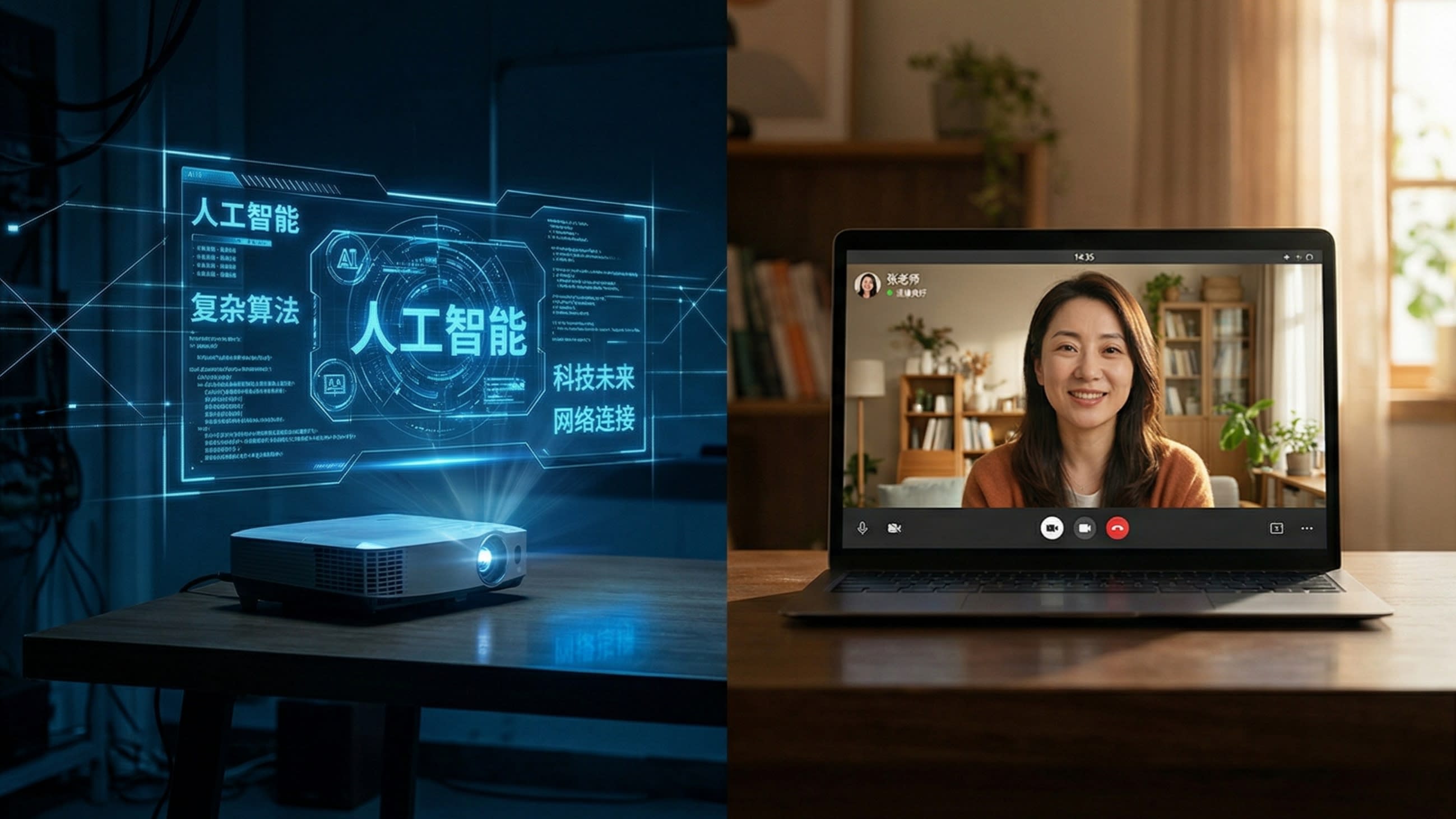
It is 2026. You open your laptop, boot up the latest AI language model, and prompt it to roleplay as a Beijing taxi driver. The AI responds instantly with flawless Mandarin, generates a perfectly tailored vocabulary list, and dissects your grammar mistakes in milliseconds. It is available 24/7, it never loses patience, and it costs a mere fraction of a traditional language course.
Looking at this incredible technology, I have to ask myself: Do we still need human Chinese teachers?
I remember the early days of my own journey, struggling to differentiate between de (的), de (地), and de (得). Back then, I didn’t have a bot to ask; I had a stern, kind-eyed teacher who would tap her desk until I got the intonation right. If learning Chinese were merely a matter of data transfer—uploading vocabulary and grammar rules from a server into your brain—the human teacher would indeed be obsolete. But language is not just data. It is a living, breathing, deeply emotional behavior. While AI is the greatest tool ever invented for practice, it often fails at the subtle psychology of teaching.
1. The Power of “Reading the Room” (察言观色)
Imagine you are trying to master the infamous “了” (le) particle or the notoriously difficult “把” (bǎ) structure. You ask an AI to explain it. It provides five perfectly crafted textbook sentences. You stare at them, your brain feeling like a bowl of cold noodles, yet you type “I understand” just to move the lesson along.
The AI, satisfied with your input, moves to the next topic. A human teacher would never do that.
One of the most critical skills of a master educator is Cháyánguānsè (察言观色)—the ability to observe someone’s words and facial expressions. A real teacher is constantly scanning your micro-expressions. They see the slight furrow of your brow, the hesitant pause before you speak, or the way your eyes glaze over when a concept misses the mark. Before you even admit you’re confused, they intervene. They might say, “I see you’re hesitating; let’s try a different analogy.” They pivot, abandoning the textbook to relate the grammar point to your specific life experiences. AI reacts to your text prompts; human teachers react to your humanity.
2. The Trap of “Efficiency” and Cognitive Overload
AI models often suffer from a fatal flaw: they do not understand Cognitive Load. An AI will happily feed you fifty new vocabulary words in ten minutes if you ask. It gives you the illusion of rapid progress, but learning Chinese is a marathon, not a sprint. If you absorb too much too quickly, you will hit a massive Píngjǐng (瓶颈 - bottleneck), and you will likely forget 90% of it by tomorrow.
A skilled human teacher practices Yīncáishījiào (因材施教 - teaching according to the student’s aptitude). They possess the pedagogical intuition to regulate the tempo of the class. If you are exhausted after a ten-hour workday, they will slow down, focusing on easy conversation and reviewing old material to build your confidence. If you are firing on all cylinders, they will push you out of your comfort zone.

3. The Accountability Factor
Let’s be honest: how many times have you set a goal to study for 30 minutes a day, only to ignore the push notifications by Friday? It is incredibly easy to close an app, mute an AI, or skip a digital lesson. There is zero social friction.
Learning Chinese requires relentless consistency. You need someone to hold you accountable. When you have a scheduled class with a teacher who has prepared customized materials just for you—and who remembers the story you told them last week about your trip to the Great Wall—you show up. You cannot ghost a human relationship easily. This emotional accountability is the secret engine of long-term language retention.
4. Mastering “Yugan” (Language Intuition)
AI speaks perfect, grammatically sterile Mandarin. But nobody on the streets of Shanghai or Chengdu actually speaks like a textbook. Chinese is built on context, unspoken implications, and regional humor. A human teacher helps you develop Yǔgǎn (语感 - language intuition).
- AI: Teaches you “Nǐ hǎo ma?” (How are you?).
- Human Teacher: Explains that native speakers rarely use that phrasing, and teaches you “Zuìjìn zěnmeyàng?” (How have things been lately?) instead.
A teacher acts as your cultural bridge. They explain why certain phrases are used, the history behind an internet slang term, and the subtle tonal differences between sounding polite and sounding sarcastic. They teach you the “soul” of the language, ensuring you don’t just sound correct—you sound native. For more on this, you might want to read about the 3 ‘De’s of Chinese Grammar to see how nuance really matters.
5. The Hybrid Approach: Your 2026 Strategy
The best strategy for 2026 is the Hybrid Approach. Use AI to practice vocabulary and drill grammar, but use a human teacher as your coach and cultural guide. If you need that human touch to break through your current plateau, you don’t need to fly to Beijing.
For 1-on-1 guidance, I suggest checking out Preply. They host over 6,000 native teachers who can provide the customized learning path you need. Whether you want to focus on business terminology or just ordering coffee like a local, they have experts ready to help.
| Feature | AI (ChatGPT/LLMs) | Human Tutor |
|---|---|---|
| Availability | 24/7 | Scheduled |
| Empathy | None | High |
| Cultural Nuance | Moderate | Expert |
| Adaptability | Logic-based | Intuition-based |
🎁 Special Bonus: Use this link to get 30% off your trial lesson with any tutor on Preply. It is a low-risk way to experience the difference a real human mentor makes.
Final Thoughts from Ming
AI is a map, but a human teacher is a guide who has actually walked the mountain. The map shows you where the path is, but the guide will hold your hand when you stumble, tell you stories about the trees, and adjust the pace when you are out of breath.
Don’t let the convenience of AI rob you of the deep, human connection that comes from learning a new language. When you combine the raw power of technology with the empathy of a teacher, your Chinese fluency will become unstoppable.

Ready to supercharge your journey? Check out Busted: The 5 Biggest Myths About Learning Chinese or learn How to Type Chinese Like a Pro.