

No matter where you roam, the weather is the ultimate, universal icebreaker. It is the safe harbor of conversation when you find yourself in a taxi navigating the gridlock of Beijing, waiting for an elevator in a bustling Shenzhen office tower, or simply standing at a street-side stall waiting for your morning baozi.
However, if your linguistic toolkit for describing the elements is limited to the textbook standard of “Hěn rè” (很热 - very hot) and “Hěn lěng” (很冷 - very cold), you are leaving a massive gap in your cultural fluency. In China, weather isn’t just a background condition; it is a visceral, full-body experience that shapes the rhythms of daily life. From the bone-dry, biting winds of a Northern winter to the soup-like, suffocating humidity of a Southern summer, the environment dictates how we dress, how we eat, and how we greet one another.
If you truly want to bridge the gap and connect with local friends, you must move beyond the basic HSK-level vocabulary. You need the specific, emotive words that natives actually use to describe the world around them. Let’s upgrade your vocabulary so you can handle the humidity, celebrate the autumn air, and confidently hold your own in the great “North vs. South” winter debate.
The Basics: Beyond Simple Adjectives
Before we dive into the sensory details, let’s clean up your foundation. The general word for weather is 天气 (tiānqì). A common mistake I often hear from new learners is the attempt to force English sentence structures into Chinese. Remember, weather isn’t always something that is—often, it is something that happens.
- Sunny Day: 晴天 (Qíngtiān).
- Usage: “今天是个大晴天!” (Jīntiān shì ge dà qíngtiān! - Today is a beautifully sunny day!)
- Overcast: 阴天 (Yīntiān).
- Usage: “今天是阴天,感觉快要下雨了。” (Jīntiān shì yīntiān, gǎnjué kuàiyào xiàyǔ le. - It’s overcast today, feels like rain is coming.)
- Raining: 下雨 (Xiàyǔ). Note that this is a verb phrase, not a simple adjective.
- Usage: “外面正下着大雨呢。” (Wàimiàn zhèng xiàzhe dàyǔ ne. - It is pouring rain outside.)
- Snowing: 下雪 (Xiàxuě).
- Usage: “明天下雪吗?” (Míngtiān xiàxuě ma? - Will it snow tomorrow?)
For those interested in building their fluency, check out our deeper dive into mastering Chinese measure words and how to properly use the ‘le’ particle to sound more like a local.
Summer Survival: The “Sauna Day” Experience
If you spend a summer in cities like Shanghai, Guangzhou, or Chongqing, you will quickly realize that “hot” is an understatement. It is an aggressive, inescapable humidity. Saying “hěn rè” makes you sound like a textbook; using the vocabulary of suffering makes you sound like a resident.
闷热 (Mēnrè) - The Suffocating Mug
This is arguably the most essential summer term. Look at the character 闷 (mēn)—it literally shows a heart (心) trapped inside a door (门). That is exactly how it feels: stagnant, thick air that leaves you gasping.
- Example: “今天太闷热了,我感觉空气都不流动。” (Jīntiān tài mēnrè le, wǒ gǎnjué kōngqì dōu bù liúdòng. - It’s so muggy today; I feel like the air isn’t even moving.)
桑拿天 (Sāngná tiān) - Sauna Weather
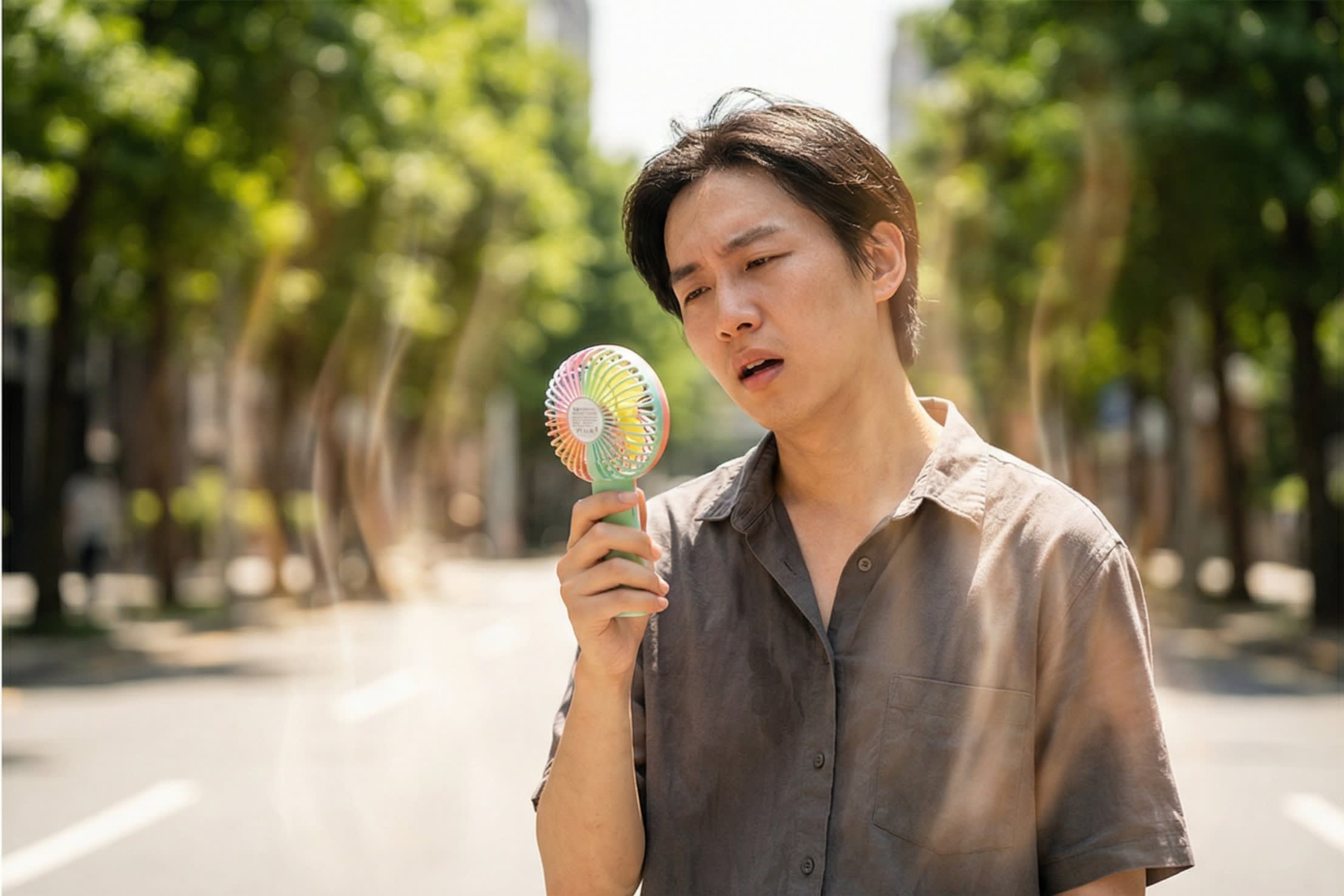
When the thermometer hits 38°C (100°F) but the humidity pushes the heat index even higher, locals call this “Sauna Weather.” Stepping out of an air-conditioned lobby feels like walking into a steam box.
- Example: “出门五分钟,流汗两小时,这就是桑拿天。” (Chūmén wǔ fēnzhōng, liúhàn liǎng xiǎoshí, zhè jiùshì sāngná tiān. - Five minutes outside, two hours of sweating; that’s the reality of a sauna day.)
The North-South Winter Divide
One of the most engaging ways to participate in Chinese small talk during the winter is to acknowledge the great geographical divide. It’s a point of pride and rivalry for many.
Northern China: 干冷 (Gānlěng) - The Dry Bite
In Beijing or Harbin, it might be -15°C (5°F), but because the air is so dry, it feels like a sharp, physical prickling on your skin. We call this 干冷 (gānlěng). Because it is dry, it’s manageable with a high-quality down jacket. Furthermore, the North benefits from 暖气 (nuǎnqì)—central heating—meaning people often lounge around indoors in light sweaters.
Southern China: 湿冷 (Shīlěng) - The Soul-Piercing Chill
Contrast this with the South, where 2°C (35°F) feels like a tragedy. This is 湿冷 (shīlěng), or “wet cold.” The moisture acts as a conductor, pulling the heat directly out of your bones. Because there is no central heating, this cold follows you inside, under your blankets, and into your cup of tea.
- Small Talk Example: “我不怕北方的干冷,但我真的无法应对南方的湿冷。” (Wǒ bú pà běifāng de gānlěng, dàn wǒ zhēnde wúfǎ yìngduì nánfāng de shīlěng. - I don’t fear the North’s dry cold, but I really can’t handle the South’s wet chill.)
If you are planning to travel during these seasons, I highly suggest learning how to manage your money with Alipay before you arrive, as you’ll want to be able to order quick, warm deliveries when the cold sets in!
Phenomenons and Idioms
To truly sound like a curator of Chinese culture, sprinkle these terms into your daily dialogue:
- 雾霾 (Wùmái) - Smog: While air quality standards have evolved, it remains a common topic during winter transitions.
- 台风 (Táifēng) - Typhoon: Essential vocabulary if you are residing in coastal tech hubs like Shenzhen or Guangzhou during late summer.
- 秋高气爽 (Qiū gāo qì shuǎng): This beautiful four-character idiom (Chengyu) is the gold standard for describing autumn. It suggests the sky is “high” and the air is impossibly crisp. Use this to compliment an October afternoon, and you will immediately earn a smile.
The Chinese Weather Cheat Sheet
| The Weather | Chinese & Pinyin | Vibe |
|---|---|---|
| Sunny | 晴天 (Qíngtiān) | Clear, blue skies. |
| Muggy/Stifling | 闷热 (Mēnrè) | Suffocating, zero breeze. |
| Sauna | 桑拿天 (Sāngná tiān) | Sweaty, thick heat. |
| Dry Cold | 干冷 (Gānlěng) | Sharp, biting cold. |
| Wet Cold | 湿冷 (Shīlěng) | Damp, bone-chilling. |
| Autumn Crisp | 秋高气爽 (Qiū gāo qì shuǎng) | Perfect autumn weather. |
A Final Note from Feng
In the context of Chinese relationships, talking about the weather is rarely about meteorology. It is a subtle, polite way of demonstrating care and social awareness. When you mention it is shīlěng (wet cold), you aren’t just giving a report; you are opening the door for a friend to say, “Remember to bundle up!” (多穿点 - duō chuān diǎn). When you complain of the sāngná tiān (sauna weather), they will naturally worry about your health and suggest you “drink more hot water” to keep your constitution balanced.
By adopting these terms, you are moving beyond the surface level of a traveler and participating in the caring, interconnected rhythm of daily life in China. So, the next time you step outside, take a deep breath, observe the sky, and try describing it like you’ve lived here your whole life.
Want to learn more about navigating daily life in China? Read our guide on Why Chinese People Drink Hot Water or master the ultimate 7 Chinese Idioms Natives Actually Use.
Disclaimer: As an Amazon Associate, ChinaCurator earns from qualifying purchases.