

I still vividly remember my first week in Shanghai. I had spent weeks memorizing the numbers one through ten, feeling quite proud of how “logical” Mandarin seemed. Eleven was just “ten-one” (shíyī), and twenty was a straightforward “two-tens” (èrshí). I felt like I had finally cracked the code of a foreign language.
Then, reality hit. I was sitting in a local office, trying to negotiate the monthly rent for a tiny studio apartment, and the landlord tossed a number at me that sounded like gibberish. My brain didn’t just stumble; it completely short-circuited. I realized then that while the foundation of Chinese counting is elegant and simple, the way the language structures large numbers, percentages, and phone sequences is fundamentally different from the Western world. If you try to map English numerical logic onto Chinese, you will freeze every single time.
To reach true fluency, you have to rewire your brain to stop thinking in “blocks of three” and start thinking in “blocks of four.” Let me walk you through the logic that finally helped me stop panicking.
1. The “Block of Four” Paradigm: The 万 (Wàn) Trap
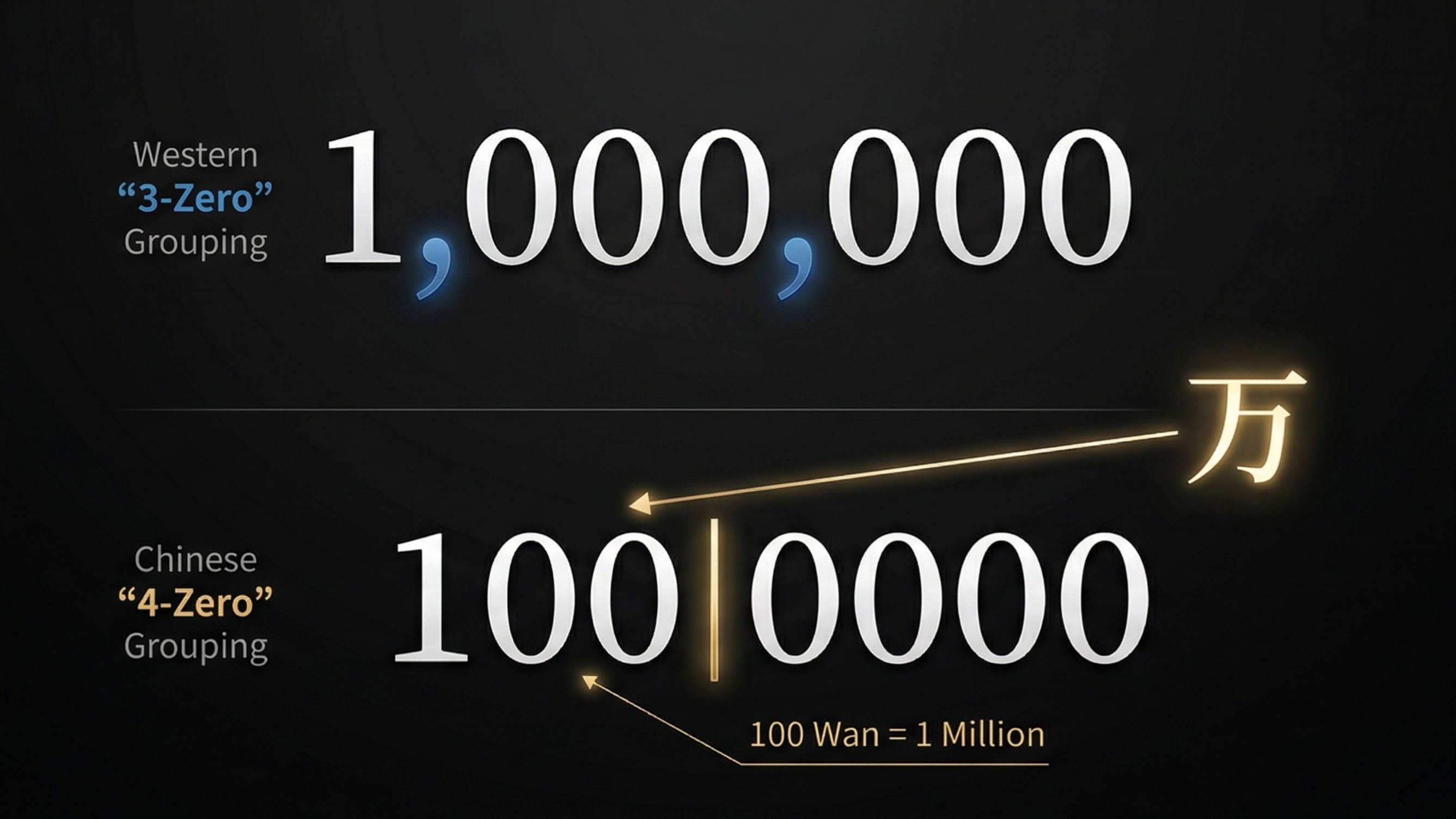
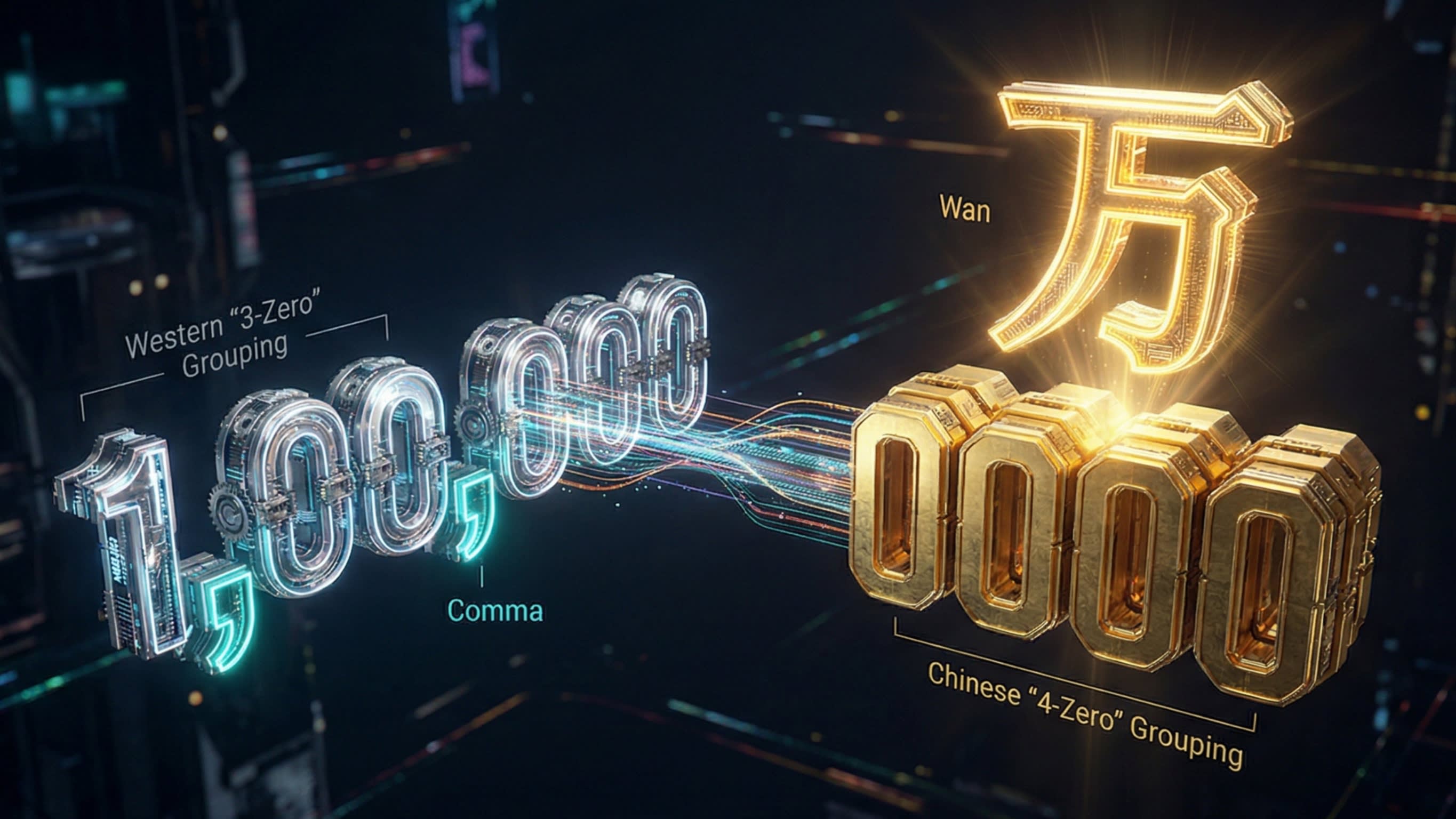
In the West, we are conditioned to group numbers by thousands—we have thousands, millions, and billions. We even punctuate our writing with commas every three digits: 1,000,000.
Chinese, however, refuses to play by these rules. The language groups large numbers by myriads, or ten-thousands (four zeros). The most important unit you will ever master is 万 (wàn - 10,000). Instead of trying to force a number into “thousands,” you must train yourself to ask: “How many Wans is this?”
Let’s look at the translation matrix that trips up almost every new arrival:
- 10,000: In English, we say “ten thousand.” In Chinese, it is simply 一万 (yí wàn). It’s a base unit.
- 100,000: Chinese has no specific word for “one hundred thousand.” Instead, you count the Wans: it is 10 groups of 10,000, or 十万 (shí wàn).
- 1,000,000: This is where I see most students fail. One million is 100 groups of 10,000. Therefore, it is 一百万 (yì bǎi wàn).
- 10,000,000: 1,000 groups of 10,000 becomes 一千万 (yì qiān wàn).
The Next Level: 亿 (Yì)
Once you pass 100 million (100,000,000—that’s eight zeros), the language upgrades to the next unit: 亿 (yì).
- 100 Million = 一亿 (yí yì).
- 1 Billion = 十亿 (shí yì) (ten groups of 100 million).
My Personal Survival Hack: When I look at a large printed number, I ignore the English commas entirely. I count four zeros from the right and draw an imaginary line in my mind: 150 | 0000. Everything to the left of that line is your Wàn. So, 150 Wàn equals 一百五十万 (yì bǎi wǔ shí wàn). If you follow this “cut and count” method, you’ll never get lost in a meeting again.
2. The Rules of Zero (零 - Líng)
In English, the number 101 is “one hundred and one.” In Chinese, that middle zero must be spoken aloud. If you omit it, you’re essentially saying “one hundred one,” which sounds as strange to a native speaker as it would be for me to say “one-hundred-one” in English.
- Rule 1: Always voice the middle zero. 101 becomes 一百零一 (yì bǎi líng yī).
- Rule 2: Consecutive zeros collapse. If you have 1,001, you don’t list every zero; you say it once: 一千零一 (yì qiān líng yī).
- Rule 3: Ending zeros are silent. If a number ends in zero, simply state the highest unit and stop. Be careful with 二百五 (èr bǎi wǔ), which means 250—it is also a common slang term for an idiot!
3. Backward Math: Percentages and Fractions
If you have ever tried to bargain for a discount at a local market, you’ve likely encountered the 打折 (dǎ zhé) system.
In the West, we talk about what we save (a 20% discount). In China, they talk about what you pay. If a merchant says 打八折 (dǎ bā zhé), they are “hitting” the 8—meaning you pay 80% of the price.
Percentages and fractions follow a “bottom-up” logic. You read the denominator first, followed by 分之 (fēn zhī), then the numerator.
- 50%: 百分之五十 (bǎi fēn zhī wǔ shí), literally “hundred-parts-fifty.”
- 1/3: 三分之一 (sān fēn zhī yī), literally “three-parts-one.”
4. The “Yao” (幺) Secret for Phone Numbers
Early in my time here, I found that my pronunciation of “one” (一 - yī) was constantly being confused with “seven” (七 - qī) over phone calls. I would recite my number, and the delivery driver would look at me with total confusion.
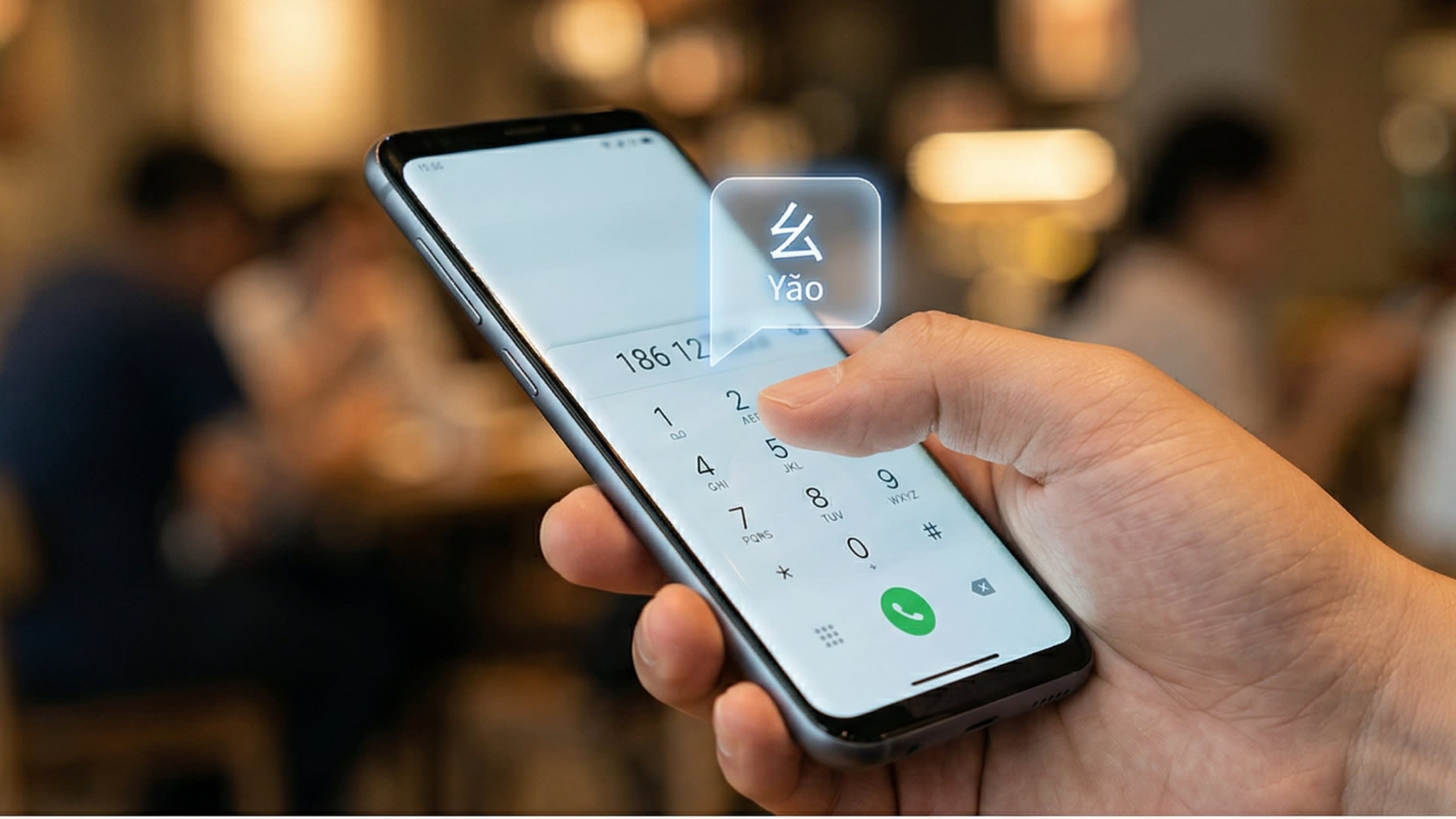
I soon learned the secret: in sequences—like phone numbers, room numbers, or passport digits—the number 1 is pronounced as 幺 (yāo).
If your phone number starts with 138, a native speaker will say yāo sān bā (幺三八). Using yāo immediately signals that you aren’t just reading from a textbook, but that you understand how life actually functions on the streets of Beijing or Guangzhou. You can even use this when ordering a durable smartphone case if you are chatting with a shopkeeper!
The Big Number Cheat Sheet
| English | Chinese Logic | Characters | Pinyin |
|---|---|---|---|
| 10,000 | 1 Wan | 一万 | yí wàn |
| 100,000 | 10 Wans | 十万 | shí wàn |
| 1,000,000 | 100 Wans | 一百万 | yì bǎi wàn |
| 10,000,000 | 1,000 Wans | 一千万 | yì qiān wàn |
| 100,000,000 | 1 Yi | 一亿 | yí yì |
Final Thoughts from Jie
The hardest part about mastering Chinese numbers isn’t the memorization; it’s unlearning the mental habits you have relied on your entire life.
When you hear a large number in Mandarin, your instinct will be to immediately translate it into English thousands and millions before you can understand it. You must fight this urge! If someone says “Sān wàn” (Three wans), don’t try to calculate that it means 30,000. Just envision the amount of “Wan.” Treat “Wan” as its own independent unit in your mind.
If you’re still working on the basics, you might also want to review our guide on The Shape-Shifting Tone Changes of ‘Yi’ or master the nuance of 二 (èr) vs 两 (liǎng). With time, your brain will naturally adapt to the four-zero system, and you’ll be handling financial talk with the confidence of a local!
Disclaimer: As an Amazon Associate, ChinaCurator earns from qualifying purchases.