

When most people decide to learn Mandarin Chinese, they are immediately captivated by the sheer beauty and mystery of Chinese characters (汉字 - Hànzì). I remember my own first week of study vividly; I was obsessed with the aesthetic power of those complex, elegant brush strokes. I spent hours compulsively buying flashcards and downloading every app I could find, feeling a desperate, slightly arrogant desire to read a newspaper headline before I even knew how to say “hello.”
Then came the “boring” part. My teacher handed me a chart of Latin letters decorated with strange, tiny diacritics—Pinyin (拼音). Like many students, I felt a wave of genuine disappointment. I wanted to learn “real” Chinese, not a remedial alphabet class that felt like a trip back to grade school. I wanted to skip the setup and jump straight to the fluency.
If you have ever felt that way, listen closely: stop.
Skipping or rushing through Pinyin is the single biggest tactical error you can make. It isn’t a roadblock; it is the ultimate shortcut. Pinyin is the operating system for the Chinese language. It is your key to unlocking tones, the engine for digital communication, and your only reliable map through the landscape of a language that otherwise has no phonetic “clues.”
1. The Blueprint for Vocal Mechanics
Chinese is a tonal language, and that is where most beginners trip. The pitch of your voice dictates the meaning. Take the syllable “ma,” which can mean anything from “mother” to “a scolding,” depending on whether your voice is flat, rising, dipping, or falling.
Without Pinyin, you are essentially flying blind. Pinyin provides the visual anchor for these tones. When you see mā (妈), the macron (the flat line) tells your vocal cords to stay level. When you see mǎ (马), the wedge (the checkmark) tells your voice to dip. Without that visual, you’re just guessing.
Furthermore, Pinyin uses the Latin alphabet, but it is not English. This is a frequent point of confusion that trips up even the most diligent students.
- The letter “c” acts like a sharp, spitting “ts” sound.
- The letter “q” is a “ch” sound that requires pulling your tongue back against your teeth.
- The letter “x” is a soft, airy “sh” that sounds like a whisper.
If you ignore the Pinyin chart, you will subconsciously force your mouth to follow English phonetic rules. You will build “ghost” muscle memory that makes it nearly impossible to sound like a native. Think of Pinyin as the architectural blueprint for your mouth. If the blueprint is wrong, the house will never stand.
2. The Digital Nervous System
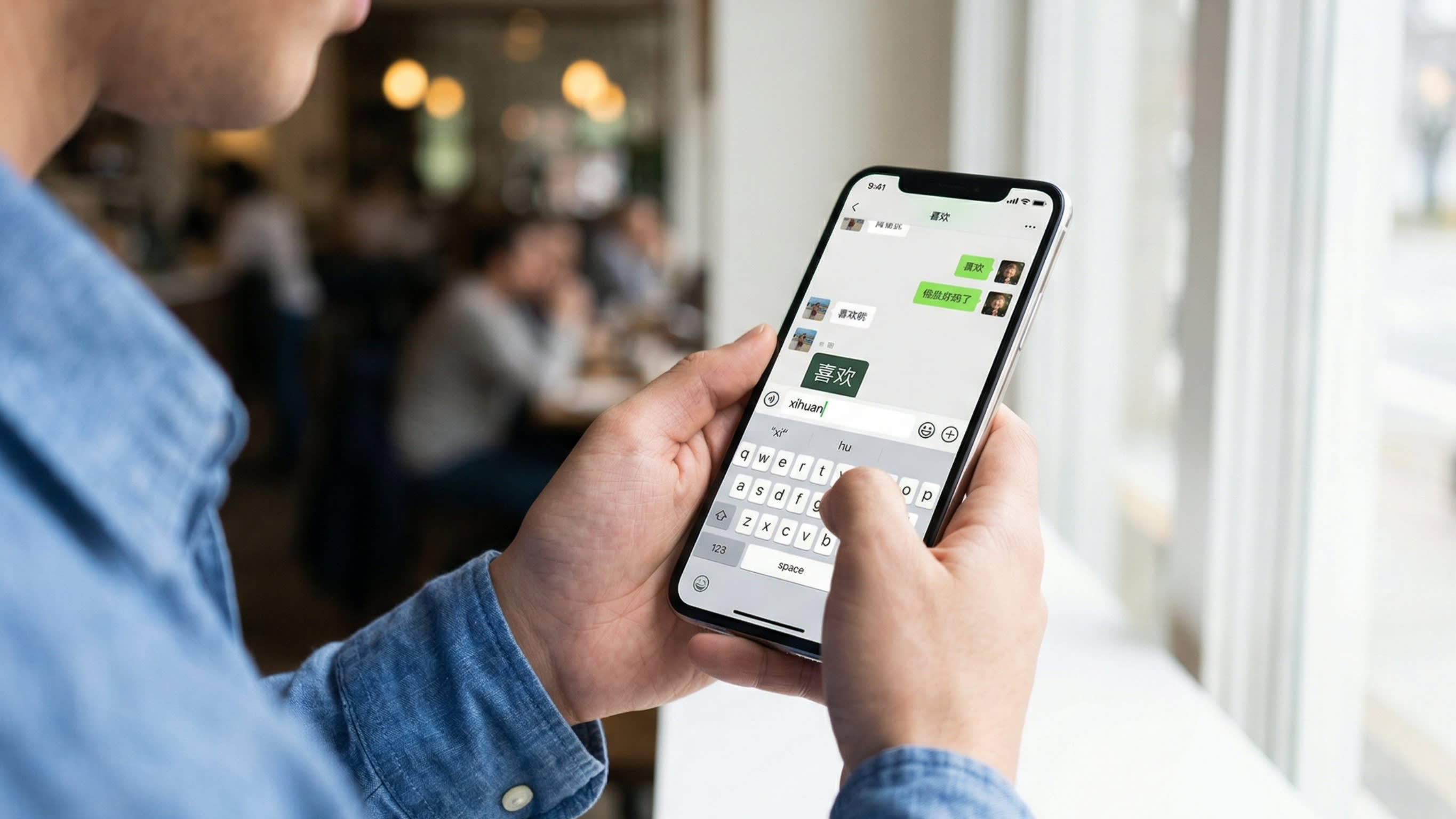
How do 1.4 billion people type on smartphones? They aren’t using keyboards with thousands of keys. They use Pinyin.
Whether you are navigating WeChat (微信 - Wēixìn) to message a friend, hunting for a rare tea set on Taobao, or simply managing your life in a digital-first society, Pinyin is the standard input method. When you type “n-i-h-a-o,” your phone’s predictive engine offers “你好.” If you don’t know Pinyin, you are effectively illiterate in the digital Chinese world. You can’t search for an address on a map, and you certainly can’t send a quick text. Mastering this skill bridges the gap between study time and real-world social interaction.
3. Achieving True Independence
I remember walking through a bustling street in Shanghai, feeling utterly overwhelmed by the sea of signs. I recognized one character, but the rest were a blur. Because I had committed to Pinyin, I was able to pull out a dictionary app—you might find a sturdy smartphone case helpful for keeping your phone secure while navigating—draw the character, and instantly see the Pinyin.
Every textbook, every graded reader, and every dictionary uses Pinyin as its scaffold. Without it, you are perpetually dependent on a tutor to explain how to pronounce every new word you encounter. Pinyin is the ultimate tool for self-education. It is the difference between being a passive student and an active explorer.
4. The Pitfall of Self-Study
There is a catch. Because Pinyin looks like English, many beginners think they can just watch a few YouTube videos and “get it.”
This is a massive risk. An app cannot correct your tongue placement when you try to pronounce the “ü” vowel. An app cannot hear that your 4th tone is too lazy, lacking the sharp “drop” of a native speaker. You need an ear that can hear what you’re doing wrong.
Locking in bad pronunciation habits during your first month is a nightmare to undo later. I highly recommend working with a native speaker early on. Platforms like Preply allow you to connect with thousands of native tutors who can focus exclusively on your mouth shapes and tonal consistency. If you want to build a foundation that won’t crumble under the pressure of real conversation, find a guide who can force you to repeat the tricky sounds until they feel natural.
| Skill Level | Focus Area |
|---|---|
| Beginner | Pinyin accuracy & Tone memorization |
| Intermediate | Pinyin-to-Character input speed |
| Advanced | Contextual recognition; Scaffolding removal |
5. The Scaffolding of Fluency
Don’t fear Pinyin; view it as temporary scaffolding. When workers build a skyscraper, they use metal frames to hold the structure until the concrete sets. Pinyin is that frame. It holds the language together while your brain works on the arduous task of memorizing the physical shapes of thousands of characters.
Eventually, the scaffolding comes down. Your reading becomes intuitive. But until that day, treat Pinyin as your best friend.
Why the “Shortcut” is a Marathon
I’ve met countless students who treat Pinyin as a “one-week hurdle.” They want to sprint over it. But think of it like learning to play the piano; you don’t sprint through the scales. You learn them until they are in your fingers. Similarly, you must learn Pinyin until it is in your throat and ears.
If you want to sound like a local, you need to stop thinking of Pinyin as a “foreign system.” It is your way to bridge the cultural and linguistic divide between your native language and the vast world of Chinese. It is how you learn to differentiate between the “soft” sounds of the southern dialects and the “hard” sounds of the north.
Final Thoughts from Wei
Do not rush this stage. Spend your first few weeks obsessed with the tones, the breath, and the consonant combinations. It might feel slow—you might feel like a child repeating “b-a, ba… p-a, pa” until your throat feels tight—but this is the single most lucrative investment you will ever make in your linguistic journey.
Master the Pinyin, find a native speaker to keep you accountable, and the beautiful, complex world of the Chinese language will eventually open its doors to you.

Ready to take the next step? You can find a professional tutor for a personalized plan on Preply to refine your accent today. Once you feel confident, dive deeper into the mechanics of Mandarin with our guides on The Secret Tone Changes of ‘Yi’ (一) or master the nuances of Bu (不) vs. Mei (没).
Disclaimer: As an Amazon Associate, ChinaCurator earns from qualifying purchases.