

If you ask any student wandering the labyrinthine paths of Mandarin Chinese what their absolute worst nightmare is, they won’t complain about the four tones. They won’t whine about the characters that look like abstract art. They will inevitably point to a single, deceptively simple character consisting of only two strokes: 了.
The character “了” is truly everywhere. It is the linguistic glue of the Middle Kingdom, appearing in almost every conversation you will ever have. Sometimes it sits tucked behind a verb. Sometimes it anchors the very end of a sentence. Occasionally, in a display of grammatical cruelty, it decides to appear twice in the same sentence just to see if you are paying attention.
To make matters significantly more confusing, your favorite language app probably insists it is pronounced “le” (that airy, blink-and-you-miss-it neutral tone). But then, you settle in to watch a Chinese drama, and you clearly hear the lead actor fire off the same character as “liǎo”—a deep, dipping third tone that commands authority.
Why does it change? Are there secret, hidden rules? Do not panic. While “了” feels like a chaotic grammar ghost haunting your studies, it actually follows incredibly rigid, logical, and dare I say, elegant rules. Once you peel back the layers and distinguish between its role as a “Grammar Particle” and an “Action Verb,” the mystery vanishes. Here is your ultimate, battle-tested guide to mastering China’s most notorious character.
1. The Light Whisper: When to Pronounce it “Le” (Neutral Tone)
In about 90% of your daily interactions, you will use “了” as le. Think of this as the “light whisper” of Chinese grammar. It is a neutral tone, meaning it has no pitch movement; it is short, soft, and essentially acts as a tiny grammatical signpost.
When pronounced as le, this character holds no dictionary meaning. You won’t find a definition for it like “table” or “run.” Instead, it is a pure function word. Its entire existence is dedicated to telling the listener about the timing or the shifting status of an action.
The Action Finisher (Verb + le)
When you place le immediately after an action verb, you are signaling that the event is complete. It is the closest thing the Chinese language has to the past tense, though purists will tell you it actually signifies “aspect”—the realization of an action.
- “我吃了一个苹果。” (Wǒ chī le yí ge píngguǒ.) — I ate an apple.
- “他买了一本书。” (Tā mǎi le yì běn shū.) — He bought a book.
The Native Pro-Tip: Only use this le when the action is finished, done, and dusted. You wouldn’t say “我昨天想了去北京” (I wanted to go to Beijing yesterday) because “wanting” is a mental state, not a completed physical deed. If you are struggling with measure words while buying items, check out my guide on Chinese measure words to keep your sentences flowing naturally.
The Status Updater (Sentence-Ending le)
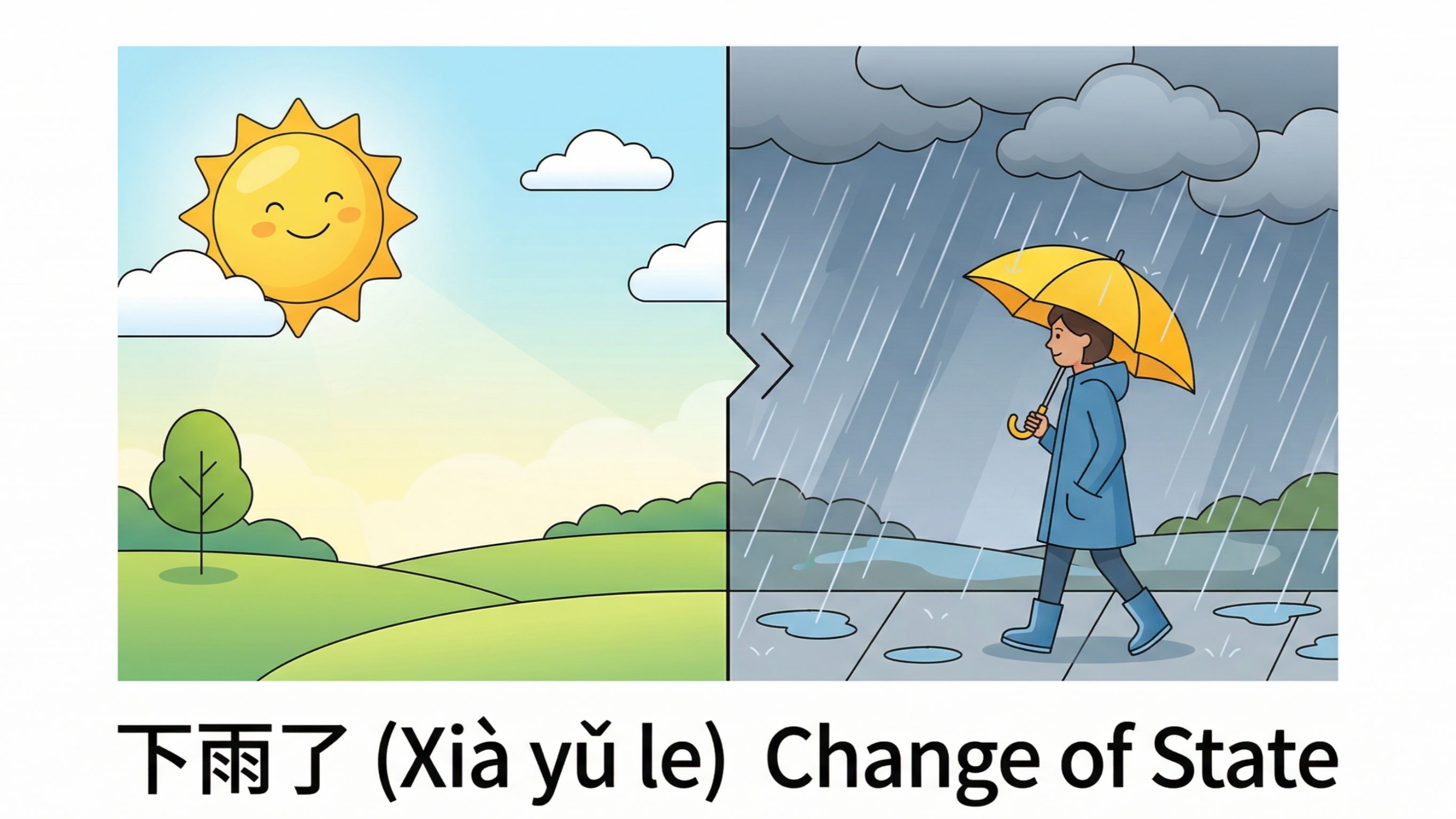
When le migrates to the very end of a sentence, it stops talking about the verb and starts talking about the world. It signals a “Change of State.” It effectively says, “Listen up: things are different now than they were five minutes ago.”
- “下雨了!” (Xià yǔ le!) — It’s raining! (The sky was clear, but now, the status has shifted to rain).
- “我饿了。” (Wǒ è le.) — I’m hungry now. (My stomach was fine earlier; now, it has updated to an empty state).
- “我不买了。” (Wǒ bù mǎi le.) — I’m not buying it anymore. (My intent has shifted).
2. The Heavy Lifter: When to Pronounce it “Liǎo” (Third Tone)
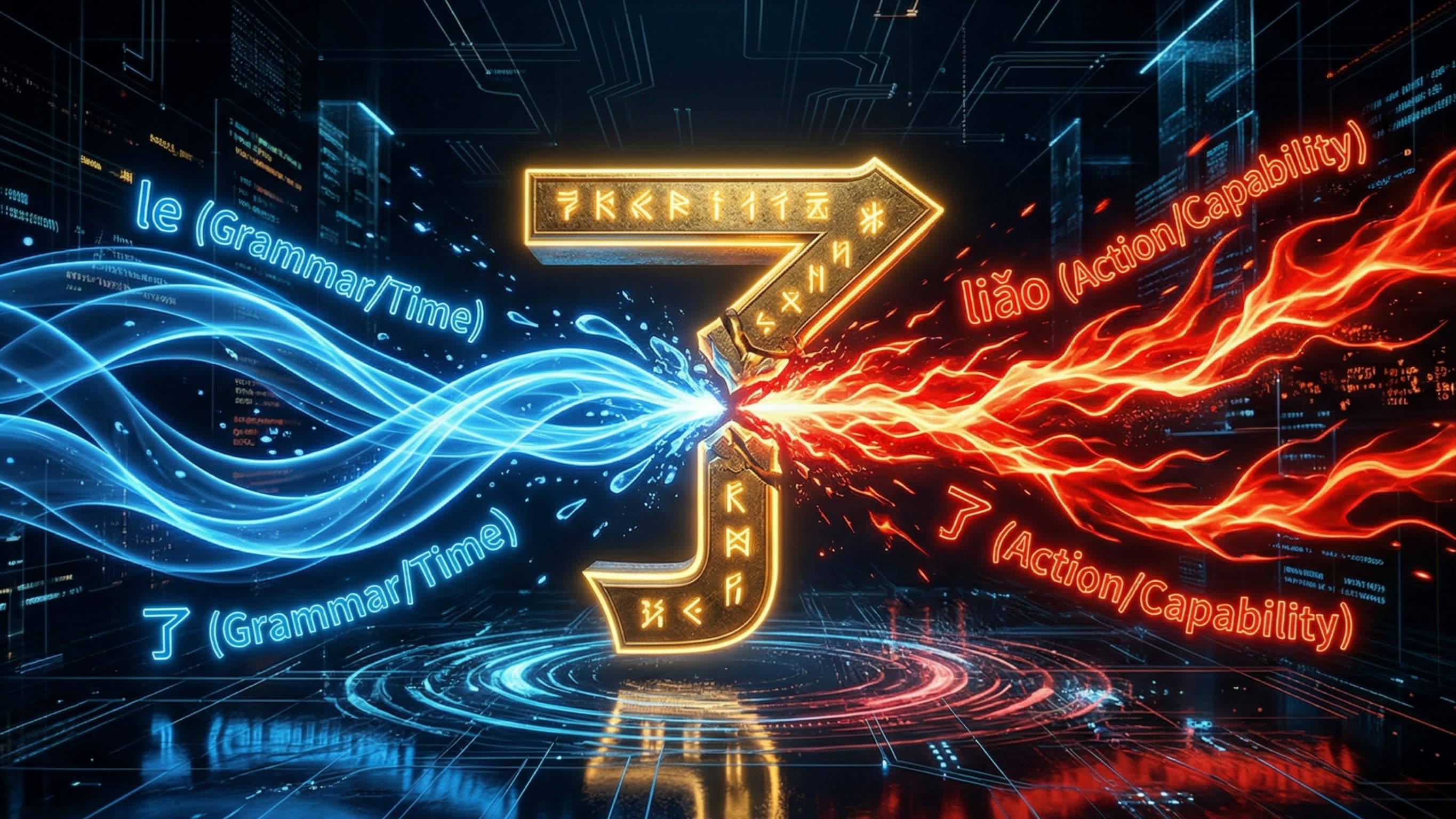
If le is the invisible grammar helper, liǎo is the heavy-duty machinery. When you pronounce it with that deep, dipping third tone, you are dealing with a totally different beast. This isn’t a particle; it is a full-fledged verb. Historically, it carries the weight of finishing, concluding, or understanding.
Scenario A: The Gauge of Capability
In conversational Chinese, you will use liǎo to express whether you possess the mental or physical capacity to tolerate or finish a task. This is known as a potential complement. If you are living, working, or traveling in China, these phrases will be your survival kit:
- 受不了 (shòu bu liǎo): “I can’t stand it!” Whether it’s the humidity of a Southern summer or the volume of a crowded subway, this is the go-to phrase.
- 吃不了 (chī bu liǎo): “I can’t eat it all.” Chinese restaurant portions are legendary for their size; use this when you’ve hit your limit.
- 做得了 (zuò de liǎo): “I can handle it.” Use this to project confidence that you have the skills to complete a project.
If you ever find yourself at a spicy hotpot restaurant, staring down a boiling pot of numbing peppers, you might find yourself saying, “太辣了,我吃不了!” (Tài là le, wǒ chī bu liǎo! — It’s too spicy, I literally cannot eat it!). To avoid more awkward dining moments, you might want to brush up on your restaurant ordering skills.
Scenario B: Fixed Formal Vocabulary
Because liǎo signifies completion or depth, it is locked into several vital, multi-character words where the pronunciation remains consistent:
- 了解 (liǎo jiě): To understand or know something deeply. (e.g., “我非常了解中国文化” — I have a deep understanding of Chinese culture).
- 了不起 (liǎo bu qǐ): Extraordinary or amazing. It literally means “cannot be looked down upon.” Use this to praise your friends!

3. The Boss Fight: Combining “Le” and “Liǎo”
You’ve reached the final level of Chinese grammar: the “Double 了” sentence. Occasionally, both versions of the character appear in the same sentence. It looks intimidating, but it is just a simple math problem of grammar.
Consider this phrase: “我受不了了!” (Wǒ shòu bu liǎo le!)
Let’s dissect this like a pro:
- 受不 (shòu bu): The negative ability (Cannot tolerate).
- 了 (liǎo): The capability verb.
- 了 (le): The status updater at the end, confirming that this “inability to tolerate” is your current, new reality.
The literal translation is: “I cannot tolerate it, and this is a new situation.” In natural English, it simply means: “I can’t take this anymore!”
Whenever you see two “了” characters sitting side-by-side at the end of a sentence, the first is always liǎo (capability), and the second is always le (the status update). Other examples include:
- 忘不了了 (wàng bu liǎo le): I can’t forget it anymore!
- 去不了了 (qù bu liǎo le): I can’t go anymore! (Plans changed).
4. Debunking the Myths
If you dig into obscure internet forums, you might find people claiming that “了” has mysterious pronunciations like luò or liào. Let’s clear the air: In modern, standard Mandarin, “了” is strictly pronounced as le or liǎo.
If a native speaker tells you otherwise, they are likely confusing it with visually similar characters like:
- 子 (zǐ): Child or Son. Note that the horizontal line cuts clean through the vertical hook.
- 孑 (jié): Solitary or lonely. Notice the horizontal line actually slants upward.
Stick to le and liǎo. Do not waste precious brainpower on imaginary pronunciations. Mastering the nuances of tone is difficult enough without chasing myths! If you want to refine your ear for these subtle changes, I highly recommend reviewing my guide on tone changes.
5. The “了” Pronunciation Cheat Sheet
Bookmark this table. It will save you hours of confusion.
| The Role | Pronunciation | The Grammar Rule | Example |
|---|---|---|---|
| Action Finisher | le (Neutral) | Directly after a verb. | 买了 (mǎi le - bought) |
| Status Updater | le (Neutral) | End of sentence. | 下雨了 (xià yǔ le - raining) |
| Capability | liǎo (3rd Tone) | Paired with 得 or 不. | 受不了 (shòu bu liǎo) |
| Formal Word | liǎo (3rd Tone) | Fixed vocabulary. | 了解 (liǎo jiě) |
Final Thoughts
Navigating the character “了” is truly a massive rite of passage for every Mandarin learner. When you finally stop viewing it as a random, frustrating sound and start using it as the precise tool it is—a lightweight particle or a heavy-duty verb—the entire language suddenly becomes much clearer.
The next time you find yourself staring at a large carbon steel wok filled with more delicious stir-fry than you can possibly finish, don’t just say “I’m full.” Channel that native speaker energy, point to the food, and declare with total confidence: “Wǒ chī bu liǎo le!”
Hungry for more grammar hacks? Discover the crucial difference between Bu and Mei to avoid another common beginner trap.
Disclaimer: As an Amazon Associate, ChinaCurator earns from qualifying purchases.