

Let’s address the elephant in the room. If you are a foreigner living in China, doing business with Chinese partners, or simply diving into the complexities of the language, you eventually encounter the “naming question.” Having a Chinese name is a rite of passage, a way to anchor yourself in a culture that values history, nuance, and meaning.
However, the way most expats approach this is often a recipe for unintentional comedy. I have seen talented professionals introduce themselves as Lóng (龙 - Dragon), assuming it sounds powerful, unaware that it sounds about as subtle as a foreigner in the West naming themselves “Sir King Lion.” Others, relying on poor translation software, inadvertently name themselves after street food. I once met a man in a Shanghai boardroom who proudly introduced himself as Bāozi (包子 - Steamed Bun). The room was polite, but the suppressed laughter was palpable.
Choosing a Chinese name is not just about phonetics; it is an act of cultural diplomacy. If you want to avoid the “Menu Item Trap” and craft a name that commands genuine respect, follow this guide to understanding the soul of Chinese naming.
1. The Anatomy of a Name: Less is More
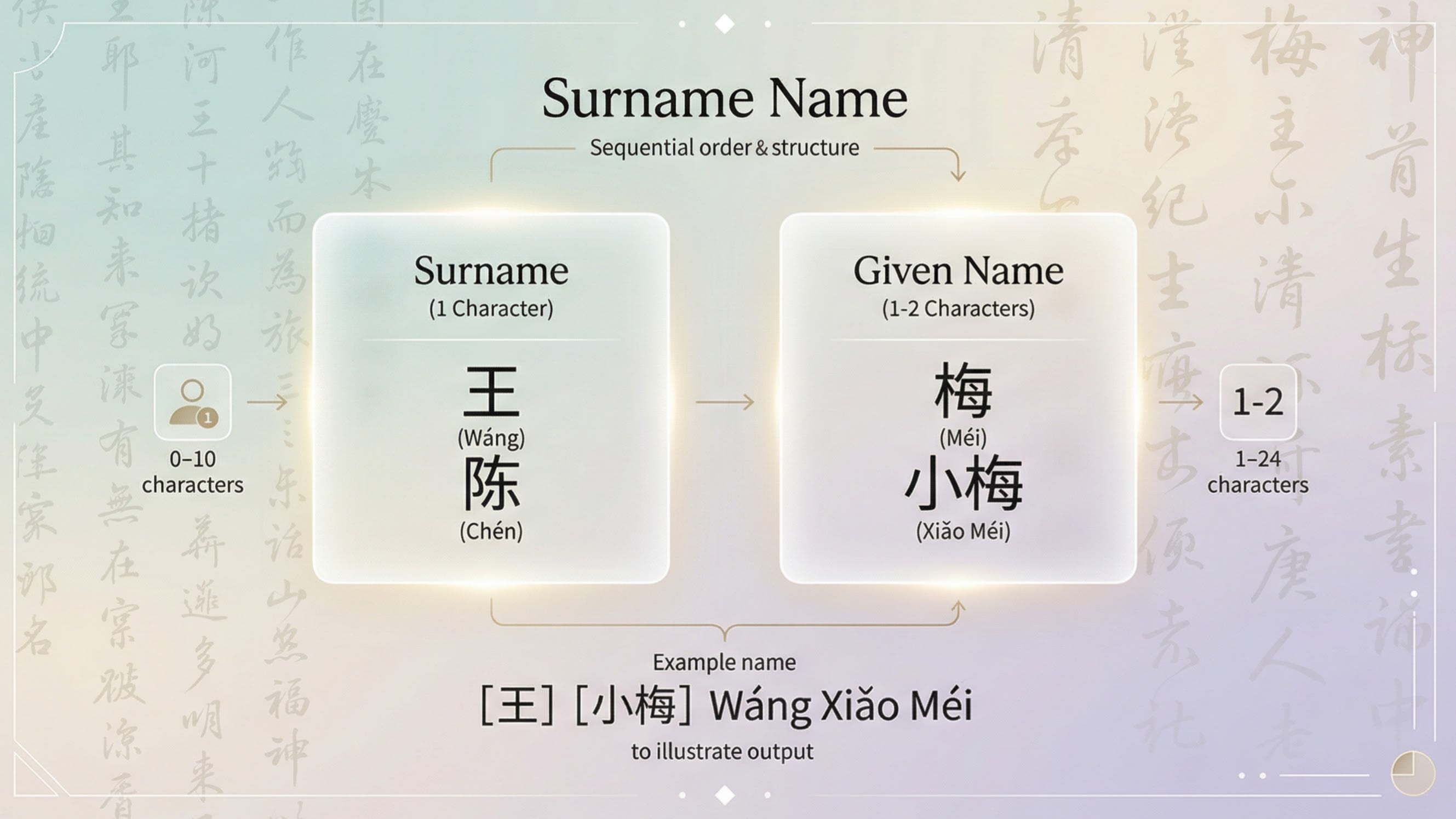
In the West, we are accustomed to the sprawling “First-Middle-Last” structure. Chinese names are far more economical, typically following a rigid formula:
Surname (1 character) + Given Name (1 or 2 characters) = Total 2 to 3 characters.
| Component | Description | Example |
|---|---|---|
| Surname | Always the first character; ancestral lineage. | Yáo (姚) |
| Given Name | 1-2 characters reflecting personal aspiration. | Míng (明) |
A quick tip: If you are still navigating the basics, you might want to brush up on the ultimate guide to grammar mistakes to ensure your professional communication stays polished. Avoid four-character names at all costs; they sound like a jarring, phonetic attempt to cram an English name into a system that wasn’t designed for it.
2. Choosing Your Surname: The Ancestral Anchor
Do not attempt to invent a surname. The lineage of Chinese names is tethered to the Bǎijiāxìng (百家姓 - Book of Family Names). For an authentic experience, pick a surname that shares a phonetic similarity with your own, or mirrors the meaning. If you find the process of learning characters daunting, consider using a high-quality Mandarin Chinese workbook to familiarize yourself with how these characters function in daily life.
- Phonetic matches: “Smith” can become Shǐ (史).
- Meaning matches: If your name implies “White,” the surname Bái (白) is a classic, widely respected choice.
3. The Given Name: Virtue Over Sound
This is where the magic—or the disaster—happens. A Chinese name is a poetic wish for the future. It is about Virtue, Imagery, and Depth.
The Pitfalls
- The “Object” Trap: As mentioned, never name yourself after food or pets. It signals a lack of cultural awareness.
- The “Power” Trap: Westerners often pick names like Lóng (龙 - Dragon) or Bà (霸 - Overlord), aiming for strength. In China, where humility is a prized virtue, these names sound like you’ve stepped off the set of an old-fashioned triad action film.
Aim for Subtlety
- For Men: Aim for wisdom or vastness. Characters like Zhé (哲 - Wise) or Yǔ (宇 - Universe/Vastness) convey intelligence without shouting.
- For Women: Grace and refinement are key. Characters like Yǎ (雅 - Refined) or Wǎn (婉 - Graceful) are timeless.
If you are just beginning to build your language skills, don’t forget that the logic behind tones and characters is just as important as the name itself.
4. The “Homophone” Sanity Check
Chinese is a language defined by tones and homophones. A name that looks beautiful in calligraphy can sound like a local slang term or, worse, an insult when spoken aloud.
The Golden Rule: Before you commit, find two native speakers and ask them, “Does this sound strange?” I learned this the hard way years ago. My first attempt at a name sounded remarkably like a word for a common kitchen utensil. When I realized the confusion, I was mortified. Always double-check your chosen characters to ensure you aren’t accidentally invoking a cultural faux pas.

5. Examples for the Discerning Expat
Let’s look at how to construct a name that feels natural and carries actual weight:
- Matthew White: Bái Mùzhé (白慕哲) — “Bai” is the surname. “Mu” (admire) and “Zhe” (wisdom) combine into a name that sounds scholarly and thoughtful.
- Olivia Martin: Mǎ Wǎnqīng (马婉清) — “Ma” is a common surname. “Wan” (graceful) and “Qing” (clear/pure) evoke the imagery of a classic, dignified heroine.
- David Cole: Kē Dáwěi (柯达伟) — “Ke” is a real surname that mimics the sound of “Cole.” “Da” (success) and “Wei” (greatness) create a professional, reliable vibe.
Final Thoughts from the Curator
Choosing a name is a profound act of self-definition in a new cultural context. It is an investment in your personal brand. When you present your business card with a name you have carefully crafted, you stop being a transient “Laowai” and start being a participant in the conversation.
Take your time. Read poetry, consult friends, and embrace the process. Once you stop trying to “be” a dragon and start aiming for the quiet elegance of a well-chosen name, you will find that the doors of Chinese culture open for you much more easily.

Ready to use your new name in the real world? Learn how to address others correctly in our guide to Chinese Titles (Shifu, Ayi, Laoban) or master the art of Polite Refusals in Business.
Disclaimer: As an Amazon Associate, ChinaCurator earns from qualifying purchases.