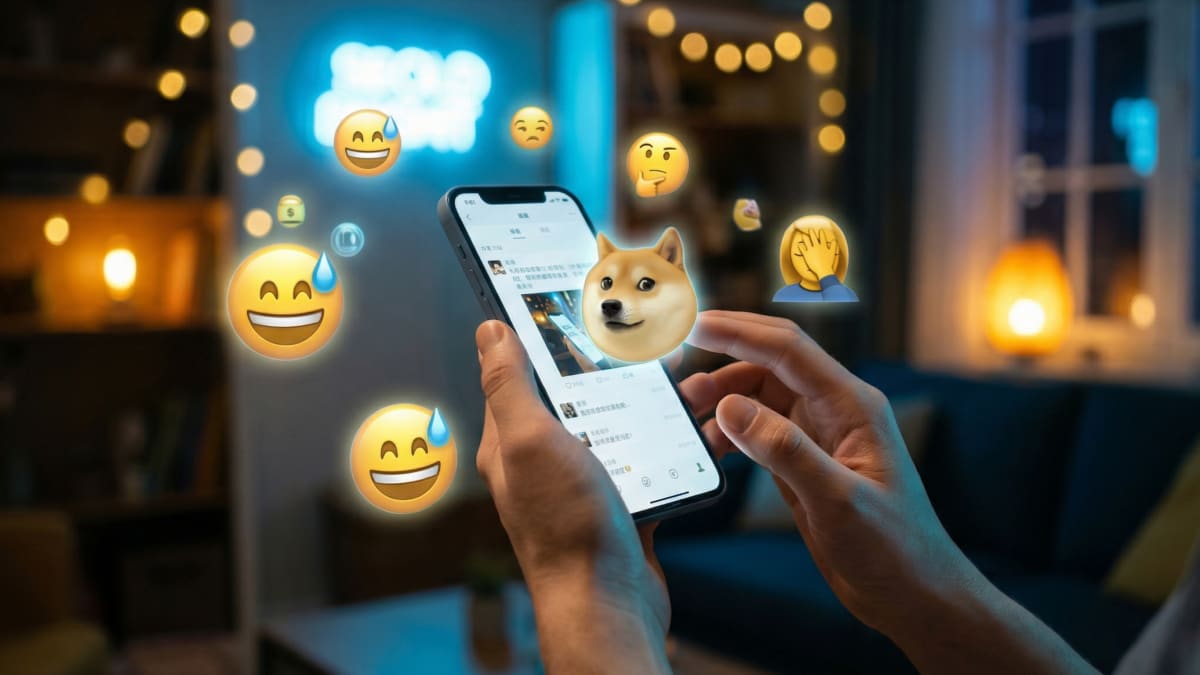

I remember the first time I made a social faux pas on WeChat. I had just enjoyed a lovely dinner with a local colleague. Wanting to be polite, I sent a quick message: “Thanks for the dinner! I had a great time! 🙂”
I waited for the “You’re welcome!” or a warm sticker in return. Instead, I was met with a deafening digital silence. What had I done? It wasn’t until later that I learned my mistake: the “Slight Smile” emoji—known as the “Death Smile” (微笑 - wēixiào)—is essentially the digital equivalent of a polite but icy stare. In the West, it’s a friendly grin. In China, it tells the recipient, “I am judging you, and I am not impressed.”
WeChat isn’t just an app; it is a complex, high-context social ecosystem. If you rely solely on textbook Mandarin without mastering the unspoken rules of digital body language, you risk sounding like a cold machine. If you are serious about becoming an insider, you need to understand the nuances of this digital dance.
1. The Emoji Minefield: 🙂 vs. 😊
Emojis are the body language of the digital age, but their meanings are not universal. In China, younger generations have completely repurposed standard emojis to communicate layers of sarcasm and irony that are completely lost on a casual observer.
The “Death Smile” (🙂)
The default “Slight Smile” is the most dangerous tool in your WeChat arsenal. A genuine smile, or a “Duchenne smile,” involves the eyes. Because this specific emoji features eyes that remain completely frozen while the mouth curves upward, it has become a symbol of detachment. It signals: “I have nothing more to say to you” or “Your opinion is wrong, but I am too polite to argue.”
The “Doge” Softener (🐶)
If you are worried about coming across as too aggressive, the Shiba Inu “Doge” emoji is your best friend. It acts as a tonal modifier. By adding it to the end of a sentence that might otherwise seem harsh, you effectively signal that you are being playful or ironic. It is a vital tool for navigating delicate conversations without losing “face” (面子 - miànzi).

2. The “Haha” Spectrum: Precision in Laughter
In English, we might toss a “lol” at the end of a message regardless of whether we are actually chuckling. In China, the length and repetition of your laughter act as a thermometer for your genuine interest.
- “Hehe” (呵呵 - hēhē): Stay away from this. While it translates to a giggle, it has been corrupted by internet culture. Using “hehe” now implies a sneer; it says “That was not funny,” or “You are acting like a fool.” It is arguably the most hated phrase in the Chinese digital space.
- “Ha” (哈 - hā): This is the “polite K.” It feels dismissive, as if you are barely acknowledging the joke.
- “Haha” (哈哈 - hāhā): This is the baseline for politeness. It confirms you heard the joke without requiring you to actually find it amusing.
- “Hahahaha…” (长哈 - cháng hā): When you break the five-character threshold, you are entering genuine territory. It signals that you are truly laughing at your screen.
If you really want to fit in, use “xswl” (笑死我了 - xiào sǐ wǒ le). It literally means “laughing to death.” It is the gold standard for “LMAO” in 2026.
3. The Punctuation Trap: Why the Full Stop is Aggressive
I often see foreigners using a period (。) at the end of a WeChat message. I understand—it feels like proper grammar. But on WeChat, the period is a weapon.
In a platform built for continuous, flowing dialogue, the period acts as a heavy, abrupt stop. It signals distance, coldness, or even anger. If you want to appear approachable, follow the lead of local users and swap that period for a Tilde (~). The tilde implies a sing-song, melodic tone that softens the edges of your text, making you appear relaxed and friendly.
4. The Nuance of Agreement: “En” (嗯) vs. “En En” (嗯嗯)
Even simple agreement has levels of social investment.
- “En” (嗯): This is a single, guttural grunt. It feels like you are shrugging your shoulders while saying “yeah.” It is very dismissive.
- “En En” (嗯嗯): By simply doubling the character, the entire energy shifts. It sounds eager, attentive, and polite. It tells your counterpart that you are not just hearing them, but you are actively engaged in the conversation.

5. The Culture of the Sticker (表情包 - biǎoqíngbāo)
If you aren’t using stickers, you are missing half the conversation. In China, the “Sticker” (表情包 - biǎoqíngbāo) is the ultimate social lubricant.
I use stickers to navigate the “Awkward Silence” zone. When a conversation naturally peters out, instead of sending a stiff “Goodbye,” I send a cute sticker of a waving cat or a sleepy rabbit. It signals that the chat is over, but that I am still on good terms with the person. It’s an essential skill for managing your social image, especially when you are unsure about the tone of a conversation.
6. The 2026 WeChat Etiquette Cheat Sheet
Keep this guide nearby until the habits become second nature to you.

| Term/Emoji | Literal Meaning | 2026 Social Reality |
|---|---|---|
| 呵呵 (hēhē) | Hehe / Giggle | Aggressive sarcasm. A huge red flag. |
| 嗯嗯 (ènèn) | Yes / Okay | Warm, attentive, and very polite. |
| 🙂 (Smile) | Happy | The "Death Smile." Use with caution! |
| 666 | Six Six Six | "Great/Awesome." Native praise. |
| xswl | Laughing to death | The best way to show you found something funny. |
Final Thoughts from Zhen
Mastering WeChat is about more than vocabulary; it is about sensing the “Qi” (气), or the underlying energy of your connection. In a society where saving face is paramount, digital body language bridges the gap where words fall short.
You don’t need to be perfect. You just need to be mindful. If you are ever feeling lost in the complexity of Chinese social rules, remember that curiosity is your best asset. For more help navigating these social waters, you might find my guide on how to properly address people or my survival guide for speaking with Didi drivers to be quite useful.
Start by swapping that period for a tilde, and watch how your digital relationships bloom. Happy chatting!