

I remember the first time I stood in a cavernous, hyper-modern high-speed railway station in Shenzhen. The air hummed with the sound of thousands of footsteps and the crisp, synthesized announcements of departing trains. I had a ticket in my hand for a 2:15 PM departure, but my Chinese friend had texted me earlier to meet at the south gate at “a quarter to two.” I stood there, staring at my watch, frantically trying to bridge the gap between my textbook knowledge and the reality of spoken Mandarin.
Time is the ultimate currency of daily life in China. Whether you are trying to coordinate a dinner date in a winding Shanghai longtang (lane), scheduling a crucial business meeting in a Beijing skyscraper, or simply ensuring you don’t miss the last bullet train of the night, mastering the clock is a non-negotiable survival skill.
The system itself is actually quite elegant—it behaves like a mathematical equation—but it requires a complete mental recalibration because the word order is essentially the mirror image of English. If you are tired of pausing to translate in your head and want to speak with the fluidity of a native, this guide will help you master the rhythm of Chinese time.
1. The Core Vocabulary: Dots and Minutes
In English, we use the somewhat vague term “o’clock.” In Chinese, the system is refreshingly literal. You use the word 点 (diǎn), which translates to “dot” or “point.” For minutes, you use the word 分 (fēn), which refers to a “fraction” or “minute.”
The Basic Formula:
[Number] + 点 (diǎn) + [Number] + 分 (fēn)
- 8:00: 八点 (Bā diǎn) — Eight o’clock.
- 8:10: 八点十分 (Bā diǎn shí fēn) — Eight ten.
- 10:25: 十点二十五分 (Shí diǎn èrshíwǔ fēn) — Ten twenty-five.
Pro Hack: In casual, fast-paced conversation, especially when you are out with friends, if the minute count is anything above 9, natives almost always drop the word 分 (fēn) at the end. Saying “十点二十五” (Shí diǎn èrshíwǔ) is perfectly natural, just as we would say “ten twenty-five” instead of “ten hours and twenty-five minutes.”
If you want to dive deeper into how numbers function, check out my guide on counting past 100 without losing your mind. Achieving fluency is much easier if you equip yourself with a reliable digital watch to practice these sequences throughout the day.
2. The Trap of “Two” and the Rule of “Zero”
Before you master the clock, you must navigate two common pitfalls that trip up almost every beginner.
The 2 O’clock Trap (两 vs 二)
If you’ve been studying, you’ve likely encountered the “number 2” dilemma. When counting pure numbers, you use 二 (èr). However, when counting the quantity of something, you must use 两 (liǎng). Since 点 (diǎn) acts as a measure word for the hour, 2:00 is always 两点 (Liǎng diǎn). You will never, ever say “二点” (Èr diǎn).
- 2:22: 两点二十二分 (Liǎng diǎn èrshí’èr fēn). Note that only the hour takes “Liang.” The minutes are treated as a pure mathematical sequence, so they stick with “Er.” If this distinction still feels fuzzy, I highly recommend reviewing my breakdown on measure words.
The “Zero” Rule (零 - Líng)
In English, if the time is 8:05, we say “eight-oh-five.” Chinese follows the exact same logic using 零 (líng). If your minutes fall between 01 and 09, you must pronounce the zero.
- 8:05: 八点零五分 (Bā diǎn líng wǔ fēn).
3. The “Big to Small” Cultural Philosophy (AM/PM)
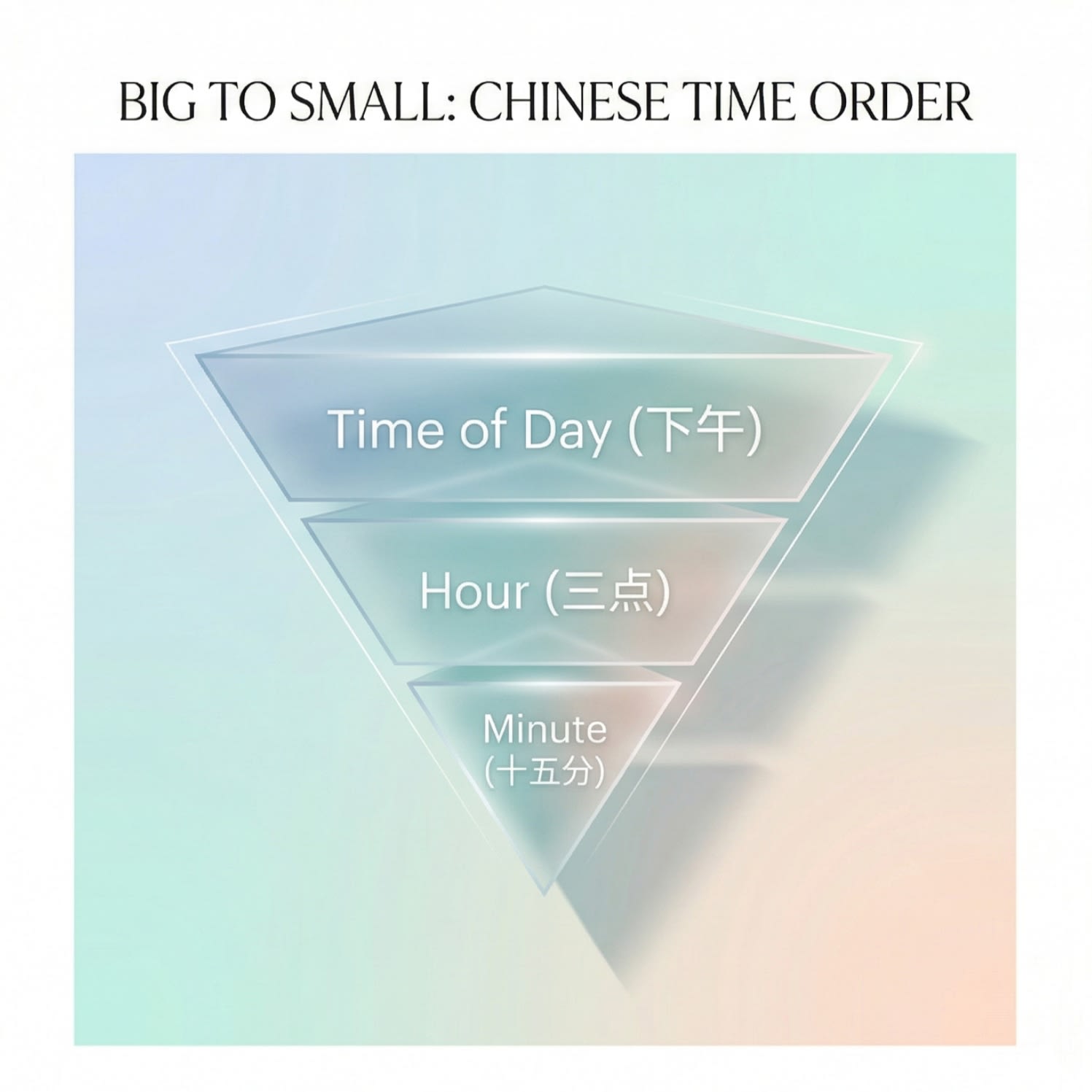
This is where the English brain usually rebels. We tend to say the specific time first, then the category: “3:00 PM.” We go from Small to Big. Chinese culture, however, dictates a strict Macro-to-Micro (Big to Small) hierarchy. You must establish the broad context—the time of day—before you mention the specific hour.
The Time of Day Vocabulary:
- 凌晨 (Língchén): The “wee hours” (Midnight - 6:00 AM)
- 早上 (Zǎoshang): Early Morning (6:00 AM - 9:00 AM)
- 上午 (Shàngwǔ): Late Morning (9:00 AM - 12:00 PM)
- 中午 (Zhōngwǔ): Noon (12:00 PM - 1:00 PM)
- 下午 (Xiàwǔ): Afternoon (1:00 PM - 6:00 PM)
- 晚上 (Wǎnshang): Evening or Night (6:00 PM - Midnight)
The AM/PM Formula:
[Time of Day] + [Hour] + 点 + [Minute] + 分
- 3:00 PM: 下午三点 (Xiàwǔ sān diǎn) — Literally: Afternoon 3 o’clock.
- 2:30 AM: 凌晨两点半 (Língchén liǎng diǎn bàn) — Literally: Early hours 2 o’clock half.
4. Shortcuts: Halves and Quarters
Native speakers have a preference for efficiency. Just like in English, we rarely say “thirty minutes,” and Chinese speakers do the same using 半 (bàn), meaning “half.”
- 10:30: 十点半 (Shí diǎn bàn).
- 2:30 PM: 下午两点半 (Xiàwǔ liǎng diǎn bàn).
For a quarter (15 minutes), the word is 刻 (kè).
- 1:15: 一点一刻 (Yī diǎn yí kè) — A quarter past one.
- 3:45: 三点三刻 (Sān diǎn sān kè) — Three quarters past three.
Curator’s Note: While “三刻” is grammatically sound, it can feel a bit old-fashioned or poetic depending on who you are talking to. Most of the modern, tech-savvy youth I meet in Beijing or Shanghai will simply say “三点四十五” (3:45) to avoid any ambiguity.
5. The Pro Hack: Subtracting Time with 差 (Chā)
How do you tell a friend “ten minutes to four”? In Chinese, you utilize 差 (chā), which means “to lack” or “to fall short of.” You are framing the time by what is missing before the next hour begins.
The Formula: 差 (Chā) + [Minutes lacking] + 分 (fēn) + [Next Hour] + 点 (diǎn)
- 3:50 (10 minutes to 4): 差十分四点 (Chā shí fēn sì diǎn).
- 8:55 (5 minutes to 9): 差五分九点 (Chā wǔ fēn jiǔ diǎn).
- 1:45 (A quarter to 2): 差一刻两点 (Chā yí kè liǎng diǎn).
6. How to Ask the Time
Now that you can answer, you need the question. Simply use 几 (jǐ), the question word for “how many” or “which.”
-
“What time is it now?” 现在几点? (Xiànzài jǐ diǎn?) (Literal: Now how many dots?)
-
“What time are we meeting?” 我们几点见面? (Wǒmen jǐ diǎn jiànmiàn?)

7. The Ultimate Time-Telling Cheat Sheet
Keep this handy for your next trip to China.
| English Time | Chinese Logic | Characters | Pinyin |
|---|---|---|---|
| 3:00 AM | Early hours 3 o'clock | 凌晨三点 | Língchén sān diǎn |
| 8:00 AM | Morning 8 o'clock | 早上八点 | Zǎoshang bā diǎn |
| 2:05 PM | Afternoon 'Liang' o'clock zero 5 | 下午两点零五分 | Xiàwǔ liǎng diǎn líng wǔ fēn |
| 7:30 PM | Evening 7 o'clock half | 晚上七点半 | Wǎnshang qī diǎn bàn |
| 9:50 AM | Morning lacking 10 min 10 o'clock | 上午差十分十点 | Shàngwǔ chā shí fēn shí diǎn |
Final Thoughts from Chen
At first glance, reading the clock in Mandarin can feel like an algebra problem. You are calculating, adding “dots,” and subtracting deficits. But once you internalize the “Macro-to-Micro” philosophy, it becomes deeply satisfying. By placing the broad time of day at the very start of the sentence, you aren’t just giving a time; you are setting a stage. It is a beautiful reflection of the highly structured and logical soul of the language. If you find yourself needing a reliable smartwatch to keep track of these moments during your travels, just remember that the time you spend mastering these small nuances will pay dividends in your fluency.

Disclaimer: As an Amazon Associate, ChinaCurator earns from qualifying purchases.