

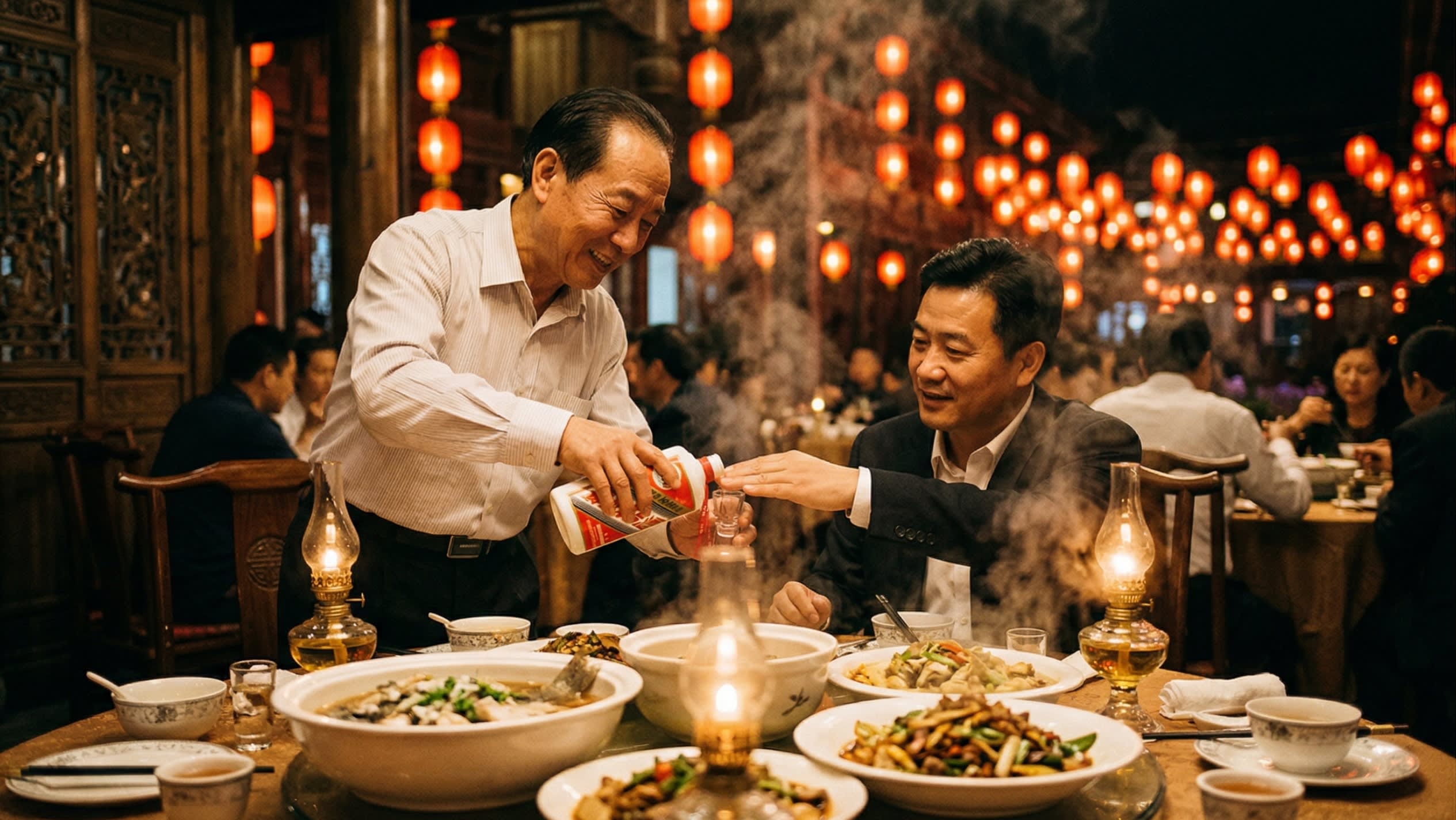
Picture this: you are at a bustling business dinner in the heart of Chengdu. The air is thick with the intoxicating, numbing scent of Sichuan peppercorns, and your host is beaming, his face flushed with hospitality. He has just poured you another glass of high-proof Baijiu (white spirit). You have already paced yourself through three glasses, and your head is starting to swim—you know for a fact that a fourth will make your early morning briefing tomorrow an absolute disaster. You look him in the eye, smile, and say: “Bù, wǒ bù yào” (不,我不要 — No, I don’t want it).
Suddenly, the warm, jovial chatter at the table dissipates. A heavy, awkward silence hangs in the air for just a second too long. Your host offers a tight, polite smile and turns to someone else, but the vibrant “vibe” of the dinner has fundamentally shifted. Without realizing it, you have just committed one of the most common social faux pas for international visitors in China: you said “No” with the bluntness of a hammer.
In many Western cultures, we are taught that directness is a hallmark of integrity, efficiency, and clarity. However, in the intricate social landscape of China, directness—particularly when refusing an offer or a request—can be interpreted as aggressive, impatient, or even a deliberate affront to the other person’s dignity. To navigate the nuances of Chinese society as an insider in 2026, you must master the art of the “Soft No.” This guide will help you understand the profound psychology of Miànzi (面子 - Face) and teach you the linguistic gymnastics required to decline an offer without ever having to utter the word “No.”
1. The Core Philosophy: Why Does “Face” Matter?
To truly grasp why a flat “No” is so problematic, you must first understand Miànzi (面子). It is far more than just “reputation”; it is an intricate currency of social standing, dignity, and intergenerational respect.
- Giving Face (给面子 - gěi miànzi): This is the act of validating someone else. By accepting an invitation or humoring a request, you are affirming their social status.
- Losing Face (丢脸 - diūliǎn): This happens when someone is publicly embarrassed, rejected, or made to feel small.
- Saving Face (留面子 - liú miànzi): This is the ultimate diplomatic goal. It involves maneuvering through social friction without causing the other person to feel humiliated.
When you offer a blunt refusal, you are effectively “stripping away” that person’s face. You are signaling that your preference overrides the relationship they are trying to foster. The “Soft No” serves as a social cushion, allowing you to decline a request while simultaneously preserving the structural integrity of your relationship. If you find this balance difficult, you might benefit from understanding how to say no without losing face in professional settings or exploring the deeper cultural myths that beginners often trip over.
2. The Social “No”: Drinks, Dinners, and Obligations
Social dynamics in China are heavily rooted in Rénqíng (人情)—a web of mutual social obligations and favors. Declining an offer here requires a delicate mix of humility and a “plausible” external excuse that shifts the blame away from the person asking.
How to Refuse Alcohol Gracefully (The “Ganbei” Trap)
Drinking is often viewed as a test of sincerity, but you don’t have to jeopardize your health to be polite. The secret is to blame an external force that is entirely out of your control.
- “Wǒ kāichē le.” (我开车了。) – “I drove here.” This is the gold-standard excuse in 2026. Given the strict enforcement of traffic laws, mentioning that you are the designated driver is universally respected.
- “Wǒ shēntǐ bù tài shūfu.” (我身体不太舒服。) – “I’m not feeling great.” A vague physical malaise—a headache, an upset stomach, or just general fatigue—is a polite, unchallengeable barrier.
- “Wǒ guòmǐn.” (我过敏。) – “I am allergic.” If you claim an alcohol allergy, your host will immediately pivot to protect your safety.
The Art of the Rain Check
If you are invited to a social outing that you simply cannot attend, never just say “No.” Use a phrase that maintains the door for future interaction.
- “Xiàcì ba!” (下次吧!) – “Next time!” This softens the refusal by explicitly signaling that you wish to participate, just not in this specific instance.
- “Wǒ kànkan bā.” (看看吧。) – “Let’s see.” This is a classic, low-pressure way to deflect, implying that you have to check your schedule or “see how things play out,” which is often understood as a polite, non-confrontational “No.”
3. The Business “No”: Managing Expectations Professionally
In a professional setting, a direct “No” to a superior or a client can feel like a direct challenge to their competence. Instead of confronting the issue, use these “high-EQ” phrases to maintain professional harmony.
The “Maybe” as a Decoupler
When a client requests a deadline or a feature that is fundamentally impossible, avoid saying “We can’t do that.” Instead, try:
- “Zàishuō ba.” (再说吧。) – “Let’s talk about it later.” This is code for “I hear you, but this is not going to happen, and I’d prefer not to argue about it.”
- “Wǒ kǎolǜ yīxià.” (我考虑一下。) – “I will consider it.” In a negotiation, this is a masterful way to buy time. It acknowledges their proposal without committing, which effectively saves their face if you later decline.
The “Inconvenience” Shield
When faced with a favor you cannot fulfill, use the word “convenient” as your ultimate shield.
- “Bù tài fāngbiàn.” (不太方便。) – “It’s not very convenient.” This is arguably the most versatile phrase in the Chinese language. It allows you to decline without providing a specific, potentially contestable reason. It implies that “external circumstances” are preventing you from saying yes.
4. Digital Body Language: Texting a Refusal
On platforms like WeChat, the “Soft No” becomes even more nuanced. If you are dodging a request via text, a delay in response followed by a soft, indirect explanation works best.
- Using the Tilde (~): As we discuss in our comprehensive guide to WeChat slang, adding a
~to your refusal message changes the tone from cold and abrupt to regretful and friendly. - The “Facepalm” Sticker: If a request is genuinely unreasonable, a well-placed, polite sticker—like a “sweating” or “facepalm” emoji—shows your internal struggle, communicating your inability to comply without you having to write a harsh, confrontational sentence.

5. The “High-EQ Refusal” Cheat Sheet
Keep this reference handy. These phrases will allow you to maintain your professional and social reputation even when you have to say no.
| Scenario | Native Phrase | Pinyin | Implied Meaning |
|---|---|---|---|
| Declining an Invite | 下次吧 / 看看吧 | Xiàcì ba / Kànkan ba | "I appreciate the offer, but not today." |
| Refusing a Request | 不太方便 | Bù tài fāngbiàn | "External factors make this impossible." |
| Ending Negotiation | 再说吧 / 我考虑一下 | Zàishuō ba / Wǒ kǎolǜ yīxià | "No, but I am keeping it polite." |
| Refusing Drinks | 我开车了 | Wǒ kāichē le | "I simply cannot, per safety laws." |
6. Conclusion: The Power of Harmony
In the West, we are often told that “No” is a complete sentence—a tool for personal boundary setting. In China, however, “No” is often the beginning of a conflict. By learning to say “No” through the lens of Face, you are not being dishonest; you are being harmonious.
In a society that values strong relationships (Guānxì - 关系) above almost all else, mastering the ability to decline a request while keeping your counterpart smiling is an absolute superpower. It shows that you value the relationship more than your own momentary convenience. Next time you find yourself in a tight spot, take a breath, offer a genuine smile, and reach for that familiar, polite Bù tài fāngbiàn. You will find that life in China becomes infinitely smoother, and your local colleagues and friends will quickly come to respect your high level of cultural intelligence (Gāo EQ - 高情商).
If you are just starting your journey to understand the deeper social codes of China, or perhaps you need to learn how to order your favorite coffee without accidentally offending anyone, practice is key. Learning to navigate these “invisible” social barriers is exactly what turns a tourist into a true curator of Chinese culture.

Want to master more subtle social cues? Check out our guide on why drinking hot water is a foundational aspect of Chinese health culture or delve into the fascinating, hidden language of Chinese numbers and superstitions.