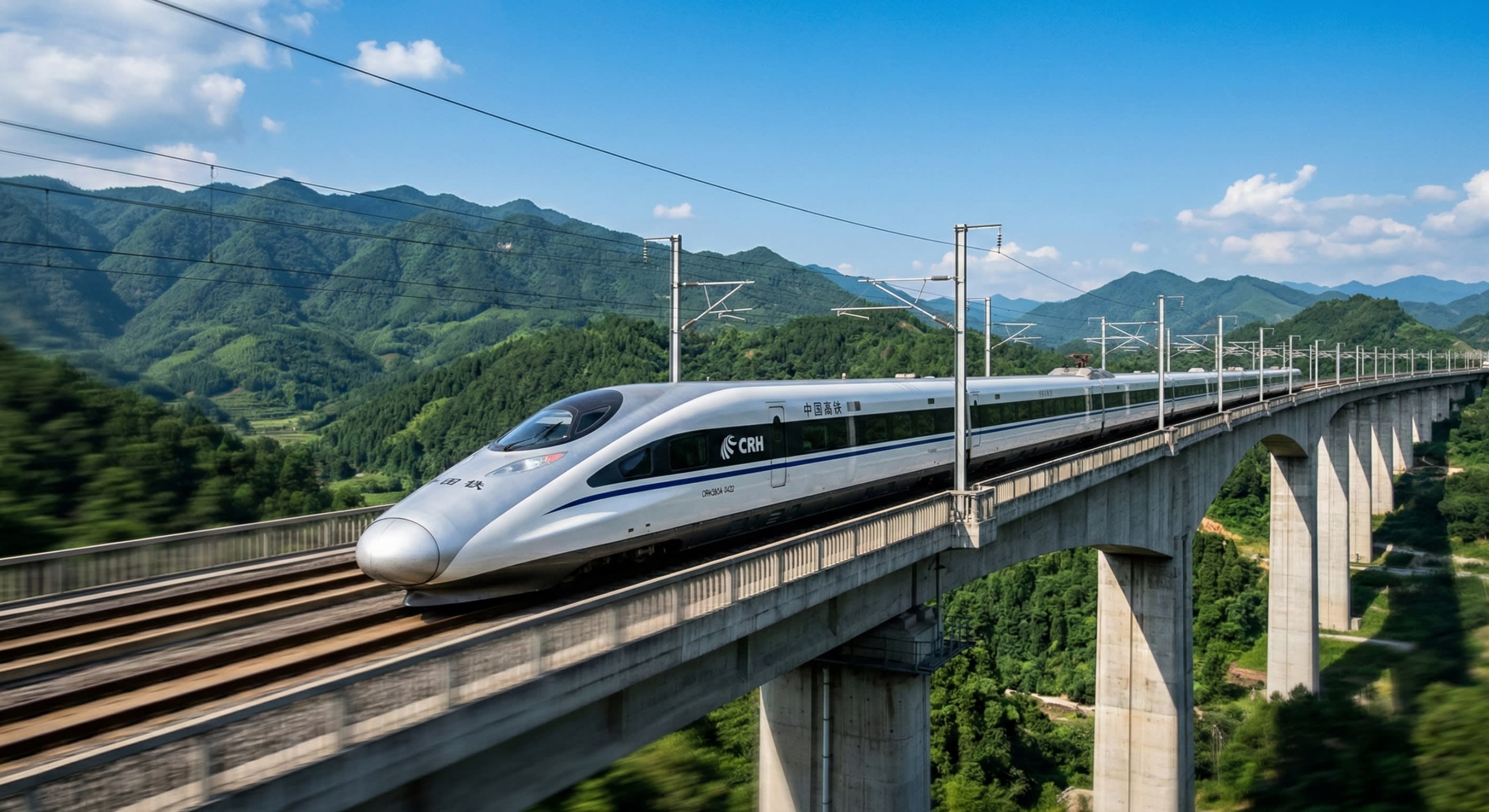
Managing a multi-floor office renovation—especially navigating the structural quirks of a building whose last major update was back in 2005—requires flawless scheduling and a zero-tolerance policy for delays. China’s High-Speed Rail network, known as gāotiě (高铁), operates on that exact same level of relentless, clockwork precision.
While tearing down the highway in a 2024 Long Range All-Wheel Drive electric vehicle gives you the ultimate freedom to explore hidden mountain villages, nothing beats the pure, stress-free efficiency of the gāotiě for crossing multiple provinces in a single afternoon. Cruising smoothly at 350 km/h (217 mph), these trains have essentially replaced domestic flights for routes under five hours.
However, for first-time visitors in 2026, getting a ticket can feel like cracking a cryptographic puzzle. The stations are massive, the booking windows are strict, and the digital ecosystem is entirely self-contained. This guide will walk you through exactly how to book, board, and enjoy China’s bullet trains like a true native.
1. The Only App You Need: 12306
As anyone who optimizes web code for platforms like chinesecurator.com knows, a clean user interface and a secure backend are everything. For years, foreigners relied on third-party travel agencies (like Trip.com) to buy train tickets. While those are still fine, they often charge hidden markup fees and struggle with real-time ticket availability during peak seasons.
The undisputed champion of train booking is the official government app: 12306 (pronounced yāo èr sān líng liù).
In recent years, China Railway has vastly improved the 12306 English interface. You can now download it directly from any global app store, register with an international phone number, and link it to your international credit card via Alipay or WeChat Pay.
Identity Verification (Shímíng Rènzhèng 实名认证)
Before you can buy a single ticket, you must verify your identity. In China, your ticket is permanently tied to your ID.
- Open the 12306 app, go to your profile, and enter your exact passport details.
- Crucial Tip: Type your name exactly as it appears on the MRZ (Machine Readable Zone) at the bottom of your passport page. If your name has a middle name, it usually goes into the “Given Name” field. If the system’s automated verification fails, you will need to upload a photo of your passport page, which takes about 24 hours for manual approval. Do this well before your trip!
2. Timing the Market: The 15-Day Rule
Unlike airlines, which sell tickets months in advance, China Railway only releases tickets exactly 15 days before the departure date.
During normal weeks, you can book a few days in advance. But during major holidays like the Spring Festival or the October Golden Week, tickets vanish in literal seconds. This intense competition is known as qiǎngpiào (抢票), or “ticket snatching.”
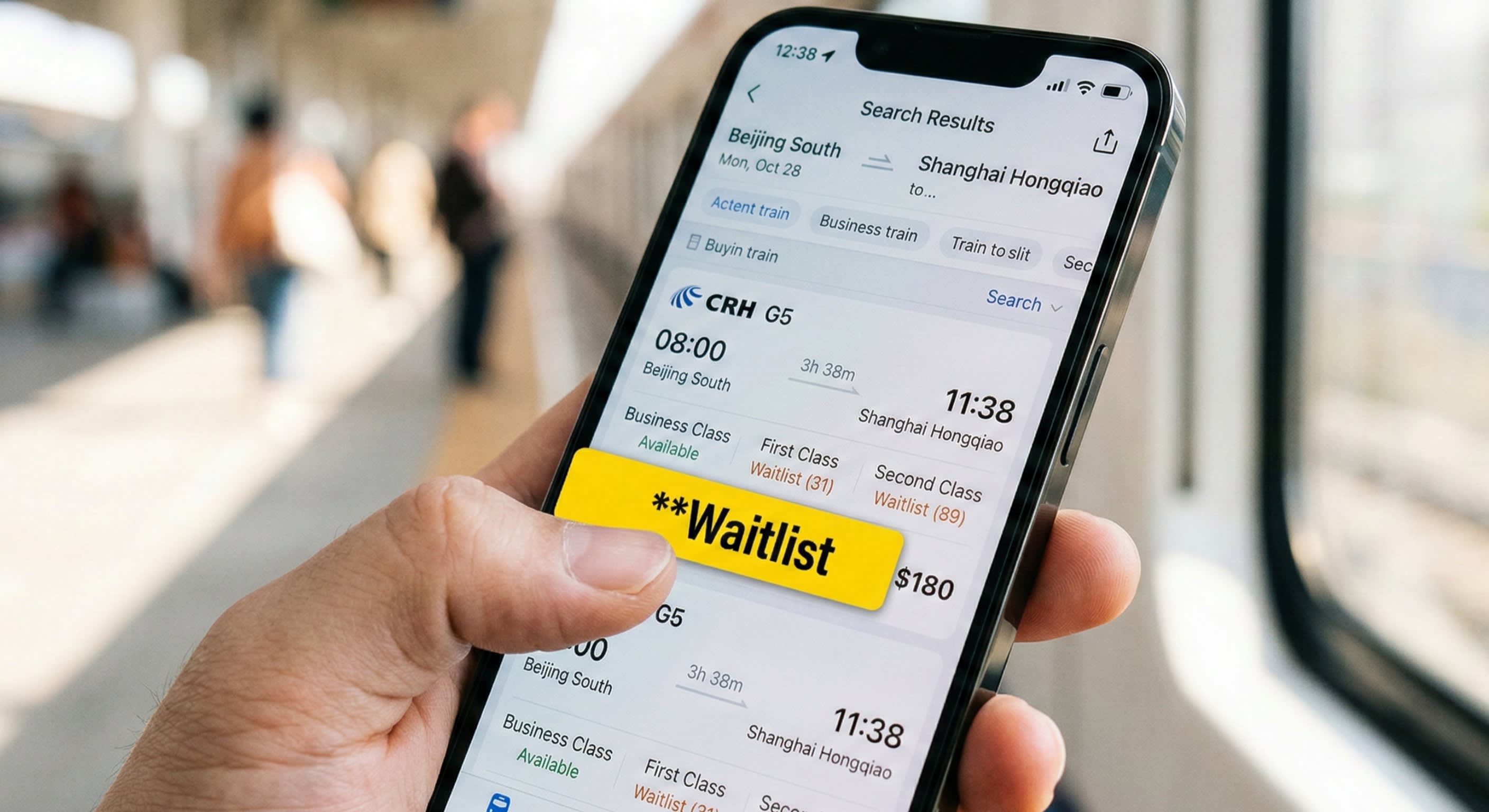
The “Waitlist” Lifesaver (Hòubǔ 候补)
If a train is sold out, do not panic. The 12306 app has a magical built-in feature called hòubǔ (候补), meaning “waitlist.”
- When you click “Waitlist” on a sold-out train, you pay for the ticket upfront.
- As other passengers cancel or change their plans, the system automatically assigns those tickets to the waitlist queue.
- It is highly effective; over 80% of waitlist orders are successfully fulfilled. If you don’t get a ticket by your departure day, the app automatically refunds your money in full.
3. Decoding the Seat Classes
High-speed trains in China (marked with a “G” or “D” on the schedule) offer a comfort level that rivals premium airlines. Here is what you need to know to choose the right cabin.
| Seat Class | Chinese & Pinyin | The Experience |
|---|---|---|
| Second Class | 二等座 (èrděngzuò) | Arranged 3-2. Very comfortable, incredible legroom, standard power outlets. The default choice for 90% of travelers. |
| First Class | 一等座 (yīděngzuò) | Arranged 2-2. Wider seats, footrests, quieter cabin. Worth the upgrade if you want to sleep or work on a laptop. |
| Business Class | 商务座 (shāngwùzuò) | Aviation-grade luxury. Fully lie-flat pod seats arranged 2-1 or 1-1. Includes a hot meal, slippers, and VIP lounge access at the station. |
4. Navigating the Mega-Stations
Chinese train stations are built on a massive scale. Stations like Shanghai Hongqiao or Guangzhou South handle hundreds of thousands of passengers a day. Treat them like major international airports: arrive at least 45 minutes to 1 hour before departure.
Step 1: Security (Ānjiǎn 安检)
As soon as you enter the station doors, your bags must go through an X-ray machine, and you will walk through a metal detector. Do not bring aerosol spray cans or large knives; they will be confiscated.
Step 2: Finding Your Gate (Jiǎnpiàokǒu 检票口)
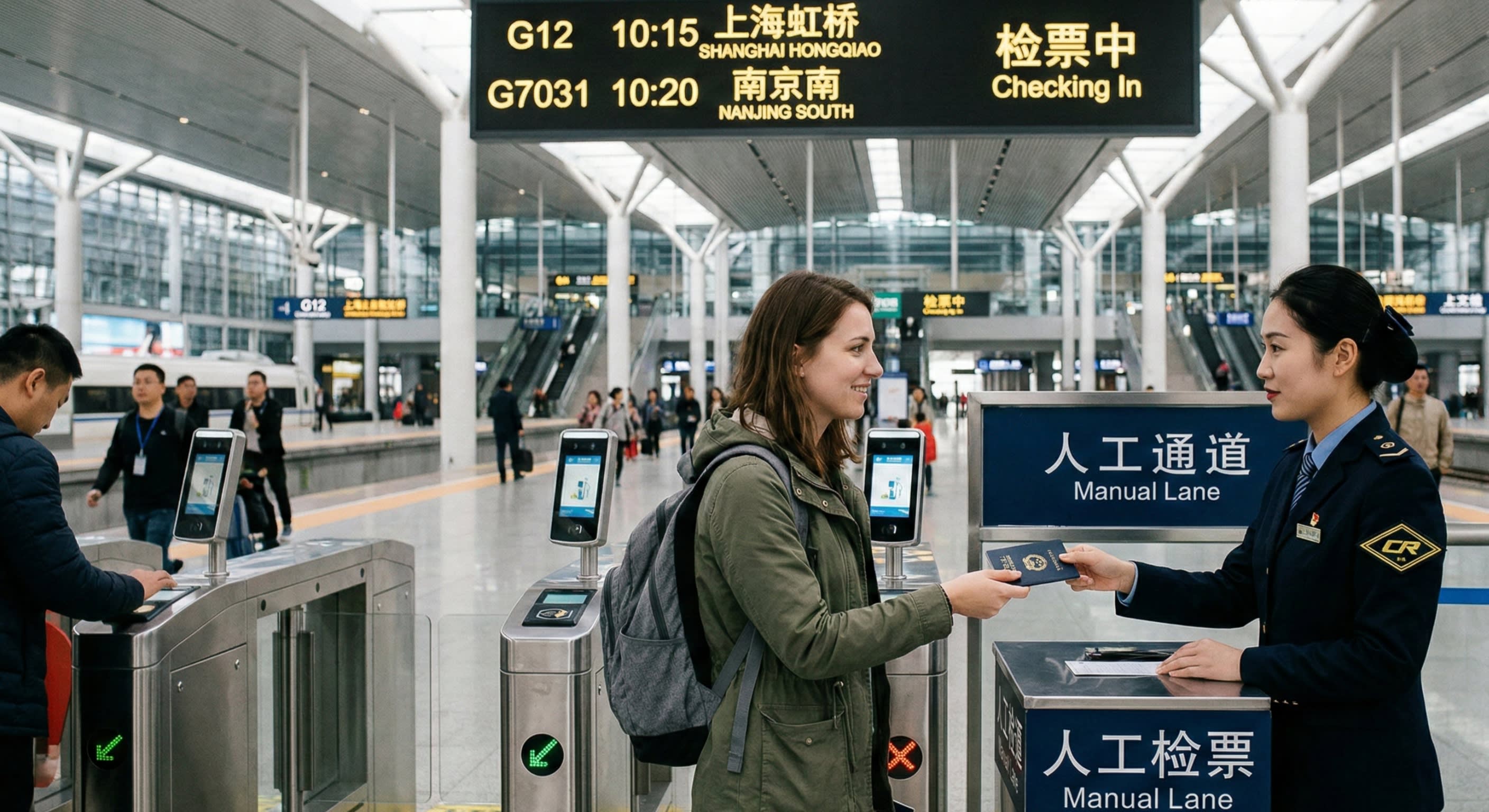
Look up at the giant digital departure boards. Find your train number (e.g., G101) and look for the corresponding jiǎnpiàokǒu (检票口)—the ticket inspection gate. Usually, there is an “A” and a “B” gate for the same train (e.g., Gate 12A and 12B). They lead to the front or back half of the train. Your app will tell you which one is closer to your specific carriage.
Step 3: Paperless Boarding
In 2026, paper tickets are entirely obsolete. China runs on a paperless system. When boarding starts (usually 15 minutes before departure), you simply walk up to the automated turnstiles.
- For Chinese Citizens: They scan their national ID card.
- For Foreigners: There is always a manual lane staffed by a railway worker at the far side of the gate. Hand them your physical passport. They will scan it, verify it matches the digital ticket in the 12306 system, and wave you through.
5. Life on Board
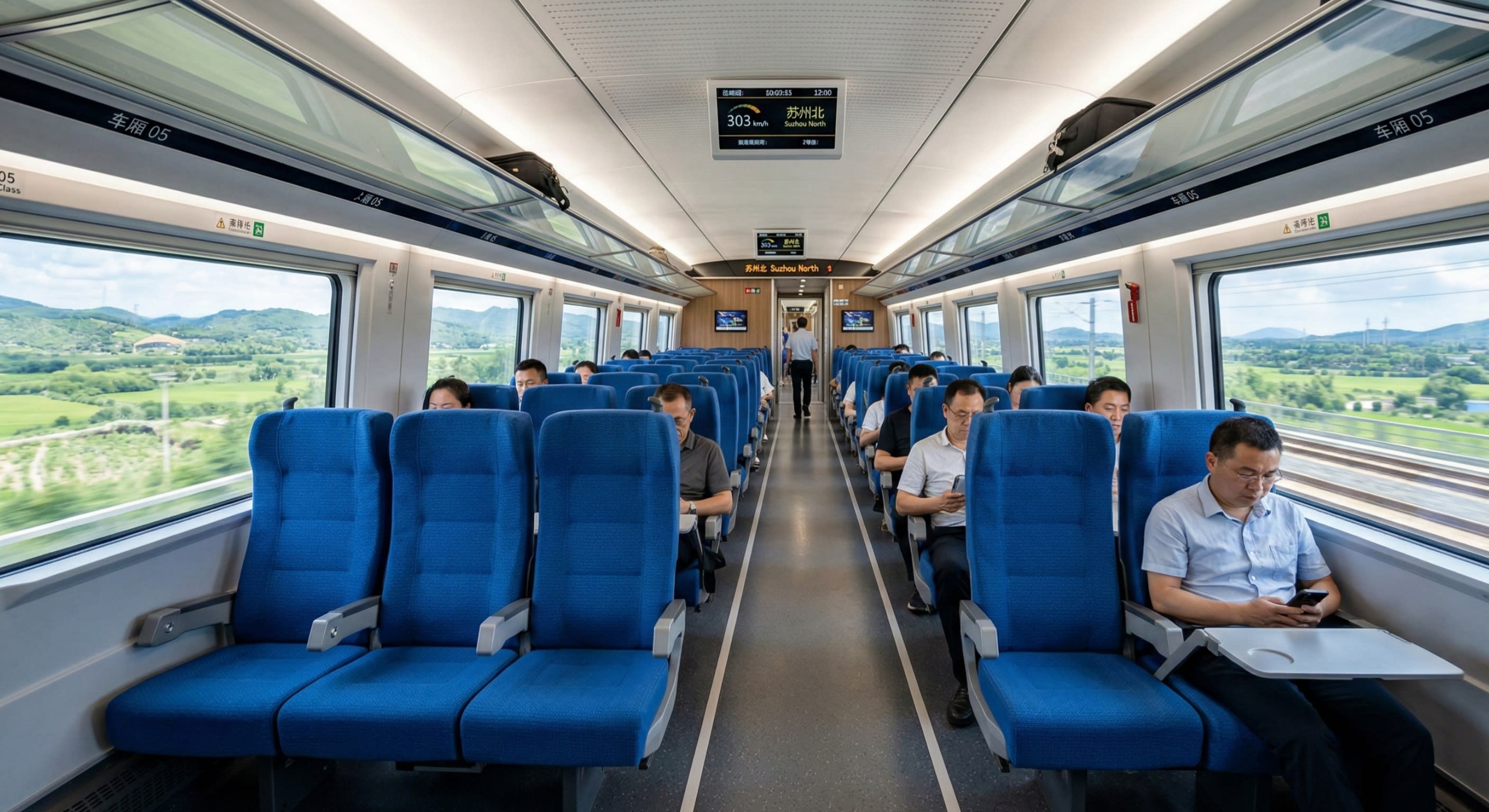
Once you find your carriage (chéngxiāng 车厢) and your seat, it is time to relax. The ride is so smooth that you can balance a coin on the windowsill while traveling at 350 km/h.
If you get hungry, attendants push carts up and down the aisles selling snacks, coffee, and boxed meals (hé fàn 盒饭). Even better, the 12306 app allows you to order food delivery from restaurants at upcoming stations. If you order a McDonald’s burger or local dumplings 45 minutes in advance, a delivery driver will hand it to the train staff at the next stop, and it will be brought directly to your seat!
Final Thoughts
Mastering the 12306 app and the gāotiě network unlocks the entirety of China. It removes the stress of airport security lines and the fatigue of long highway drives, depositing you directly into the heart of your destination city.
Whether you are heading to an intensive business meeting or setting off to explore ancient ruins, the high-speed rail ensures that your journey is as smooth and predictable as the destination itself.
Got your tickets booked? Make sure you know how to communicate when you step out of the station with our guide to Talking to Your Didi Driver or figure out what to eat upon arrival with The Ultimate Street Food Map.

