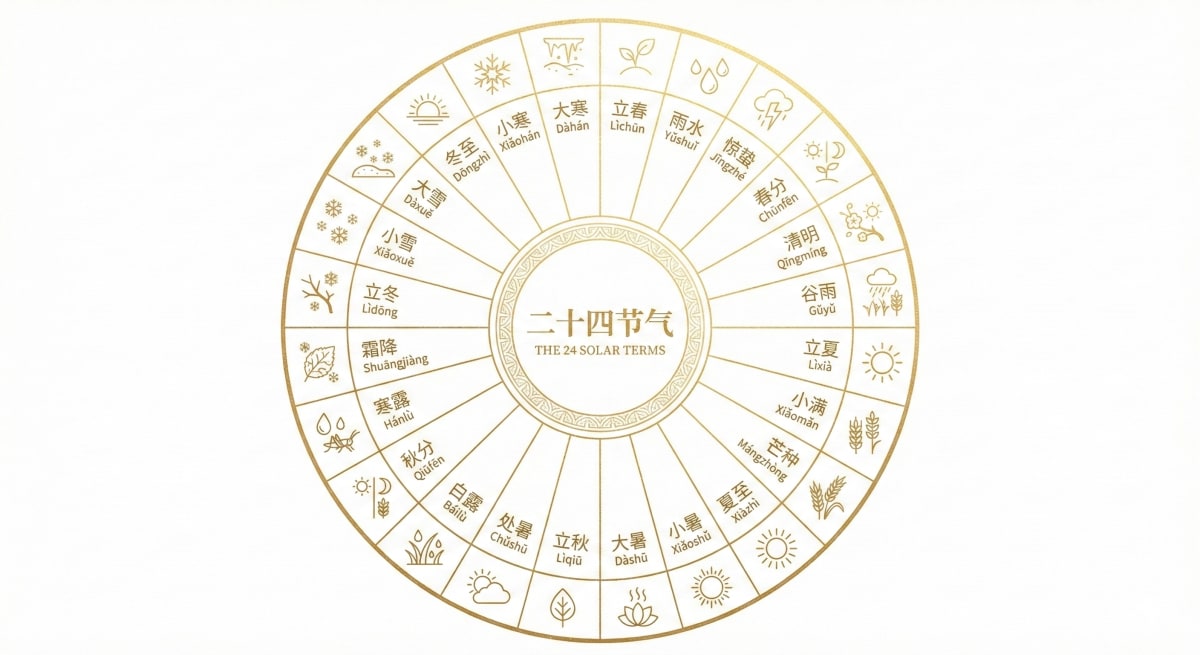

In our frenetic modern era, most of us carve the year into four rigid blocks: Spring, Summer, Autumn, and Winter. Yet, there is a far more nuanced, ancient heartbeat that pulses beneath the surface of Chinese life. For over 2,000 years, the 24 Solar Terms (èrshísì jiéqì 二十四节气) have served as the silent compass for millions. Think of them not just as calendar dates, but as a biological clock—a sophisticated lifestyle guide that whispers exactly when the cicadas will begin their drone, when the morning dew turns crisp enough to bite, and when it is time to shift your diet or tend to your most precious belongings.
While many mistakenly categorize these as part of the “Lunar Calendar,” they are actually rooted in solar movement. It is a highly precise astronomical system, tracking the Earth’s orbit with a sensitivity that modern planners often lack. Whether you are a traveler looking to align your trip with the flowering of the peach trees or a collector seeking the optimal climate to maintain your Wenwan gourds, this system offers a profound invitation to move in harmony with the Earth.
1. How it Works: The Sun’s Path
The 24 Solar Terms were born from the patient observations of ancient agrarian scholars who looked up and saw the stars as a clock. They mapped the sun’s annual trajectory and sliced it into 24 distinct, equal segments. Each “term” covers roughly 15 days of terrestrial change.
Imagine standing on a rotating Earth, observing a giant ecliptic circle overhead. Every time the sun shifts 15 degrees, a new chapter of nature begins. This is why the system feels so eerily accurate. For instance, chūnfēn (Spring Equinox) inevitably arrives around March 20th. It marks the moment when the sun stands perfectly perpendicular to the equator, granting us an exact balance of light and dark. It is a moment of equilibrium that you can feel in the air—a shift from the lethargy of winter to the restless ambition of spring.
2. The Complete 24 Solar Terms Guide
Navigating this system is easier than it seems once you start tracking the subtle shifts in your own environment.
| Term (Pinyin & Hanzi) | Meaning | Date | What Happens? |
|---|---|---|---|
| lìchūn (立春) | Start of Spring | Feb 4 | The earth begins its slow, quiet awakening. |
| yǔshuǐ (雨水) | Rain Water | Feb 19 | Frozen crystalline snow melts into life-giving rain. |
| jǐngzhé (惊蛰) | Awakening of Insects | Mar 5 | The first rolls of spring thunder stir the soil. |
| chūnfēn (春分) | Spring Equinox | Mar 20 | Perfect equilibrium; day and night are twins. |
| qīngmíng (清明) | Pure and Bright | Apr 4 | The air turns crisp and clear for family treks. |
| xiàzhì (夏至) | Summer Solstice | Jun 21 | The sun reaches its zenith; the longest shadow. |
| qiūfēn (秋分) | Autumn Equinox | Sep 22 | Summer yields, and the golden harvest begins. |
| dōngzhì (冬至) | Winter Solstice | Dec 21 | The deepest, longest night of reflection. |
(Note: These represent the key pivot points of the year. The full 24 terms cycle with similar poetic precision.)
3. Seasonal Living: Eating with the Sun
In China, the kitchen is where the 24 Solar Terms become reality. The concept of shì lì ér shí (适历而食)—eating in accordance with the calendar—is not just folk wisdom; it is a nutritional strategy. When the weather shifts, our bodies crave different fuels, and the Solar Terms act as a menu for that transition.
During the peak of the summer heat (xiǎoshǔ), you will find families reaching for cooling green tea and bitter melon to “clear heat” from the blood. It is a visceral, refreshing way to survive the swelter. Contrast this with dōngzhì (Winter Solstice), when the air is biting and cold. You will see grandmothers everywhere wrapping dumpling flour to make jiǎozi, not just because they are delicious, but because they provide the dense, warming comfort needed to keep the blood flowing against the frost. It is a multi-generational ritual that turns a simple meal into a survival tactic.

4. Caring for your Treasures: The Collector’s Secret
If you have started an interest in the tactile world of Wenwan collectibles, you quickly learn that these items are alive. A mahogany bead or a carved gourd reacts to the seasons just as much as a human body.
During the oppressive humidity of dàshǔ (Major Heat), a gourd can develop dark, unsightly spots if it remains damp. I’ve learned the hard way to move my collection to a dehumidifier-equipped cabinet to keep them breathing correctly. Conversely, when dàhán (Major Cold) arrives, the air in the north turns aggressive and dry. If you leave your precious wooden beads out in the open, they will inevitably crack. It is a constant, rhythmic negotiation between the object and the environment.
5. Finding Balance in a Digital Fog
In the year 2026, we are trapped in an endless loop of screen notifications and artificial lighting. The 24 Solar Terms offer an escape hatch. When you choose to pay attention to these terms, you are opting out of the “always-on” culture.
Take a moment every 15 days. Step outside. Is the light hitting the leaves differently? Is there a subtle change in the scent of the evening air? This is mindfulness in its most ancient form. It is a gentle reminder that we are not separate from the environment, but a part of it. Whether you are mastering the art of tea or simply finding a quiet corner to clear your mind, you are connecting to a rhythm that has survived centuries of change.

Final Thoughts
The 24 Solar Terms are a gift from the past—a blueprint for living that values observation over haste. They teach us that even in a high-tech world, there is immense value in knowing when to bloom, when to harvest, and when to retreat into the warmth of home. As the sun moves, so do we.
Ready to live more intentionally? Explore our guides on The Art of Chinese Tea or start your journey into Literati Collectibles.
Disclaimer: As an Amazon Associate, ChinaCurator earns from qualifying purchases.