
If you have spent any time exploring the myths of the Dragon Boat Festival, you are likely familiar with the melancholy, poetic tale of Qu Yuan. But I can promise you this: when you find yourself standing on a humid riverbank in southern China come June, poetry is the very last thing on your mind. The reality of Sài lóngzhōu (赛龙舟—Dragon Boat Racing) is pure, unadulterated adrenaline.
It is a grueling, high-stakes team sport that fuses the synchronized precision of Olympic rowing with the chaotic, high-speed peril of street racing. In 2026, the festival falls on June 19th. If you want to witness the loudest, most passionate, and visually staggering sporting events in the country, you need to be in one of these three places.
🏎️ 1. Foshan, Guangdong: The Art of “Dragon Boat Drifting”
If your time in China is limited, make Foshan (佛山) your primary destination. Specifically, you want to immerse yourself in the township of Diéjiào (叠滘).
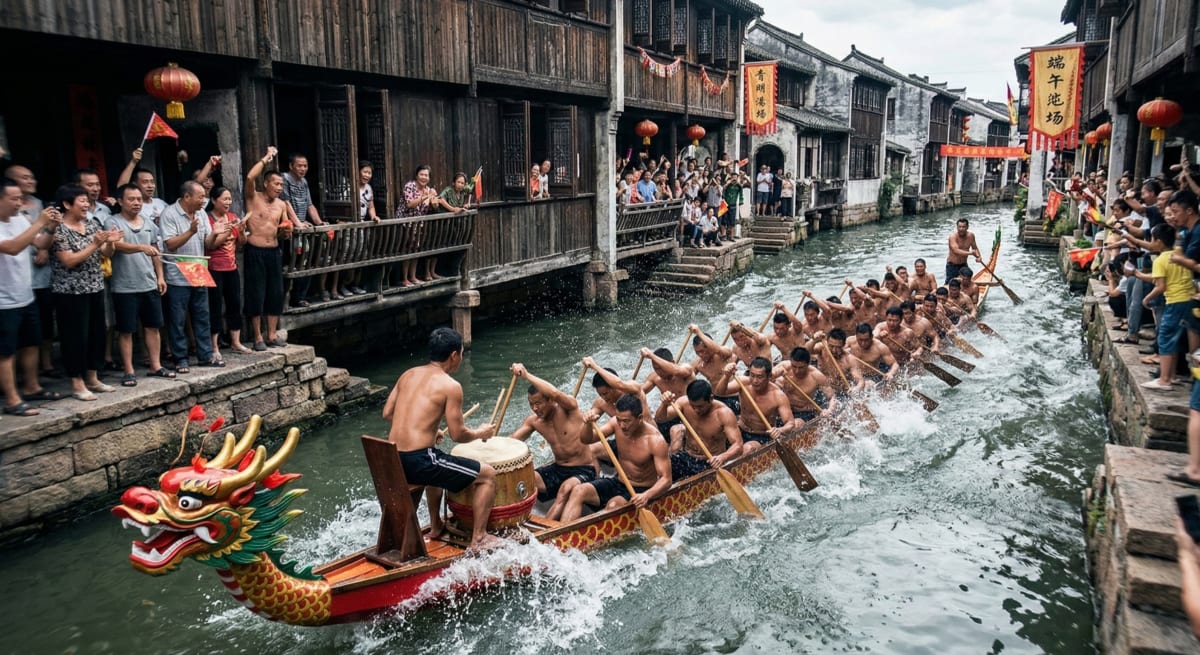
Most of the world knows dragon boat racing as a straight-line sprint on calm, expansive lakes. In Diejiao, they do things differently. These teams race through narrow, winding, centuries-old village canals. Some of these waterways are barely 6 meters wide, forcing 25-meter-long boats packed with 40 powerhouse paddlers to navigate impossible turns.
How do they handle a 90-degree bend at top speed without splintering against the stone walls? They drift.

The Fast and the Furious: Village Edition
Known locally as Diéjiào Lóngzhōu Piāoyí (叠滘龙舟漂移—Diejiao Dragon Boat Drifting), this is quite possibly the most terrifyingly impressive water sport you will ever witness.
The courses are defined by their wicked geometry: L-bends, C-bends, and the dreaded “Straight-Angle” corner. As a boat hurtles toward a blind stone wall, the drummer executes a rhythmic shift that sounds like a sonic explosion. Paddlers on one side pull furiously backward while the other side digs deep to propel the bow. The steersman, balancing on the back, uses his entire body weight to whip the tail around. The boat physically skids sideways across the water, often missing the stone embankment by mere inches. It is loud, reckless, and requires a level of telepathic teamwork that is mesmerizing to watch.
The “Landlord” Phenomenon (Bāozūgōng 包租公)
To truly grasp the local culture, you have to appreciate a beloved regional meme. Locals don’t say “racing the boat”; they call it Pá lóngchuán (扒龙船—rowing the dragon boat).
These rowers represent their ancestral villages, and in Guangdong’s booming economy, many of these “humble” rowers are actually wealthy property owners. The internet affectionately calls them Bāozūgōng (包租公—Landlords). They don’t race for a paycheck; they race for the honor of their ancestors. As the saying goes: “If they win, they feast on roast pig in the ancestral hall. If they lose, they face the ancestors in shame.” The financial backing and sheer intensity behind these Foshan teams make them the most competitive in China.
🏮 2. Miluo River, Hunan: The Sacred Origin
If Foshan represents the peak of adrenaline, the Miluo River (汨罗江) in Yueyang, Hunan, is the center of spiritual gravity. This is the very river where the poet Qu Yuan is said to have drowned himself. Being here is less like attending a sports match and more like participating in a living, breathing ceremony.

Awakening the Dragon (Jì Lóngtóu 祭龙头)
Before the boats meet the water, you must witness the Jì Lóngtóu (祭龙头)—the Sacrificial Ceremony. Carved wooden dragon heads are carried to a temple, where elders offer incense and rice wine. The most profound moment is the “Dotting of the Eyes,” where an elder uses a calligraphy brush to paint the dragon’s eyes with red cinnabar, symbolically awakening the beast. Only then is the head attached to the boat. The races here are grand and solemn, and watching the boats cut through the misty river while the paddlers chant creates an emotional resonance that stays with you long after the holiday ends.
🏙️ 3. Hong Kong: The International Carnival
For those who want the excitement of the race with an international party vibe, Hong Kong is unbeatable.
While the roots of the festival are ancient, Hong Kong essentially exported modern competitive dragon boat racing to the rest of the world. In 1976, the city held the first international race, standardizing the sport we see today.
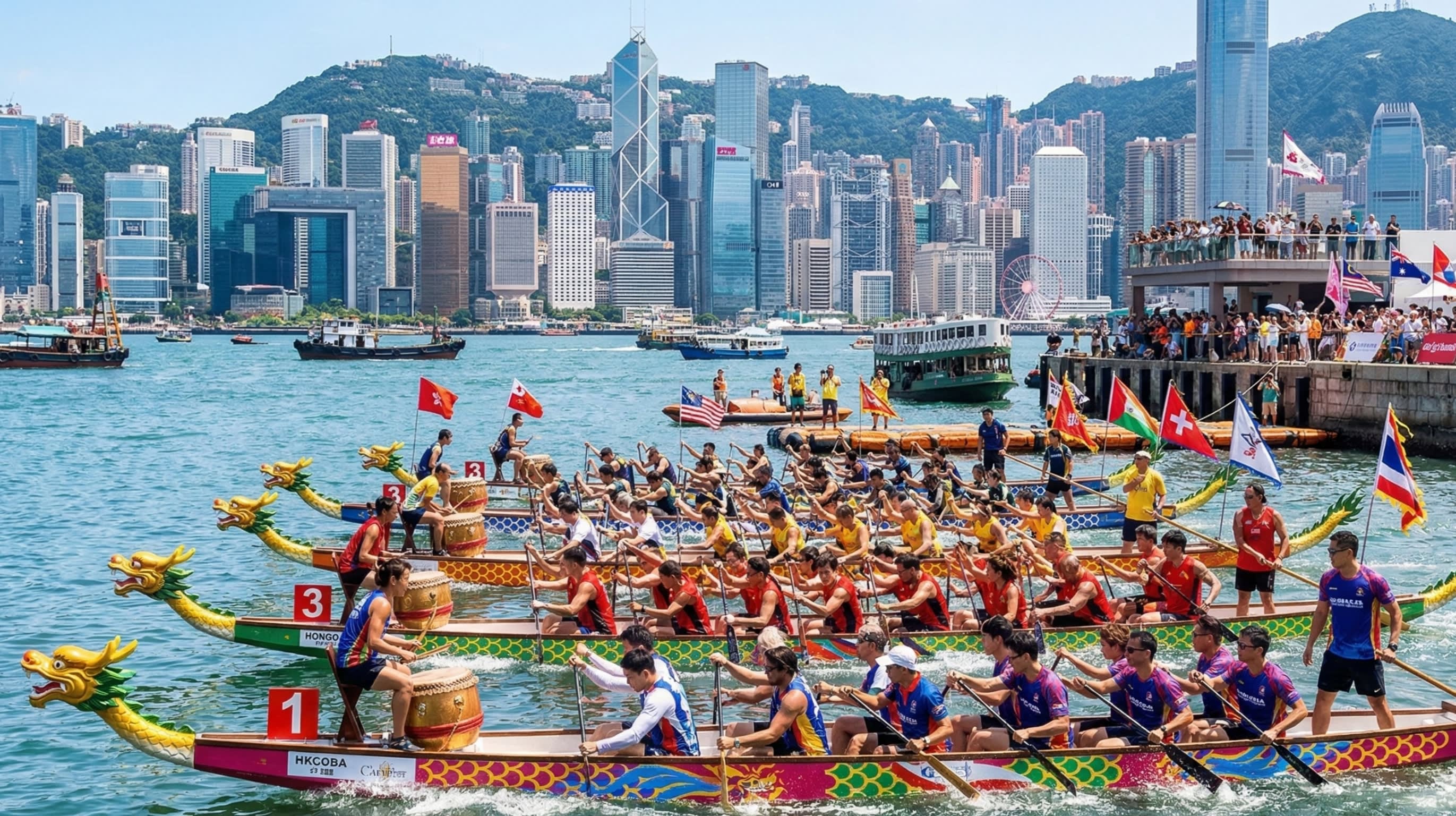
The Victoria Harbour Extravaganza
During the festival, Victoria Harbour transforms into a massive, multi-day carnival. You’ll see professional teams from Australia, Europe, and beyond competing alongside local corporate crews. It feels like an Olympic-level event mixed with a beach party. For a more relaxed experience, head to Stanley Main Beach, where the atmosphere is lighthearted, the costumes are bizarre, and the beer gardens are always bustling.
☔ 2026 Logistics: Surviving the “Plum Rain”
If you are heading to southern China in June, prepare for the Méiyǔ (梅雨)—the “Plum Rain” season. Named for the ripening of the plums, this season brings high humidity, heat (often over 32°C / 90°F), and sudden, heavy downpours.

- Hydration: Standing on a riverbank in high humidity is tiring. It is wise to pack an insulated water bottle to maintain hydration in the humidity.
- Footwear: Forget your best sneakers. You will be walking through mud and puddles. Opt for quick-drying athletic water shoes.
- Rain Gear: Large umbrellas are considered rude in dense crowds as they block the view. Bring a high-quality, compact raincoat and a brimmed hat instead.
💬 Essential Racing Vocabulary
Use these terms to blend in with the local crowd:
| The Term | Characters & Pinyin | Context |
|---|---|---|
| Add Oil! | 加油 (Jiāyóu) | The universal chant of encouragement. Shout this as the boats pass. |
| Dragon Boat Drifting | 龙舟漂移 (Lóngzhōu piāoyí) | The Foshan-specific extreme sport. |
| Rowing the Dragon Boat | 扒龙船 (Pá lóngchuán) | The authentic Southern term for racing. |
| Landlord | 包租公 (Bāozūgōng) | Slang for the wealthy Guangdong villagers who fund the teams. |
There are very few things in this world that possess the raw energy of a dragon boat race. When the drums echo off the water and the crowd’s roar vibrates in your chest, you realize that the festival is not just a holiday—it is the beating heart of the Chinese summer. Pick a riverbank, grab some Zongzi, and prepare for a spectacle you won’t soon forget.
㊗️ Wishing you an exhilarating and unforgettable Dragon Boat Festival!
Need help getting to these epic races? Read our comprehensive guide on Booking High-Speed Trains in China to secure your travel plans, or dive back into the mythology behind the festival in our Cultural Guide to Qu Yuan and Zongzi.
Disclaimer: As an Amazon Associate, ChinaCurator earns from qualifying purchases.