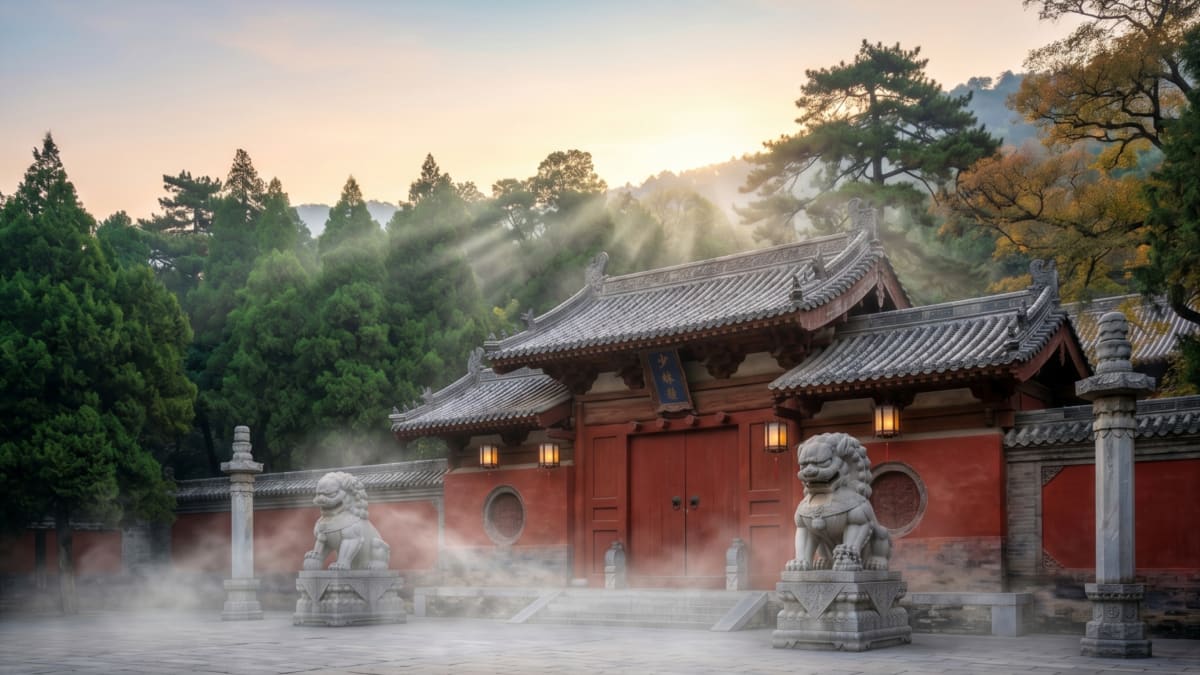

For over 1,500 years, the name Shaolin (少林 - shào lín) has echoed through history as the pinnacle of martial arts and the birthplace of Zen Buddhism. But for the modern traveler in 2026, the temple often feels like a paradox—a global icon caught between its ancient, contemplative soul and the inevitable rush of 21st-century tourism. I have walked these paths many times, and I can tell you: the “Real Shaolin” is never found at the ticket booth. It is found in the damp, quiet silence of the Pagoda Forest (塔林 - tǎ lín) at dawn, and in the burning sensation of your calves as you conquer the grueling, steep hike to the Dharma Cave (达摩洞 - dá mó dòng).
If you are planning your pilgrimage, you need more than a generic itinerary. You need a survival strategy.
Phase 1: Navigating the Digital Gate
In 2026, your Shaolin journey begins long before you set foot on Mount Song (嵩山 - sōng shān). The days of wandering up to a window to buy a paper ticket are gone.
- HSR Connectivity: The new Zhengzhou-Dengfeng Express is a game-changer, whisking you from the city hub to the temple’s doorstep in under 40 minutes.
- Smart Entry: You must book your Timeslot Entry (分时段预约 - fēn shí duàn yù yuē) at least 3-5 days in advance via the “Shaolin Scenic Area” WeChat mini-program.
- The International Hurdle: Do not get confused by the high-tech face scanners. Foreign passport holders should look for the Manual Check-in (人工通道 - rén gōng tōng dào) at the 5A gate. Keep your passport handy, as it is still the only document that registers your entry properly.
My Personal Advice: Do not be intimidated by the commercial noise at the base. The temple’s true yān huǒ qì (烟火气 - the “smoke and fire” of daily life) lives in the mountains, not the souvenir shops. If you only stick to the main paved road, you are merely a spectator. To be a traveler, you must walk toward the silence.
Phase 2: The Silent Guardians – The Pagoda Forest (塔林)

Just 300 meters west of the main monastery, the Pagoda Forest (塔林 - tǎ lín) stands as a somber, beautiful testament to generations of masters. With over 240 stone structures dating from the Tang to the Qing dynasties, it feels like a graveyard of history.
For those of us who appreciate the patience required in the art of Wenwan, these pagodas are a lesson in time. Each brick and carving was polished by centuries of wind and mountain rain. While you cannot enter the forest itself—the structures are far too fragile—the perimeter path offers the best vantage point for photography. If you want to capture the true depth of this place, try to arrive exactly when the temple gates open. The light hitting the weathered stone in the early morning creates a hòu zhòng gǎn (厚重感 - a sense of profound weight) that is impossible to replicate.
Phase 3: The Warrior’s Path – Kung Fu and The Cave

You cannot visit the home of Kung Fu (功夫 - gōng fu) without seeing the practitioners. While the official stage shows are acrobatic and impressive, the real magic happens in the smaller, hidden training yards tucked into the valley’s folds.
The Dharma Cave Hike (达摩洞)
If you want to understand the origin of Zen, you must earn it. The hike to the Dharma Cave (达摩洞 - dá mó dòng) is a steep, 45-minute ascent up Wuru Peak.

It is said that Bodhidharma meditated here for nine years, his silhouette supposedly burned into the stone wall. The path is fèi tuǐ (费腿 - “leg-taxing”), but the reward is unmatched. Standing at the top, feeling the mountain breeze whip against your face as you look down upon the sprawling temple complex, you realize why the masters chose this remote, cloud-shrouded peak for their meditation.
Phase 4: Where to Stay (And What to Eat)
To escape the “Day Trip” crowds, you must stay overnight. For a comfortable stay, look for a boutique hotel in Dengfeng City, or if you are looking for a true, deep-immersion experience, research local Zen Retreats.
For the trek up these slopes, make sure you have reliable, breathable hiking shoes, and always carry a reusable stainless steel water bottle to help preserve the sanctity of this UNESCO-protected landscape.
Shaolin Stay Comparison Matrix (2026)
| Stay Type | Vibe | Accessibility |
|---|---|---|
| Zen Retreat | Silent, minimalist, meditative. | Early morning access. |
| Dengfeng Boutique | Modern, comfortable, convenient. | Close to city dining. |
| Kung Fu Dorm | Spartan, disciplined, loud. | Martial arts focus. |
A Taste of Zen: Shaolin Su-zhai (素斋)

Food at Shaolin is about ‘Su-zhai’ (素斋 - vegetarian temple food). It is designed to be clean, simple, and devoid of the heavy pungent spices found in common takeout.
“Shaolin’s food is about yuán zhī yuán wèi (原汁原味 - the original flavor of the ingredients),” my guide told me. “We don’t mask the vegetables; we honor them.” If you find yourself in a local eatery, order the luó hàn zhāi (罗汉斋 - Arhat’s Feast). It is a humble combination of mushrooms, bean curd, and seasonal greens, but the earthy, umami richness is a meditative experience all its own.
Traveler’s Language Survival Table (Shaolin Edition)
| English | Chinese & Pinyin |
|---|---|
| Where is the Kung Fu show? | 武术表演在哪里? (Wǔ shù biǎo yǎn zài nǎ lǐ?) |
| I’d like a vegetarian meal. | 我想吃素斋。 (Wǒ xiǎng chī sù zhāi.) |
| How many steps to the cave? | 到达摩洞有多少台阶? (Dào dá mó dòng yǒu duō shǎo tái jiē?) |
| It's a very spiritual place. | 这里很有禅意。 (Zhè lǐ hěn yǒu chán yì.) |
Final Thoughts from the Road
Shaolin is a test—not just of your physical endurance, but of your patience. In 2026, the crowds can be dense, and the digital systems can be demanding. But if you take a breath, wake up for the early morning chants, and hike away from the neon lights, you will find that the spirit of the old masters is still alive in the mountain mist.
Before you go, ensure you have planned your itinerary well—perhaps even pairing this trip with a visit to the ancient temples of Shanxi to truly appreciate the breadth of China’s religious heritage. Remember: the Kung Fu you see on screen is just the surface. The real power of Shaolin is the deep, enduring silence that follows after the crowds have gone home.
Disclaimer: As an Amazon Associate, ChinaCurator earns from qualifying purchases.