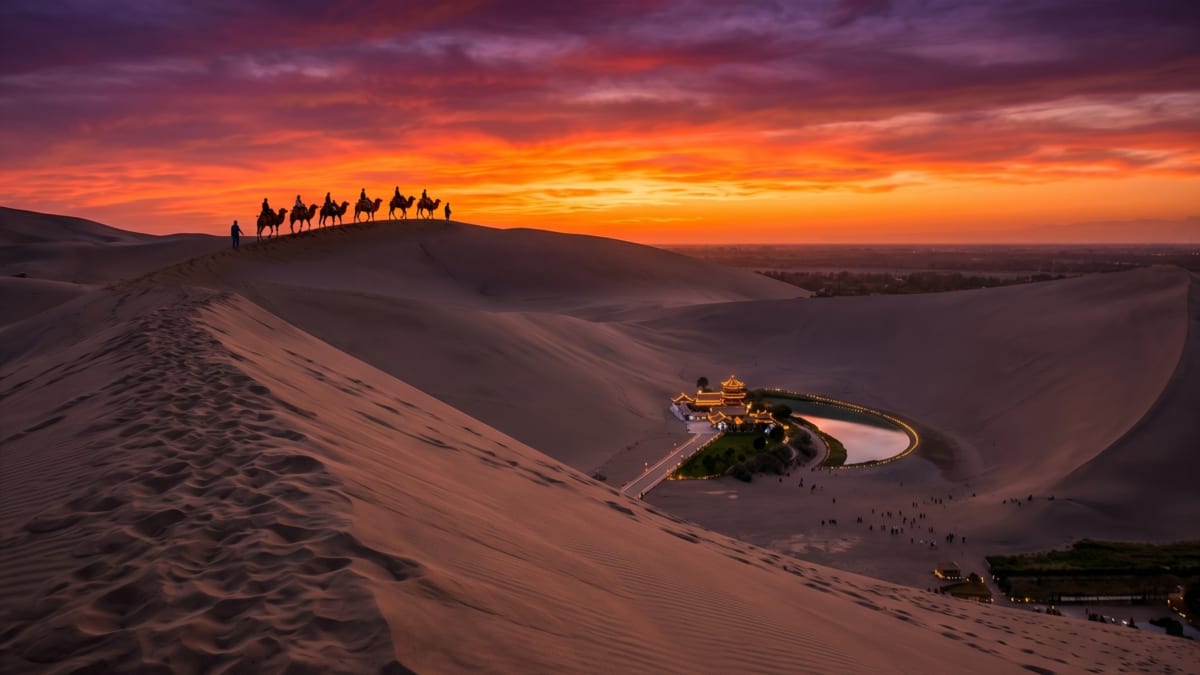

In the heart of the Gobi Desert (戈壁滩 - gē bì tān), the city of Dunhuang stands as a golden gateway to another era. For thousands of years, Silk Road traders arrived here with weary feet and parched throats. In 2026, we arrive with high-resolution cameras and travel apps, but the desert remains as vast, silent, and unforgiving as ever. Whether you are here to slide down 200-meter dunes or ride a camel into the shifting sunset, this is your curator-approved survival guide to navigating China’s ultimate desert playground.
Why 2026 is the Year for the Gobi
Dunhuang is no longer the remote, unreachable outpost it once was. With the expansion of the Gobi High-Speed Rail Loop, you can now zip from hubs like Lanzhou (兰州 - lán zhōu) or the ancient capital of Xi’an (西安 - xī ān) to Dunhuang in record time. However, don’t let the convenience of modern rail fool you—once you step onto the slopes of Mingshashan (鸣沙山 - míng shā shān), it is just you against the elements.
In 2026, the park implemented “Smart Oasis Management,” regulating visitor flow around the Crescent Moon Spring (月牙泉 - yuè yá quán). It is a necessary move to preserve the delicate ecology of this miracle pool. This change means a far more serene experience for you, provided you book your timeslots well in advance.
Phase 1: Gear Up – The “Anti-Sand” Protocol
The most common rookie mistake in the Gobi? Trusting your expensive fashion sneakers to survive the trek.
- The Booties: At the entrance of Mingshashan, you will see vendors offering neon-orange Sand Boots (鞋套 - xié tào). They look like something out of a space-age cartoon, and yes, they will absolutely clash with your “desert chic” travel photos. Wear them anyway. Without these covers, you will be shaking fine-grain sand out of your socks for the next three weeks of your trip.
- The Shield: The wind here is relentless and carries dust that settles everywhere. A Silk Scarf (丝巾 - sī jīn) or a high-quality neck buff is essential; it keeps your lungs clear and protects your skin from the abrasive, wind-blown sand.
- Local Insight: “别为了拍照好看就不穿鞋套,鸣沙山的沙子细到能钻进你每个毛孔。还有,墨镜和口罩是必须的,除非你想在吃午饭前先吃一肚子沙子。” (Don’t skip the sand boots just for photos; the sand at Mingshashan is fine enough to penetrate every pore. Sunglasses and a mask are mandatory unless you want a stomach full of sand before lunch.)
Phase 2: Camel Trekking – The Ship of the Desert

Riding a Camel (骆驼 - luò tuó) through the dunes is a classic “Bucket List” (人生清单 - rén shēng qīng dān) item. In 2026, the camel caravans at Dunhuang are highly organized, operating along dedicated “Camel Lanes” that keep the experience safe and rhythmic.
- The Mounting Ritual: When your camel begins to rise, the golden rule is to lean back, then shift forward. If you do it in reverse, you might find yourself performing an unintentional somersault into the soft dunes.
- The Sound of the Silk Road: There is something deeply hypnotic about the metallic clinking of camel bells in the vast, silent desert. It is the closest thing to historical time travel you will find in modern China.
- Local Insight: “骑骆驼一定要抓紧扶手,特别是它站起来和蹲下的时候。现在的骆驼队都有编号,像排队一样,很有秩序,但千万别在骆驼后面大声叫,容易惊着它们。” (Hold onto the handle tightly when the camel stands up or kneels down. The caravans are numbered and orderly, but never shout behind a camel—it’s easy to startle them.)
Phase 3: Sand Sliding – Adrenaline in the Dunes

If the camels represent the “slow-mo” aesthetic of Dunhuang, Sand Sliding (滑沙 - huá shā) is the “fast-forward” button.
- The Climb: To slide down, you must first earn your descent. In 2026, the park has installed structured Wooden Ladder Paths on the steepest dunes. While it is still a physical workout, it is no longer the “two steps forward, one step back” struggle of previous years.
- The Descent: You sit on a simple wooden board and gravity takes over. As the sand shifts under your weight, the mountain “sings”—a low, vibrating hum caused by the friction of thousands of grains, which is exactly why Mingshashan (Singing Sand Mountain) bears its name.
- Local Insight: “滑沙是年轻人的最爱。那个坡看着挺陡,其实很安全。滑下去的那一刻,你能听到沙子在‘唱歌’,那种‘耳鸣’的感觉非常神奇。” (Sand sliding is a favorite for the young. The slope looks steep, but it’s safe. At the moment you slide down, you can hear the sand ‘singing’; that ‘tinnitus’ feeling is quite magical.)
Phase 4: The Mirage – Crescent Moon Spring (月牙泉)

In the middle of the towering, dry dunes lies an impossible oasis. Crescent Moon Spring has survived for millennia, defying the surrounding shifting sands.
- The Sunset View: Do not simply stay by the water’s edge. Climb the ridge directly opposite the spring as the sun begins to dip. The interplay of long, jagged shadows against the teal water is the most photogenic moment in the region.
- Tech-Check: In 2026, you can use your phone to access an AR Historical Guide, allowing you to see how this spring looked during the height of the Tang Dynasty compared to its modern-day preservation efforts.
If you find yourself needing to capture these views, a stable tripod is invaluable for those long-exposure sunset shots of the dunes.
Desert Activity Comparison Matrix (2026)
| Activity | Adrenaline | Best Time | Sweat Factor |
|---|---|---|---|
| Camel Trek | Low (Relaxing) | Sunrise / Sunset | Low |
| Sand Sliding | High (Fast) | Late Afternoon | High |
| Crescent Lake Walk | Medium (Chill) | Morning | Medium |
The Desert Thirst-Quencher: Xingpishui (杏皮水)

After hours in the sun, you won’t want a soda; you will crave Xingpishui (杏皮水 - xìng pí shuǐ). This traditional Dunhuang beverage is crafted from sun-dried apricots, boiled slowly with rock sugar and dates.
- The Vibe: It is tart, sweet, and incredibly refreshing. In 2026, every street corner in Dunhuang city features vendors selling this “Liquid Gold.”
- Local Insight: “在敦煌不喝杏皮水,这趟算是白来了。一定要喝那种手工熬制的,冰镇一下简直是‘续命神药’ (xù mìng shén yào)。” (If you don’t drink Xingpishui in Dunhuang, the trip is wasted. You must drink the handmade ones; when iced, it’s a literal ‘life-saving medicine.’)
Traveler’s Language Survival Table (Desert Edition)
| English | Chinese & Pinyin |
|---|---|
| How much for the camel ride? | 骑骆驼多少钱? (Qí luò tuó duō shǎo qián?) |
| I’d like a glass of iced apricot tea. | 我想喝冰镇杏皮水。 (Wǒ xiǎng hē bīng zhèn xìng pí shuǐ.) |
| The desert is incredible. | 大漠太震撼了。 (Dà mò tài zhèn hàn le.) |
Final Thoughts
Dunhuang is a land of extremes—extremely hot, visually stunning, and perpetually dusty. But when you stand on top of a 200-meter dune, looking down at an ancient, living oasis as the sun sets over the historic Silk Road, you realize that every grain of sand in your shoes was worth it.
My advice? Embrace the grit. Don’t be afraid to get a little sandy, and definitely don’t leave without drinking your weight in apricot tea. The Gobi is waiting. If you’re looking for more unique landscapes, check out my guide on visiting China’s high-altitude parks or explore the cultural heritage sites of the region.
Disclaimer: As an Amazon Associate, ChinaCurator earns from qualifying purchases.