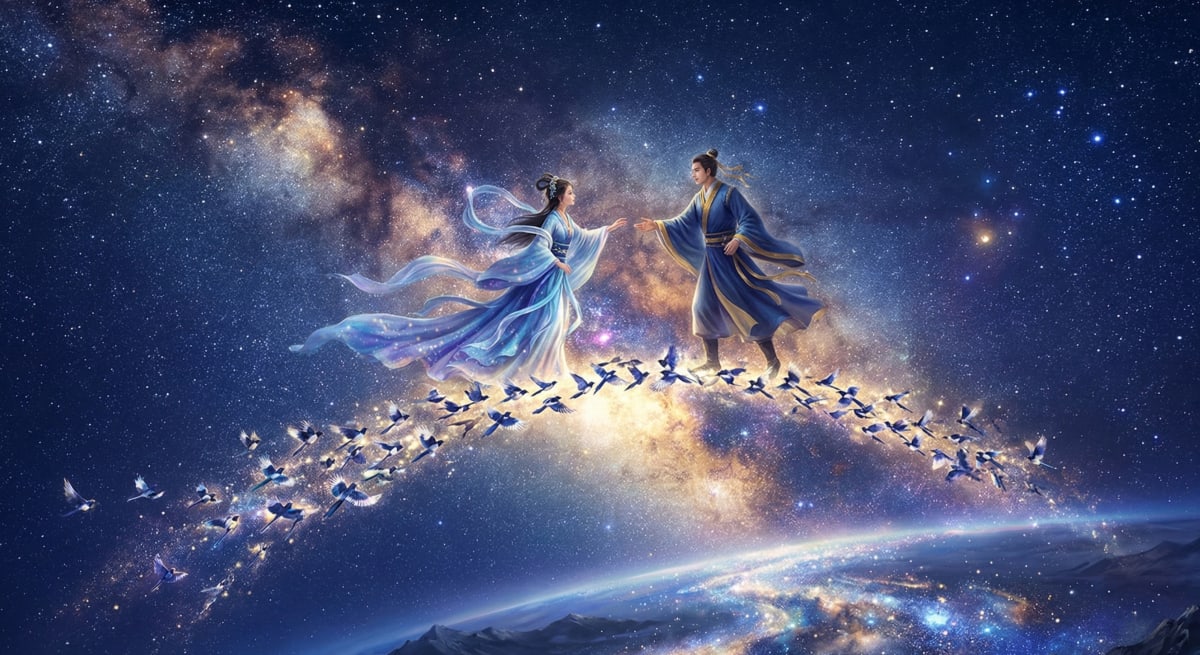
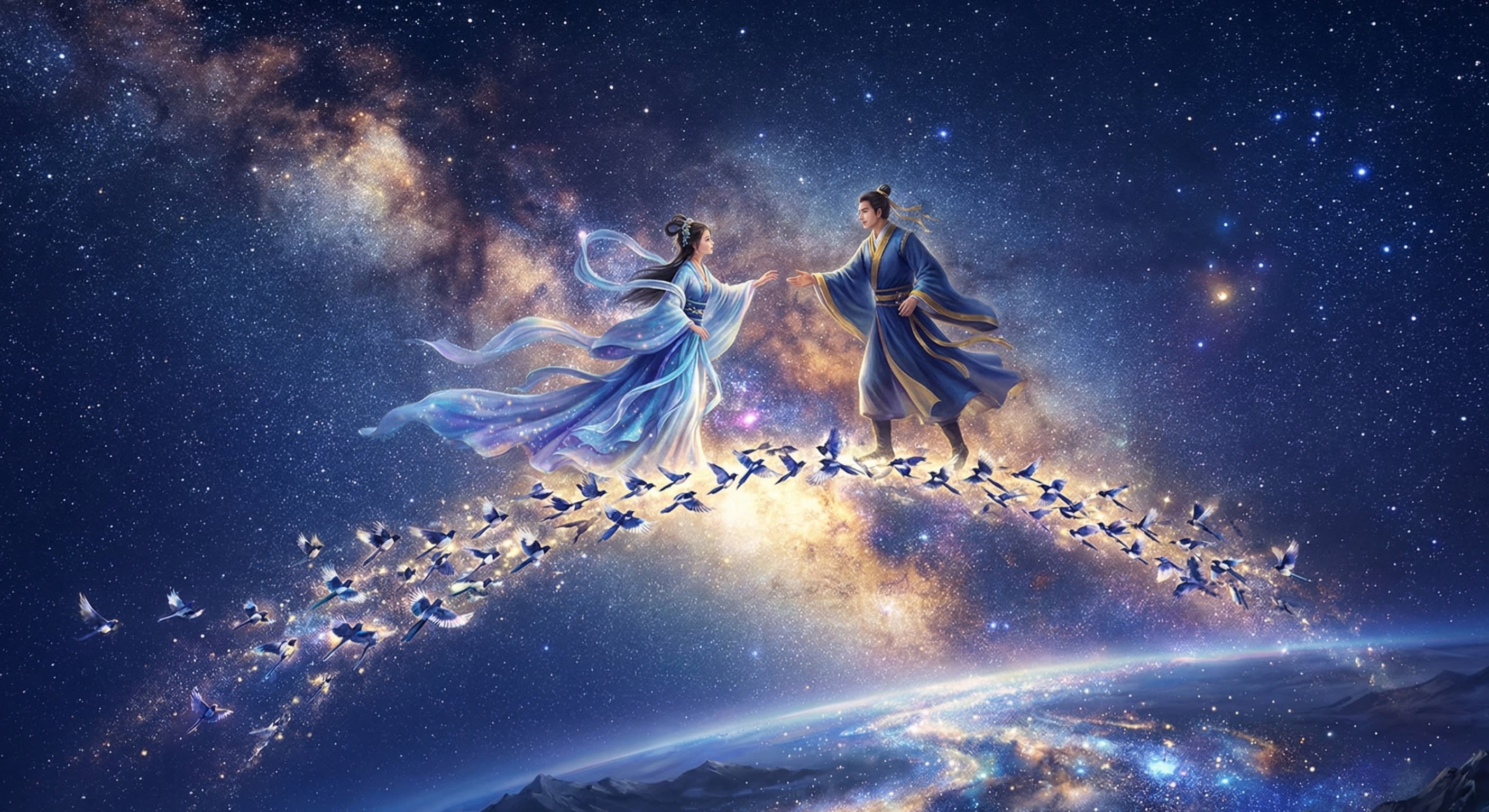
“If you look up at the night sky in late August, far away from the city lights, you will see the silver river of the Milky Way stretching across the heavens. For thousands of years, Chinese stargazers have looked at two specific bright stars on opposite banks of that river and told a story of a love so powerful that it moved the animal kingdom to tears. This is the Qīxī Jié (七夕节)—the Festival of the Seventh Night. Often called ‘China’s Valentine’s Day,’ Qixi is far more than just flowers and chocolates; it is a celebration of craftsmanship, a ritual of celestial timing, and a reminder that even the vastness of the universe cannot permanently separate two souls meant for each other.”
✨ 1. The Cosmic Tragedy: The Cowherd and the Weaver Girl
The heart of Qixi lies in one of the ‘Four Great Folk Legends’ of China: the story of Niúláng (牛郎—the Cowherd) and Zhīnv (织女—the Weaver Girl).
I recall sitting on a rooftop in a small village in Anhui years ago, listening to an elderly neighbor point toward the sky. As she traced the faint glimmer of the Milky Way, she told me of Zhinv, the daughter of the Celestial Empress, a goddess who wove the multi-colored clouds of sunset. Bored with the rigidity of the heavens, she descended to Earth, where she found love with Niulang, a humble, hardworking mortal. Their life was simple and filled with the warmth of a small family, until the Empress—furious at this earthly union—snatched Zhinv back to the stars.
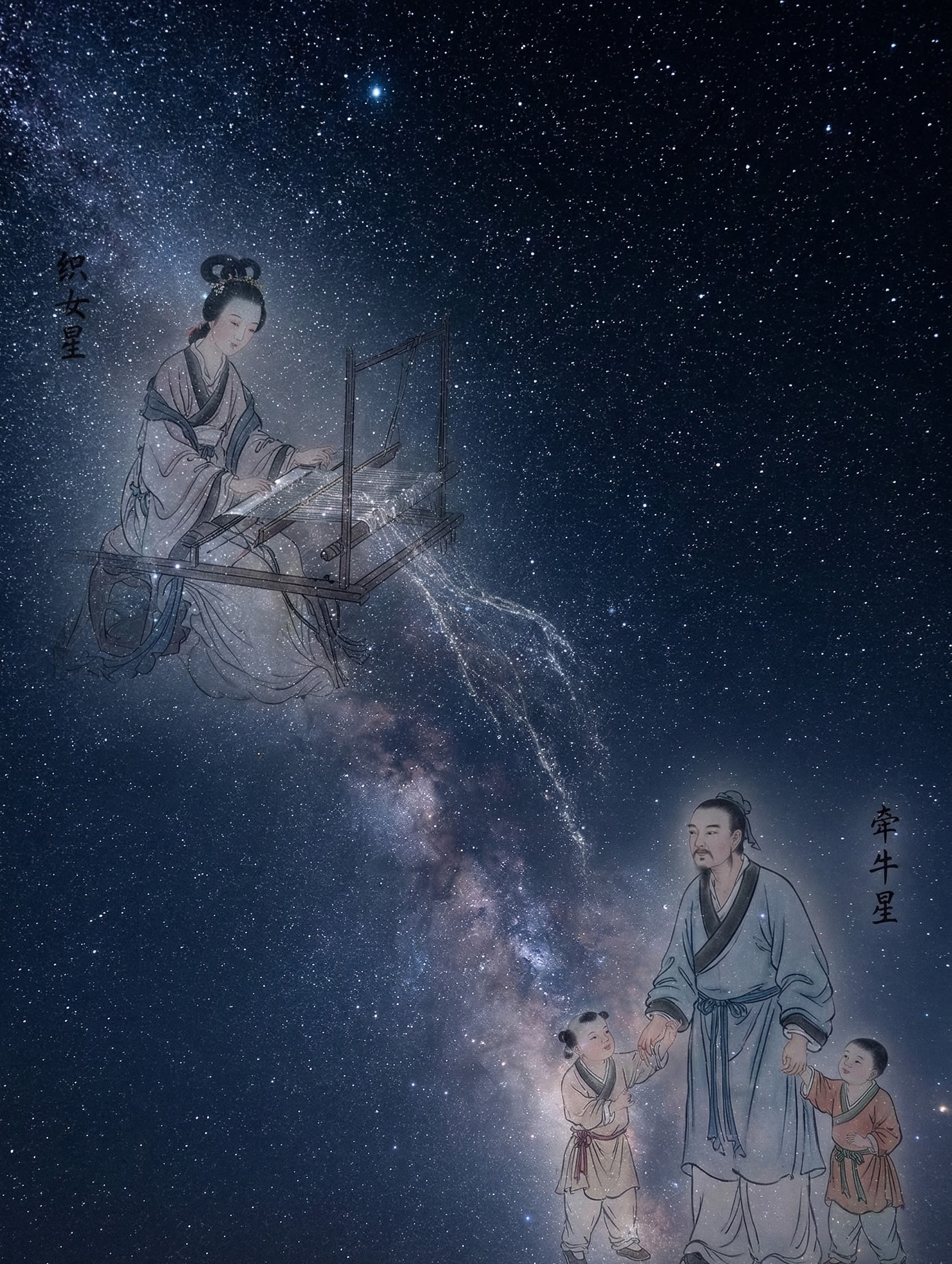
Niulang chased her into the sky, his two children in tow, only to be stopped by a river of light scratched into existence by the Empress’s golden hairpin: the Yínhé (银河), or the Milky Way. Moved by their eternal longing, the magpies of the world—birds that hold a special place in folklore as messengers—flew up to heaven to form the Quèqiáo (鹊桥—the Magpie Bridge), allowing the lovers one night of reunion each year. When I gaze at Vega and Altair now, I no longer see just cold celestial bodies; I see a story of persistence that transcends the mortal coil.
🪡 2. The Ritual of “Qǐqiǎo” (乞巧): Begging for Skill
While modern Qixi is draped in romantic tropes, it was historically the Qǐqiǎo Jié (乞巧节), the ‘Festival to Beg for Skills.’ In the quiet courtyards of dynastic China, this was a day for women to honor Zhinv, the goddess of needlework.
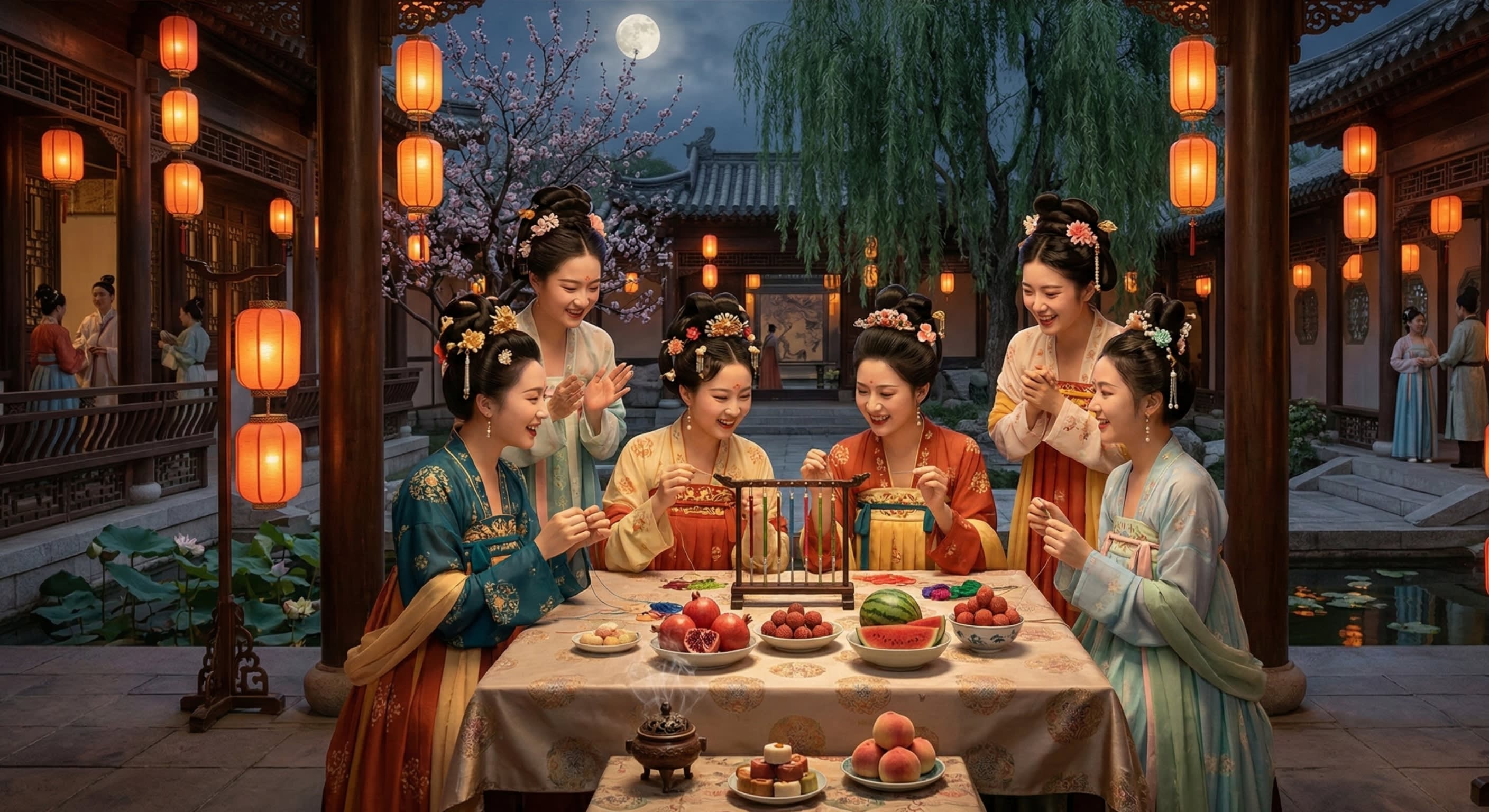
The Competition of the Needle
I remember once attempting the traditional needle-threading ritual during a festival workshop. Trying to thread a needle by the flickering light of a candle in the humid night air was an exercise in extreme patience; my hands shook, and the thread seemed to dance away from the eye of the needle. For ancient women, success here was a prayer for dexterity, a trait vital for the intricate embroidery that defined their artistry. It was not merely about romance; it was about the cultivation of one’s own capabilities.
🍪 3. The Taste of Qixi: Qiǎoguǒ (巧果)
No Qixi is complete without Qiǎoguǒ (巧果)—’Skill Fruit.’ These are not fruits, but deep-fried, honey-dusted pastries.
I still remember the first time I bit into a freshly fried Qiaoguo; the crunch of the sugar-dusted pastry reminded me of my grandmother’s kitchen, where oil hissed and popped in the wok, releasing a scent of caramelized sugar and toasted flour. You can achieve this traditional texture at home if you have a reliable heavy-duty spider strainer to pull the golden treats from the oil at the perfect moment of crispness.
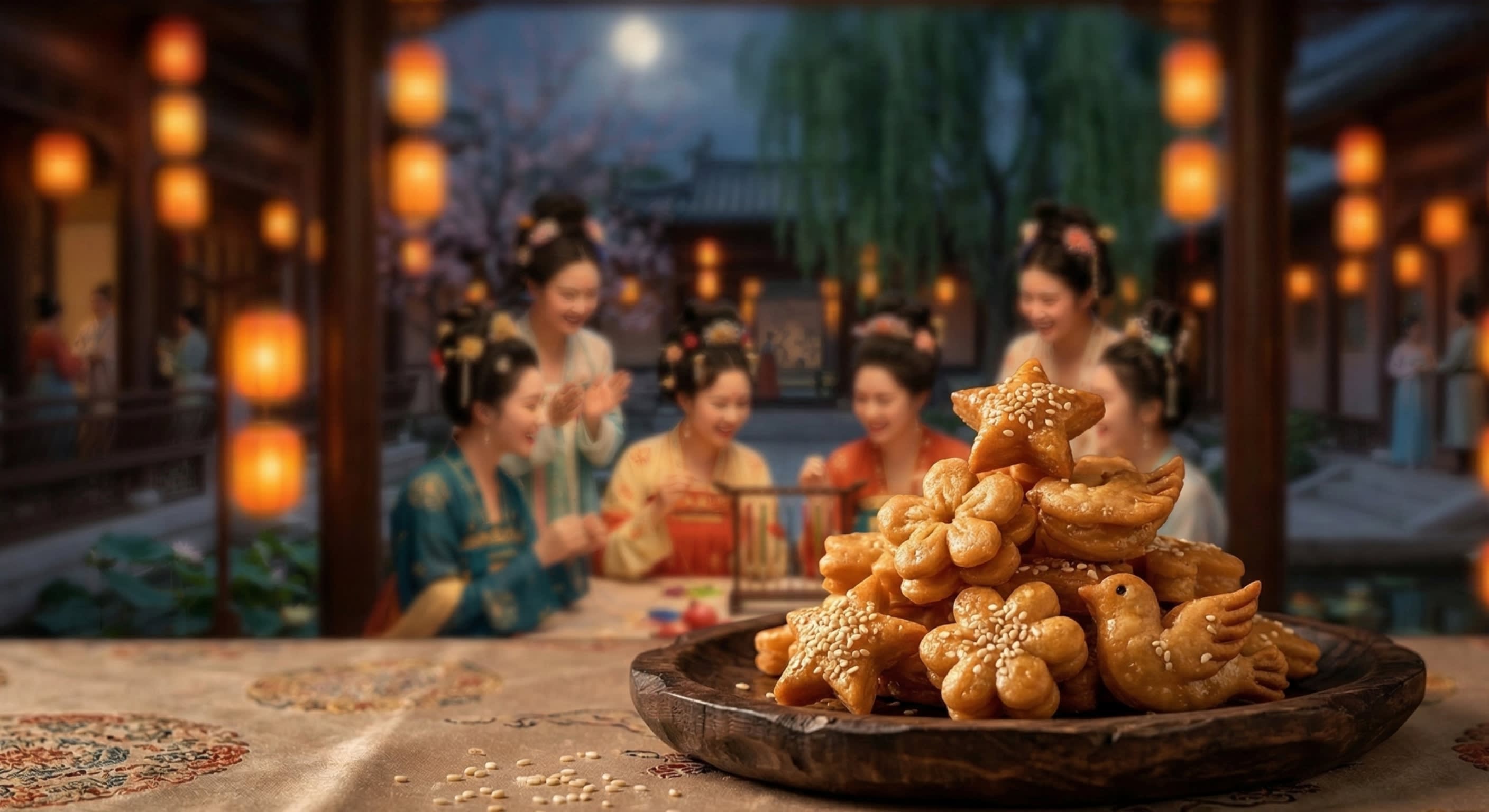
The dough is pressed into molds shaped like magpies or flowers, representing a wish for qiǎo (巧), or cleverness. It is a humble treat that carries the weight of a thousand-year-old tradition.
🏮 4. The “Chinese Valentine’s Day”: Ancient vs. Modern
If you visit China during Qixi today, the scene is a whirlwind of roses and jewelry advertisements. But this ‘Valentine’s Day’ framing is a modern layer over an ancient soul. For a deeper perspective on how these traditions compare to other festivities, you might enjoy reading about the Lantern Festival, which historically served as a more public stage for courtship.
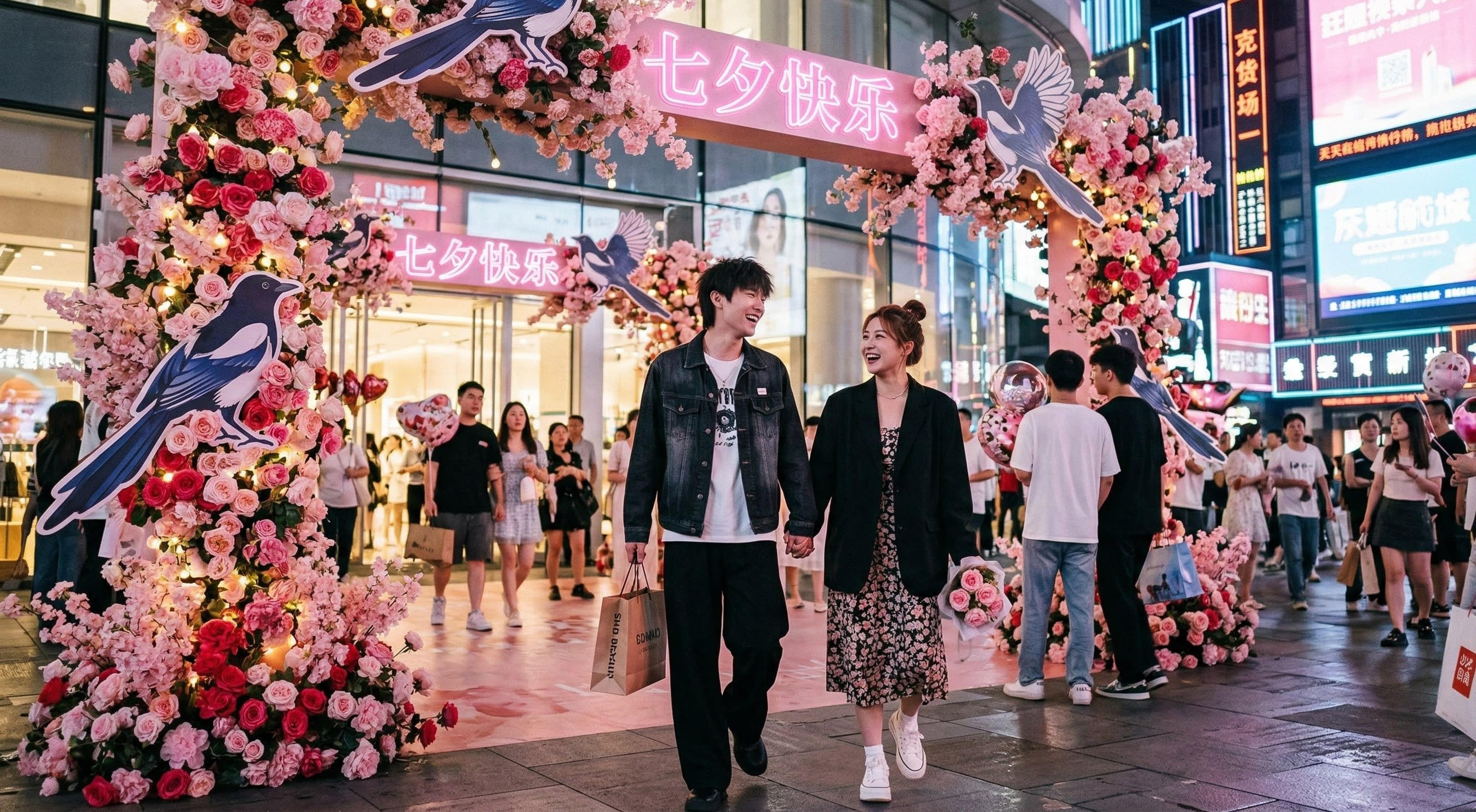
The legend of Niulang and Zhinv survives because it is the ultimate symbol of Zhēn’ài (真爱—True Love). It isn’t just about the date night; it is about the devotion required to endure separation. As I walk through the bustling streets during Qixi, I find it fascinating how a myth born of stars and tears has managed to anchor itself so firmly in our modern, fast-paced world.
💬 5. Essential Qixi Vocabulary
| The Term | Characters & Pinyin | Context |
|---|---|---|
| Happy Qixi | 七夕快乐 Qīxī kuàilè |
The standard festive greeting. |
| Magpie Bridge | 鹊桥 Quèqiáo |
A symbol of connection across distance. |
| To Beg for Skill | 乞巧 Qǐqiǎo |
Focuses on personal growth and arts. |
Final Thoughts from Zihan
There is a local superstition that if it rains on the night of Qixi, the droplets are the tears of the lovers as they part once more. I’ve spent many a Qixi night listening to the rain, wondering if those ancient stars still feel the distance as keenly as the poets claim. Whether or not you are celebrating with someone special, Qixi is a day to reflect on the beauty of longing. It reminds us that distance is merely a detail when the connection is profound.
㊗️ Wishing you a romantic Qixi and a love that stands the test of time!
Inspired by the ancient romance of China? Discover the other major festivals in our Ultimate 2026 Travel Guide or explore the agricultural wisdom behind the 24 Solar Terms.
Disclaimer: As an Amazon Associate, ChinaCurator earns from qualifying purchases.