

Learning to count from 1 to 10 in Mandarin Chinese takes about five minutes. It is famously logical. Eleven is just “ten-one” (十一 - shíyī). Twenty is just “two-tens” (二十 - èrshí).
Armed with this basic knowledge, you feel invincible. Then, you move to China and try to sign a lease for an apartment, negotiate a salary, or read a financial report. Suddenly, someone tells you the price is “one hundred ten-thousands,” and your brain completely short-circuits.
The truth is, while the foundation of Chinese numbers is incredibly simple, the way Chinese people group large numbers, fractions, and sequences is fundamentally different from the Western world. If you try to directly translate English numerical concepts into Chinese, you will freeze in the middle of a sentence.
To reach true fluency, you need to rewire your brain to think in “blocks of four” instead of “blocks of three.” Here is the ultimate, foolproof guide to mastering the Chinese number system, from big money to percentages and phone numbers.
1. The “Block of Four” Paradigm: The 万 (Wàn) Trap
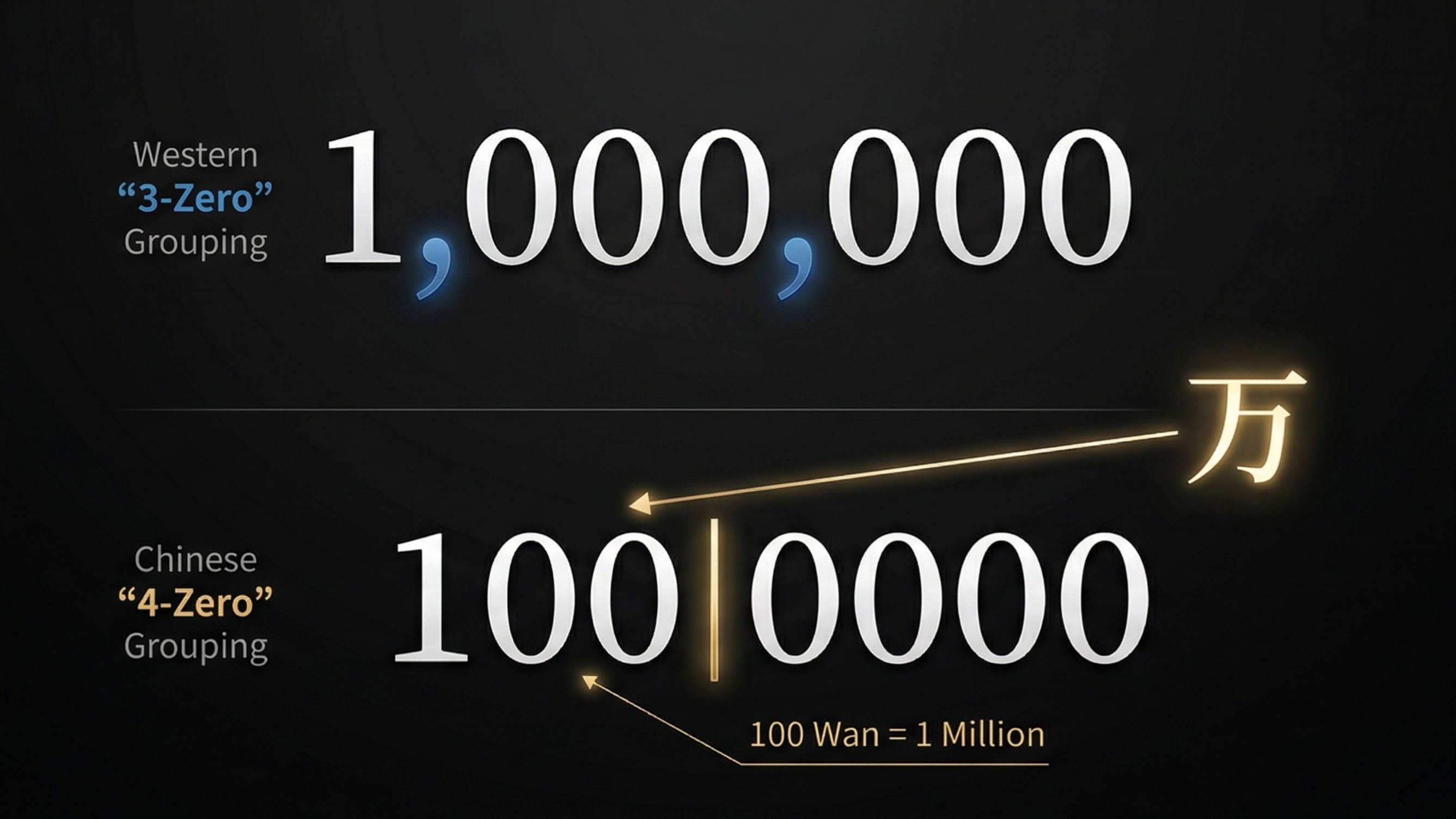
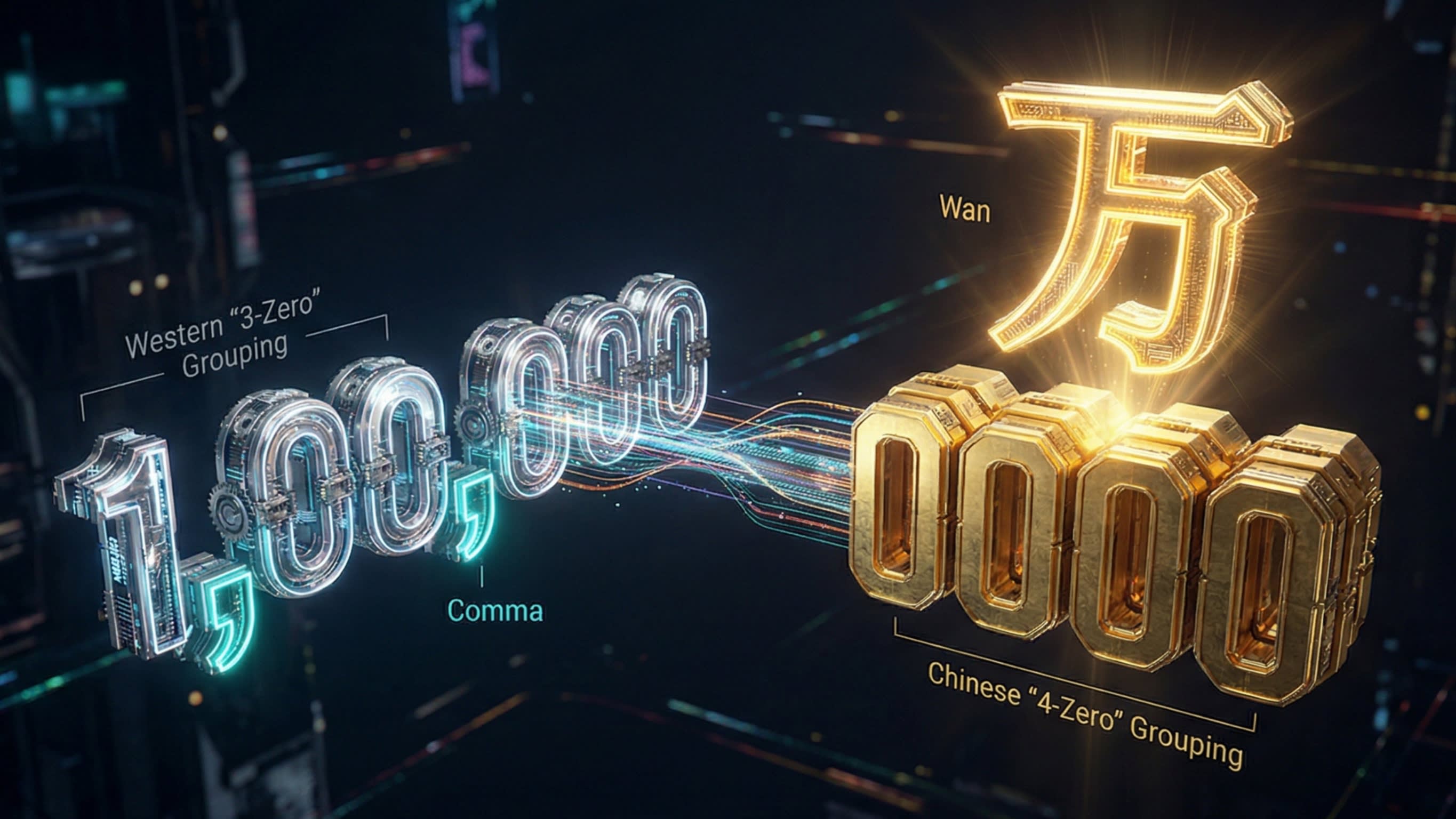
In English, we group large numbers by thousands (three zeros). We have thousands, millions (thousands of thousands), and billions. We even write our numbers with commas every three digits: 1,000,000.
Chinese, however, groups large numbers by myriads, or ten-thousands (four zeros).
The core unit you must master is 万 (wàn - 10,000). Instead of thinking in thousands, you must train your brain to ask: “How many Wans is this?”
Let’s break down the translation matrix that trips up every single expat:
- 10,000: In English, “Ten thousand.” In Chinese, it is its own base unit: 一万 (yí wàn).
- 100,000 (One Hundred Thousand): Chinese doesn’t have a word for “a hundred thousand.” Instead, it is 10 groups of 10,000. So, it becomes 十万 (shí wàn).
- 1,000,000 (One Million): This is the ultimate trap. One million is 100 groups of 10,000. Therefore, one million is 一百万 (yì bǎi wàn).
- 10,000,000 (Ten Million): 1,000 groups of 10,000. 一千万 (yì qiān wàn).
The Next Level: 亿 (Yì)
Once you hit 100 million (100,000,000 - eight zeros), Chinese introduces the next major unit: 亿 (yì).
- 100 Million = 一亿 (yí yì).
- 1 Billion = 十亿 (shí yì). (Ten groups of 100 million).
The Survival Hack: When looking at a large printed number like 1,500,000, ignore the Western commas. Count four zeros from the right and draw an imaginary line: 150 | 0000. Everything to the left of the line is your Wàn. So, 150 Wàn = 一百五十万 (yì bǎi wǔ shí wàn).
2. The Rules of Zero (零 - Líng)
What happens when there are zeros in the middle of a number? In English, for the number 101, we might say “One hundred and one.” In Chinese, the zero must be explicitly spoken.
Rule 1: Always pronounce the middle zero.
- 101: 一百零一 (yì bǎi líng yī) - One hundred zero one.
- 1,005: 一千零五 (yì qiān líng wǔ) - One thousand zero five.
Rule 2: Multiple consecutive zeros shrink to one. If you have a number like 1,001, you do not say “zero zero.” You only say the word 零 (líng) once to indicate that there is a gap.
- 1,001: 一千零一 (yì qiān líng yī).
- 10,005: 一万零五 (yí wàn líng wǔ).
Rule 3: Zeros at the end are silent. If a number ends in zero, you just state the highest unit and stop.
- 250: 二百五 (èr bǎi wǔ) - Literally “Two hundred five [tens]”. (Note: As we learned in our previous guide, ‘Er bai wu’ is also a slang term for an idiot, so be careful!)
- 3,500: 三千五 (sān qiān wǔ) - Three thousand five [hundred].
3. Backward Math: Fractions and Percentages
If you work in business, or even just like shopping for discounts, you must understand how Chinese structures math. Warning: It is exactly backward from English.
Percentages (%)
In English, we say “Fifty percent.” In Chinese, you read the percentage sign first, stating “Out of one hundred parts,” and then you say the number.
- Format: 百分之 X (Bǎi fēn zhī X) -> “Hundred parts’ X”
- 50%: 百分之五十 (bǎi fēn zhī wǔ shí).
- 100%: 百分之百 (bǎi fēn zhī bǎi).
Fractions
Fractions follow the exact same “bottom-up” logic. You read the denominator (the bottom number) first, followed by 分之 (fēn zhī), and then the numerator (the top number).
- 1/3 (One third): 三分之一 (sān fēn zhī yī) -> Out of three parts, one.
- 3/4 (Three quarters): 四分之三 (sì fēn zhī sān) -> Out of four parts, three.
Cultural Note: When negotiating discounts, China uses the 打折 (dǎ zhé) system, which focuses on what you pay, not what you save. “打八折” (dǎ bā zhé - hit 8 discount) means you pay 80% of the price—which is a 20% discount in the West!
4. The “Yao” (幺) Secret for Phone Numbers
If you ask a local Chinese friend for their phone number, you might hear a word that isn’t in your textbook.
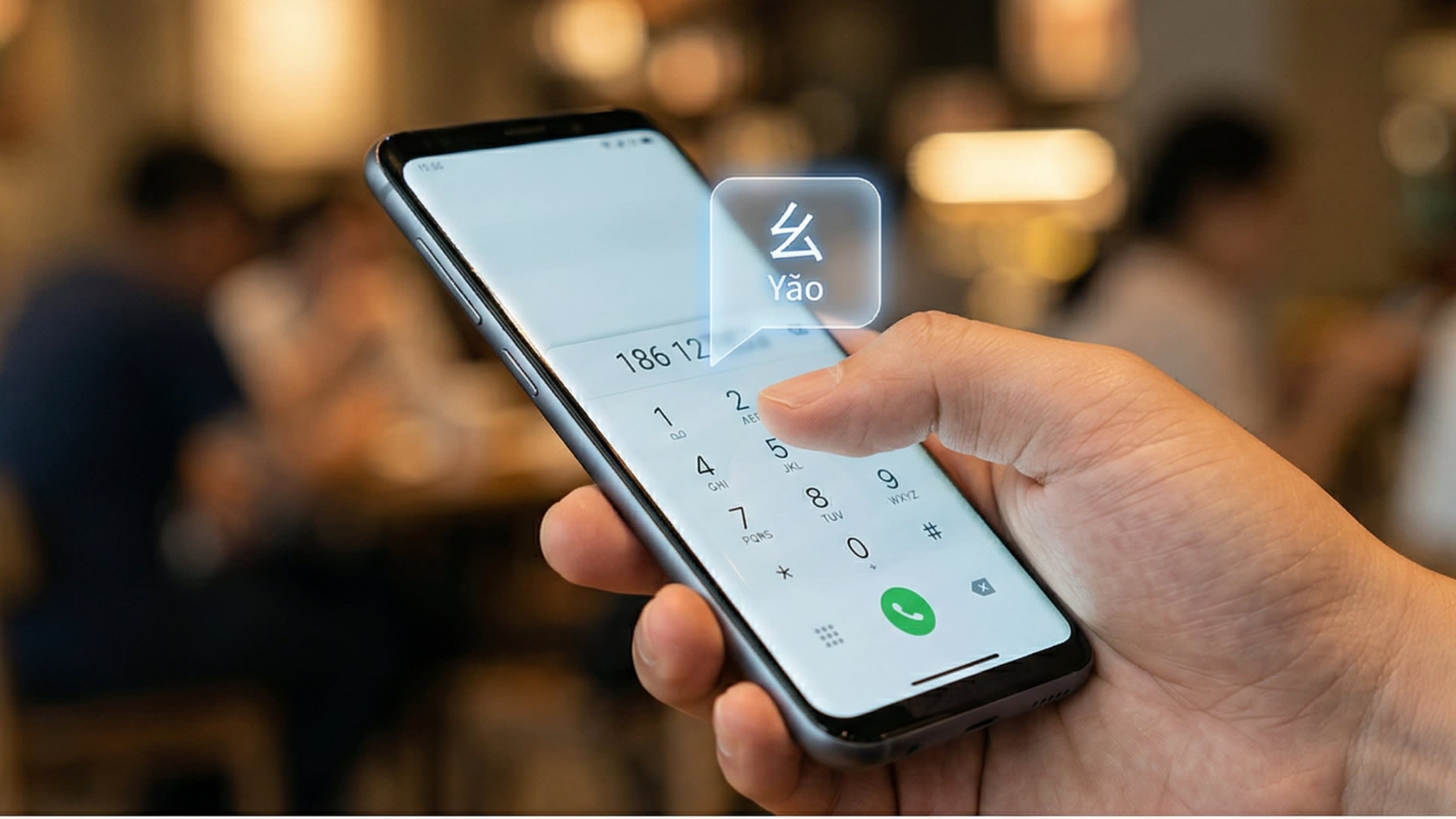
Chinese phone numbers are long (11 digits, usually starting with 1). When reading a string of numbers like a phone number, room number, or passport number, the number 1 (一 - yī) sounds too similar to the number 7 (七 - qī) over a bad phone connection.
To prevent miscommunication, the number 1 is pronounced as 幺 (yāo) in sequences.
- Phone Number (138…): Instead of saying yī sān bā, a native speaker will say yāo sān bā (幺三八).
- Room 101: You can say 幺零幺 (yāo líng yāo).
- Emergency Police (110): 幺幺零 (yāo yāo líng).
If you read your phone number to a delivery driver using “Yao” instead of “Yi,” their respect for your Chinese skills will instantly skyrocket.
5. A Quick Refresher: The Number Two (二 vs 两)
We cannot talk about Chinese numbers without reminding you of the most famous trap: The dual nature of the number two.
- 二 (èr): Used for pure math, counting, and sequences (Room 202, 2nd floor, the year 2026).
- 两 (liǎng): Used for quantities when attached to a measure word (Two people - liǎng ge rén, Two cups - liǎng bēi).
(If you still struggle with this, check out our Ultimate Er vs Liang Grammar Guide!)
The Big Number Cheat Sheet
| English Number | Chinese Logic | Chinese Characters | Pinyin |
|---|---|---|---|
| 10,000 | 1 Wan | 一万 | yí wàn |
| 100,000 | 10 Wans | 十万 | shí wàn |
| 1,000,000 | 100 Wans | 一百万 | yì bǎi wàn |
| 10,000,000 | 1,000 Wans | 一千万 | yì qiān wàn |
| 100,000,000 | 1 Yi | 一亿 | yí yì |
Final Thoughts from Jie
The hardest part about Chinese numbers isn’t learning the vocabulary; it is unlearning the mental habits you have used your entire life.
When you hear a large number in Mandarin, your instinct will be to immediately translate it into English thousands and millions before you can understand it. You must fight this urge! If someone says “Sān wàn” (Three wans), don’t try to calculate that it means 30,000. Just envision the amount of “Wan.” Treat “Wan” as its own independent currency in your mind.
With a little practice, your brain will adapt to the four-zero system, and you’ll be negotiating contracts and reading financial reports with the speed of a true native!
Want to master more pronunciation secrets? Check out our guide on The Shape-Shifting Tone Changes of ‘Yi’ (一) or discover Why Chinese People Drink Hot Water.

