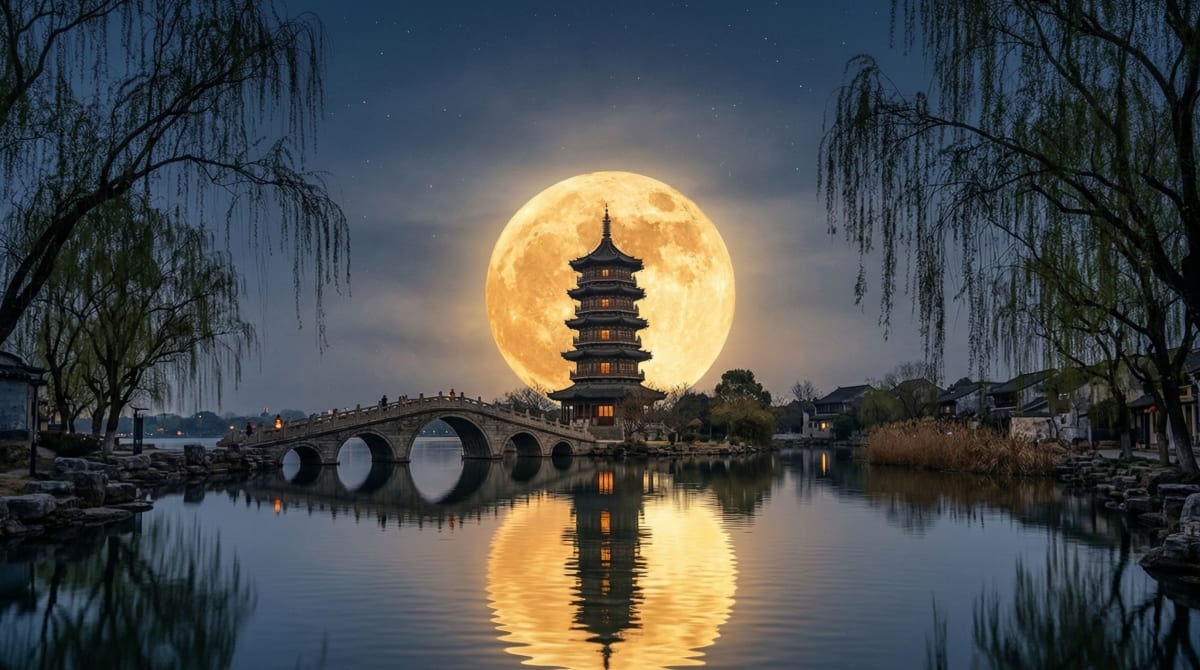
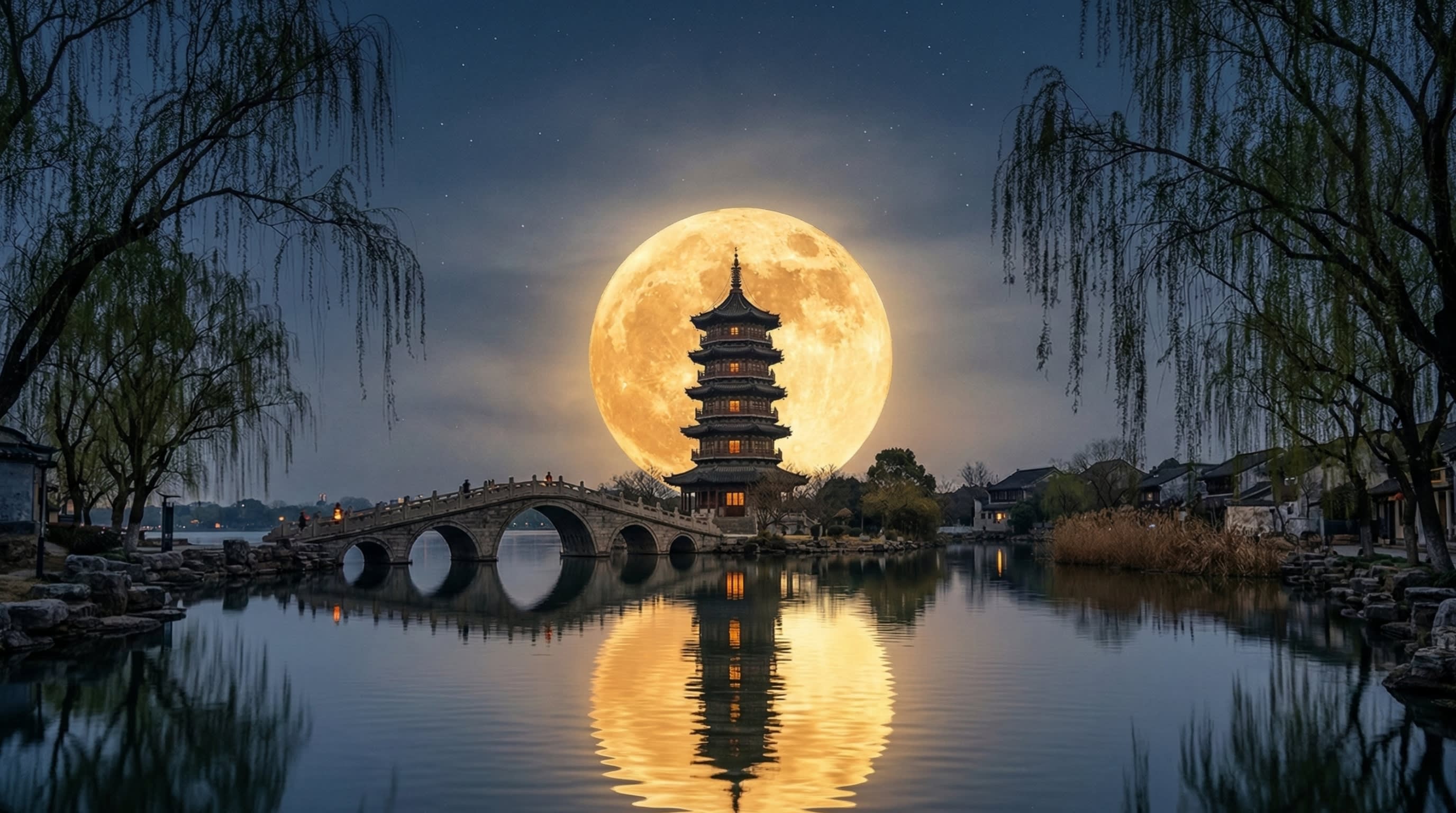
“There is a specific feeling that every Chinese person knows. It happens on a crisp evening in late September or early October, when the humidity of summer has finally broken. You look up at a sky so clear it looks like black velvet, and there is the moon—bigger, brighter, and more perfectly round than at any other time of the year. In Chinese culture, this isn’t just an astronomical event. It is the Zhōngqiū Jié (中秋节)—the Mid-Autumn Festival. It is a night when the entire nation stops to look at the same silver disc and feels a powerful, ancient pull toward home. While the world knows it for the mooncakes, the true soul of the holiday is a single, beautiful word: Tuányuán (团圆)—Unity.”
🌙 1. The Lady in the Moon: The Legend of Chang’e
Every Chinese child grows up looking at the shadows on the moon and seeing not a “man,” but a goddess and her rabbit. The origin of the Mid-Autumn Festival is inseparable from the story of Cháng’é (嫦娥) and her husband, the heroic archer Hòu Yì (后羿).
Legend has it that long ago, ten suns appeared in the sky, scorching the earth and bringing misery to the people. Hou Yi, a master archer, climbed to the top of Mount Kunlun, shot down nine of the suns, and left one to provide light and warmth. As a reward, the Queen Mother of the West gave him an elixir of immortality. However, Hou Yi didn’t want to become a god if it meant leaving his beautiful wife, Chang’e, behind. He asked her to hide the elixir.
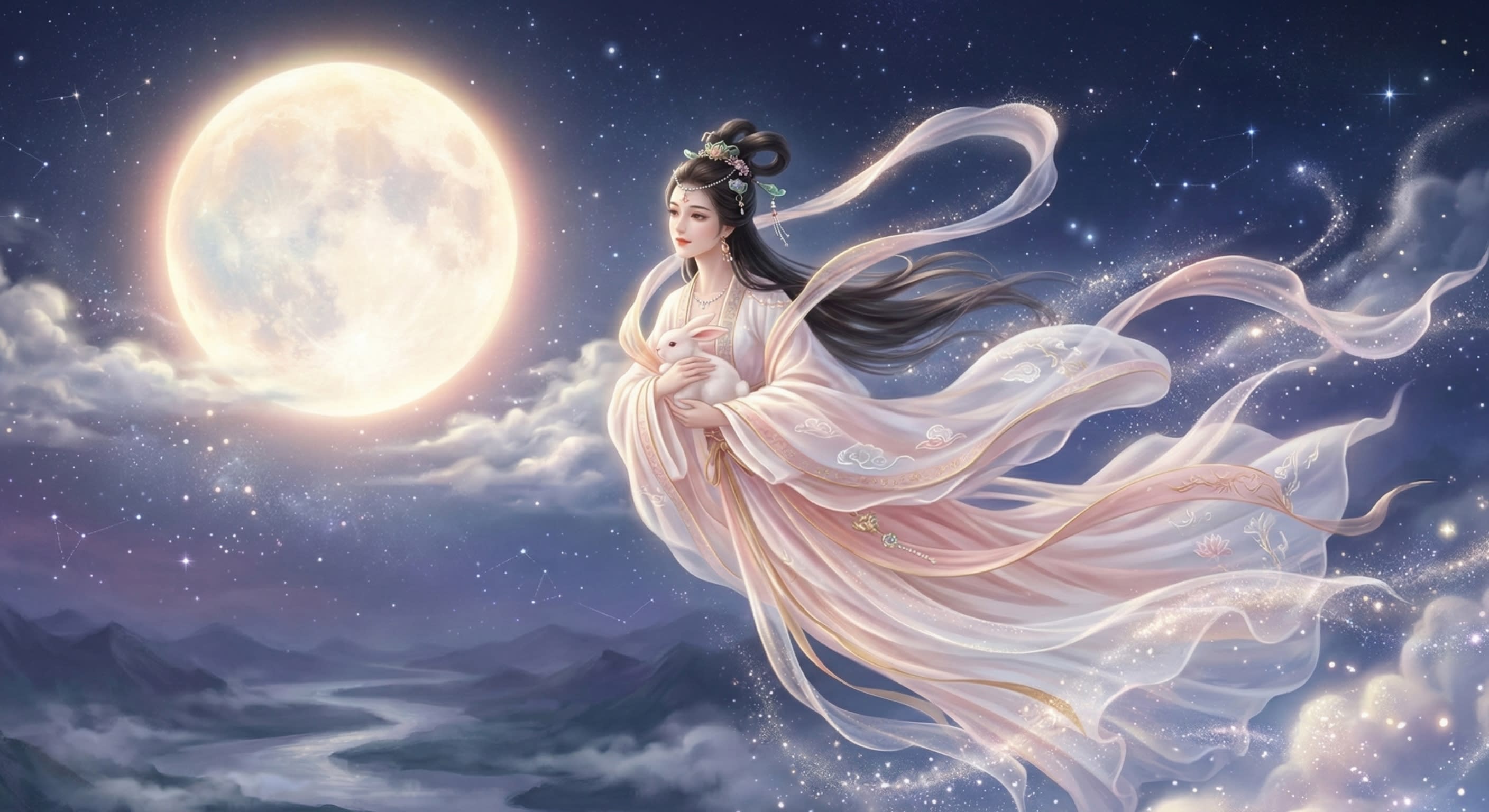
One day, while Hou Yi was out hunting, a wicked apprentice tried to steal the elixir. To prevent him from taking it, Chang’e drank it herself. Suddenly, her body became light, and she began to float out of the window and toward the heavens. Because she loved her husband so much, she chose to land on the moon, the closest place in the sky to Earth.
When Hou Yi returned and saw his wife on the moon, he was heartbroken. He set up a table in their garden with her favorite fruits and cakes to show he was still with her. The neighbors, moved by their love, joined him in offering sacrifices to the moon. This is why, even today, we call the holiday the “Moon Festival.”
🥮 2. Mooncakes: From Secret Messages to Culinary Art
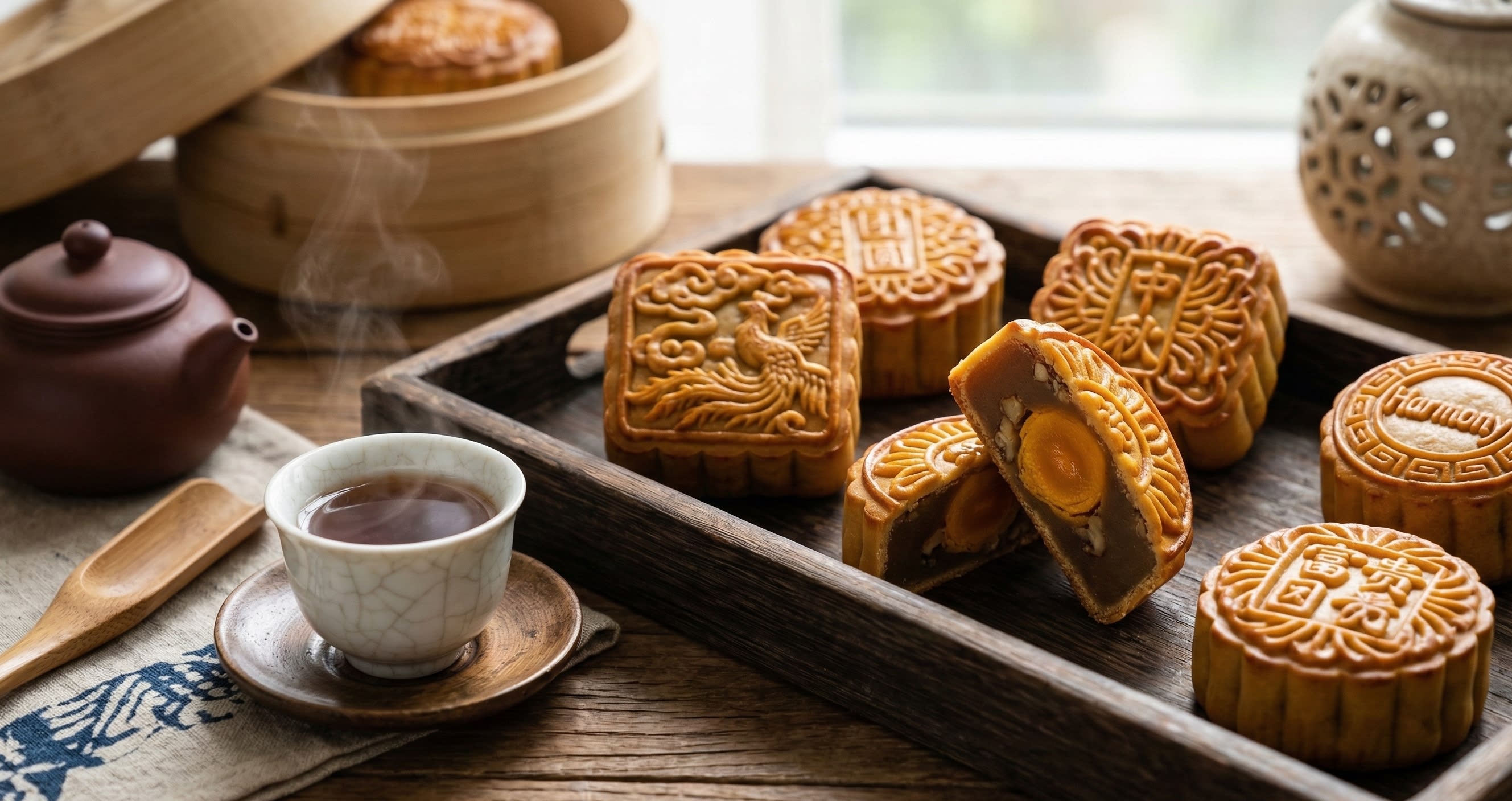
If you are in China during this season, you cannot escape the Yuèbǐng (月饼)—the Mooncake. These dense, circular pastries are the ultimate symbol of the holiday. Their round shape mimics the full moon and represents the completeness of the family.
The Legend of the Rebellion
While mooncakes are a treat today, they were once a tool of war. According to popular folk history, during the Yuan Dynasty, China was ruled by the Mongols. The Han people planned a secret uprising but had no way to coordinate the date without being caught.
The rebel leader, Liu Bowen, came up with a brilliant plan. He spread a rumor that a deadly plague was coming and that eating special mooncakes was the only cure. Inside thousands of mooncakes, he hid tiny slips of paper that read: “Act together on the 15th night of the 8th month!” On the night of the Mid-Autumn Festival, the message was discovered, the rebels attacked, and the dynasty was overthrown. Whether the story is 100% historically accurate or not, it cemented the mooncake as a symbol of collective will and national unity.
The Great Flavor Debate
Much like the Zongzi war during the Dragon Boat Festival, mooncakes have intense regional identities.
- Cantonese Style (Guǎngshì 广式): The most famous version internationally. They have a thin, chewy, reddish-brown crust and are filled with sweet lotus seed paste or red bean paste. The “gold standard” includes one or two salted duck egg yolks in the center, representing the moon.
- Suzhou Style (Sūshì 苏式): These have a white, flaky, multi-layered pastry crust. They are often smaller and can be either sweet or savory (filled with fresh minced pork).
- The Infamous “Five Nuts” (Wǔrén 五仁): This is the most controversial flavor in China. Filled with a mix of walnuts, pumpkin seeds, almonds, sesame seeds, and melon seeds, it is often criticized by the younger generation for its tough texture but loved by elders for its traditional, nutty taste.
👨👩👧👦 3. Shǎngyuè (赏月): The Ritual of Moon Gazing
The core activity of the festival is Shǎngyuè (赏月)—appreciating the moon. In 2026, even in the middle of a bustling city like Shanghai or Shenzhen, you will see families taking their dinner outdoors or sitting on balconies to look at the sky.
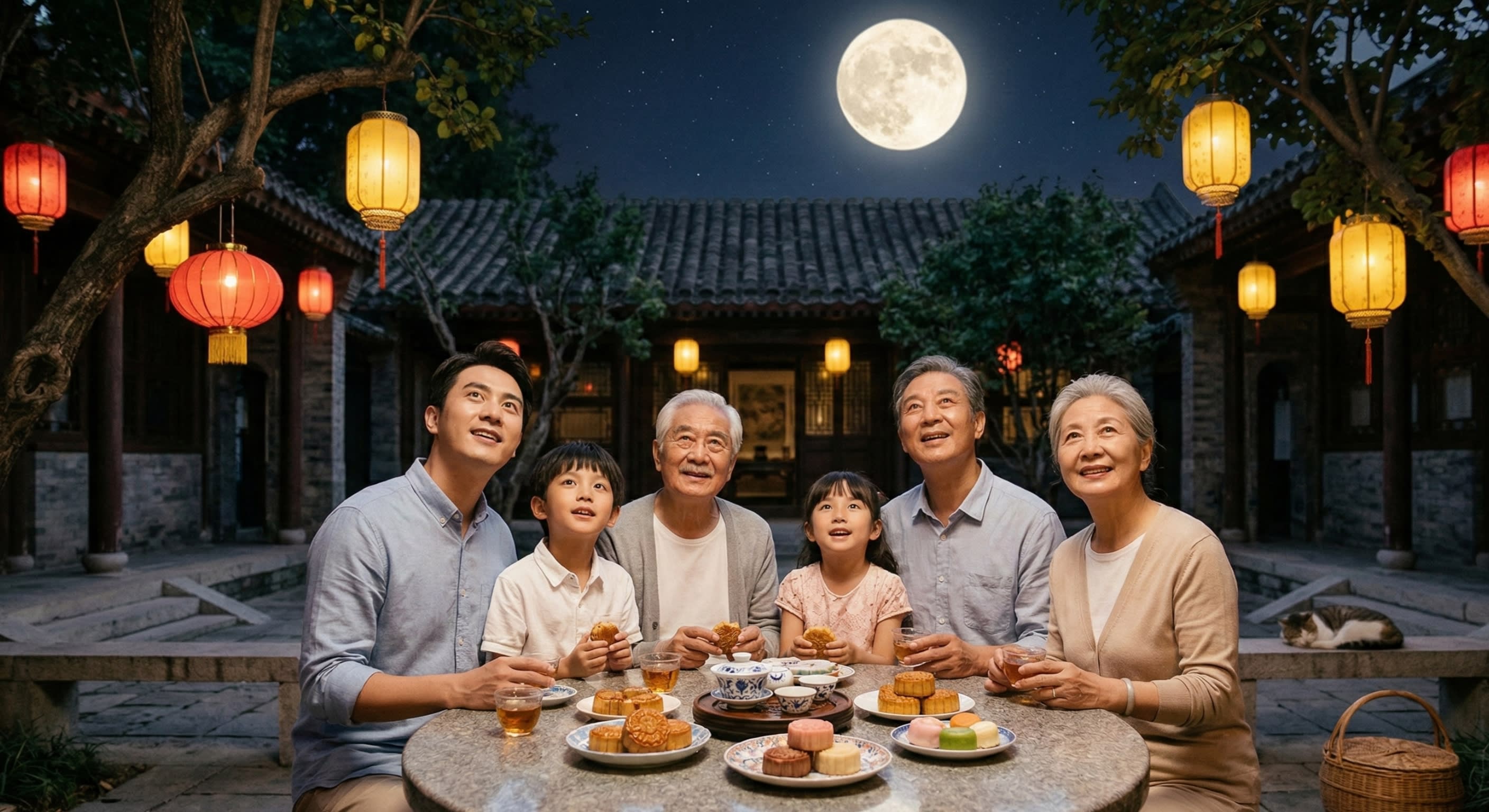
For a native Chinese person, looking at the moon on this night triggers a feeling of Wǔwèi záshén (五味杂陈)—a “complex mix of five flavors” (emotions). If the family is together, it is a moment of pure joy. But if a family member is far away—perhaps studying abroad or working in another province—the moon acts as a bridge.
There is a famous line of poetry by the Song Dynasty master Su Shi that every Chinese person can recite:
“Dàn yuàn rén chángjiǔ, qiānlǐ gòng chánjuān” (但愿人长久,千里共婵娟). “May we all be blessed with longevity, though far apart, we are still looking at the same beautiful moon.”
This sentiment is the reason why Mid-Autumn is often considered the second most important holiday after the Spring Festival. It is a deadline for the soul to return home.
🌼 4. Osmanthus and Wine: The Scents of Autumn
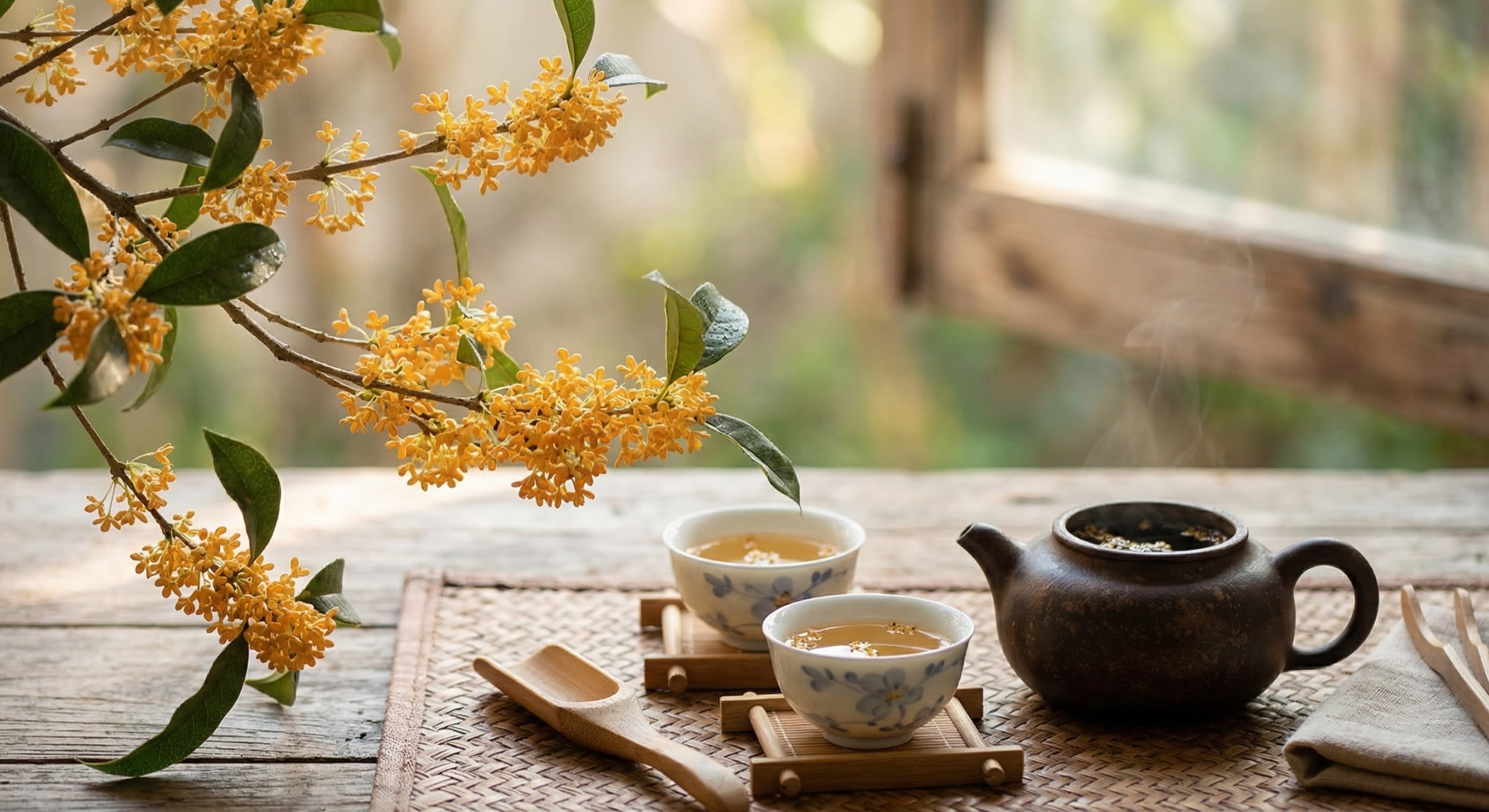
While the moon and cakes take center stage, the “vibe” of Mid-Autumn is defined by the Guìhuā (桂花)—Osmanthus. In many parts of China, the Mid-Autumn Festival coincides with the blooming of these tiny, golden flowers.
The scent of Osmanthus is intoxicatingly sweet, like a mix of honey and apricot. Families will gather to drink Guìhuā jiǔ (桂花酒)—sweet fermented osmanthus wine—which is believed to promote health and longevity. Sitting under an osmanthus tree, smelling the blossoms, and feeling the first cool breeze of autumn is the ultimate sensory experience of the festival.
💬 5. Essential Mid-Autumn Vocabulary
If you are celebrating with Chinese friends or colleagues in 2026, these phrases will help you express the spirit of the holiday perfectly:
| The Term | Characters & Pinyin | Context & Meaning |
|---|---|---|
| Happy Mid-Autumn | 中秋快乐 Zhōngqiū kuàilè |
The standard greeting. Use it with everyone! |
| Reunion / Unity | 团圆 Tuányuán |
The spiritual core of the holiday. "The family is Tuanyuan." |
| Moon-gazing | 赏月 Shǎngyuè |
The traditional activity of appreciating the full moon. |
| Mooncake | 月饼 Yuèbǐng |
The indispensable round pastry of the festival. |
Final Thoughts from Zirui
The Mid-Autumn Festival is a reminder that in a world that is constantly changing, some things remain constant. The moon will always be round again. The family will always yearn to be together. When you take a bite of a sweet mooncake and look up at that massive silver disc in the sky, you aren’t just observing a Chinese tradition—you are participating in a 3,000-year-old human celebration of belonging.
㊗️ Wishing you a bright moon, a warm home, and a very happy Mid-Autumn Festival!
Curious about the best places to watch the moon in 2026? Check out our travel guide: The Best Moon-Watching Spots in China for Mid-Autumn or learn how this holiday fits into the 24 Solar Terms.

