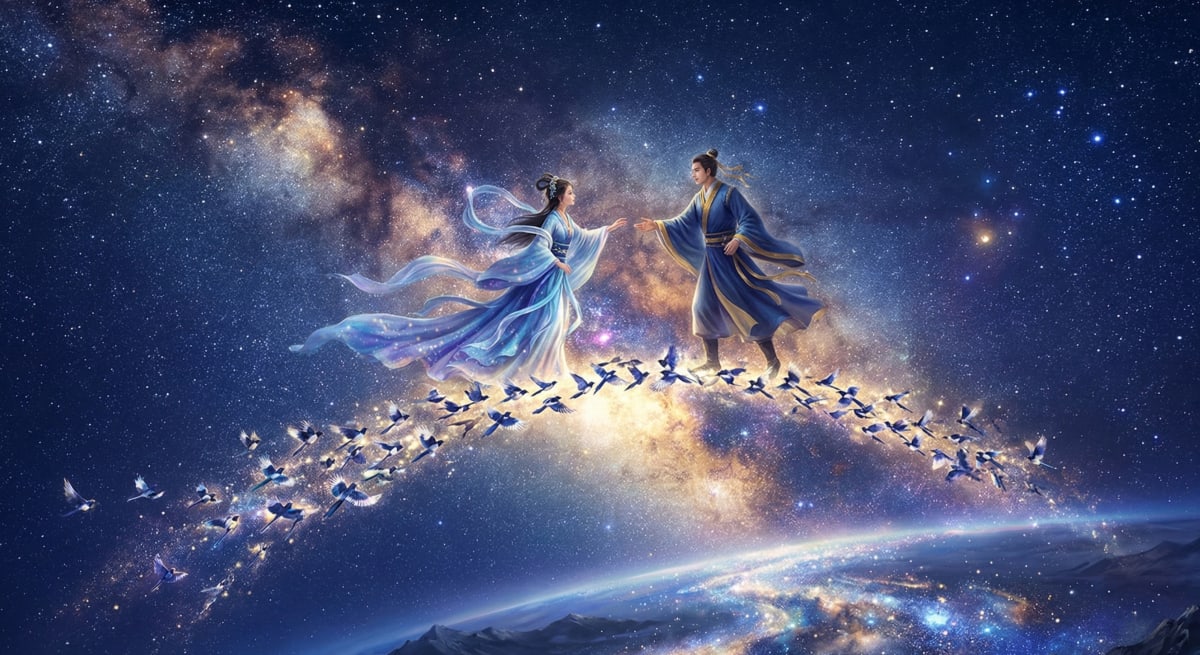
“If you look up at the night sky in late August, far away from the city lights, you will see the silver river of the Milky Way stretching across the heavens. For thousands of years, Chinese stargazers have looked at two specific bright stars on opposite banks of that river and told a story of a love so powerful that it moved the animal kingdom to tears. This is the Qīxī Jié (七夕节)—the Festival of the Seventh Night. Often called ‘China’s Valentine’s Day,’ Qixi is far more than just flowers and chocolates; it is a celebration of craftsmanship, a ritual of celestial timing, and a reminder that even the vastness of the universe cannot permanently separate two souls meant for each other.”
✨ 1. The Cosmic Tragedy: The Cowherd and the Weaver Girl
The heart of Qixi lies in one of the ‘Four Great Folk Legends’ of China: the story of Niúláng (牛郎—the Cowherd) and Zhīnv (织女—the Weaver Girl).
Zhinv was the daughter of the Celestial Empress, a goddess who wove the beautiful, multi-colored clouds of the sunset. Bored with her repetitive heavenly life, she descended to Earth and fell in love with a kind, hardworking mortal cowherd named Niulang. They married in secret, lived a humble life, and had two children.
However, when the Empress discovered that a goddess had married a mere mortal, she was furious. She descended to Earth, snatched Zhinv away, and flew back to the heavens. Niulang, desperate to save his wife, put his two children in baskets and chased her into the sky using the magical hide of his loyal ox.
Just as Niulang was about to reach Zhinv, the Empress pulled a gold hairpin from her hair and scratched a deep, wide river in the sky to separate them forever. This river became the Yínhé (银河)—the ‘Silver River’ or the Milky Way.
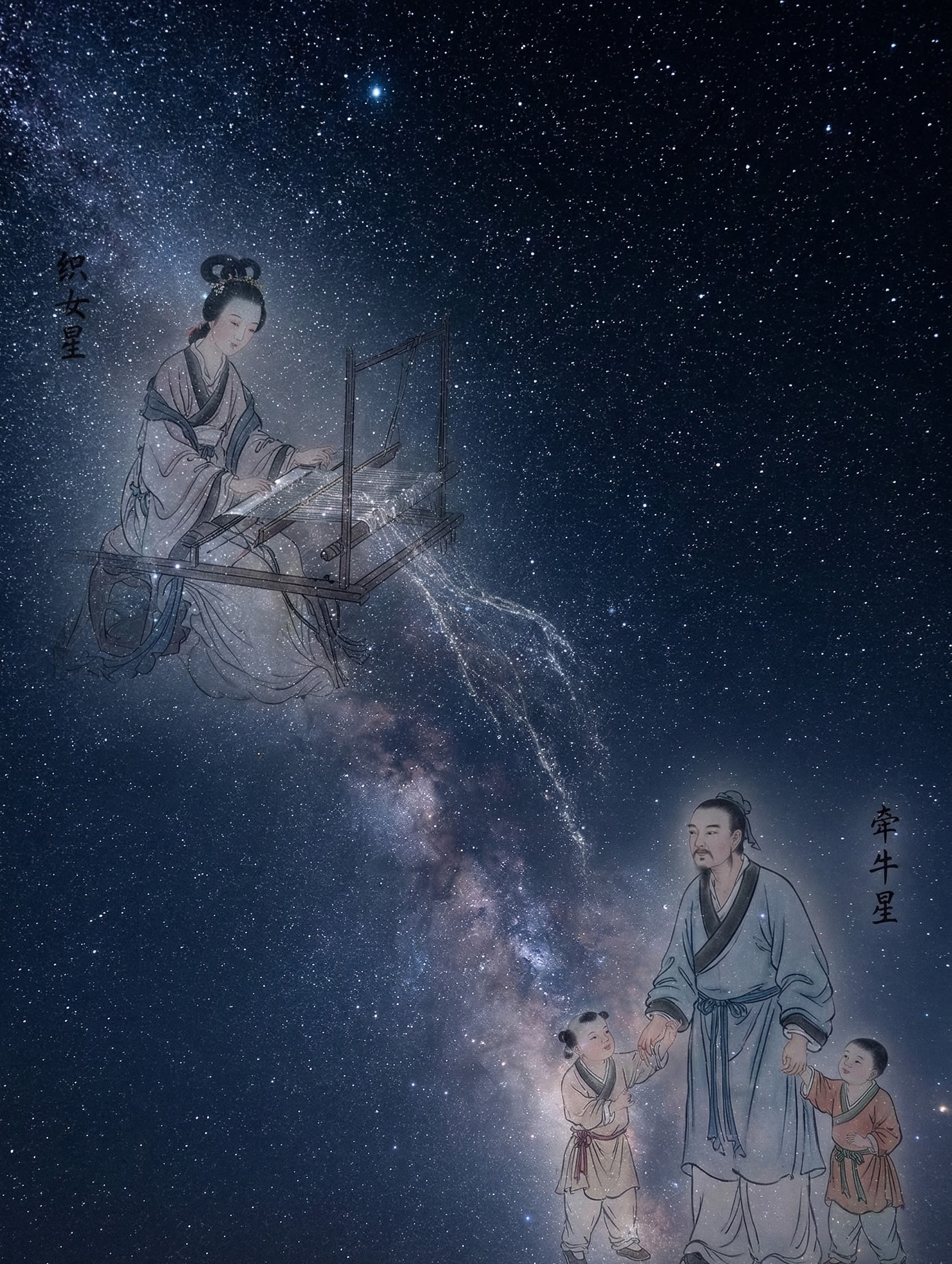
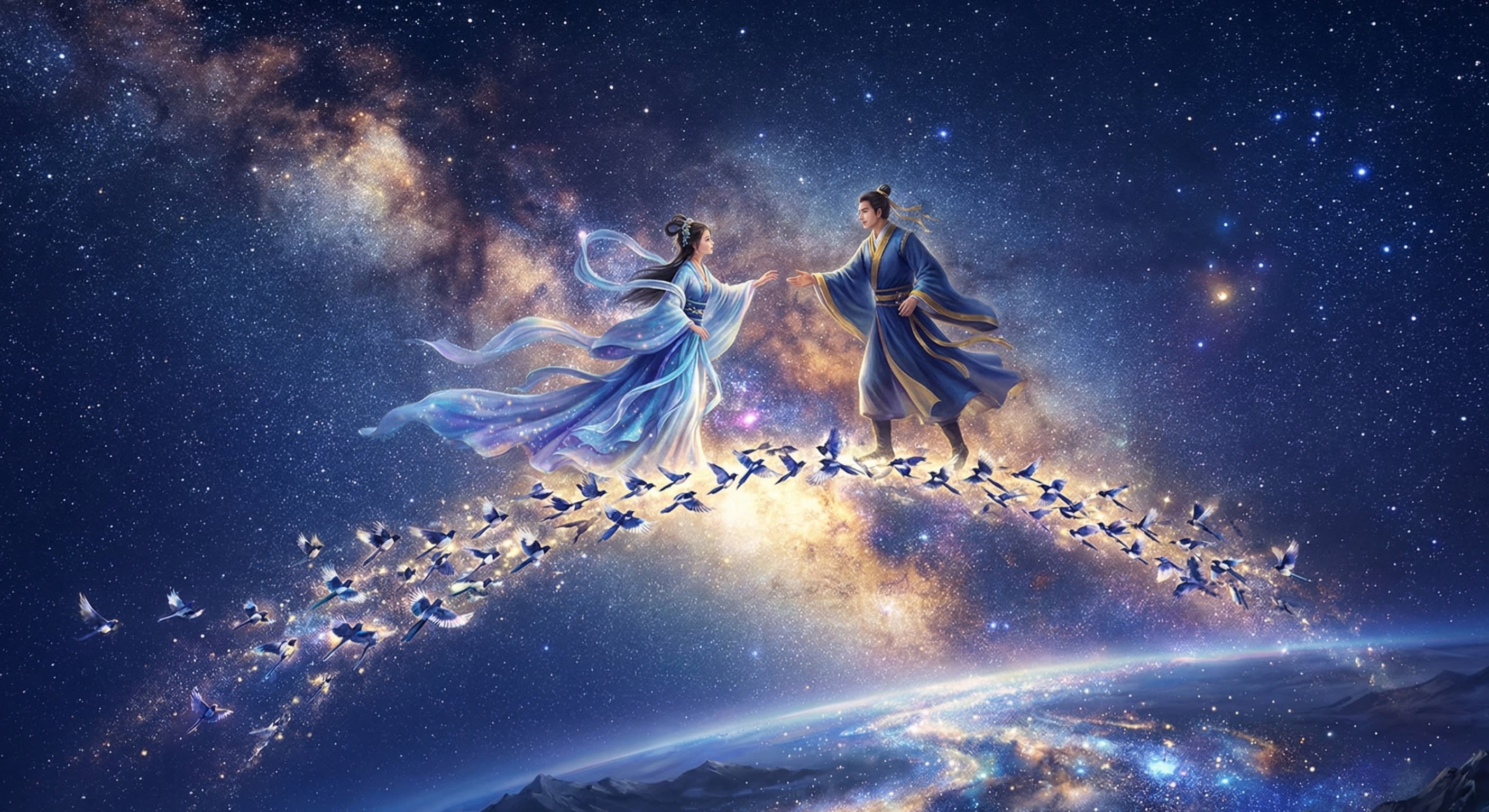
Moved by their inconsolable crying, all the magpies of the world flew up to heaven to help. On the 7th day of the 7th lunar month, they formed a living bridge with their wings—the Quèqiáo (鹊桥—the Magpie Bridge)—allowing the two lovers to meet for just one single night. In Chinese astronomy, Zhinv is represented by the star Vega, and Niulang is represented by the star Altair. If you look closely at Altair, you will see two smaller stars nearby—these are said to be the two children in their baskets, still following their father across the stars.
🪡 2. The Ritual of “Qǐqiǎo” (乞巧): Begging for Skill
While modern Qixi is about romance, for over two thousand years, it was primarily a festival for women. Historically, it was known as the Qǐqiǎo Jié (乞巧节), or the ‘Festival to Beg for Skills.’
In ancient China, a woman’s social value and marriage prospects were often tied to her domestic skills, particularly weaving and embroidery. Since Zhinv (the Weaver Girl) was the patron goddess of these arts, young girls would pray to her on the seventh night of the seventh month, asking for ‘nimble fingers’ and a ‘wise heart.’
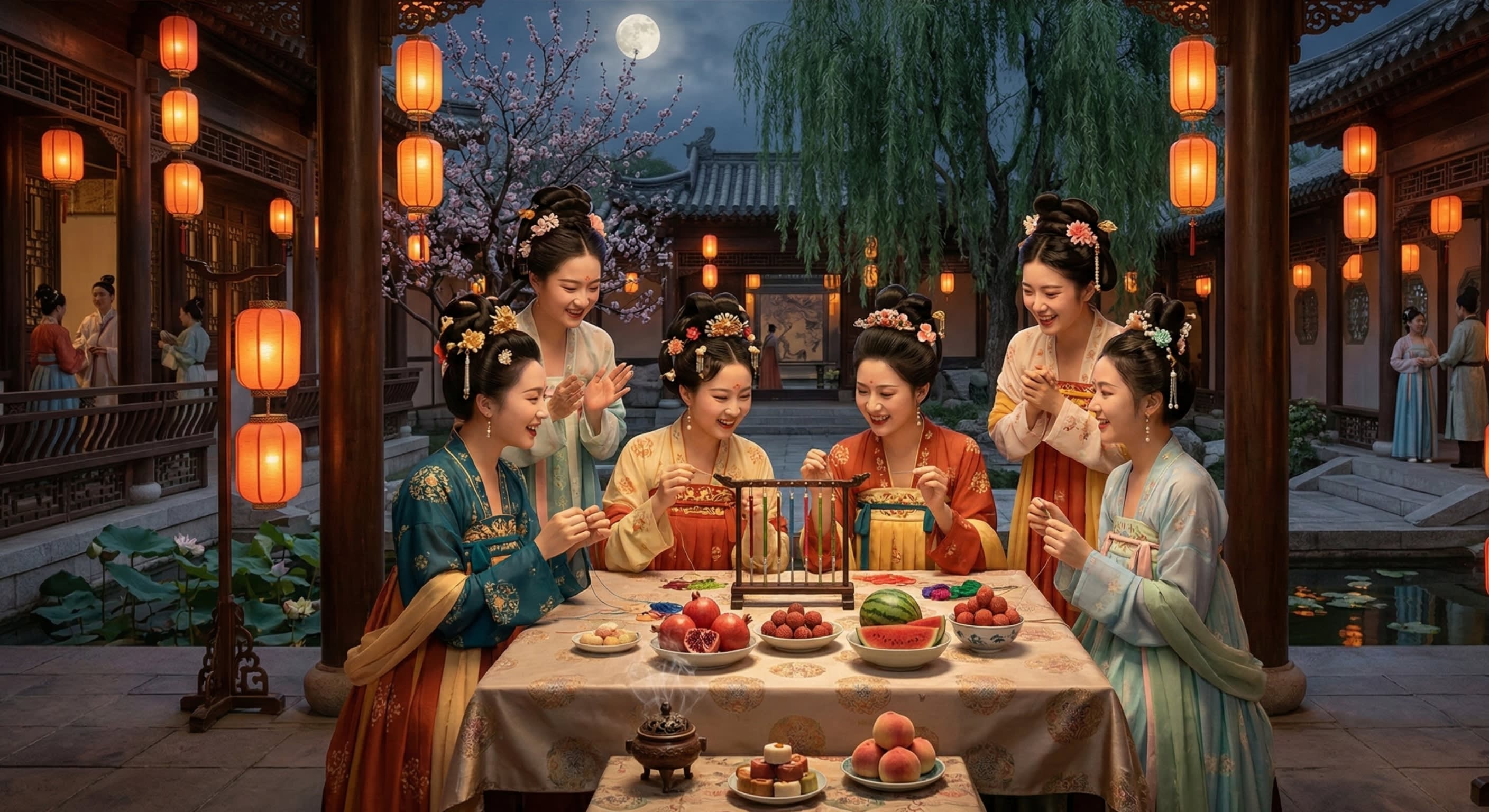
The Competition of the Needle
The most popular ritual involved a needle-threading competition. Young women would gather under the moon with needles featuring seven holes (seven being a lucky number during Qixi). The first girl to thread her needle completely by the dim moonlight was considered to have received the Weaver Girl’s blessing and was destined for a life of domestic excellence.
Another charming, albeit slightly spooky, ritual involved spiders. Girls would catch a spider and place it in a small box overnight. If the spider had woven a round, dense, and beautiful web by the next morning, it was a sign that the girl would become an expert weaver. These traditions highlight a time when ‘romance’ was not just a feeling, but a practical preparation for a shared future.
🍪 3. The Taste of Qixi: Qiǎoguǒ (巧果)
No Chinese festival is complete without its signature snack. For Qixi, we eat Qiǎoguǒ (巧果)—’Skill Fruit.’ Despite the name, these are not actually fruits, but delicate, fried pastries made from flour, oil, sugar, and honey.
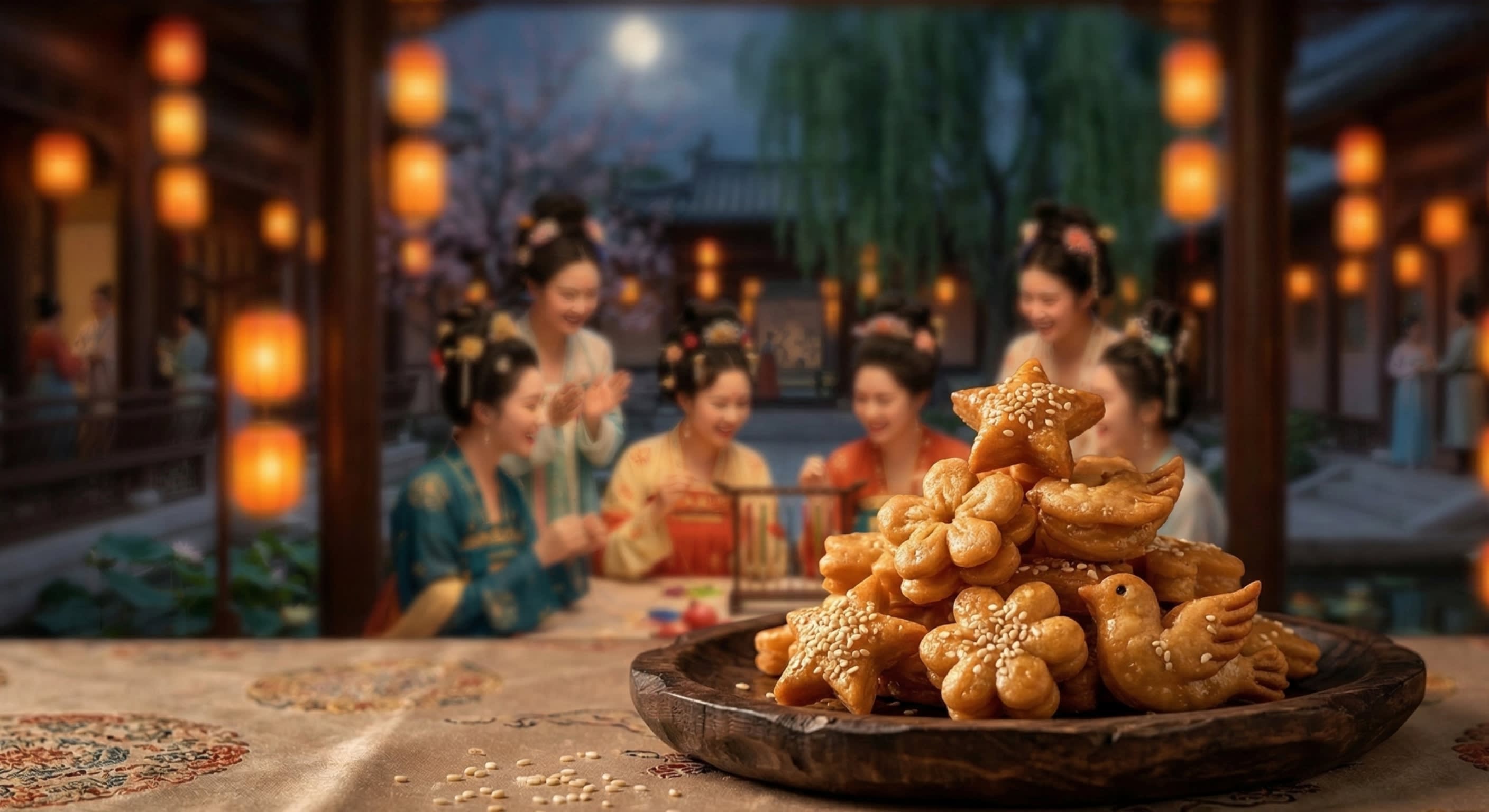
The making of Qiaoguo is an extension of the ‘Begging for Skill’ theme. The dough is pressed into intricate wooden molds featuring shapes like stars, flowers, magpies, and even the characters for luck and longevity.
Eating Qiaoguo is believed to make the eater ‘skillful’ and ‘clever’ (qiǎo 巧). In some regions, women would string the fried pastries together on a red thread and hang them around children’s necks, or place them on the rooftops for the magpies to eat as ‘payment’ for building the bridge in the sky.
🏮 4. The “Chinese Valentine’s Day”: Ancient vs. Modern
If you visit China during Qixi in 2026, you will see a landscape that looks very similar to February 14th in the West. Florists are sold out of roses, restaurants are booked months in advance for ‘romantic dinners,’ and jewelry brands launch massive marketing campaigns.
However, the ‘Valentine’s Day’ label is a relatively modern invention. For a long time, the Lantern Festival was the true day for romantic meetings, as it was the only time young women could leave their homes at night.
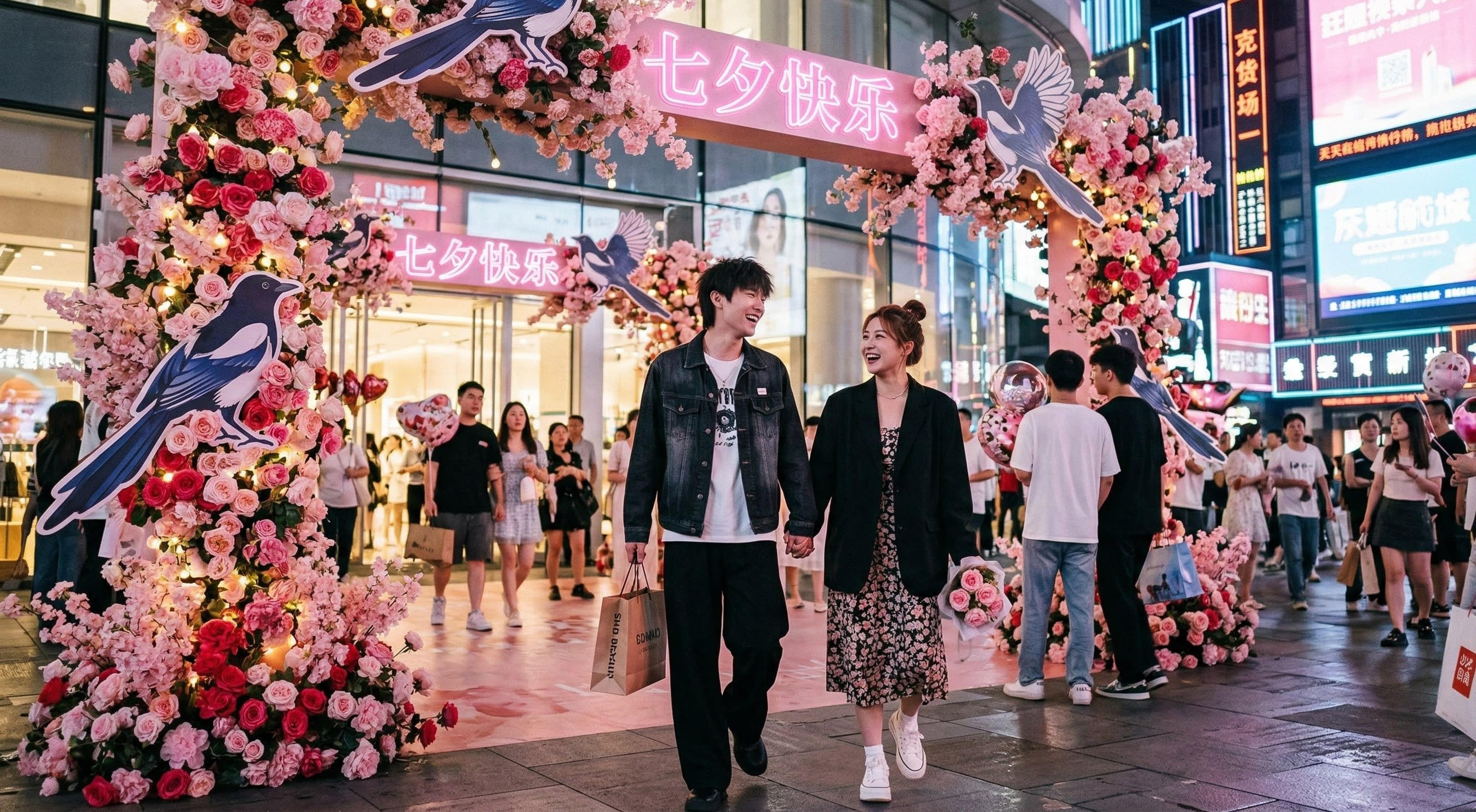
The transition of Qixi into a romantic holiday happened because the legend of Niulang and Zhinv is the ultimate symbol of Zhēn’ài (真爱—True Love). Unlike the casual dating culture often associated with modern Valentine’s Day, Qixi represents a love that is patient, enduring, and capable of surviving long-term separation. In a world of fast-paced relationships, the idea of waiting an entire year for a single night of reunion resonates deeply with the Chinese soul.
💬 5. Essential Qixi Vocabulary
If you are celebrating with a loved one or simply observing the festivities, these terms will help you navigate the ‘Magpie Bridge’ like a native:
| The Term | Characters & Pinyin | What It Means in Practice |
|---|---|---|
| Happy Qixi | 七夕快乐 Qīxī kuàilè |
The standard greeting used for friends and romantic partners. |
| Magpie Bridge | 鹊桥 Quèqiáo |
The bridge built by magpies. In modern slang, 'meeting on the Magpie Bridge' means a long-awaited reunion. |
| To Beg for Skill | 乞巧 Qǐqiǎo |
The traditional cultural core of the festival. |
| The Silver River | 银河 Yínhé |
The Chinese name for the Milky Way, the 'river' that separates the lovers. |
Final Thoughts from Zihan
There is a local superstition that if it rains on the night of Qixi, the raindrops are actually the tears of Niulang and Zhinv as they say goodbye for another year. Whether you believe the myths or not, the Qixi Festival offers a beautiful moment of reflection. It reminds us that while technology and modern life have changed how we meet, the fundamental human desire for a love that can bridge any distance—even the Milky Way itself—remains unchanged.
㊗️ Wishing you a romantic Qixi and a love that stands the test of time!
Inspired by the ancient romance of China? Discover the other major festivals in our Ultimate 2026 Travel Guide or explore the agricultural wisdom behind the 24 Solar Terms.

