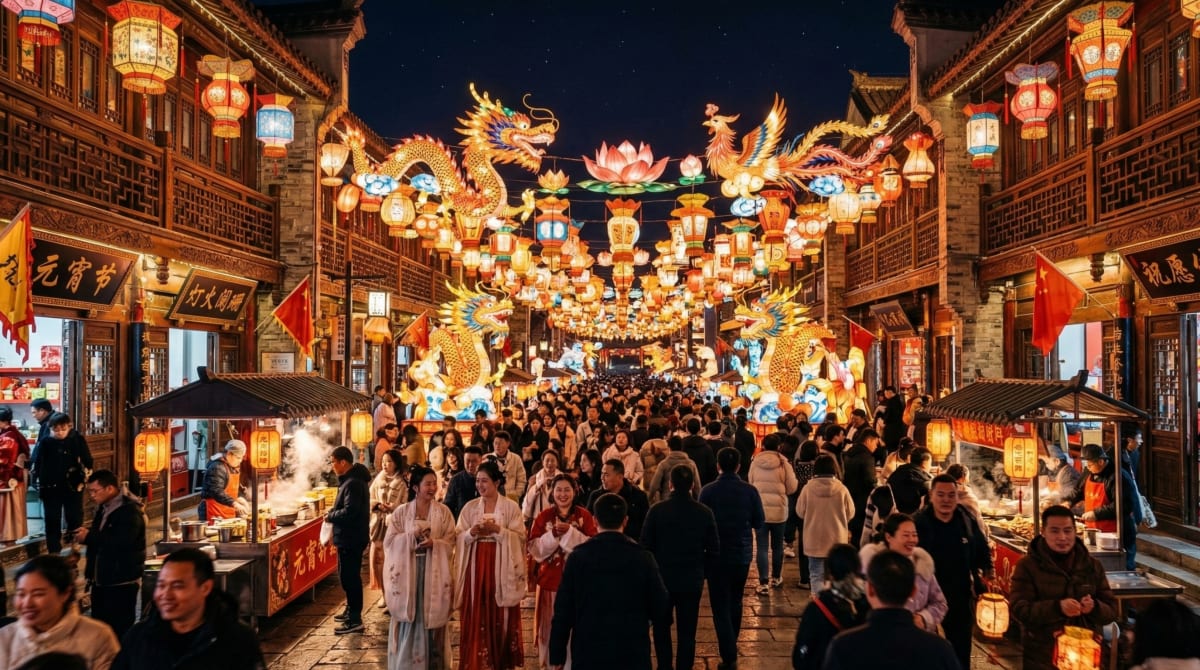
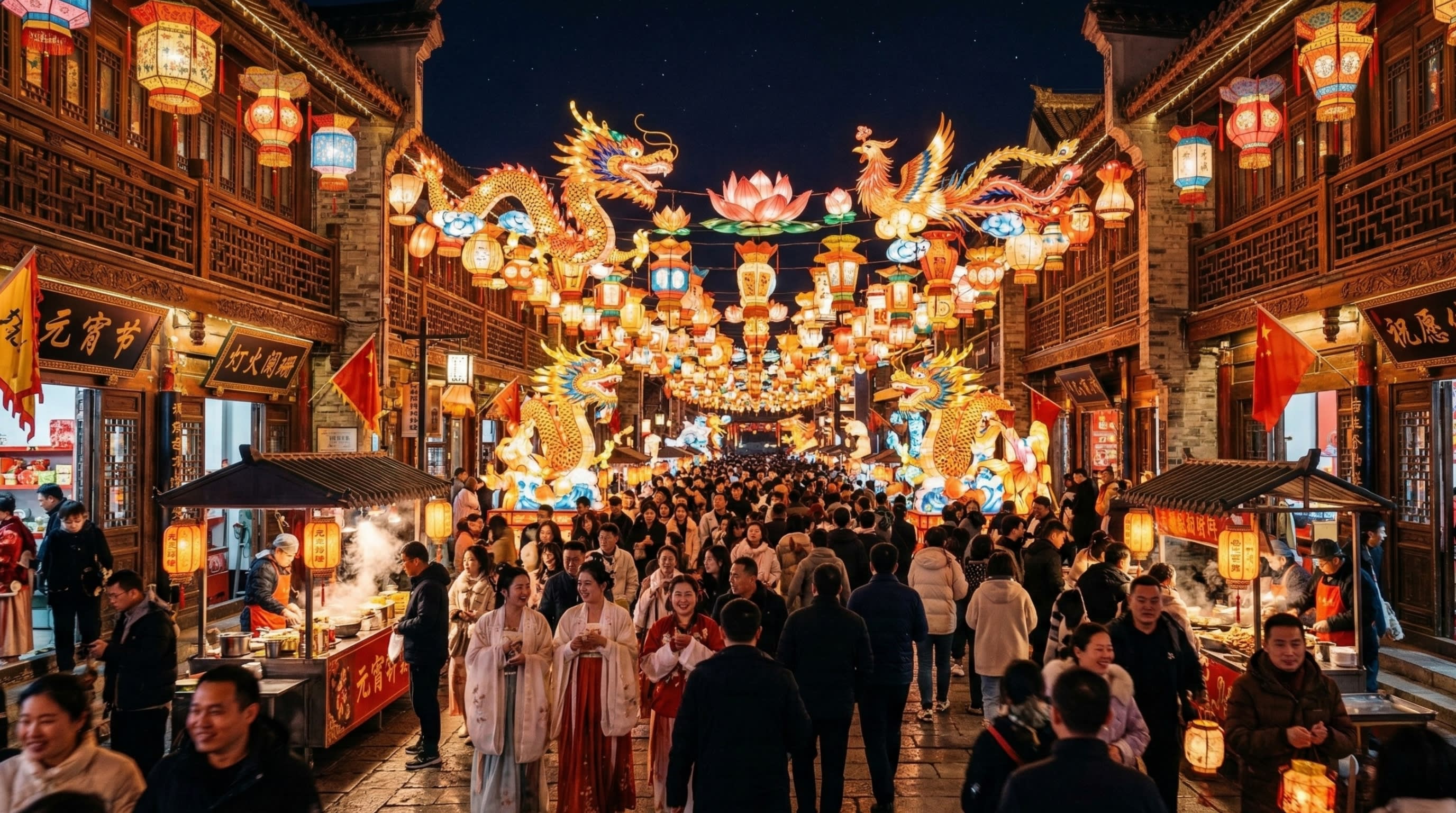
“If the Spring Festival is a private, indoor holiday defined by family reunions and quiet reverence, the Lantern Festival is its exact opposite. Falling on the 15th day of the first lunar month, the Yuánxiāo Jié (元宵节) is an explosion of public energy, community interaction, and sensory overload. It is the night of the first full moon of the year, marking the grand, bittersweet finale of the Chinese New Year celebrations. To truly understand this holiday, we must look past the modern neon lights and understand why, for thousands of years, the Lantern Festival was the only night of the year when the rules of ancient Chinese society were completely thrown out the window.”
🏮 1. The Concept of “Nao”: To Make Joyful Noise
To describe how Chinese people celebrate the Lantern Festival, we use a very specific verb: Nào (闹).
We do not simply “observe” or “spend” the Lantern Festival; we Nào Yuánxiāo (闹元宵). The character Nào translates to making noise, stirring up excitement, or causing a joyful ruckus. This linguistic distinction is crucial. While the eve of the Lunar New Year is about staying home and eating a quiet dinner with blood relatives, the Lantern Festival is about stepping out into the cold night air, mixing with strangers, watching acrobats, and being immersed in a sea of lights.
It is China’s true, unadulterated carnival. But why did this specific night become synonymous with such wild, public freedom? The answer lies in the strict laws of ancient Chinese dynasties.
🚫 2. The Broken Curfew: A Taste of Freedom
To comprehend the historical magnitude of the Lantern Festival, you must understand the concept of the Yèjìn (夜禁), or the “night curfew.”
During the illustrious Tang (618–907 AD) and Song (960–1279 AD) dynasties, ancient Chinese mega-cities like Chang’an (modern-day Xi’an) were heavily regulated. Once the sun went down, massive drums would beat exactly 400 times. After the final drumbeat, the city gates and neighborhood ward doors were locked tight. Anyone caught walking the streets at night without an official emergency permit was subject to severe punishment, including public flogging. The nights belonged to the guards and the silent darkness.
However, there was one magical exception: The Lantern Festival.
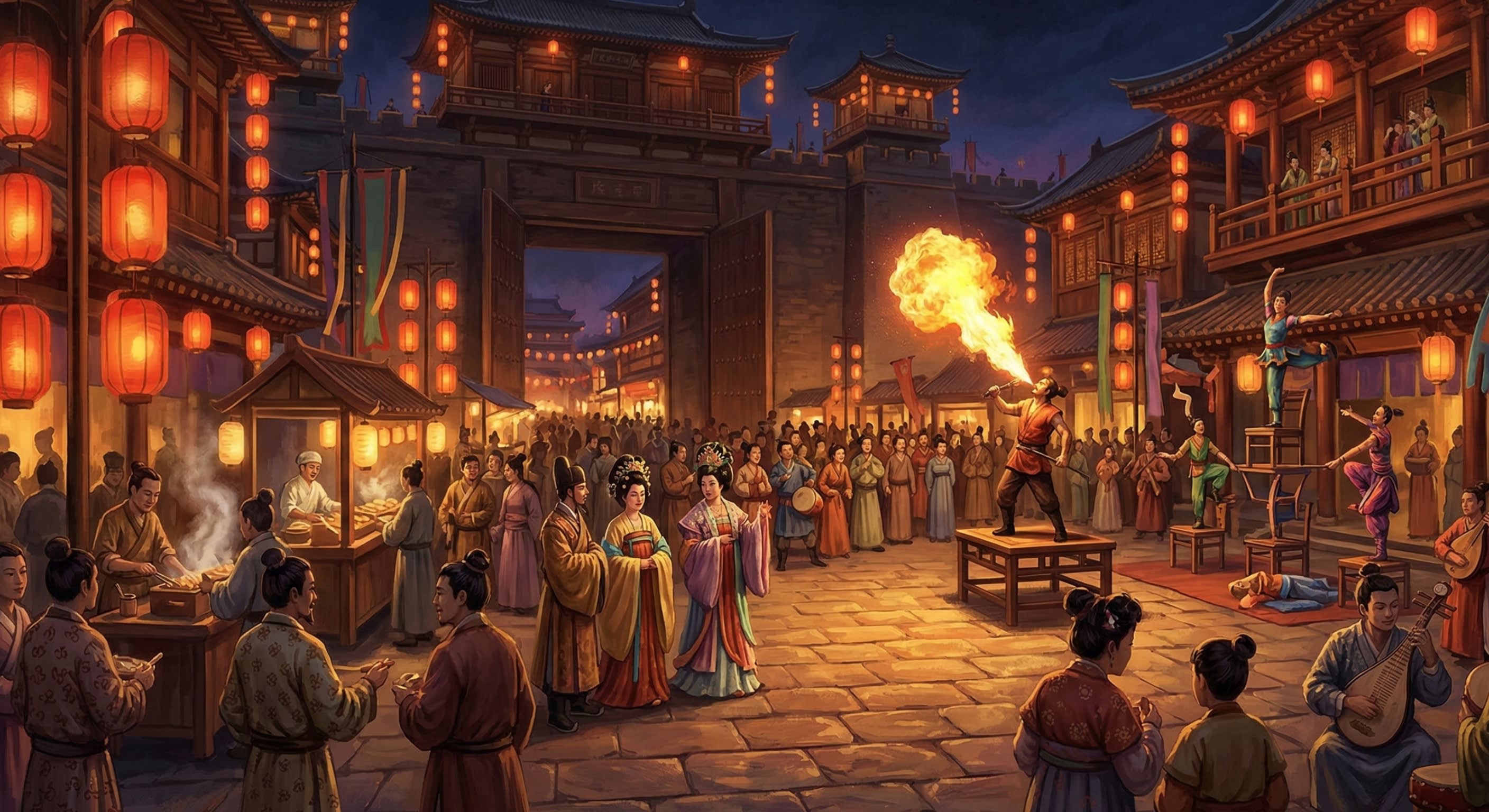
For three days during the Tang Dynasty (later extended to five days during the Song Dynasty), the Emperor decreed a complete suspension of the curfew. This period was known as Fàngyè (放夜), literally meaning “releasing the night.”
For these few fleeting days, the gates were thrown wide open. The darkness was pushed back by the light of millions of meticulously crafted paper and silk lanterns. Commoners, wealthy merchants, poets, and even members of the royal family poured into the streets. There were fire-breathers, lion dancers, magicians, and massive lantern towers constructed to look like glowing mountains. For the ancient Chinese populace, the Lantern Festival was a brief, intoxicating taste of absolute freedom and social mixing that they could not experience at any other time of the year.
💖 3. The Original Chinese Valentine’s Day
Today, many people associate the Qixi Festival (the 7th day of the 7th lunar month) with Chinese Valentine’s Day. But historically speaking, Qixi was a holiday for women to pray for domestic skills. The true holiday for romance, the one that actually resulted in marriages and love stories, was the Lantern Festival.
In ancient feudal China, young, unmarried women of good social standing were strictly confined to the inner courtyards of their family homes. They were forbidden from casually walking the streets or interacting with men outside their immediate family. The phrase “a girl who has not stepped out of her boudoir” was the standard of the era.
But during the Lantern Festival, the rules were suspended. Young women were finally allowed to step out of their homes, dressed in their finest winter silks, to admire the lanterns alongside everyone else.
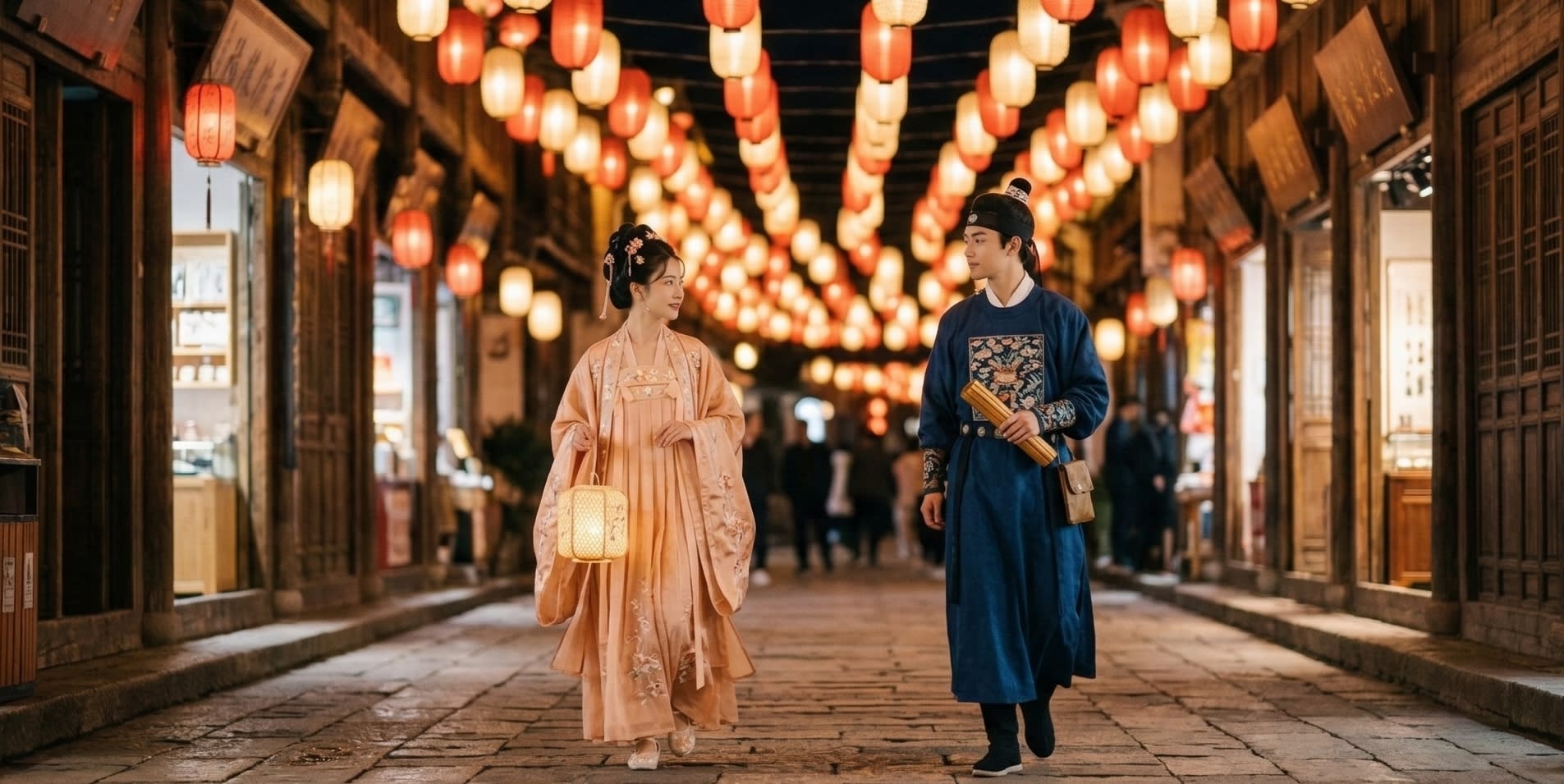
Naturally, this made the festival the ultimate matchmaking event of the year. Young scholars and eligible bachelors would flock to the streets, not just to look at the lanterns, but to catch a glimpse of the beautiful women who were normally hidden away. Glances were exchanged under the glowing lights, handkerchiefs were “accidentally” dropped, and countless romances were born in the crowded streets.
This romantic atmosphere is immortalized in some of the most famous poetry in Chinese history. The Song Dynasty literary master Ouyang Xiu captured the melancholy beauty of this night perfectly:
“Last year on the night of the Lantern Festival,
The flower market lights were as bright as day.
When the moon rose above the willow tree,
I kept my twilight tryst with my beloved.”
Even today, the Lantern Festival carries a subtle undercurrent of romance—a reminder of the days when love could only be found under the glow of a suspended curfew.
📜 4. The Intellectual Game: Lantern Riddles
While the lion dances and acrobatics entertained the masses, the literati and scholars engaged in a more cerebral form of carnival: Cāi Dēngmí (猜灯谜), or “Guessing Lantern Riddles.”
Since the Song Dynasty, it has been a tradition for festival organizers to write complex, poetic riddles on colorful slips of paper and hang them from the bottom of the lanterns. If a passerby thought they knew the answer, they could pull the slip of paper down and bring it to the lantern owner. If their guess was correct, they would be rewarded with a small prize, such as a brush, an inkstone, or a sweet treat.
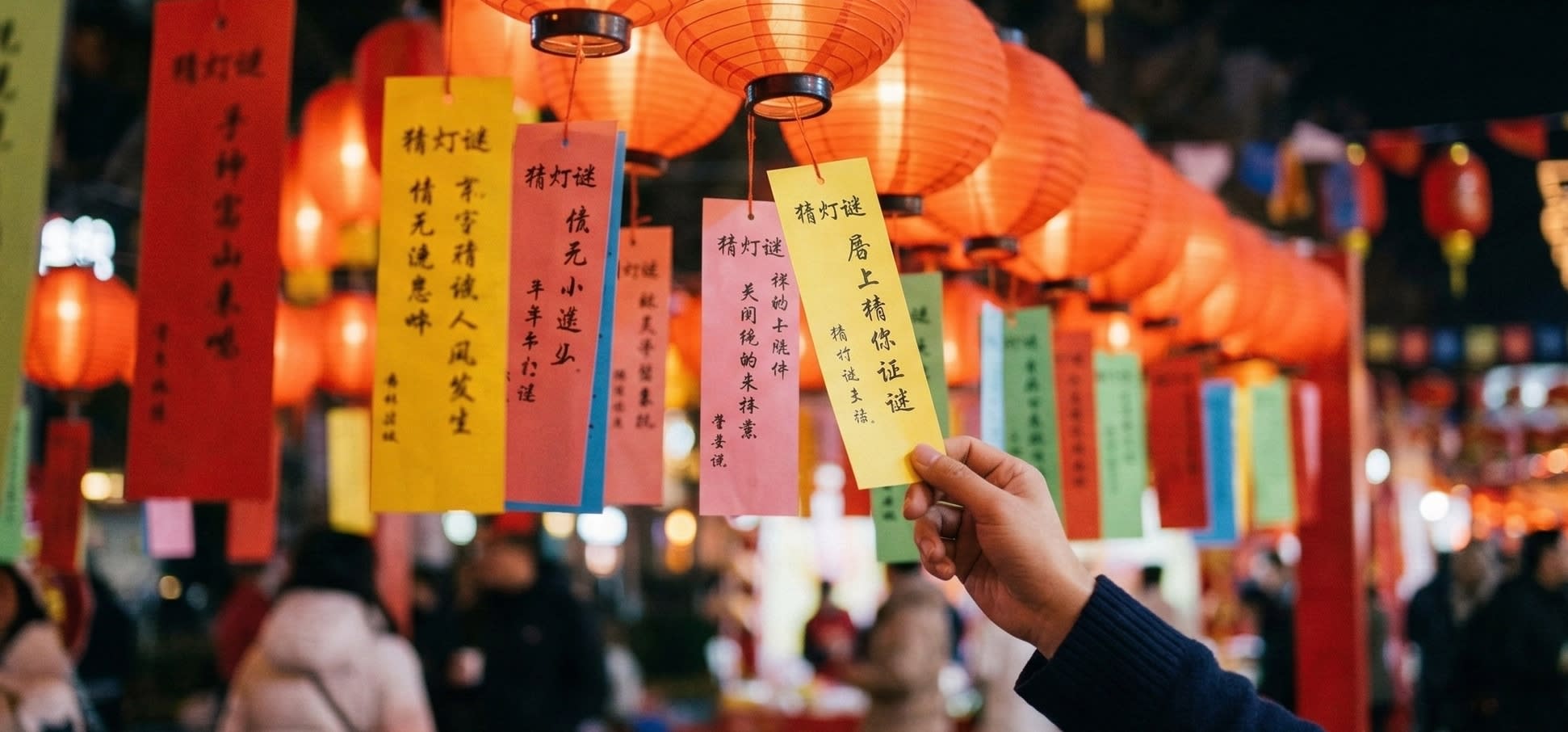
Chinese lantern riddles are notoriously difficult to translate because they rely heavily on the unique structure of Chinese characters, historical puns, and literary wordplay. A classic riddle might involve dissecting a Chinese character into its radical components or referencing a highly specific line from a classical poem.
For example, a very simple, modern character riddle might ask: “A person stands next to a piece of wood. What is the character?” The answer is Xiū (休), which means “to rest” (comprised of the radical for “person” 亻 and the character for “tree/wood” 木).
Guessing riddles was a way for scholars to show off their quick wit, often to impress the crowds of young women wandering the streets. Today, it remains a beloved intellectual tradition, keeping the brilliant linguistic history of the Chinese language alive in a fun, interactive way.
🥣 5. The Great Culinary Debate: Tangyuan vs. Yuanxiao
No Chinese festival is complete without its signature dish. For the Lantern Festival, the undisputed culinary star is a sweet, round dumpling made of glutinous rice flour, usually filled with a rich paste of black sesame, crushed peanuts, or red beans.
The round shape of the dumpling, served in a round ceramic bowl beneath the round full moon, represents the ultimate Chinese cultural ideal: Tuányuán (团圆), meaning “reunion” or “completeness.”
However, depending on where you are in China, this dessert has different names, different textures, and entirely different methods of preparation. It is the subject of an eternal, friendly rivalry between Northern and Southern China.

The South: Tangyuan (汤圆)
In Southern China, people eat Tāngyuán (汤圆), which translates to “soup spheres.” The preparation method is similar to making a dumpling. You take a piece of wet, kneaded glutinous rice dough, flatten it in your palm, place a ball of soft filling in the center, and gently fold and roll the dough around it until it is smooth and perfectly spherical. The result is a dessert with a delicate, silky, and incredibly soft exterior that melts in your mouth.
The North: Yuanxiao (元宵)
In Northern China, the dish is named after the festival itself: Yuánxiāo (元宵). The making of Yuanxiao is a dynamic, almost aggressive process. The filling is made first—usually a solid, hardened cube of sugar, lard, and nuts. These solid cubes are dipped in water and then tossed into a massive flat bamboo basket filled with dry glutinous rice flour.
The maker rhythmically shakes and sifts the basket, causing the wet cubes to roll around and pick up layers of the dry flour. They are dipped in water and shaken again, repeating the process until they grow into large, snowy-white spheres. Because they are “rolled” rather than “wrapped,” Yuanxiao have a rougher, chewier exterior and a bite that is more substantial than their southern cousins.
Whether you prefer the silky elegance of Southern Tangyuan or the robust chewiness of Northern Yuanxiao, eating a bowl of these sweet treats is the essential final ritual of the New Year period.
🎆 6. Where to Experience the Magic Today
While the ancient curfews are long gone, the grandeur of the Lantern Festival lives on. In 2026, the art of lantern-making has fused with modern LED technology, resulting in staggering visual displays across the country.
- Zigong, Sichuan (四川自贡): Zigong is the undisputed lantern capital of the world. The Zigong International Dinosaur Lantern Festival features displays that are mind-boggling in scale—entire glowing palaces, dragons spanning hundreds of meters, and intricate mechanical lanterns that move and breathe smoke.
- Qinhuai River, Nanjing (南京秦淮河): For a more traditional, romantic vibe, the Confucius Temple area in Nanjing offers the ultimate cultural experience. Taking a slow wooden boat ride down the Qinhuai River, surrounded by ancient architecture and thousands of reflections of traditional red lanterns in the water, is a journey back to the Ming Dynasty.
- Yu Garden, Shanghai (上海豫园): Right in the heart of modern Shanghai, the classical Yu Garden hosts a spectacular lantern fair. The juxtaposition of the glowing traditional mythic beasts against the backdrop of the futuristic Shanghai skyline is a perfect metaphor for modern China.
💬 7. Essential Lantern Festival Vocabulary
If you are celebrating the end of the New Year, use these terms to navigate the festivities like a local:
| The Term | Characters & Pinyin | Meaning & Context |
|---|---|---|
| Happy Lantern Festival | 元宵节快乐 Yuánxiāo jié kuàilè |
The standard greeting used throughout the day and night of the festival. |
| To Celebrate | 闹元宵 Nào Yuánxiāo |
"To make joyful noise." The act of going out to see the lanterns and crowds. |
| Guessing Riddles | 猜灯谜 Cāi dēngmí |
The intellectual game of solving puzzles attached to the lanterns. |
| Reunion / Completeness | 团圆 Tuányuán |
The cultural core of the holiday, symbolized by the full moon and round rice balls. |
Final Thoughts from Xin
When you eat your final bowl of Tangyuan and watch the last fireworks fade into the night sky, a quiet sense of reality sets in. The Spring Festival is officially over. Tomorrow, the alarms will ring, the schools will open, and the intense rhythm of normal life will resume. But the Lantern Festival ensures that the holiday doesn’t just fade away; it goes out with a spectacular, joyful roar. It reminds us that while the winter was dark and cold, we made it through together—and the light of spring has finally arrived.
㊗️ Wishing you a brilliant Lantern Festival and a year filled with completeness and joy!
Fascinated by the mythology and history behind Chinese festivals? Dive deeper into the Ancient Origins of the Spring Festival or explore how to navigate the modern celebrations in our 2026 Travel Guide to Finding Authentic Nian Wei.

