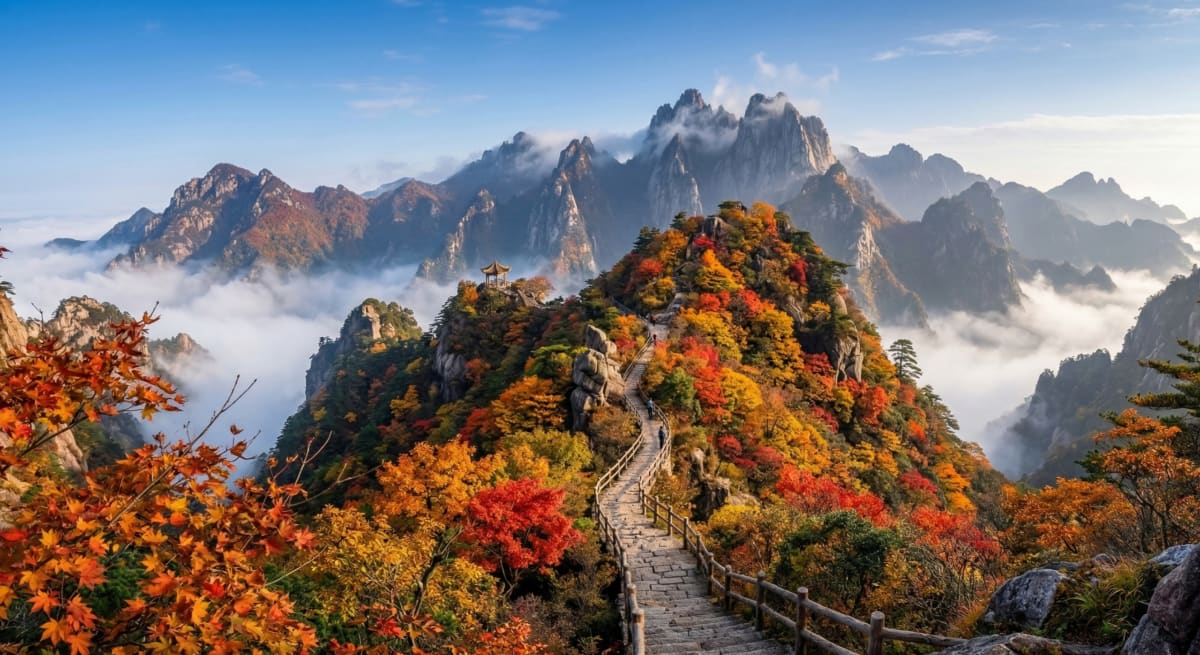
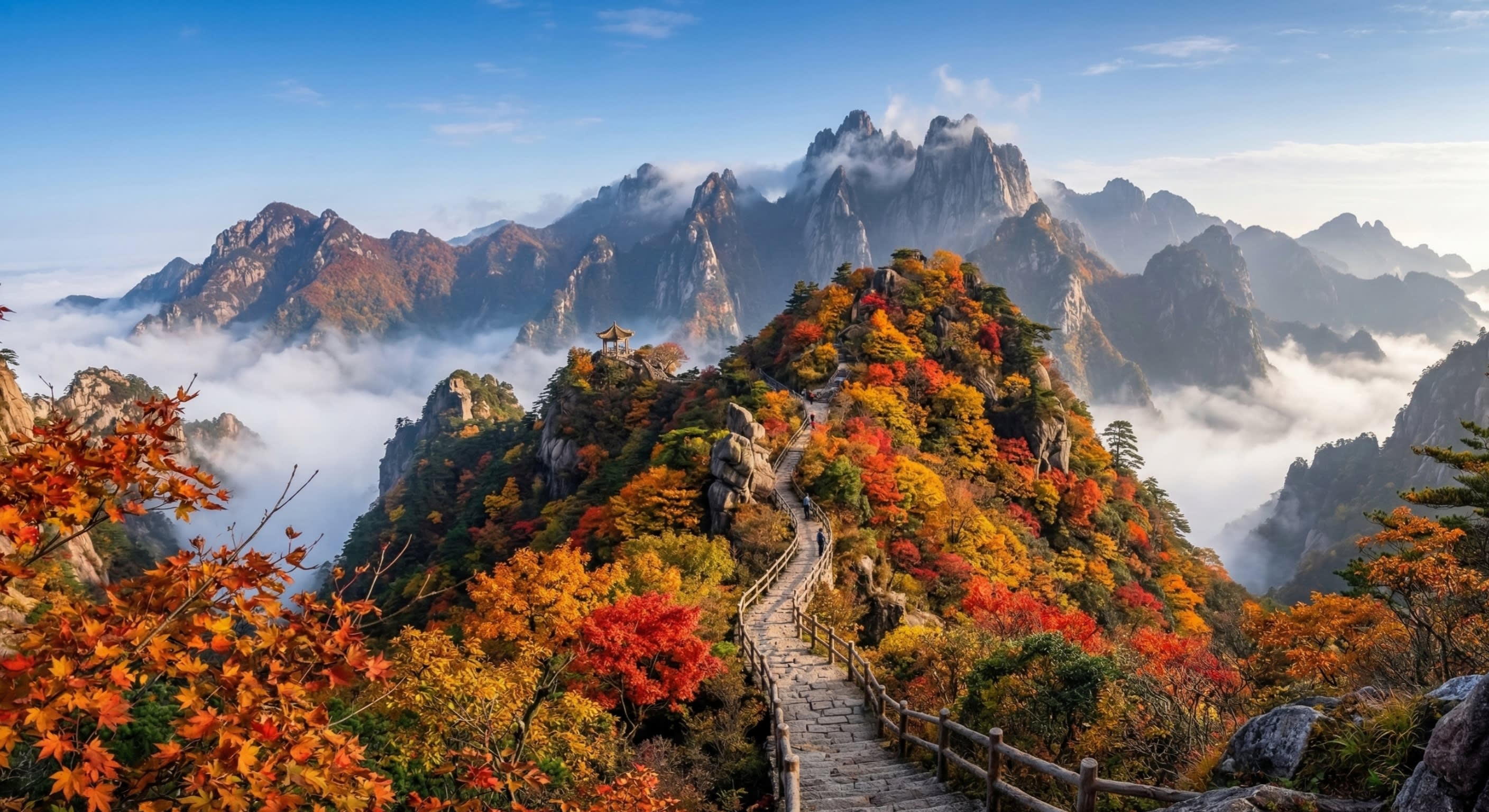
“In the traditional Chinese calendar, there is a day when the entire nation looks upward. As the heat of summer gives way to the sharp, clear air of autumn, millions of people set out to conquer the nearest mountain peaks. This is the Chóngyáng Jié (重阳节)—the Double Ninth Festival. While the Spring Festival is about the start of life and Mid-Autumn is about the fullness of the family, the Double Ninth is about the endurance of the spirit. It is a day defined by high altitudes, bitter herbs, golden wine, and a profound, cultural promise to cherish the wisdom of our elders.”
🗡️ 1. The Warrior and the Plague: The Myth of Heng Jing
The origins of the Double Ninth Festival are rooted in a heroic struggle against the unseen. According to legend, during the Eastern Han Dynasty, a terrible plague monster lived in the Nu River, bringing sickness and death to the local villages whenever it emerged.
A young man named Héng Jǐng (恒景), whose parents had died from the plague, vowed to destroy the beast. He traveled to the mountains to seek the help of an ancient immortal, who gifted him a magical sword and taught him the secrets of the elements.
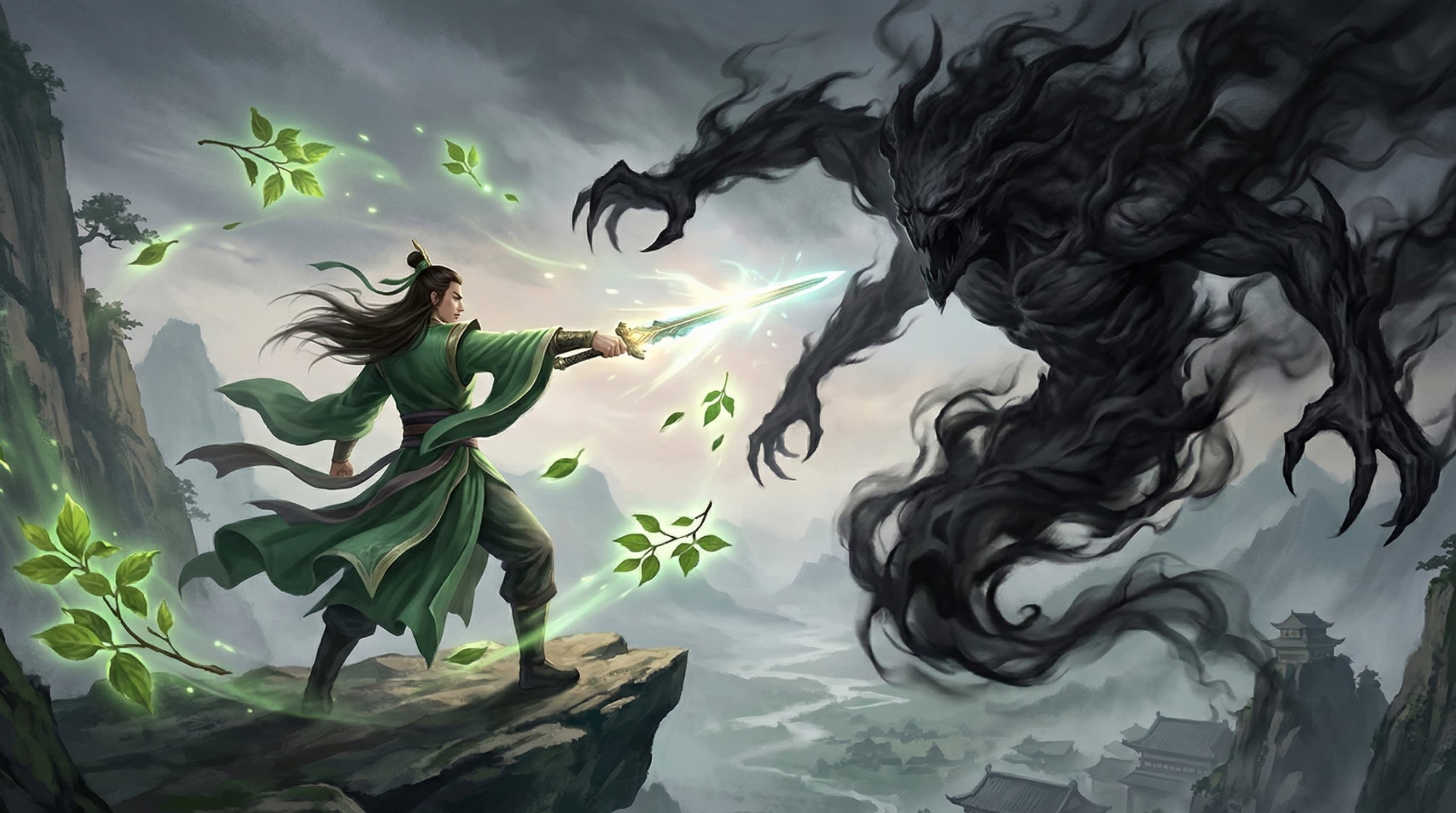
On the 9th day of the 9th lunar month, the immortal told Heng Jing that the monster would return. He gave Heng Jing a bag of Zhùyú (茱萸—Cornelian cherry/dogwood) leaves and a bottle of chrysanthemum wine. Heng Jing returned to his village, led everyone to the top of a high mountain, and gave each person a leaf and a sip of the wine.
When the plague monster emerged from the river, it was overwhelmed by the pungent, medicinal scent of the dogwood and the intoxicating power of the wine. Dazed, it couldn’t advance. Heng Jing seized the moment, dove from the mountain, and slew the monster with his magical sword. Since that day, climbing mountains and using these protective herbs on the ninth day of the ninth month became a ritual to ward off evil and celebrate victory over disease.
🔢 2. The Power of Nine: Why “Double Ninth”?
To understand the name Chóngyáng (重阳), we have to look at the ancient philosophy of the I Ching (Book of Changes). In traditional Chinese numerology, numbers are divided into Yin (even/feminine/cold) and Yang (odd/masculine/hot).
The number 9 is considered the “ultimate Yang” number—the peak of energy and fire. Therefore, a day featuring two nines (the 9th day of the 9th month) is a day of “Double Yang” or Chong Yang.
While having “Double Yang” energy is considered auspicious and powerful, ancient Chinese people also believed it was potentially dangerous because the energy was too high, leading to imbalance. This is why the festival’s traditions are almost all medicinal or protective—climbing to cooler altitudes, drinking bitter wine, and wearing pungent herbs are all ways to balance the intense energy of the day.
Furthermore, the word for “nine” in Chinese, Jiǔ (九), sounds exactly like the word for “long-lasting” or “longevity,” Jiǔ (久). Because of this linguistic connection, the Double Ninth evolved from a day of warding off danger into a day of wishing for Chángcháng jiǔjiǔ (长长久久)—a life that is long, stable, and enduring.
🏔️ 3. Dēnggāo (登高): Climbing to New Heights
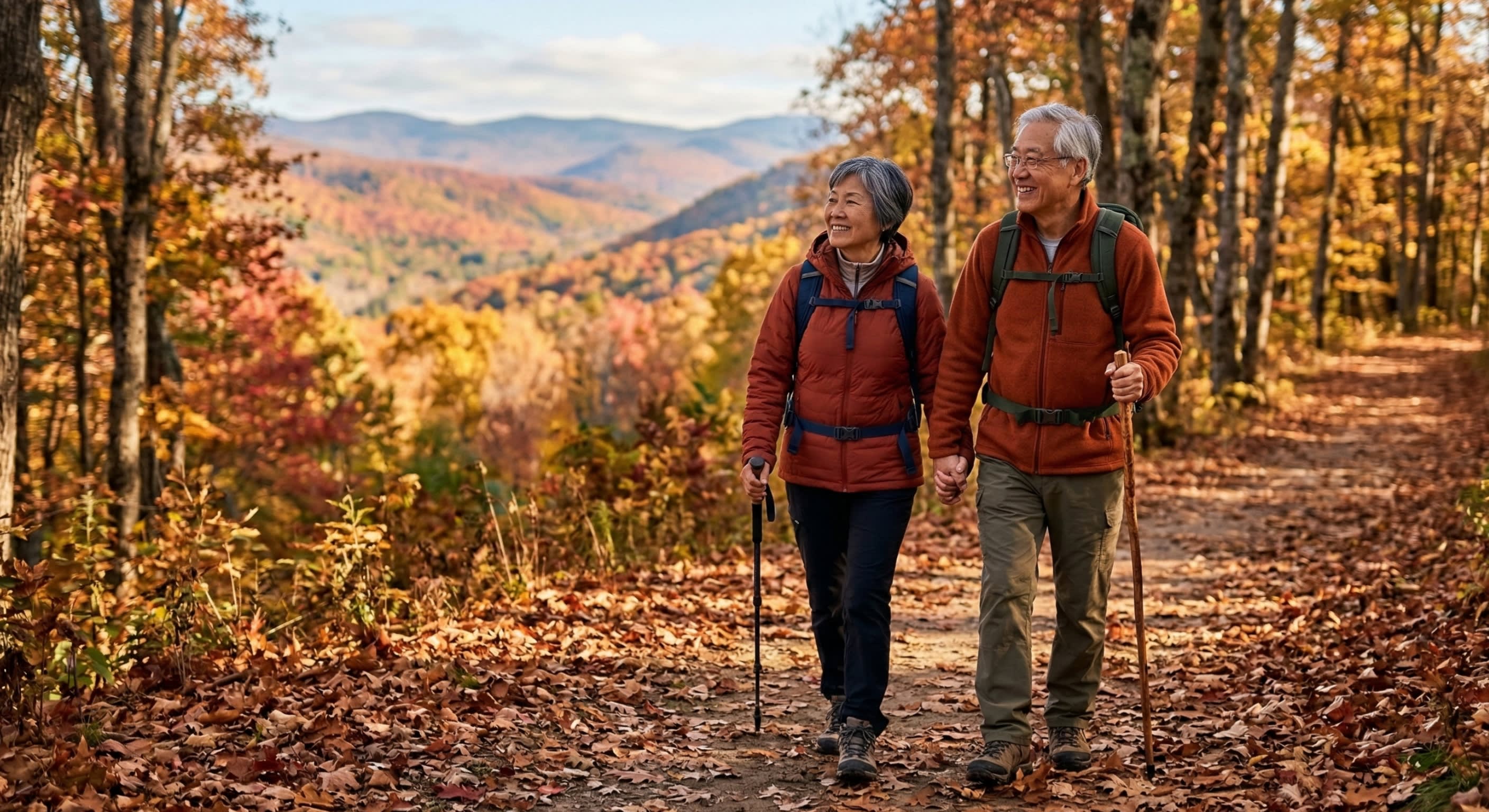
The most famous activity of the festival is Dēnggāo (登高), which literally means “climbing high.” On this day, parks and mountains across China are packed with families.
Why Climb?
- Health and Luck: Beyond the legend of Heng Jing, climbing in the autumn is a practical way to enjoy the “crisp air and clear sky” (Tiāngāo qìshuǎng 天高气爽). It is believed that by reaching a high point, you are physically moving closer to heaven and distancing yourself from the “polluted” air of the lowlands.
- Symbolic Promotion: For professionals and students, Denggao represents a wish for Bùbù gāoshēng (步步高升)—rising step-by-step in one’s career or studies.
- The View: Autumn is the most beautiful season for mountain scenery in China. The “maple leaves are redder than February flowers,” and the panoramic views from the peaks offer a moment of Zen-like reflection before the arrival of winter.
🎂 4. Cakes and Wine: The Flavors of Longevity
Every Chinese festival has its mandatory flavors. For the Double Ninth, the menu is designed to support the “Yang” energy of the season.
Chongyang Cake (重阳糕)
Since “climbing a mountain” (denggao) sounds like “cake” (gao), people who cannot physically climb a mountain eat Chóngyáng gāo (重阳糕) instead.
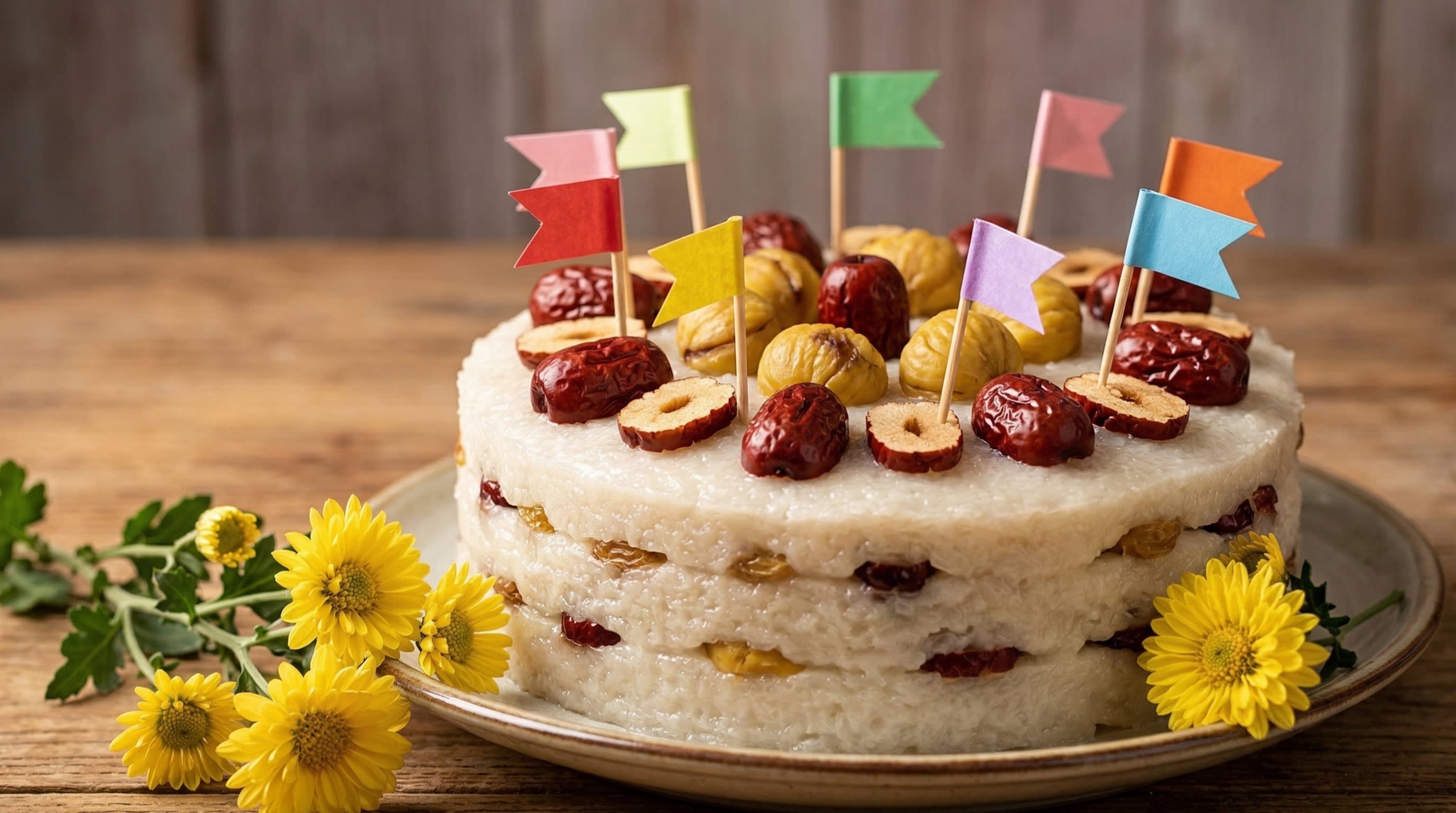
This is a steamed, multi-layered sponge cake, often filled with nuts, dried fruits, and red bean paste. A traditional cake features two small paper flags on top (representing the mountain peaks) and is often topped with chestnuts and red dates (Hóngzǎo 红枣) to symbolize good luck and fertility.
Chrysanthemum Wine (菊花酒)
The Double Ninth is also known as the “Chrysanthemum Festival.” Chrysanthemums are admired in China because they bloom in the cold, harsh autumn when all other flowers have withered. They represent the “gentleman of flowers” who does not fear the frost.
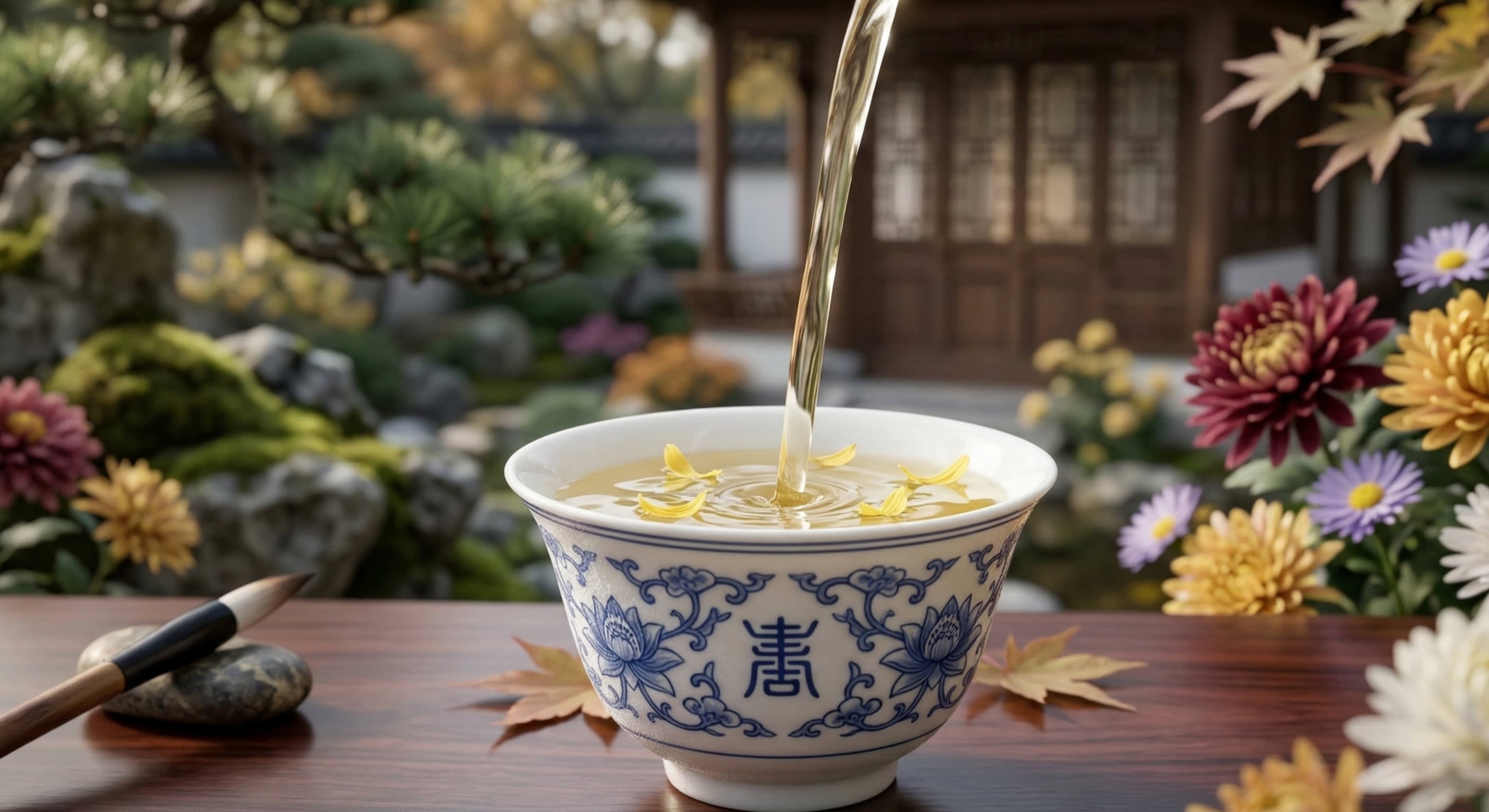
Ancient Chinese people would pick fresh chrysanthemums, mix them with grains, and ferment them for an entire year to be opened on the next Double Ninth Festival. Drinking Júhuā jiǔ (菊花酒) is believed to brighten the eyes, detoxify the body, and slow down the aging process.
👵 5. Modern Soul: Senior Citizens’ Day
In 1989, the Chinese government officially designated the Double Ninth Festival as Jìnglǎo Jié (敬老节)—Senior Citizens’ Day. This was a brilliant move to align an ancient holiday with the modern social value of Jìnglǎo zūnxian (敬老尊贤—respecting the elderly and honoring the wise).
In modern China, the day is an opportunity to express gratitude to the older generation. Schools organize trips for students to visit nursing homes, and children living in the cities will call their parents or travel back to their hometowns to take them on a “Step-climbing” trip.
It reminds us that while the “Double Ninth” energy is about strength and height, that strength is built on the foundation of those who came before us.
💬 6. Essential Double Ninth Vocabulary
If you are hiking in China during October or greeting your elderly neighbors, these terms are indispensable:
| The Term | Characters & Pinyin | Meaning & Context |
|---|---|---|
| Climbing High | 登高 Dēnggāo |
The primary activity. "Let's go denggao this weekend!" |
| Respecting the Elderly | 敬老 Jìnglǎo |
The modern theme of the festival. |
| Longevity / Long-lasting | 长长久久 Chángcháng jiǔjiǔ |
A blessing for long life and enduring relationships. |
| Double Ninth Cake | 重阳糕 Chóngyáng gāo |
The special steamed cake eaten during the festival. |
Final Thoughts from Yifei
The Double Ninth Festival is a beautiful paradox. It is a day when we look to the highest peaks of the mountains, but our hearts turn to the oldest members of our families. It teaches us that “height” is not just about altitude, but about the depth of one’s life experience. Whether you find yourself climbing a famous peak like Huangshan or simply sharing a slice of steamed cake with your grandparents, take a moment to breathe in the crisp autumn air and celebrate the enduring, “Double Yang” spirit within us all.
㊗️ Wishing you a healthy, high-reaching, and long-lasting Double Ninth Festival!
Inspired to conquer the peaks? Read our travel guide on the Best Mountains to Climb During the Double Ninth Festival or learn more about the seasonal wisdom of the 24 Solar Terms.

