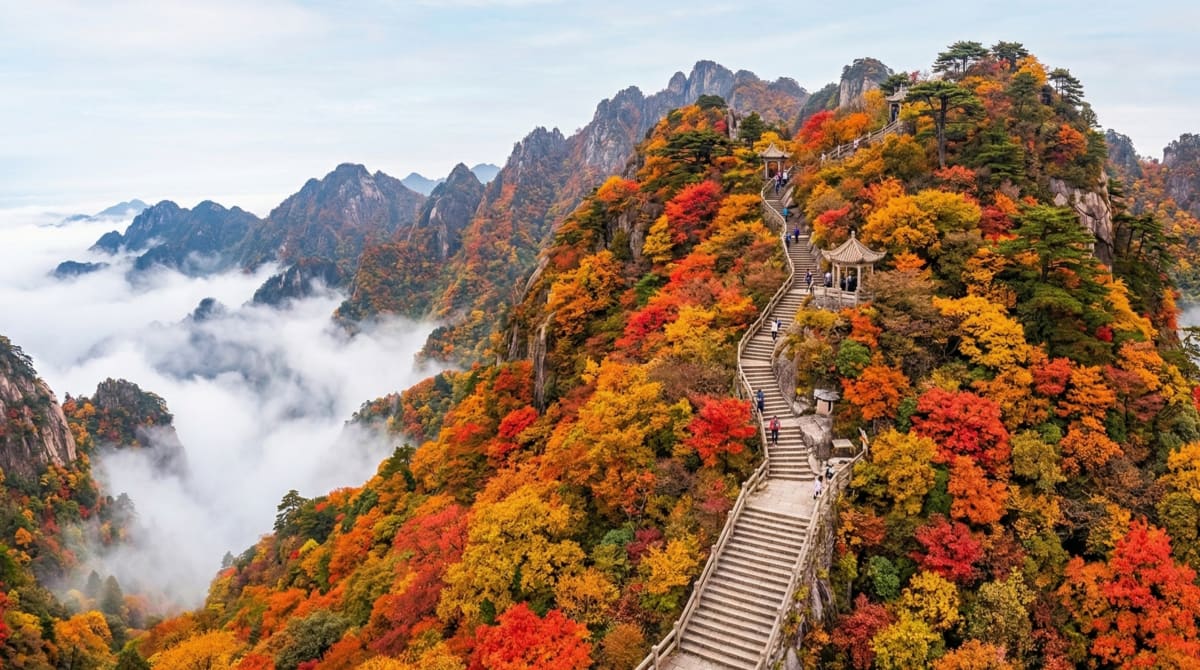
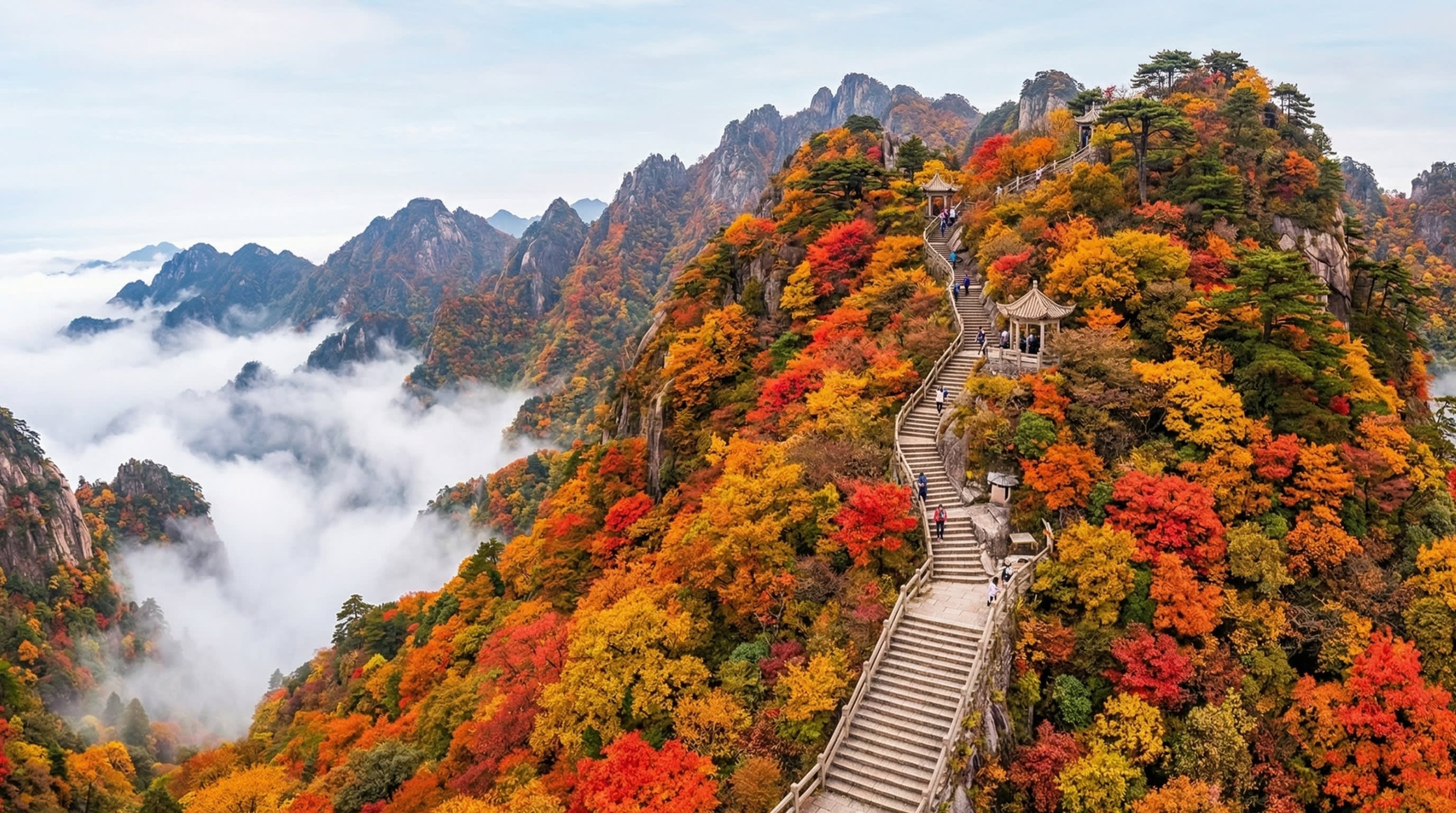
In our cultural deep dive into the Double Ninth Festival, we explored how climbing high serves as an ancient ritual of protection and a sincere prayer for longevity. Beyond the spiritual weight of the tradition, the ‘Double Ninth’ (falling on October 18th in 2026) happens to align with the absolute apex of China’s autumn transition. The atmosphere is what we locals call Tiāngāo qìshuǎng (天高气爽)—a sky so vast and air so sharp that it feels like a physical reset for your senses. If you are ready to trade the hum of the city for granite summits and the scent of crushed maple leaves, I have compiled this guide to help you choose your ascent.
🏔️ 1. Huangshan (黄山): The Aesthetic Masterpiece
There is a local adage that says, “Once you have traversed the peaks of Huangshan, you will never feel the need to climb another.” Tucked away in Anhui Province, the Yellow Mountain is the undisputed sovereign of Chinese landscapes.
- The Vibe: Ethereal, legendary, and hauntingly beautiful.
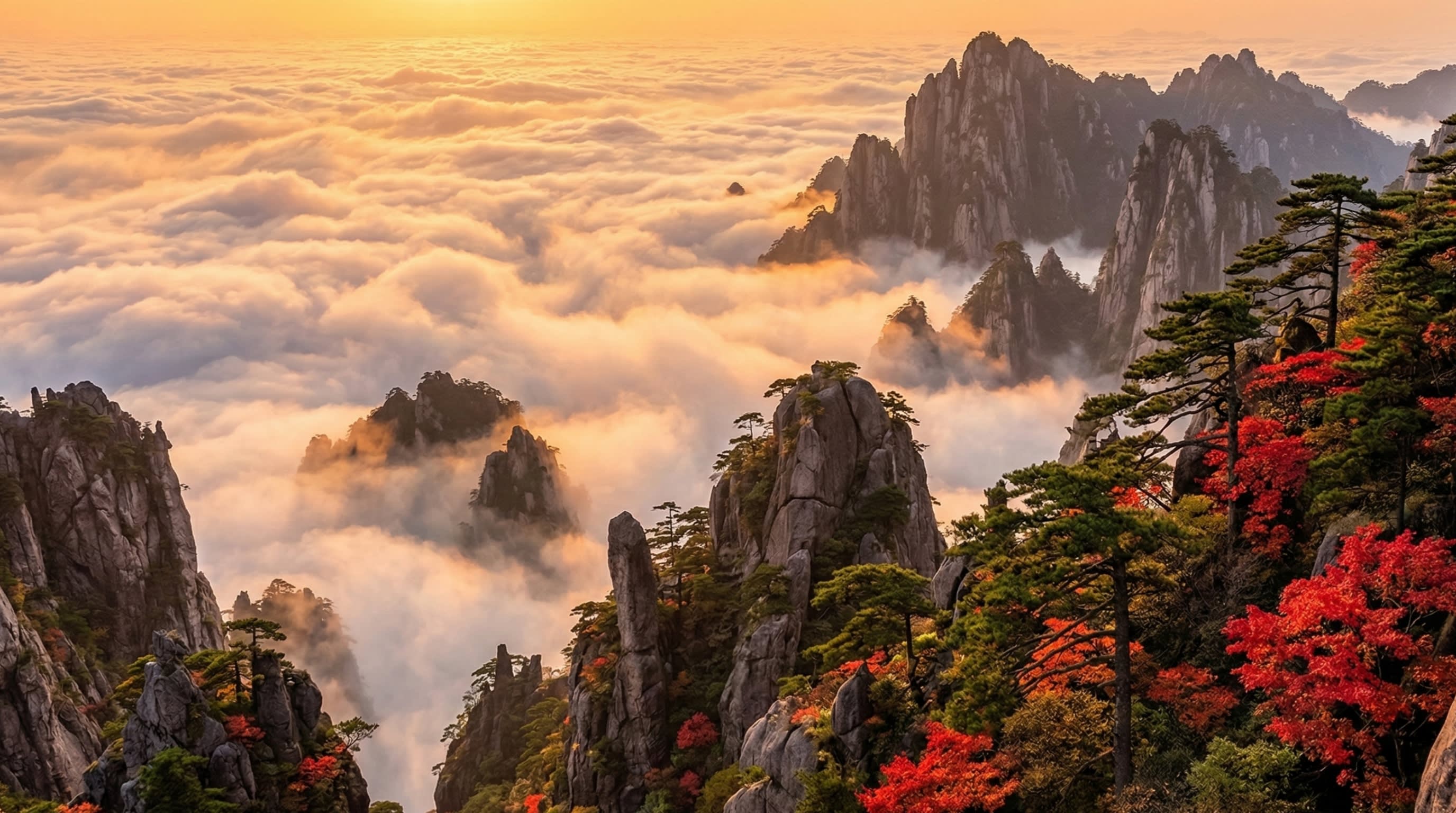
- Why Autumn? Huangshan is a year-round marvel, but autumn is when its ‘Four Wonders’ reach their crescendo. The ancient, twisted Yellow Mountain Pines stand out in defiance against the brilliant, burning crimson of the surrounding maples.
- The Experience: On the Double Ninth, we are all chasing the Yún hǎi (云海—Sea of Clouds). When the biting autumn chill meets the sun-warmed granite, the valleys inhale a thick, velvet mist, leaving only the sharpest granite teeth poking through like islands in a celestial ocean.
- Personal Curator Tip: This is a ‘hard mode’ climb. Even with the mechanical assistance of cable cars, you will be tackling thousands of vertical stone steps. I strongly advise booking a lodge on the summit at least two months in advance. Watching the sunrise from the peak is the quintessential way to fulfill the ritual of ‘climbing high.’
⛩️ 2. Mount Tai (泰山): The Imperial Pilgrimage
If Huangshan is a canvas of beauty, Mount Tai in Shandong Province is a monument to power and history. For millennia, Emperors climbed these slopes to perform sacrifices and hold court with the heavens. It remains the ‘First of the Five Sacred Mountains.’
- The Vibe: Grand, deeply spiritual, and physically demanding.
- The Experience: Climbing Mount Tai is a cultural marathon. You ascend through massive, weather-beaten stone gates, passing thousands of ancient calligraphy inscriptions etched directly into the cliffs. The real trial is the Shíbā pán (十八盘—The Eighteen Bends), a brutal, near-vertical flight of 1,600 steps leading to the South Gate to Heaven.
- Double Ninth Significance: Reaching the summit here on the Double Ninth is considered the purest form of Dēnggāo (登高). You aren’t just hiking; you are walking in the footsteps of dynastic history.
- Personal Curator Tip: Many locals opt for a night climb, starting around 11:00 PM, to reach the summit just as the sun ruptures the horizon. The sight of the ‘Golden Belt’ of the Yellow River in the far distance under the autumn sun is a moment that will stay with you for a lifetime.

🍁 3. Xiangshan (香山): The Red Leaf Classic
For those based in Beijing seeking a less grueling but equally atmospheric tradition, Xiāngshān (Fragrant Hills Park) is the destination. It is arguably the most famous spot in northern China for viewing Hóngyè (红叶—Red Leaves).
- The Vibe: Vibrant, nostalgic, and pleasantly accessible.
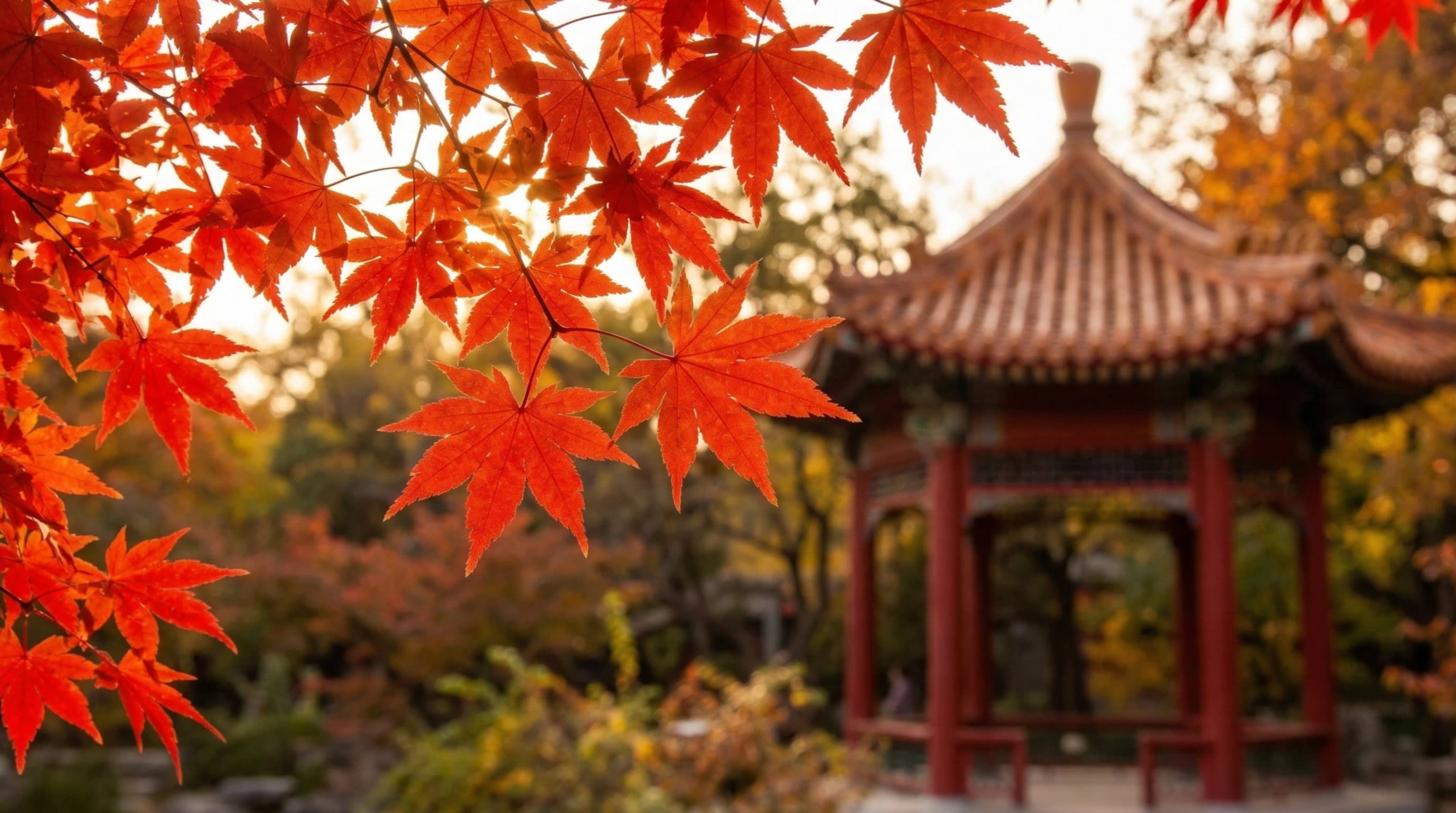
- The Experience: By late October, the smoke-trees and maples across these hills ignite into a fiery red. The sight of these crimson forests cradling traditional Qing Dynasty pavilions is so quintessential that it feels like stepping into a classic Chinese ink wash painting.
- The Ritual: Because it sits right on the urban edge, Xiangshan is where Beijing families congregate to celebrate the Double Ninth with their elders. You can take the cable car to the peak, known as the ‘Incense Burner,’ to enjoy the panoramic view without the heavy toll on your knees.
- Personal Curator Tip: Because of its immense popularity, the park becomes Rénshān rénhǎi (人山人海—People mountain, people sea) on autumn weekends. Try to go on a weekday morning. The back-lit red leaves against the morning sun are a photographer’s dream—make sure you have your camera gear ready.
🌊 4. Mount Wutong (梧桐山): The Southern Coastal View
If you find yourself in the subtropical south—Shenzhen or Hong Kong—the autumn is much milder, but the tradition remains robust. Mount Wutong, the highest peak in Shenzhen, offers a unique cocktail of mountain air and maritime views.
- The Vibe: Tropical-autumn, modern, and high-energy.
- The Experience: Climbing Wutong on the Double Ninth is a local rite of passage. At the summit, the payoff is a 360-degree spectacle: on one side, the chrome-and-glass skyline of Shenzhen; on the other, the cerulean waters of Dapeng Bay stretching toward Hong Kong.
- The Culture: Post-climb, locals often gather at the base to share a piece of Chóngyáng gāo (重阳糕—Double Ninth Cake) and sip on chrysanthemum tea. It is a modern interpretation of ancient ritual, proving that the ‘Yang’ energy of the holiday thrives even in China’s high-tech capitals.
🍵 5. Survival Tips for the “Double Ninth” Climber
Mountain climbing in China is a unique, ritualistic pursuit. Here is how to navigate the peaks like a seasoned curator:
- Respect the Knees: Unlike Western trails that prioritize dirt paths and switchbacks, Chinese mountains are almost exclusively stone stairs. This is significantly harder on your joints. I cannot recommend bringing a sturdy walking stick enough—it is a lifesaver, and it certainly isn’t just for the elderly!
- Hydration and Re-fueling: Don’t stress about packing a heavy lunch. Most Chinese mountain paths have rest stations every few hundred meters selling fresh water, refreshing cucumber sticks, and local snacks. Sitting on a stone bench with a hot cup of tea while overlooking a misty valley is a crucial part of the experience.
- The Crowd Factor: If the Double Ninth falls on a weekend in 2026, the big-name mountains will be shoulder-to-shoulder. For a quieter experience, consider reverse tourism—smaller, local mountains often hold the same autumnal magic with a fraction of the noise.
- Digital Pre-planning: For major sites like Huangshan and Taishan, you must secure entry tickets and cable car slots via WeChat mini-programs at least a week prior.

💬 6. Essential Mountain Vocabulary
Use these phrases to navigate your climb and connect with fellow hikers:
| The Term | Characters & Pinyin | Meaning & Context |
|---|---|---|
| Climbing High | 登高 (Dēnggāo) | The formal, poetic term for the festival ritual. |
| Red Leaves | 红叶 (Hóngyè) | Your primary aesthetic goal during an autumn hike. |
| Sea of Clouds | 云海 (Yún hǎi) | The iconic, misty seas seen from peak summits. |
| Check-in / Photo | 打卡 (Dǎkǎ) | "Let's daka at the summit!" (Documenting the achievement). |
Final Thoughts
There is something profoundly humbling about standing on a peak that has been climbed for thousands of years. As you gaze out over the ‘Double Yang’ landscape, you realize the climb was never just about exercise—it was about perspective. It was about escaping the noise of the world below to find clarity in the crisp mountain air. Pick your peak, take the first step, and may your 2026 Double Ninth journey be defined by longevity and high-altitude peace.
㊗️ Wishing you a successful ascent and a breathtaking view!
Curious about the folklore that inspired these climbs? Revisit our Cultural Guide to the Double Ninth Festival or explore other seasonal adventures in our 2026 Ultimate Guide.
Disclaimer: As an Amazon Associate, ChinaCurator earns from qualifying purchases.