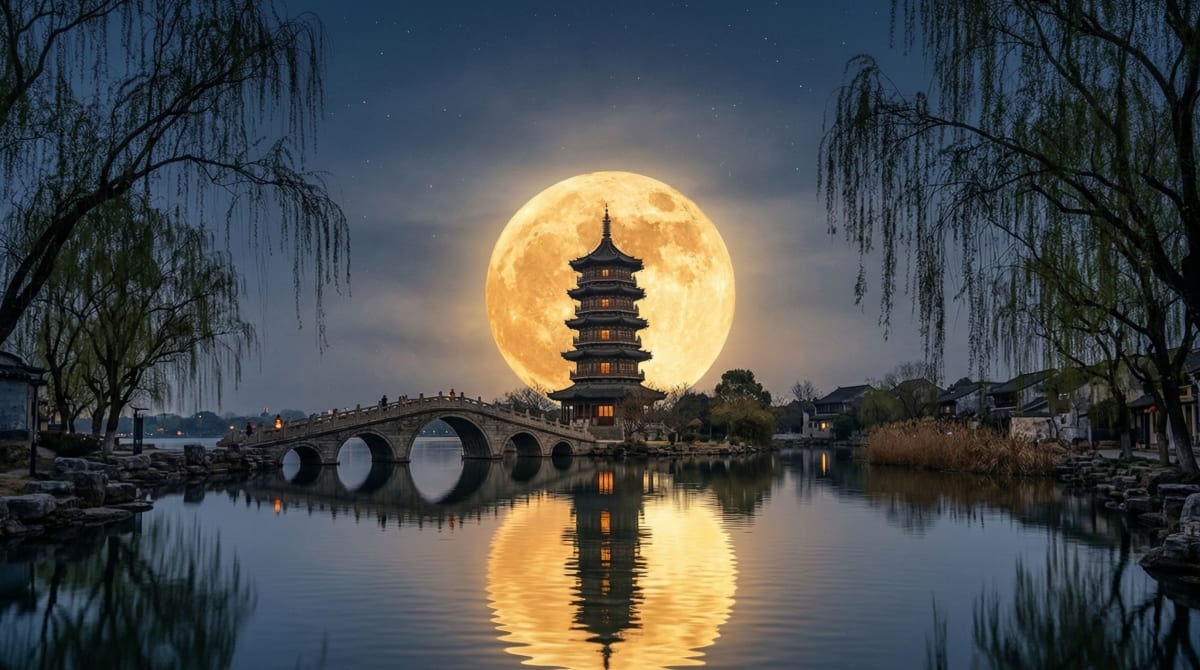
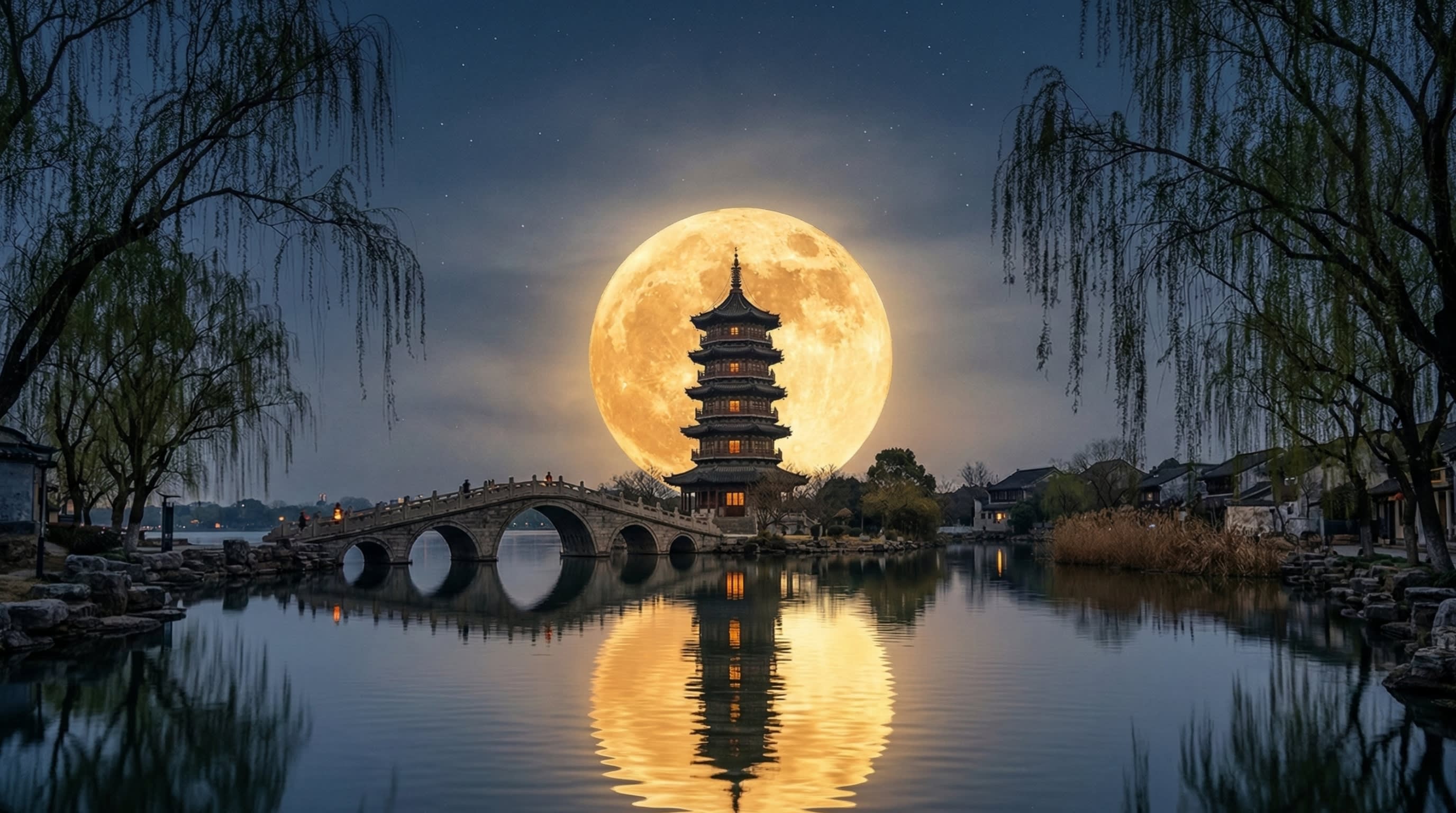
There is a specific, melancholic magic that every person in China knows well. It arrives on a crisp evening in late September or early October, just as the suffocating humidity of summer finally fractures. You step outside, look up at a sky so clear it resembles polished black obsidian, and there it is—the moon. It is impossibly large, a glowing silver disc that commands your attention like nothing else in the nocturnal sky.
In Chinese culture, this isn’t merely an astronomical curiosity. It is Zhōngqiū Jié (中秋节)—the Mid-Autumn Festival. It is the moment when the entire nation pauses to look toward the same light and feels an ancient, gravity-like pull toward home. While the world often reduces this holiday to the simple act of eating pastries, the true soul of the night is captured in a single, profound word: Tuányuán (团圆), or the concept of a complete, unbroken reunion.
🌙 1. The Lady in the Moon: The Legend of Chang’e
To understand the Mid-Autumn Festival, you have to look at the moon and see the story etched into its craters. Growing up, I was always told that if you squinted at the moonlight, you wouldn’t see a “man,” but the goddess Cháng’é (嫦娥) and her loyal rabbit.
The story is deeply tied to her husband, the legendary archer Hòu Yì (后羿). As the myth goes, ten suns once scorched the earth, drying the rivers and turning the soil to dust. Hou Yi, a man of incredible skill and steady hands, climbed Mount Kunlun and shot down nine of the suns, sparing one to warm the world. His reward was an elixir of immortality. But Hou Yi was a man of the heart—he couldn’t bear the thought of ascending to the heavens as a god if it meant leaving his beloved Chang’e behind. He entrusted the elixir to her for safekeeping.
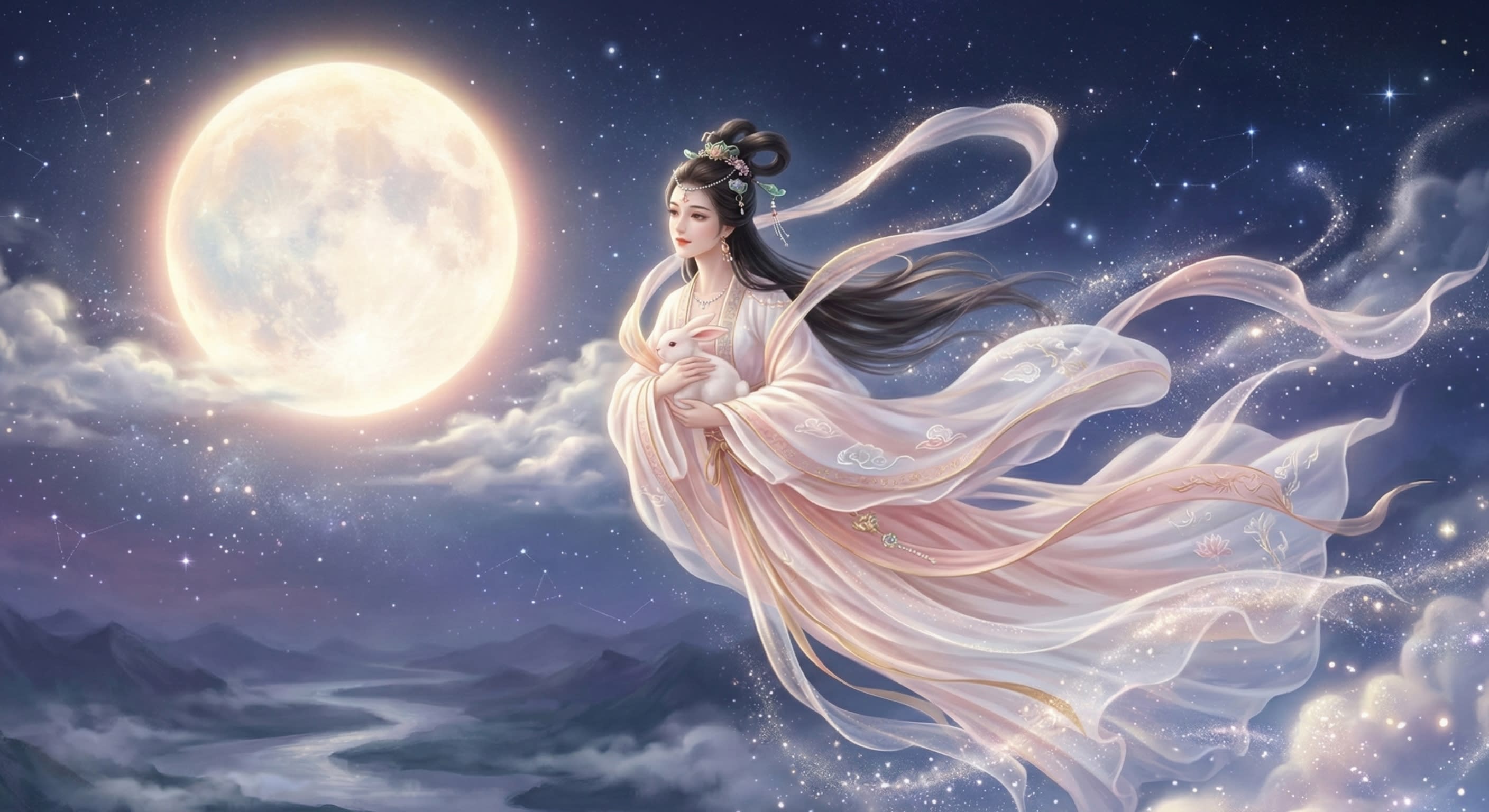
Fate, however, is a cruel author. An apprentice attempted to steal the potion while Hou Yi was away. In a desperate act of protection, Chang’e drank it herself. She became weightless, drifting through the window and toward the stars, ultimately choosing the moon—the closest point to her husband’s home—as her eternal residence. When Hou Yi returned to find his wife gone, he set up a table in their garden, offering the fruits and cakes she loved. Neighbors, touched by his devotion, joined him in the gesture. That act of mourning and love became the foundation of the Moon Festival.
🥮 2. Mooncakes: From Secret Rebellion to Culinary Icon
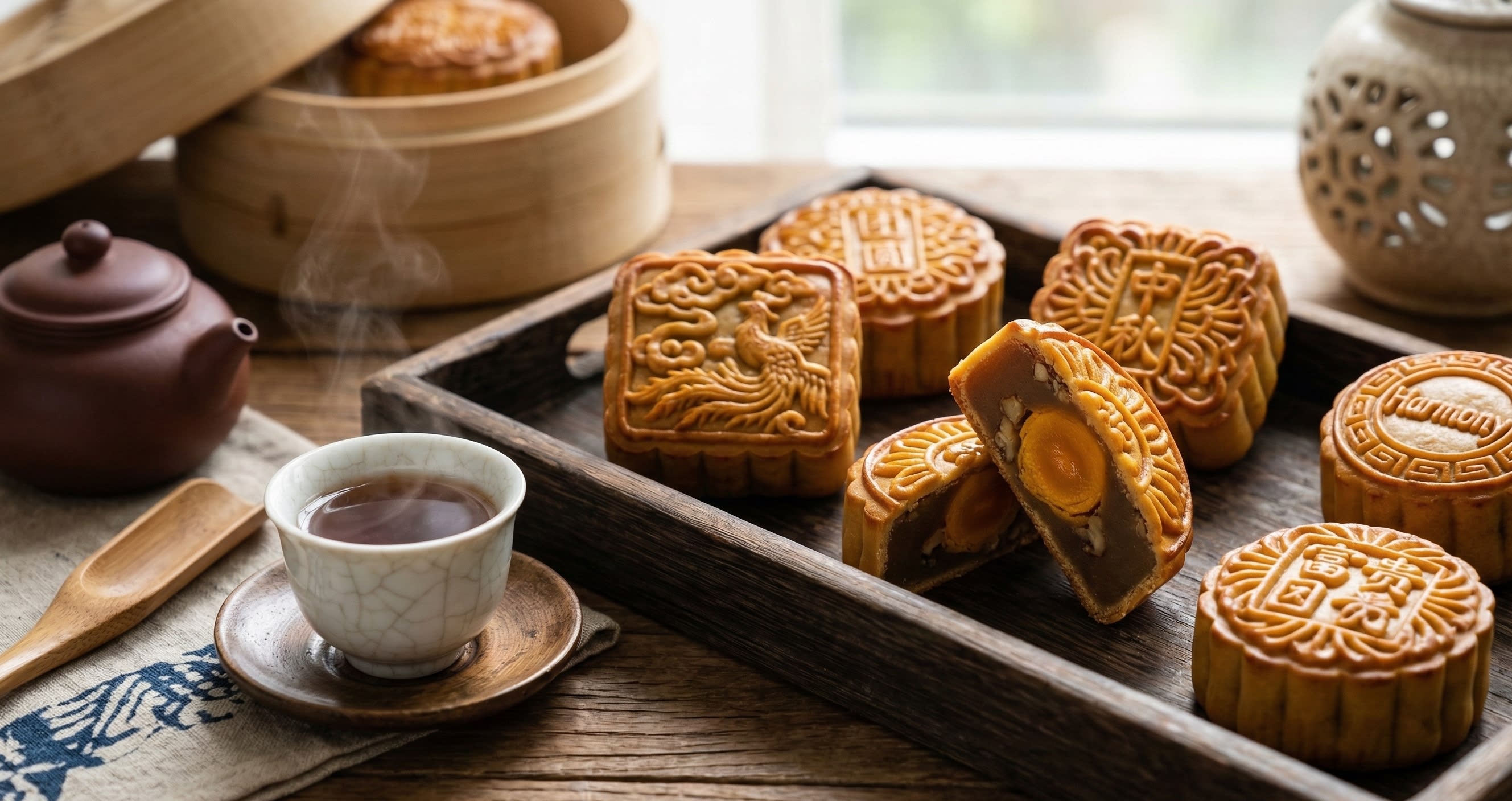
If you visit China during the Mid-Autumn season, you are literally surrounded by Yuèbǐng (月饼), or mooncakes. These dense, circular treasures are the physical embodiment of the holiday—a culinary representation of a family that has come full circle.
The Hidden Message of the Rebels
Mooncakes haven’t always been the refined, gift-boxed pastries we see today. Centuries ago, they served as a clever tool of liberation. During the twilight of the Yuan Dynasty, the Han people sought to overthrow the ruling Mongols but struggled to coordinate a nationwide uprising under the watchful eyes of the authorities.
The rebel strategist Liu Bowen allegedly distributed mooncakes that contained a secret: a slip of paper hidden within the filling, calling for an attack on the 15th night of the 8th lunar month. When the message was discovered, the revolution ignited in unison, and the dynasty fell. Whether this is literal history or a piece of embellished folklore, the mooncake remains a symbol of collective will.
The Great Flavor Debate
Like many things in China, the “correct” mooncake is a subject of passionate, often heated debate.
- Cantonese Style (Guǎngshì 广式): This is the version most familiar to international palates. It features a thin, mahogany-colored crust and is filled with lotus seed or red bean paste. The ultimate version contains a salted duck egg yolk in the center, a golden orb meant to mimic the moon itself.
- Suzhou Style (Sūshì 苏式): If you prefer texture, these are a delight. They have a white, puff-pastry shell that shatters into thousands of buttery, flaky layers. They can be found with sweet fillings or savory ones—the latter being a particularly satisfying treat filled with fresh pork.
- The “Five Nuts” (Wǔrén 五仁): You either love it or you avoid it at all costs. This traditional filling—packed with walnuts, almonds, sesame, and melon seeds—is a point of contention. While younger generations often recoil at the dense, rustic texture, the older generation views it as the only “real” mooncake. It is a taste of memory.
👨👩👧👦 3. Shǎngyuè (赏月): The Ritual of Moon Gazing
The heart of the holiday is Shǎngyuè (赏月), the art of moon-gazing. In modern cities like Shanghai or Shenzhen, where skyscrapers often dominate the view, you might think this tradition would vanish. Instead, you see families moving their tables to open-air balconies or public parks, leaving the neon lights behind to reconnect with the sky.
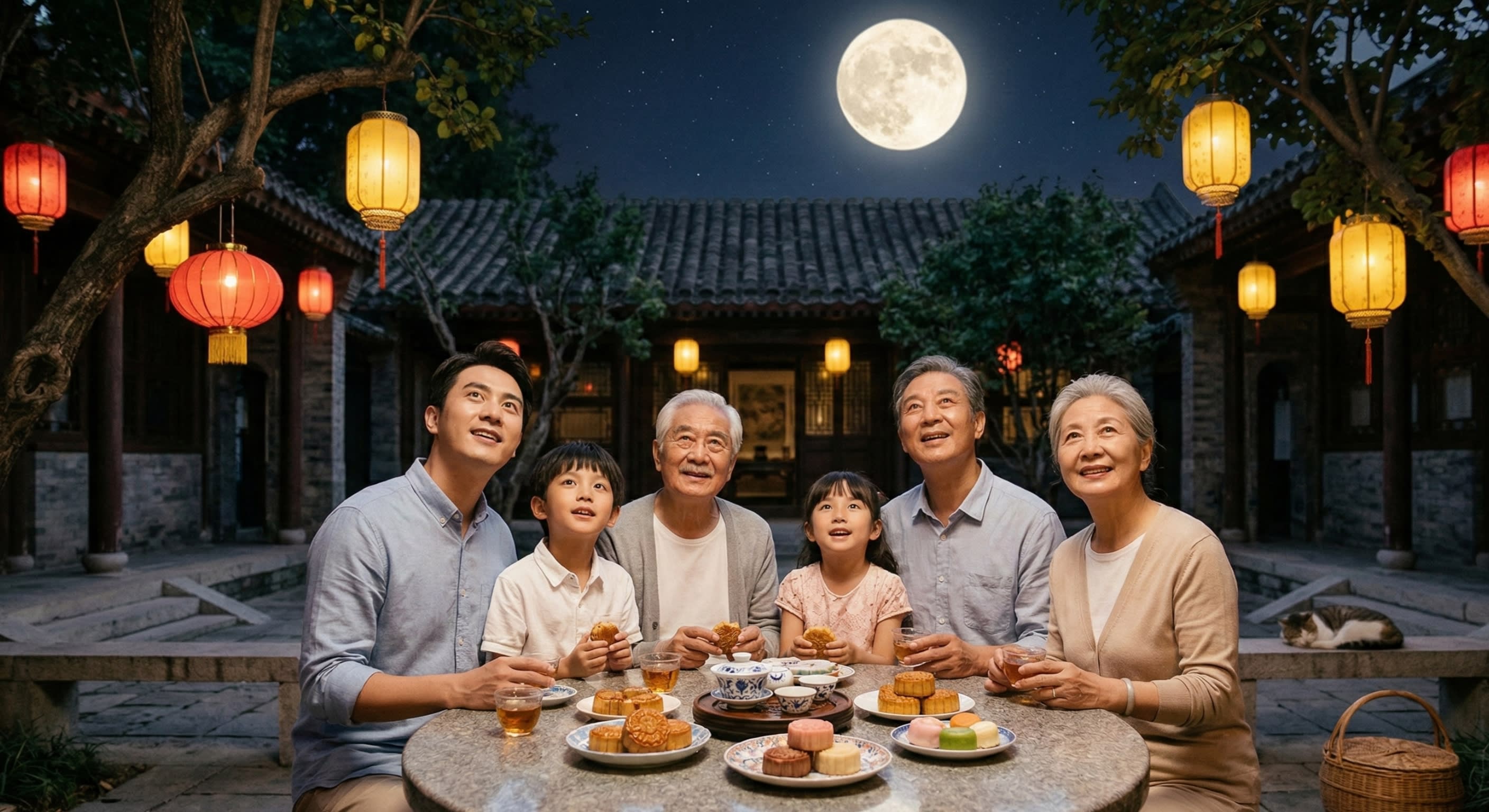
For a native, watching the moon on this night triggers a feeling of Wǔwèi záshén (五味杂陈)—literally “the five flavors mingled together,” describing a complex, bittersweet emotional state. It’s a moment of joy if the family is intact, but a moment of longing if distance separates you. This is why you’ll often hear people reciting the famous lines of Su Shi, the great Song Dynasty poet:
“May we all be blessed with longevity, though far apart, we are still looking at the same beautiful moon.”
It is a comforting thought that we can all look at the same silver light, no matter how many miles lie between us.
🌼 4. Osmanthus and Wine: The Scents of Autumn
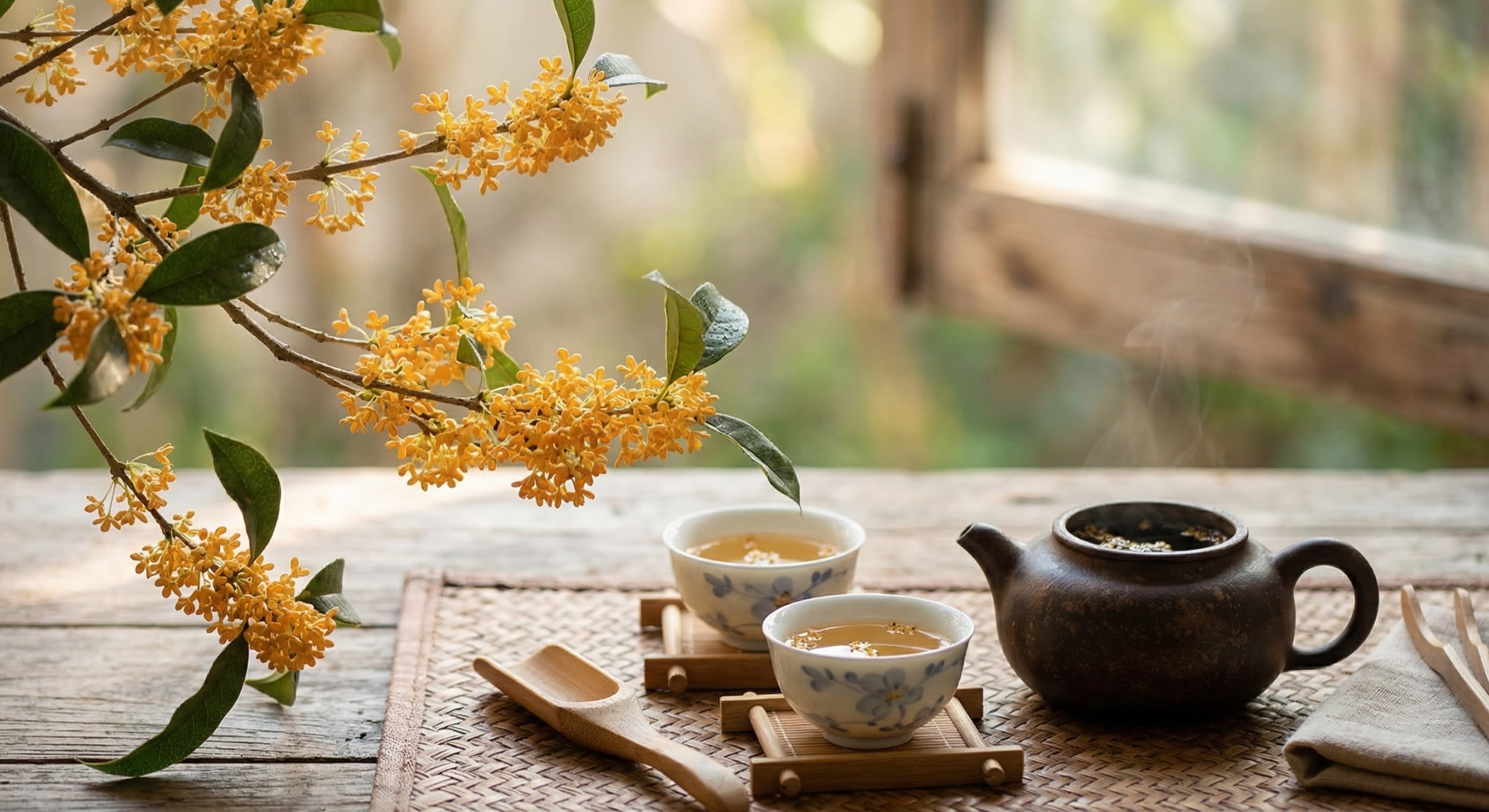
The Mid-Autumn Festival isn’t just a visual experience; it has a fragrance. This season marks the height of the Guìhuā (桂花), or osmanthus blossom.
These tiny, golden flowers possess a perfume that is impossibly sweet, a blend of apricot and warm honey that seems to hang in the cool autumn air. It is traditional to toast the moon with Guìhuā jiǔ (桂花酒), a sweet osmanthus-infused wine. Drinking it while the scent of the flowers wafts over the table is, in my opinion, the most refined sensory experience the season offers.
💬 5. Essential Mid-Autumn Vocabulary
If you find yourself celebrating with friends, these terms will allow you to participate in the conversation with local nuance:
| The Term | Pinyin / Characters | Context |
|---|---|---|
| Happy Mid-Autumn | Zhōngqiū kuàilè 中秋快乐 |
The essential greeting for the day. |
| Reunion | Tuányuán 团圆 |
The emotional goal of the holiday. |
| Moon-gazing | Shǎngyuè 赏月 |
The act of appreciating the full moon. |
| Mooncake | Yuèbǐng 月饼 |
The iconic pastry shared by families. |
The Mid-Autumn Festival is a gentle reminder that even as our world accelerates, the rhythms of nature and the human need for connection remain the true North Star. The moon will always return to its perfect, round state. Families will always carve out time to sit together.
If you are just beginning to explore these cultural depths, I highly recommend reading about the 24 Solar Terms, which provide the calendar structure for these moments of reflection. And if you’re planning a trip to catch the best moonscapes for yourself, check out our guide on romantic travel destinations.
㊗️ Wishing you a bright moon, a warm home, and a very happy Mid-Autumn Festival!