
🥮 Introduction: The Jewel of the Chinese Bakery
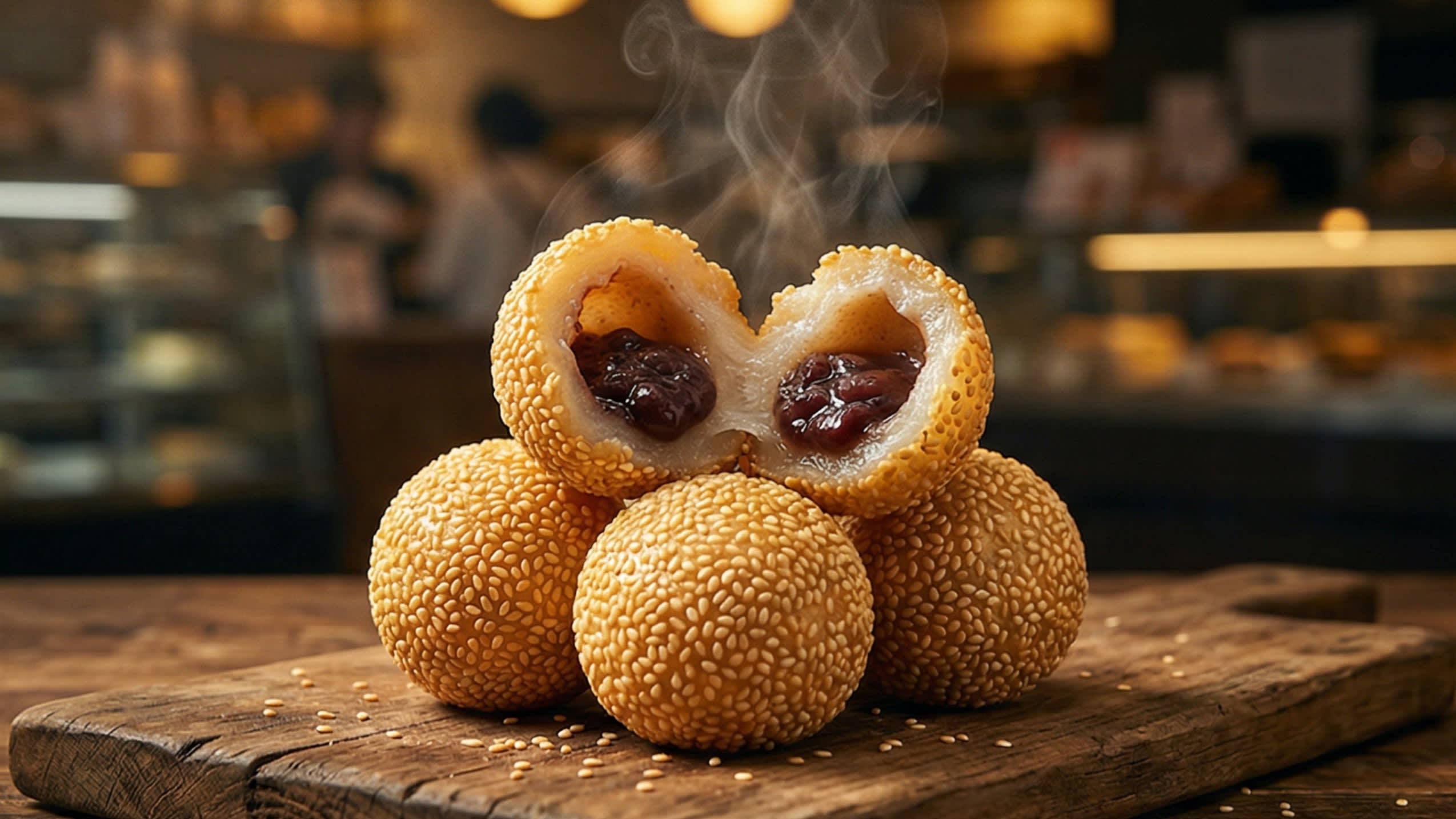
If you step into an authentic Chinese bakery early in the morning—past the rows of buttery egg tarts and the savory, scent-filled trays of roast pork buns—your eyes will inevitably gravitate toward a stack of glowing, perfectly spherical golden globes encrusted in toasted sesame seeds. These are Sesame Balls (芝麻球 - Zhīma Qiú), or as we call them in Cantonese, Jian Dui (煎堆).
To me, these are the undisputed royalty of Chinese deep-fried sweets. When I manage to fry them perfectly, the sensory payoff is incredible. You get that initial, deeply nutty, shatteringly crisp crunch from the exterior. Just beneath that, you hit a layer of warm, stretchy dough that reminds me of high-end mochi, and in the very center—suspended within a hollow, airy cavern—rests a soft dollop of sweet, earthy Red Bean Paste. It is the perfect marriage of Wàisū lǐnuò (外酥里糯 - Crispy outside, chewy inside).
During the Lunar New Year, these spheres are mandatory. I remember watching my elders fry them, noting how they expand to three times their original size, embodying the spirit of the Cantonese proverb: “Jian Dui lulu, jin yin man wu” (煎堆辘辘,金银满屋)—”As the sesame balls roll, gold and silver fill the house.”
However, I’ll be the first to admit that attempting these at home can be a recipe for disaster. My early batches often ended in heartbreak: dough that cracked mid-fry, balls that would aggressively burst, or the most tragic outcome of all—perfectly round spheres that deflated into sad, wrinkled pancakes the moment they touched a cooling rack. Today, I am going to walk you through the culinary physics required to achieve that elusive, hollow center every single time.
🔬 The Dough Science: “Tang Mian” (烫面)
The single biggest error I see in home recipes is treating this like standard wheat dough. The foundation here is Glutinous Rice Flour (糯米粉 - Nuòmǐfěn), which contains zero gluten. If you try to mix it with cold water, you end up with a pile of damp, unusable sand that cracks upon touch.
To master this, I rely on the technique of Tàng Miàn (烫面 - Scalding the Dough). By pouring rapidly boiling water directly into the mixture of rice flour and sugar, the intense heat gelatinizes a portion of the starches instantly. This serves as a molecular glue, transforming a crumbly mess into a smooth, elastic, and incredibly pliable dough that feels almost like professional pastry clay. This structural integrity is your best insurance policy against cracking during the violent expansion of frying.
🧲 The Secret to Perfectly Attached Seeds
I often hear the complaint, “Why do all my sesame seeds end up in the bottom of the wok, leaving me with bald dough balls?” It happens because the surface of a raw rice ball simply isn’t tacky enough.
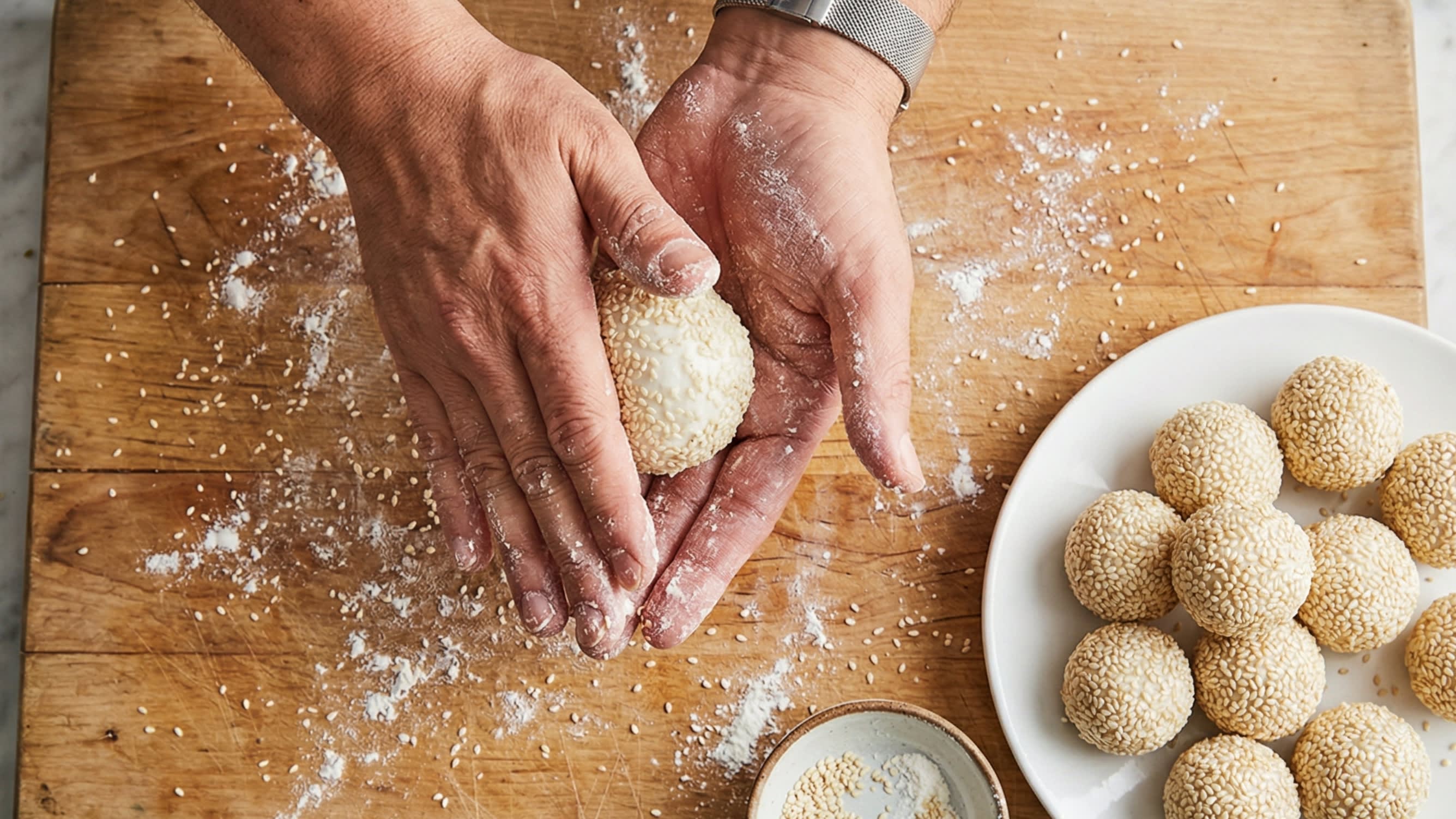
The trick I use is twofold. Once I have formed the balls, I briefly submerge them in a bowl of cold water, then roll them in white sesame seeds. But the real secret happens immediately after: I take each coated ball and roll it firmly between my palms again. This physical pressure acts as a mechanical bond, embedding the seeds deep into the surface of the dough, ensuring they stay put when the oil hits.
💥 The Physics of Frying: Low Heat and “The Press”
Frying Jian Dui is unlike any Western frying technique I know.
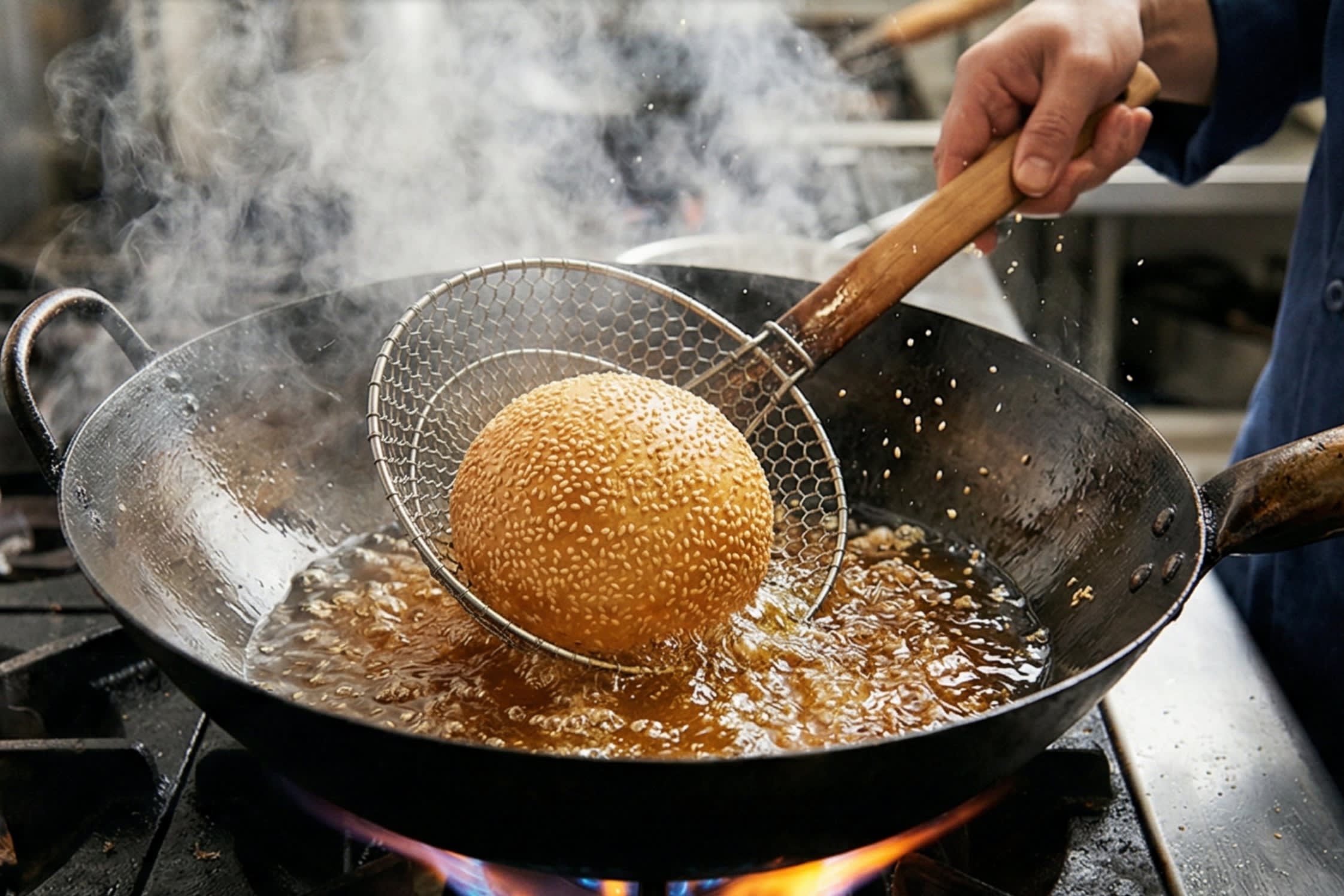
Rule 1: Temperature Control. If you drop these into 350°F (175°C) oil, the exterior hardens into a rigid cage before the air inside can expand. The internal steam pressure builds until, inevitably, you have an explosion. I keep my oil strictly around 300°F (150°C). This slow, gentle heat allows the dough to stretch evenly as it swells.
Rule 2: The “Pressing” Technique (按压膨胀). This is the mark of a pro. When the balls start to float, they are merely warm and dense. To turn them into massive, hollow spheres, I use a metal strainer to gently press them down into the oil. When I release the pressure, the balls bounce back up. I repeat this 4-5 times. The physical force, combined with the heat, mimics a hot air balloon effect, inflating the dough into a cavernous, hollow shell.
If you are looking for other fried delights, you might enjoy mastering my Authentic Salt and Pepper Tofu or the legendary Crispy Chinese Spring Rolls.
🛠️ The Essential Toolkit
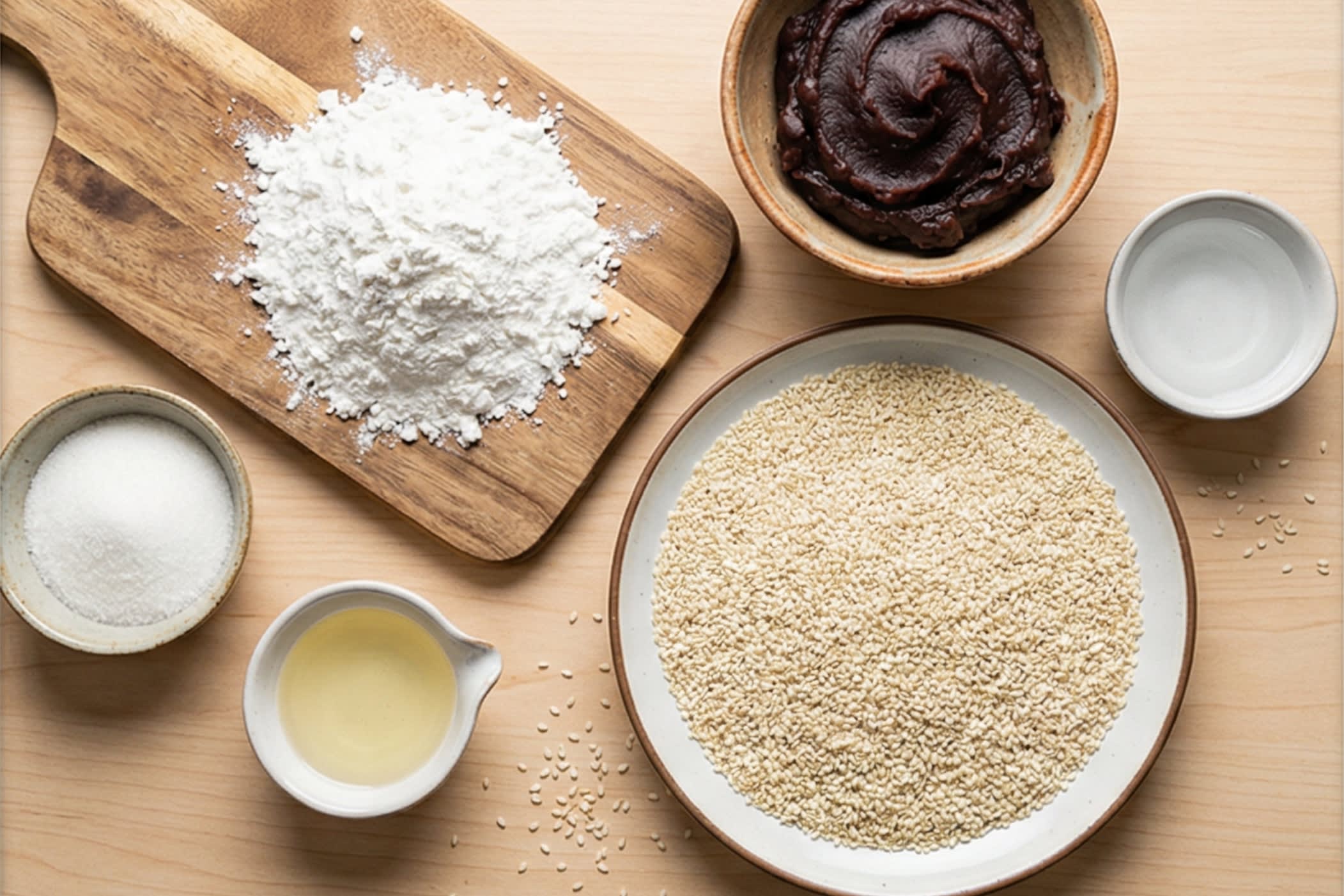
To prepare for this, I recommend gathering your high-quality Glutinous Rice Flour, a smooth Sweet Red Bean Paste, and a reliable Instant Read Kitchen Thermometer to ensure the oil stays at that crucial 300°F threshold. Using a sturdy Asian Stainless Steel Spider Strainer will also make the “pressing” technique feel safe and effortless.
📝 Step-by-Step Execution
| Step | Instruction |
|---|---|
| 1. Prep Filling | Scoop red bean paste into 15g marbles; chill in the fridge so they remain firm and easy to wrap. |
| 2. Scald Dough | Combine flour and sugar. Stir in rapidly boiling water until shaggy flakes form. |
| 3. Knead | Add oil and knead until the dough becomes a smooth, elastic sphere resembling soft clay. |
| 4. Assembly | Wrap filling in dough, seal tightly, and roll between palms until the surface is flawless. |
| 5. Seed Coating | Dip into water, then into sesame seeds. Firmly press the seeds into the dough with your palms. |
| 6. Fry | Fry at 300°F. When they float, use a strainer to press them down, repeating until massive and hollow. |
💡 Pro Tips for Success
- Dough Maintenance: Glutinous rice dough loses moisture faster than you’d think. Always keep the unused portion covered under a damp towel. If it starts to crack while you are wrapping, a tiny drop of water kneaded back in will save it.
- Avoid Deflation: If you pull the balls out while they are still blonde, they will collapse. You must fry them until they are a deep, uniform golden-brown to ensure the crust is sufficiently dry and rigid to hold that hollow structure.
- The Danger Zone: If your balls explode, it is almost certainly because the oil temperature exceeded 320°F. Keep your thermometer handy; precision is the only way to guarantee a peaceful frying session.
Whether you are hosting a Lunar New Year feast or just want to experience that bakery-style magic at home, this recipe will get you there. It takes a little practice to get the “pressing” technique just right, but once you master it, the satisfaction of hearing that shatteringly crisp crunch is well worth the effort.
Disclaimer: As an Amazon Associate, ChinaCurator earns from qualifying purchases.