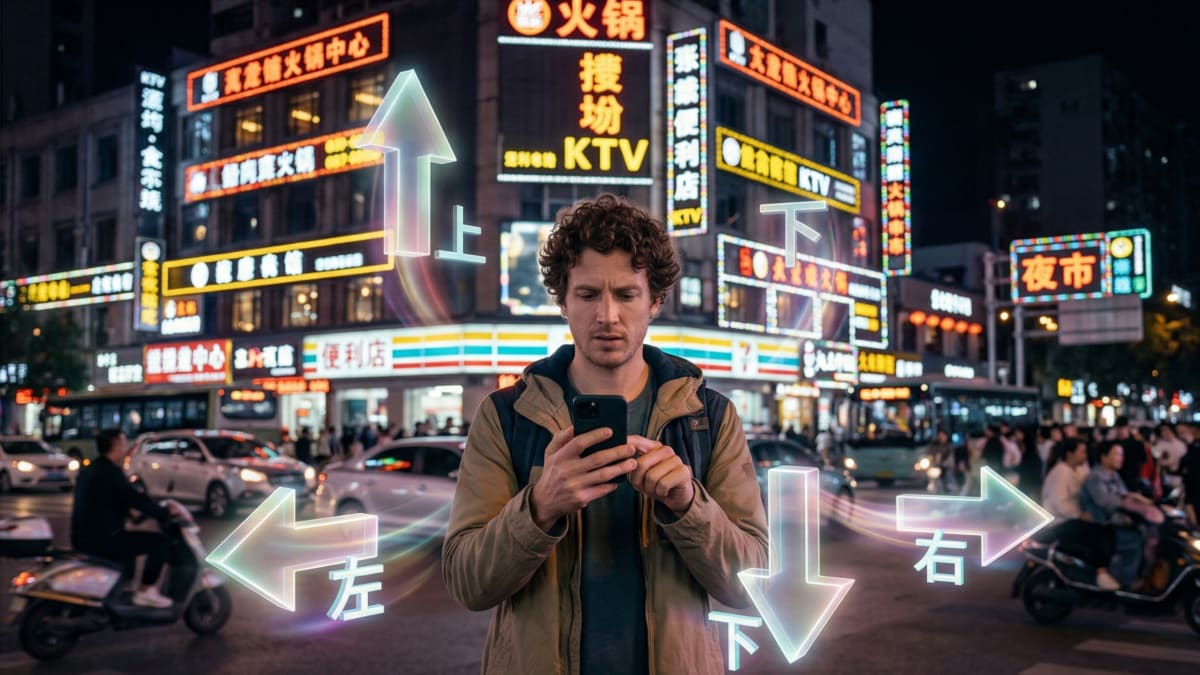
I still remember the first time I felt truly defeated by the streets of Beijing. I was running late for a dinner party in a hutong I’d visited only once before. My phone’s battery had plummeted into the red zone, the screen flickering like a dying candle, before finally giving up on me entirely at a chaotic, neon-lit intersection. I stood there, the cool night air biting at my skin, while the heavy smell of charcoal smoke and street-side lamb skewers swirled around me. I hailed a taxi, breath hitching in my throat, and showed the driver the scribbled address. As we approached the final turn, the driver glanced at me in the rearview mirror and barked, “Zěnme zǒu?” (How do we go?).
I panicked. My heart hammered against my ribs—that distinct, cold prickle of anxiety every language learner knows. I knew the restaurant was on the left, but my brain seized. I stammered, pointing vaguely at the windshield, utterly paralyzed by the fear of sending us into a dead end.
Spatial awareness isn’t just about memorizing words; it’s a foundational survival skill. But as I’d soon learn, Chinese direction words—方位词 (fāngwèicí)—operate on a logic that feels entirely backward to a native English speaker. If you want to stop getting lost, find your missing keys, and navigate the city like a local, you have to stop thinking in English.
1. The Core Compass: The Building Blocks
Before we tackle the grammar, you need to internalize the core vocabulary. These characters are the DNA of Chinese spatial orientation.
- 上 (shàng): Up / Above
- 下 (xià): Down / Below
- 左 (zuǒ): Left
- 右 (yòu): Right
- 前 (qián): Front / Forward
- 后 (hòu): Back / Behind
- 里 (lǐ): Inside
- 外 (wài): Outside
Pro Tip: Don’t just memorize them; see them. Chinese characters are inherently visual. Look at 上 (Up); the single vertical stroke is clearly perched above the horizontal baseline. Now look at 下 (Down); the stroke hangs below that same horizontal line. They are literal maps for your eyes.
2. The Suffix System: Why We Need 面 (miàn) and 边 (biān)
In daily conversation, native speakers rarely use these single characters in isolation. A single syllable can sound abrupt, almost robotic. Instead, we use suffixes to ground these concepts into physical, tangible locations.
You’ll hear these three suffixes constantly:
- 边 (biān): “Side” or “edge.” Used for directions and physical placement.
- 面 (miàn): “Surface” or “face.” This is a bit more formal and is the go-to for many learners.
- 头 (tóu): “Head” or “end.” This is heavily favored in Northern Chinese dialects and feels more casual.
So, when I’m looking for something, “Up” (上) naturally becomes 上面 (shàng miàn)—the top surface—or 上边 (shàng biān)—the upper side. If I’m digging through my sturdy travel backpack looking for my passport, I’m looking 里面 (lǐ miàn), the inside surface. For a beginner, don’t overthink the difference between biān and miàn; they are largely interchangeable in casual speech.
3. The Grammar Trap: The “Reverse Geography” Rule
This is the moment where most English speakers hit a wall. In English, we use prepositions—we say “the cat is on the table.” The location word comes first.
Chinese, however, uses postpositions. You must state the object first, then the direction. You aren’t saying “on the table”; you are saying “the table’s top surface.”
The Chinese Formula:
Noun + 方位词 (Direction Word)
- On the table: 桌子上 (Zhuōzi shàng)
- In the bag: 包里 (Bāo lǐ)
- Behind the sofa: 沙发后面 (Shāfā hòumiàn)
If you’re helping me move into my new place and ask where the box is, and I point to the sofa, I’ll tell you, “在沙发后面” (Zài shāfā hòumiàn). Note the verb 在 (zài), which means “to be located at.” Never, under any circumstances, try to say “在后沙发.” That would be the linguistic equivalent of saying “the behind-sofa is at,” which will leave your Chinese friends staring at you in utter confusion.
4. Street Survival: Directing the Taxi Driver
When I’m in the back of a taxi, my anxiety levels often hinge on my ability to communicate the final turn.
- To turn: You can use 转 (zhuǎn) or 拐 (guǎi). If you’re traveling through the winding streets of Shanghai, you’ll hear zhuǎn more often; in the straight, grid-like streets of Beijing, guǎi is the king of commands.
- Straight: Keep it simple with 一直走 (Yìzhí zǒu), which literally translates to “walk/go straight.”
The Taxi Survival Sheet:
- Turn Left: 左转 (Zuǒ zhuǎn) / 左拐 (Zuǒ guǎi)
- Turn Right: 右转 (Yòu zhuǎn) / 右拐 (Yòu guǎi)
- Go Straight: 一直走 (Yìzhí zǒu)
If you’re really feeling the pressure, just keep your commands short and rhythmic. “师傅,路口,左拐” (Shīfu, lùkǒu, zuǒ guǎi—Driver, intersection, turn left). It’s efficient, clear, and perfectly polite.
5. The Mind-Bending Rule: Mapping Time with Space
This is where the logic of Chinese truly gets beautiful. While English speakers view time as a horizontal line—past behind us, future ahead—Chinese speakers view time as a vertical, flowing river.
Gravity pulls time downward.
- The past is Up (上 - shàng) because it has already occurred and piled up.
- The future is Down (下 - xià) because it hasn’t happened yet; it is still “descending” toward us.
This is why we say:
- Last week: 上个星期 (Shàng ge xīngqī - “The up week”)
- Next week: 下个星期 (Xià ge xīngqī - “The down week”)
It’s a conceptual shift that took me months to master. When you talk about weeks, months, or semesters, stop thinking left-to-right and start thinking up-to-down. If you’re planning your 2026 travel calendar, keep this vertical logic in mind; it makes memorizing these phrases so much more intuitive.
6. The Master Direction Matrix
Use this guide to keep your bearings, whether you’re navigating a high-speed train station or looking for a lost phone.
| Concept | Chinese | Pinyin | Usage Example |
|---|---|---|---|
| Up / On | 上面 | Shàng miàn | 在桌子上 (On the table) |
| Down / Under | 下面 | Xià miàn | 在椅子下面 (Under the chair) |
| Left | 左边 | Zuǒ biān | 左转 (Turn left) |
| Right | 右边 | Yòu biān | 右转 (Turn right) |
| Inside | 里面 | Lǐ miàn | 在包里 (Inside the bag) |
Final Thoughts from Tao
Rewiring your brain to process space and time this way feels exhausting at first. There were nights in Beijing when I felt like I was learning to walk again, stumbling over the most basic grammatical structures. But keep at it.
Once these concepts click, you’ll stop translating and start thinking. You’ll find yourself navigating the subway, the busy night markets, and your own schedule with a newfound, native-like confidence. So, next time you’re out, don’t rely on the GPS. Point the way, take a deep breath, and command your own journey: “一直走!” (Keep going straight!).
If you’re still feeling a bit shaky with your Chinese grammar, check out my guide on The 3 ‘De’s of Chinese Grammar to clear up those common pitfalls, or dive into The Shape-Shifting ‘Yi’ to refine your pronunciation. Mastering these small details is exactly what separates a tourist from a true curator of Chinese culture.
Disclaimer: As an Amazon Associate, ChinaCurator earns from qualifying purchases.