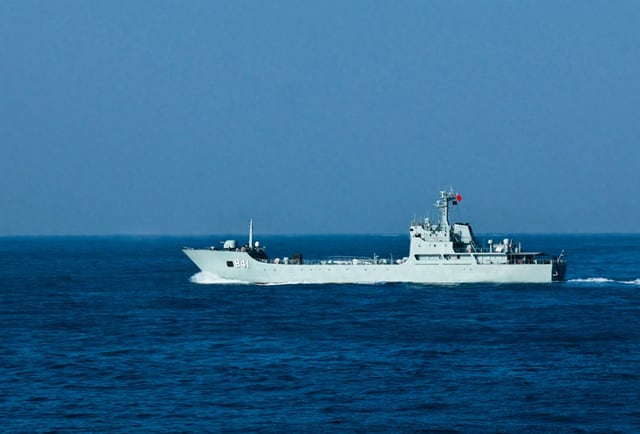
I watched the raw video footage coming out of the East China Sea (Dong Hai 东海) this week, and even through a computer screen, I could almost feel the bone-chilling Siberian wind whipping off the gray, churning swells. For anyone who has ever stood on the deck of a vessel in the dead of winter, you know that the sea in January is an unforgiving, metallic wilderness. The spray doesn’t just wet the deck; it freezes almost instantly into a slick, treacherous glaze on steel railings and gun mounts.
It was against this brutal, salt-encrusted backdrop that the Eastern Theater Command of the People’s Liberation Army (Zhongguo Renmin Jiefangjun Dongbu Zhanqu 中国人民解放军东部战区) recently unleashed a series of intensive, unscripted live-fire naval exercises. Designed to test the absolute limits of both human endurance and high-tech naval hardware, the drills painted a stark picture of modern maritime confrontation in one of the world’s most contested waterways.
The Cold Realities of the Eastern Theater
For those of us tracking Western Pacific defense dynamics, these exercises are more than routine calendar events. They represent a grueling physical test. While civilian families across the mainland were preparing for the massive domestic travel rushes—much like the colossal migrations we see during China’s 2026 Spring Festival Travel Rush—these naval crews were isolated at sea, steering steel hulls through relentless winter gales.
The weather itself is a silent adversary. The biting cold of the northern maritime corridors—a stark contrast to the dry, high-altitude freeze that has driven Qinghai’s cold resource breakthroughs—demands specialized equipment. On the open bridge, watchstanders rely on heavy thermal layers and specialized waterproof tactical jackets to keep the freezing spray from seizing their joints. Lookouts scanning the misty horizon through fog-resistant marine binoculars must contend with sea smoke and sudden, blinding squalls that can reduce visibility to mere yards in seconds.
In these conditions, the ships themselves become temperamental beasts. Hydraulic fluids stiffen, radar arrays face severe atmospheric clutter, and the simple act of moving across an exposed deck requires deliberate, claw-like footing. Yet, it is precisely this unforgiving environment that the PLA Navy (Zhongguo Renmin Jiefangjun Haijun 中国人民解放军海军) seeks out for its realistic combat training (shizhanhua xunlian 实战化训练). The philosophy is simple: if a crew cannot operate their weapons systems when their fingers are numb and the deck is pitching at a twenty-degree angle, they cannot operate them in a shooting war.
Step-by-Step Reconstruction: Inside the Drill
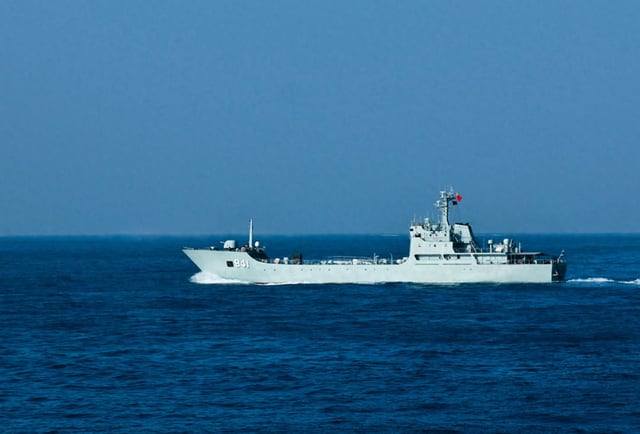
The core of the exercise involved a multi-type ship flotilla, primarily featuring landing ships (dalu jian 登陆舰) and escort destroyers. Unlike older, heavily scripted drills of the early 2000s, this operation was characterized by its rapid-fire transition between vastly different combat scenarios, leaving the crews with virtually zero prep time between alarms.
Phase I: Clashing with the Skies (Air Defense)
The exercise initiated without warning when shipborne air-search radars picked up multiple low-altitude radar returns—simulated inbound anti-ship cruise missiles skimming just feet above the whitecaps.
Within seconds, the tranquil hum of the ship’s diesel engines was shattered by the high-pitched shriek of the general quarters alarm. Inside the Combat Information Center (CIC), the serene blue light transitioned instantly to a high-alert red glow. I have always found the transition inside a warship’s command center during a drill to be a masterclass in controlled chaos: the frantic, rhythmic barking of coordinate updates, the smell of warm electronics, and the rapid-fire clicking of keyboards as tactical action officers assign targets.
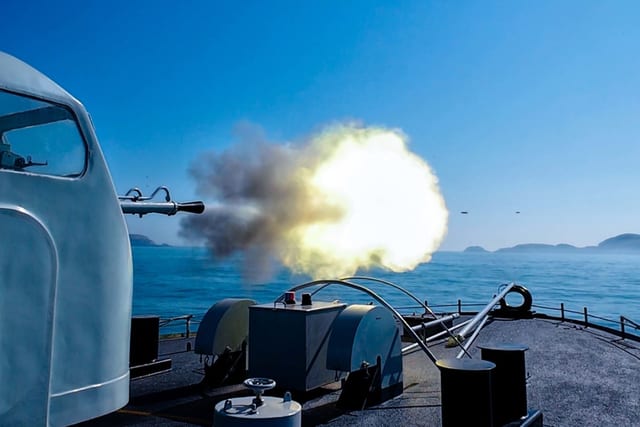
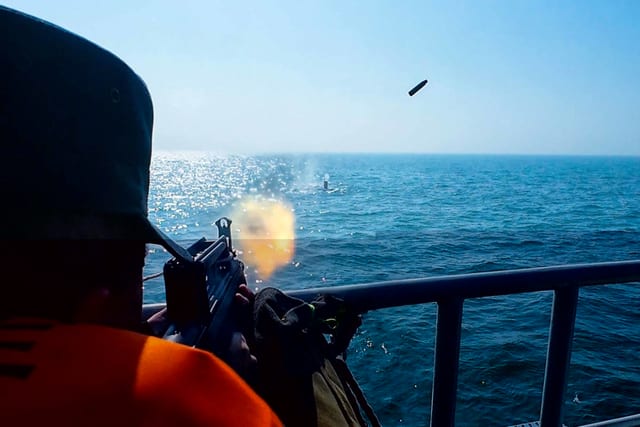
On deck, the ship’s main batteries swung into action. The massive muzzle flashes of the deck guns punched through the overcast gray sky, sending shockwaves through the hull that rattled the teeth of everyone on board.
Phase II: Asymmetric Surface Threats
No sooner had the simulated aerial threats been neutralized than the radar consoles lit up again. This time, the threat was closer, faster, and highly asymmetric: a swarm of simulated hostile fast-attack craft and explosive-laden maritime drones darting between the heavy ocean swells.
In the shallow, cluttered waters of the East China Sea, spotting these low-profile targets is notoriously difficult. The water’s surface acts as a mirror for radar waves, hiding small vessels in the “sea clutter.”
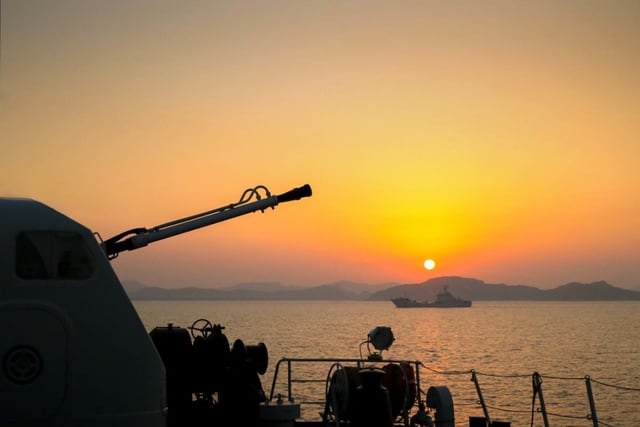
Commanders on the bridge had to coordinate immediate defensive maneuvers, turning the vessels to bring their secondary gun ports and heavy machine guns to bear. This phase tested the raw marksmanship of deck-mounted rifle teams, who had to lock onto highly agile targets while riding the violent, unpredictable roll of the ship.
Phase III: The Nightmare Scenario (Damage Control)
The final, and perhaps most grueling, phase of the drill simulated a worst-case scenario: a direct hit. Under the rules of realistic combat training, a ship is never assumed to emerge unscathed.
A simulated strike on the ship’s forward hydraulic station triggered a cascade of emergency events. Smoke generators filled the narrow, metallic companionways with thick, white artificial smoke, reducing visibility to zero. Power was cut to simulate localized electrical failures, leaving emergency damage control teams (sunshang kongzhi 损伤控制) to navigate the pitching ship by the dim, flickering light of chemical glowsticks.
Crews clad in heavy, stifling fire-proximity suits had to drag pressurized fire hoses through airtight hatches, simulating the grueling task of cooling superheated steel bulkheads while wading through ankle-deep water. This is where the physical toll of naval service becomes most apparent; the air inside these suits becomes hot and suffocating within minutes, and the sheer physical strength required to manage ruptured high-pressure lines on a rolling deck is immense.
Drill Profile & Tactical Overview
To better understand the scale and composition of these winter maneuvers, we can look at the operational components highlighted during the multi-day deployment:
| Exercise Phase | Primary Focus / Threat Simulated | Key Systems & Tactics Employed |
|---|---|---|
| Phase I: Integrated Air Defense | Low-altitude anti-ship cruise missiles; hostile strike aircraft. | Rapid radar hand-off, 130mm main batteries, Close-In Weapon Systems (CIWS). |
| Phase II: Surface Interdiction | Swarming fast-attack craft and maritime drone threats. | High-speed maneuvering, tactical coordinate sharing, secondary gun batteries and small arms engagement. |
| Phase III: Advanced Damage Control | Hull breaches, electrical fires, and steering failure under active bombardment. | Rapid isolation protocols, pressurized foam deployment, wet-deck casualty extraction. |
The Geopolitical Chessboard: Why the East China Sea Matters
To understand why the Eastern Theater Command operates with such relentless urgency, one must look at a map of the Western Pacific. Headquartered in Nanjing, the Eastern Theater Command is the ultimate tip of the PLA’s spear. Its geographical area of responsibility includes the sensitive waters of the Taiwan Strait (Taiwan Haixia 台湾海峡) and the contested waters surrounding the Diaoyu Islands (Diaoyu Dao 钓鱼岛).
For decades, naval warfare in this region was dominated by foreign blue-water navies. Today, however, the PLA Navy has transitioned from a coastal defense force into a formidable, modern blue-water navy (lanhai haijun 蓝海海军). These winter drills are designed to project a clear message of regional deterrence. Unlike the predictable parameters we expect when leveraging AI travel planning in 2026, the realities of maritime defense require preparing for total, chaotic signal degradation and structural strain.
The East China Sea is an incredibly complex battlespace. It is shallow—dominated by a vast continental shelf—which makes underwater acoustic tracking highly unpredictable. The thermal layers of the water change rapidly with the seasons, creating “shadow zones” where submarines can easily hide from surface sonar. This environmental complexity is why the PLA Navy places such emphasis on joint operations, requiring surface ships to seamlessly share tracking data with land-based anti-ship missile units and airborne early-warning aircraft.
The Evolution of PLA Training: De-Scripting the Drill
For years, international military observers criticized PLA exercises as being theatrical and overly scripted—rehearsed performances where target drones always flew in straight, predictable lines and damage control drills were scheduled down to the minute.
That era is long gone. Under current directives, “scripted” training is treated as a liability. Today’s exercises emphasize “unprogrammed” (wuyubao 无预报) events. Opposing forces (lanjun 蓝军—the “Blue Team,” representing adversarial forces) are given free rein to exploit the training units’ weaknesses, utilizing electronic jamming, sudden course changes, and simulated cyber-attacks to blind the command staff.
During this latest drill, the emphasis on “continuous combat capability” (lianxu zuozhan nengli 连续作战能力) was front and center. Crews were kept at their battle stations for days on end, simulating the physical and mental exhaustion of an active conflict. In a real-world clash, sleep deprivation is as deadly an enemy as an incoming missile. By forcing sailors to make high-stakes tactical decisions under extreme fatigue and freezing conditions, command staff can identify exactly which links in their operational chain are prone to snapping under pressure.
International Echoes and Regional Vigilance
Naturally, these drills do not happen in a vacuum. A live-fire naval exercise of this scale in the East China Sea immediately draws the attention of regional neighbors and international monitoring forces.
During the exercise, Japanese Maritime Self-Defense Force (JMSDF) surveillance aircraft and U.S. Navy vessels kept a close, watchful eye from international waters, mapping the electromagnetic signatures of the PLA vessels and analyzing their tactical maneuvering patterns. This quiet, high-stakes game of hide-and-seek is a daily reality in the Western Pacific, where electronic intelligence gathering is as constant as the tides.
From my perspective, what makes this drill particularly significant is its timing and focus. Landing ships are inherently offensive or amphibious transport assets. Testing their defensive readiness against air and surface attacks in high-intensity environments highlights a growing emphasis on survivability. It shows that the PLA Navy is not just focusing on how to transport force across water, but how to protect those highly valuable assets in highly contested, “anti-access” environments where every mile of progress must be fought for.
As the smoke cleared from the gun batteries and the flotilla steered back toward its homeports, the message left behind in the gray waters of the East China Sea was unmistakable. The Eastern Theater Command continues to sharpen its edge, turning the brutal, freezing winter into its greatest training ally. For regional observers and naval strategists alike, these cold-weather maneuvers offer a vivid reminder of the high stakes, high-tech realities of modern maritime power projection.
Disclaimer: As an Amazon Associate, ChinaCurator earns from qualifying purchases.