
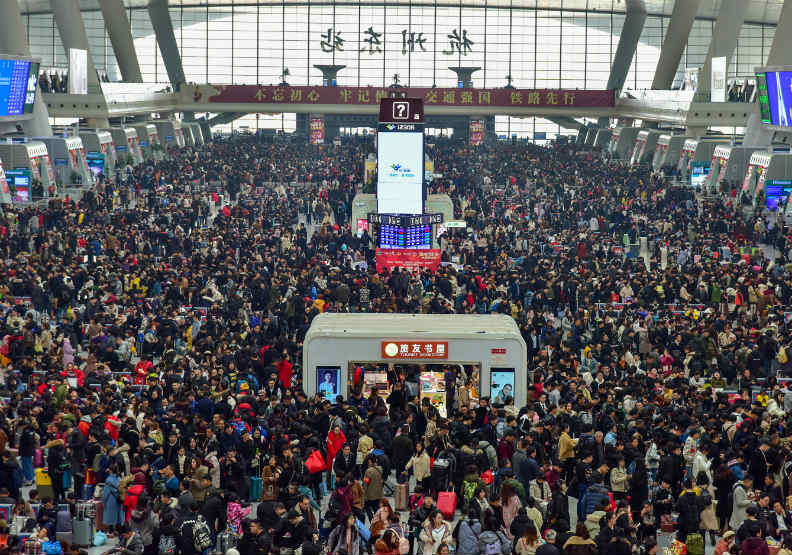
When I stand in the middle of a massive Chinese railway station during early February, the sheer scale of humanity is dizzying. The air is thick with the scent of braised beef instant noodles—the unofficial fuel of long-haul Chinese rail journeys—mixed with the crisp, dry winter wind blowing through the open doors. There is a rhythmic, symphonic roar: the collective clatter of thousands of rolling suitcase wheels on polished granite, parents calling out to their children, and the calm metallic chime of the announcer echoing over the departure gates.
This is not just a holiday travel rush. This is 春运 (Chūnyùn), the Spring Festival travel rush, and in 2026, I am watching it shatter every historical record. China’s State Council Information Office has announced that the 40-day travel period will see an estimated 950 million cross-regional trips—an incredible testament to the country’s social ties and transport infrastructure.

What is Chunyun?
To me, 春运 (Chūnyùn) has always felt like a heartbeat—an unstoppable, nation-wide pulse where everyone drops everything to return to their roots. The term refers to the 40-day period surrounding 春节 (Chūnjié), or Chinese New Year, when hundreds of millions of workers, students, and families migrate across the country.
To put 950 million trips into perspective, consider these figures:
- It is nearly 1.2 times the entire global population moving within one country in just over a month.
- It is equivalent to every single resident of the European Union boarding a train or plane twice.
- It is more than triple the total annual domestic air traffic of the United States.
As China travel in 2026 experiences a massive surge, the domestic transport networks are operating at absolute capacity to ensure that everyone makes it home in time for the highly anticipated 年夜饭 (niányèfàn)—the sacred reunion dinner on Lunar New Year’s Eve.
2026 Chunyun by the Numbers
The 2026 travel period runs from February 2 to March 13, covering 40 peak days. Based on the official estimates, the breakdown of how people are choosing to travel highlights some fascinating shifts in modern Chinese lifestyle:
| Transport Mode | Expected Volume | Key Notes & Personal Observations |
|---|---|---|
| Self-driving | ~760 million trips (80% of total) | Private cars remain the dominant choice. Highway networks are expanding rapidly, and toll fees are waived for passenger vehicles during the holiday. |
| Railway | 540 million trips | The lifelines of the migration, led by the ultra-efficient high-speed G-trains linking major economic hubs to regional towns. |
| Aviation | 95 million trips | A surging sector as airlines add midnight charter flights and new routes to second- and third-tier provincial cities. |

The “Reverse Migration” Trend
I’ve noticed a profound shift over the last few years. It used to be that Tier 1 mega-cities like Shanghai, Beijing, and Shenzhen would empty out completely, turning into peaceful, quiet ghost towns. Lately, however, there is a new phenomenon called 反向春运 (fǎnxiàng chūnyùn), or “reverse Spring Festival travel.”
Instead of younger professionals squeezing onto packed trains to head back to rural provinces, many are now buying tickets for their elderly parents and relatives to fly into the cities instead. It is often cheaper, more comfortable for the elders, and allows families to enjoy the festive city lights together.
Others are choosing to spend their holidays traveling to scenic spots. If you plan to be in a major city during this period, keeping your digital life running smoothly is absolutely essential. I always tell my visiting friends to master using mobile wallets like Alipay and WeChat Pay well before they land, as cash and foreign physical cards can be incredibly tricky to use when the holiday crowds peak.

On a recent road trip during a previous holiday rush, I survived a massive twelve-hour bottleneck simply because I had prepared ahead. I kept myself warm and cozy by packing a reliable insulated travel mug filled with hot jasmine tea and used sturdy luggage organizer bags to prevent my trunk from descending into total chaos during security checks.
My Survival Tips for Foreign Visitors
If you are planning to travel through China during late January or February, do not panic. With a little insider knowledge, you can navigate the rush smoothly:
- Book Everything the Second It Opens: Train tickets go on sale exactly 15 days in advance, and flights sell out weeks before that. Make sure you learn how to navigate the high-speed rail booking system early to secure your seats on the popular G-trains.
- Avoid the Peak Travel Windows: The three days immediately leading up to Lunar New Year’s Eve (February 17, 2026) and the final two days of the golden holiday are absolute gridlock. I once made the mistake of booking a last-minute flight on the eve of the festival, only to spend nine hours waiting out a delay at the airport.
- Opt for Rail Over Regional Flights: If you must travel, stick to high-speed rail. China’s rail system is incredibly punctual, whereas winter weather, heavy fog, and packed airspace frequently lead to frustrating airline delays.
- Pack for Personal Comfort: Train stations are incredibly noisy and bustling. I highly recommend buying a soft travel neck pillow and a high-quality pair of noise cancelling earplugs so you can catch some sleep amidst the festive chatter.
The Soul of the Migration
At its core, 春运 (Chūnyùn) is much more than a triumph of modern logistics—though watching a nation coordinate nearly a billion trips in forty days is nothing short of an engineering miracle. To me, it is a yearly reminder of the cultural emphasis on family.
It is the smell of freshly folded 饺子 (jiǎozǐ) waiting in a warm kitchen, the clinking of glasses of plum wine, and the profound sigh of relief when you finally step through the front door after a long journey. If you are willing to embrace the crowds, traveling during this period offers an unforgettable, deeply moving look into the very heart of Chinese society.
Source: State Council Information Office
Disclaimer: As an Amazon Associate, ChinaCurator earns from qualifying purchases.