
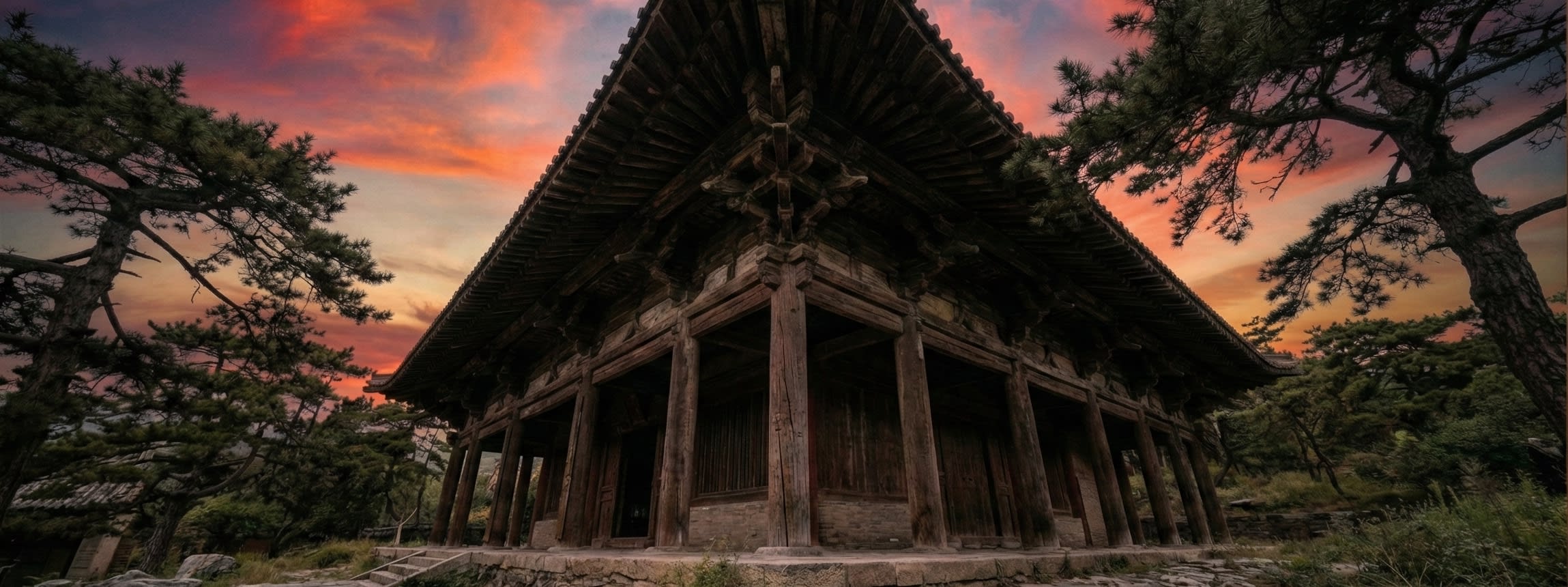
There is a proverb I often hear when chatting with local historians in the region: “For a 500-year history, look at Beijing; for a 5,000-year history, look at Shanxi.” While Beijing commands attention with the red walls and golden tiles of its imperial palaces, the province of Shānxī (山西) guards a much older, more fragile secret. Here, history isn’t just documented in books—it is still standing, breathing, and weathering the centuries in the form of the oldest surviving wooden buildings in all of China.
To walk into a structure like the Foguang Temple is to step into a time machine. You are crossing a threshold built over a millennium ago, held together entirely by precise joinery—no metal nails, no modern bolts, just the stubborn endurance of wood. Scholars often refer to these masterworks as “frozen music,” a nod to the way the beams, eaves, and brackets harmonize in a rhythm that feels both mathematical and poetic.
1. Why Shanxi? The Museum of “Above-Ground” History
When we think of ancient civilizations, we usually picture archaeologists dusting off pottery shards in deep pits. Shānxī breaks that narrative. Because of its rugged, mountainous terrain and a climate that stays reliably dry, the region has avoided the humidity that rots timber and the rapid urbanization that swallowed history in other parts of the country.
I vividly remember the thrill of learning about Liang Sicheng and Lin Huiyin. In the 1930s, these pioneers traversed the treacherous mountain passes of Shānxī on stubborn mules, fueled only by the belief that the Tang Dynasty’s architectural spirit hadn’t vanished. In the Wutai Mountains, they uncovered the Fóguāng Temple (佛光寺). Finding it was the equivalent of discovering a lost library; it confirmed that the wooden skeletons of China’s Golden Age were not just myths.
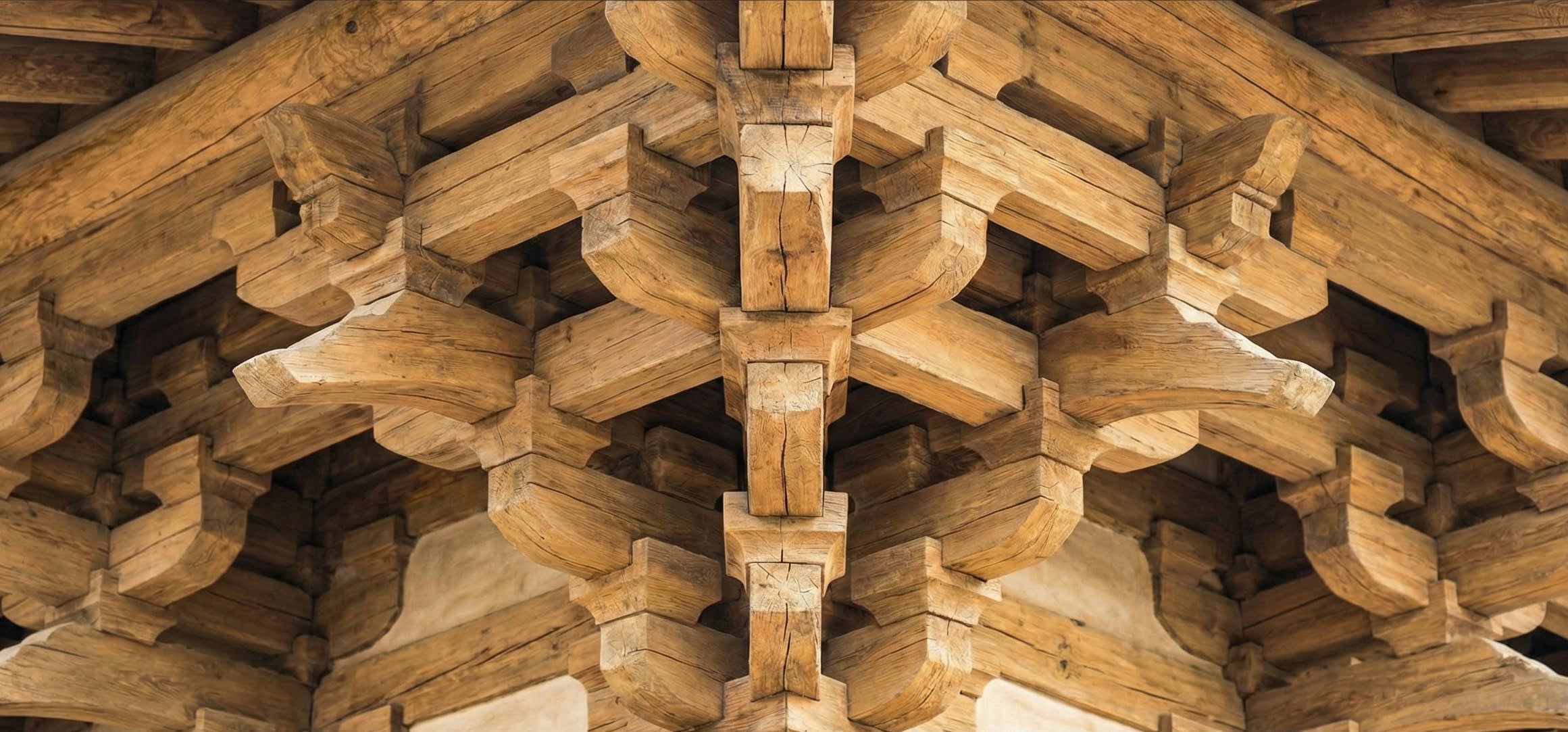
2. The Mechanics of Beauty: The Magic of “Dougong”
When you stand in the courtyard of a Shānxī temple, look up. Between the tops of the columns and the heavy, sweeping roof, you will see a dense, intricate cluster of interlocking wooden blocks. These are called dǒugǒng (斗拱).
If you are a fan of traditional puzzles, think of dǒugǒng as the ultimate “LEGO” set, but with life-saving engineering behind it. These brackets don’t just hold the roof up; they act as a flexible skeletal system. When the earth shakes, the joints shift ever so slightly, shedding seismic energy rather than resisting it. It is a brilliant, silent conversation between human craft and the laws of physics.
3. The Giants of Shanxi: A Quick-Reference Guide
If you are planning your own pilgrimage to these sites, it helps to know what you are looking at. Use this table as your field guide:
| Site Name | Dynasty | Age | Key Feature |
|---|---|---|---|
| Fóguāng Temple (佛光寺) | Tang (唐) | ~1,170 Years | The "First National Treasure" of Chinese architecture. |
| Yìngxiàn Wood Pagoda (应县木塔) | Liao (辽) | ~970 Years | The world's oldest and tallest wooden pagoda. |
| Jìncí Temple (晋祠) | Song (宋) | ~1,000 Years | Famous for the stunning "Flying Bridge." |
| Píngyáo Ancient City (平遥古城) | Ming/Qing | ~600 Years | A living museum of ancient finance. |
4. Reaching for the Clouds: The Yingxian Wood Pagoda
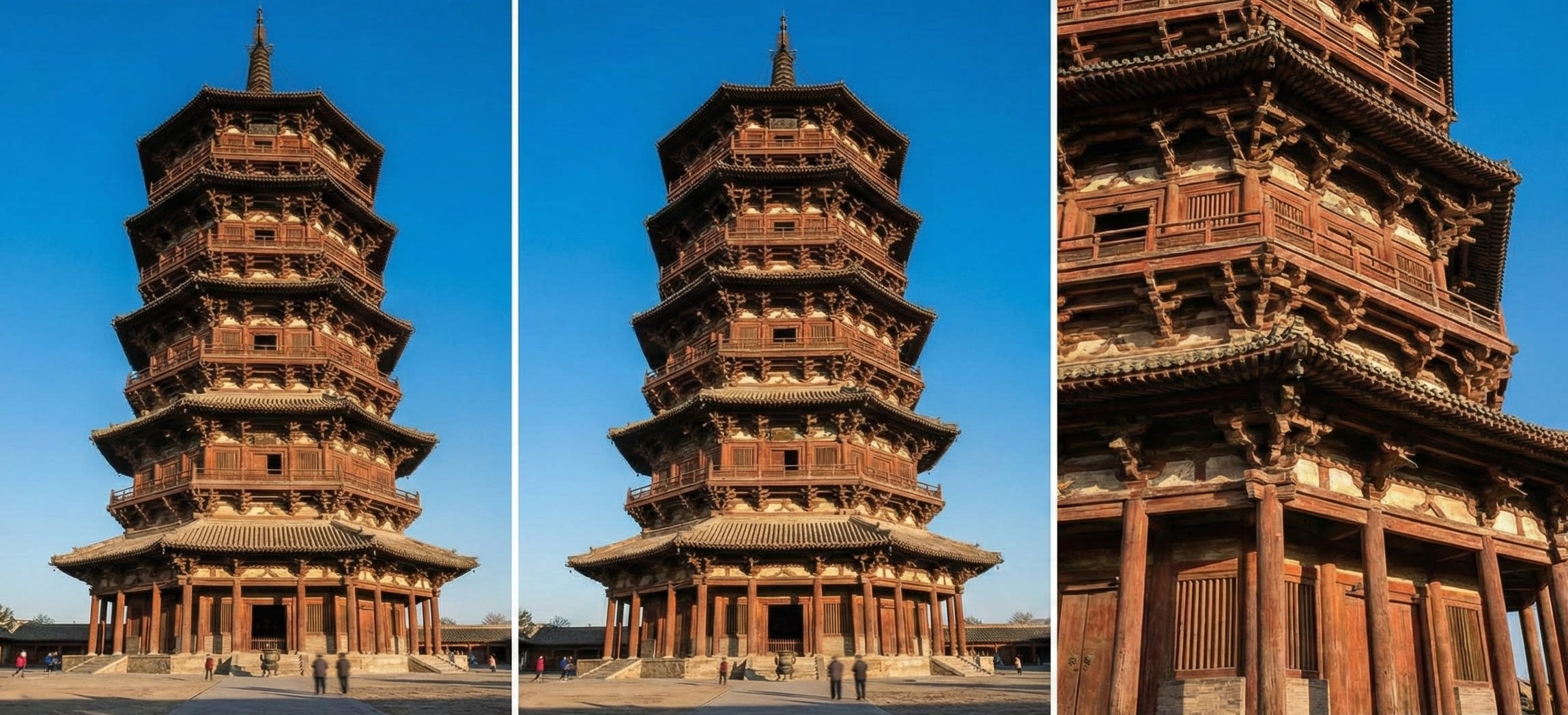
Standing at 67 meters—roughly the height of a 20-story building—the Yìngxiàn Wood Pagoda (应县木塔) isn’t just a building; it is a declaration of confidence. Built during the Liao Dynasty, it contains no steel reinforcements. None.
When I visited, I found myself walking around the base for an hour, craning my neck to count the layers of dǒugǒng. It is humbling to realize that for nearly a thousand years, this tower has stood through war, massive earthquakes, and the simple, crushing weight of gravity. It leans slightly, like an old man who has lived a full life, but it remains one of the most stable structures ever conceived by humanity.
5. Walking Through History: The Soul of Pingyao
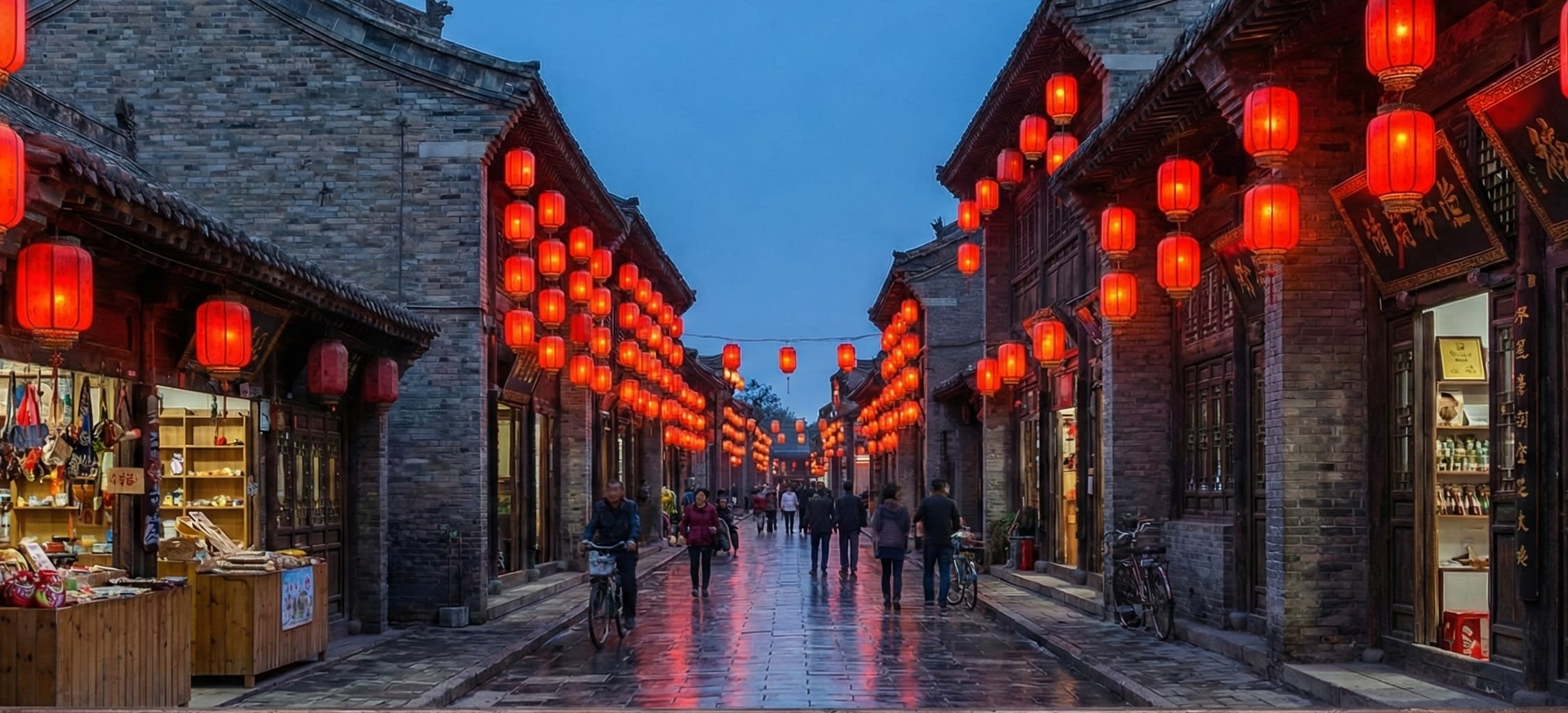
If the isolated temples are the “frozen music,” then Píngyáo (平遥) is the full orchestral score. This ancient city is walled, fortified, and miraculously preserved. As you walk the stone-paved streets, you aren’t just looking at history; you are inhabiting it.
This was the financial heartbeat of the Qing Dynasty. Inside the merchant courtyards, you can feel the rigid social hierarchy—the inner rooms were reserved for the head of the household, while the outer chambers were for business. At night, when the red lanterns flick to life and cast a warm, flickering glow on the gray brick, the noise of the modern world feels a world away. It’s the perfect place to pause and reflect on the meditative art of bead rubbing to quiet your own mind.
6. Curator’s Survival Tips for Shanxi
Traveling to Shānxī is far more comfortable today than in the 1930s, but it remains a rugged, authentic experience. Here is how to navigate it like a pro:
- Make Taiyuan your base camp. It is the most accessible hub for high-speed trains. Once you arrive, you can radiate outward to the mountains.
- Leave your camera flash off. The murals inside these temples are centuries old and light-sensitive. Please respect the silence and the preservation efforts of the local keepers.
- Carb-load on the local specialty. You cannot leave Shānxī without trying dāoxiāomiàn (刀削面), or “knife-cut noodles.” They are thick, chewy, and provide the exact kind of fuel you need after climbing temple stairs.
- Layer your clothing. Shanxi’s elevation means the sun can be harsh at noon, but the nights—even in mid-summer—can turn surprisingly chilly.
Final Thoughts
Shanxi’s architecture is a testament to the idea that humans, when working in harmony with nature and tradition, can create things that outlast their own lifespans. Whether you find yourself lost in the structural complexity of the Foguang Temple or tracing the mercantile history of Pingyao, remember that you are walking on the same dust and stone that poets and emperors have traversed for a millennium.
If you are craving more cultural depth, I highly recommend exploring the philosophy behind the 24 Solar Terms, which dictated the seasons for the builders who raised these halls. Or, if you want to understand the aesthetic of the Chinese literati, take a dive into the world of Wenwan collectibles.
Shānxī is waiting. Are you ready to listen to the music?