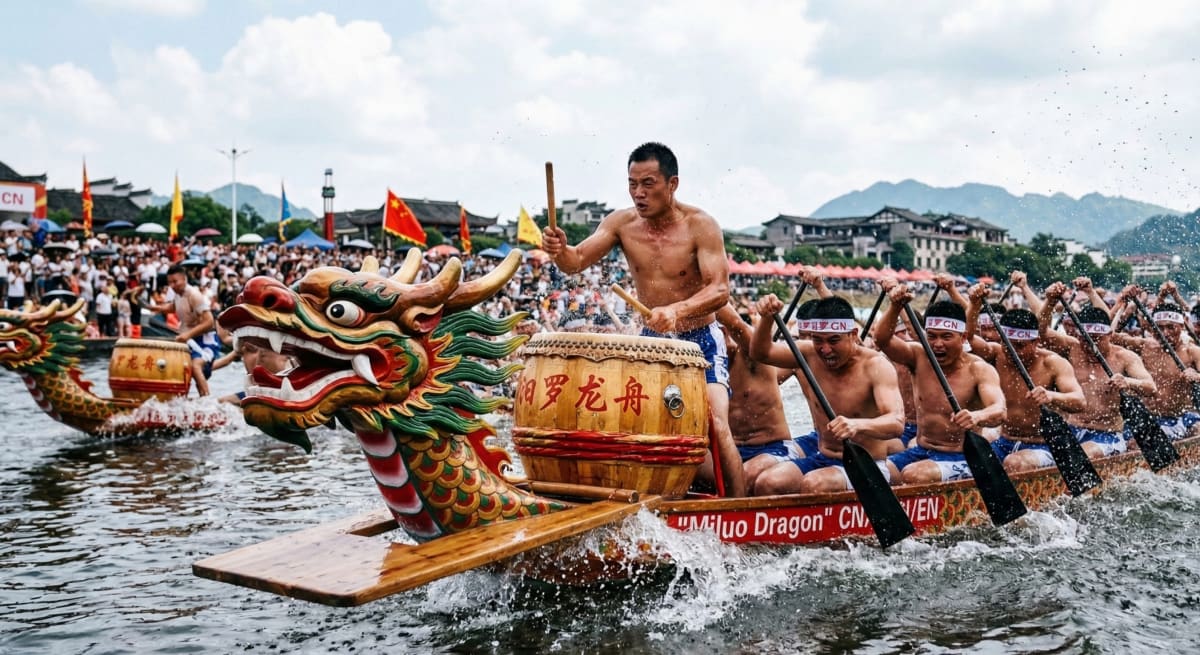
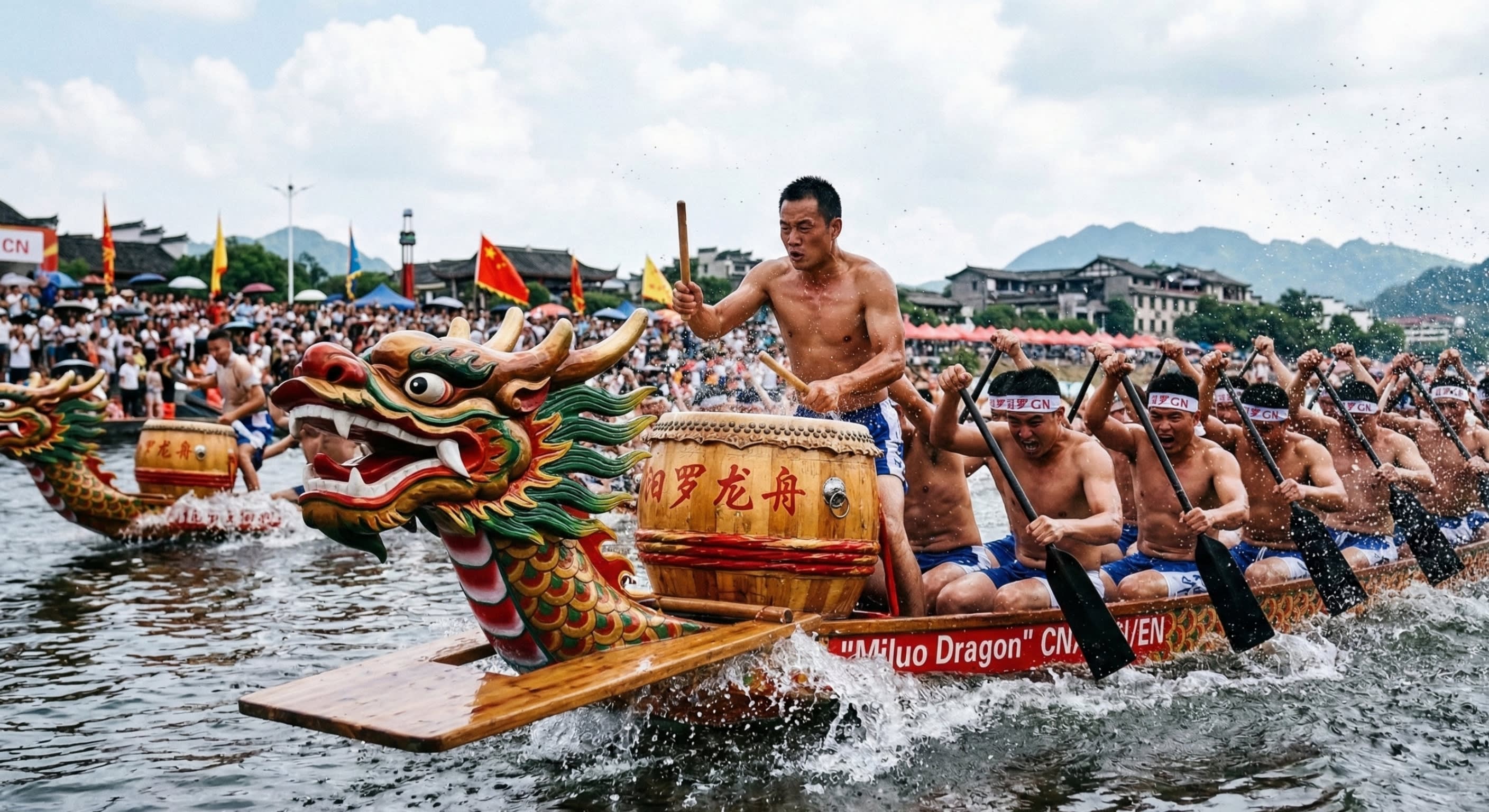
“If you stand on the banks of any major river in southern China in the early days of June, you will feel it in your chest before you see it. The relentless, primal thumping of massive wooden drums. The synchronized shouts of thirty muscular paddlers cutting through the water. This is the Duānwǔ Jié (端午节)—the Dragon Boat Festival. To an outsider, it looks like an incredible, adrenaline-fueled extreme sport. But to the Chinese, it is a living, breathing memorial. It is a 2,000-year-old story of unyielding loyalty, a tragic suicide, a desperate rescue mission, and the brilliant ancient wisdom of surviving the most dangerous month of the year.”
🐉 1. The Tragic Hero: The Ballad of Qu Yuan
To decode the Dragon Boat Festival, we must travel back to the Warring States period (around 278 BC), a time of endless military conflict between seven ancient Chinese kingdoms. The hero of our story is Qū Yuán (屈原), a brilliant poet and a high-ranking minister in the State of Chu.
Qu Yuan was fiercely patriotic and famously uncompromising. He urged his king to ally with neighboring states to resist the aggressive and terrifyingly powerful State of Qin. However, corrupt rival politicians slandered Qu Yuan, accusing him of treason. The foolish king believed the lies, banished his most loyal servant, and exiled him to the remote wilderness.
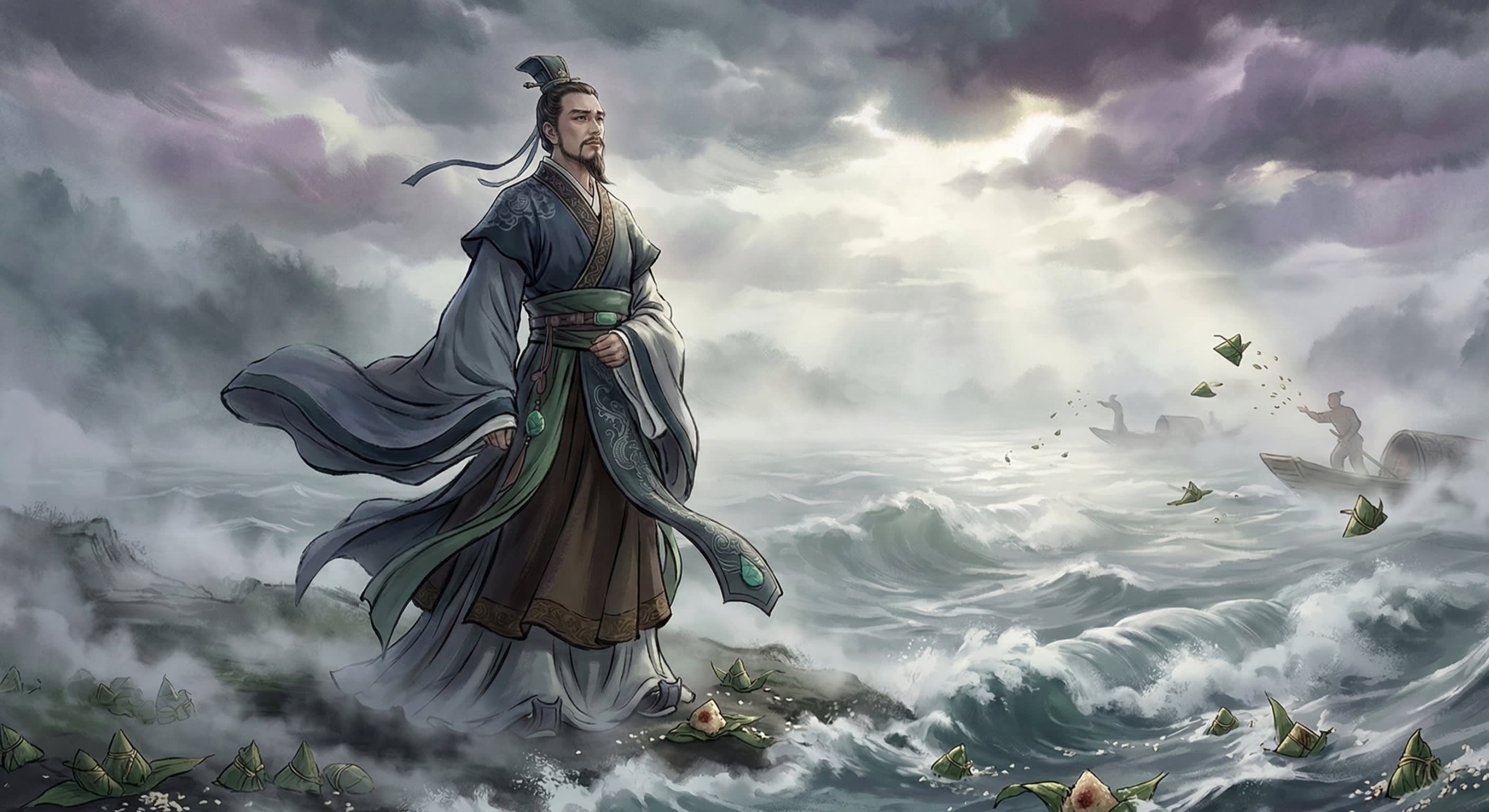
During his long exile, Qu Yuan wrote some of the greatest foundational poetry in Chinese literature, most notably the Li Sao (The Lament), expressing his deep sorrow and undying love for his country. Eventually, the news he dreaded finally arrived: the capital of Chu had been conquered and burned by the Qin army.
Devastated, realizing his beloved state was lost and unable to bear the agony of living in a conquered land, Qu Yuan walked to the banks of the mighty Miluo River. He clasped a heavy stone to his chest and waded into the dark, roaring waters, drowning himself in an ultimate act of sorrow and protest. The day he died was the 5th day of the 5th lunar month.
🥁 2. The Desperate Rescue: Birth of the Dragon Boat
When the local villagers—who loved Qu Yuan dearly—heard that he had thrown himself into the river, they panicked. They immediately rushed to their wooden fishing boats and paddled frantically out into the turbulent waters to save him.
They knew the river was filled with hungry fish and aquatic spirits. To protect Qu Yuan’s body from being devoured, the villagers began beating loudly on drums, clashing cymbals, and slapping their wooden paddles violently against the water to scare the creatures away.
They never found his body. However, their frantic, desperate race across the river became an annual tradition to mourn his death. Over the centuries, these rescue boats evolved into the magnificent, carved wooden vessels we see today, painted with fierce dragon scales and adorned with massive, intimidating dragon heads.
Today, Sài lóngzhōu (赛龙舟—Dragon Boat Racing) has become a highly competitive international sport. But the structure remains identical to that ancient rescue mission: the drummer sits at the front, acting as the heartbeat of the crew; the steersman guides at the back; and the paddlers operate as a single, explosive engine.
🥢 3. Zongzi (粽子): The Sticky Rice Dumpling and the Great Culinary War
Beating drums was not the only tactic the villagers used to protect Qu Yuan’s body. To distract the fish, they threw lumps of rice into the river, hoping the fish would eat the rice instead of the poet. Later legends say that Qu Yuan’s spirit appeared to the villagers, telling them that a river dragon was stealing the rice. He instructed them to wrap the rice in bamboo or reed leaves and tie it with colored silk threads, as the dragon was afraid of these materials.
This is the mythological origin of Zòngzi (粽子)—the quintessential food of the Dragon Boat Festival.
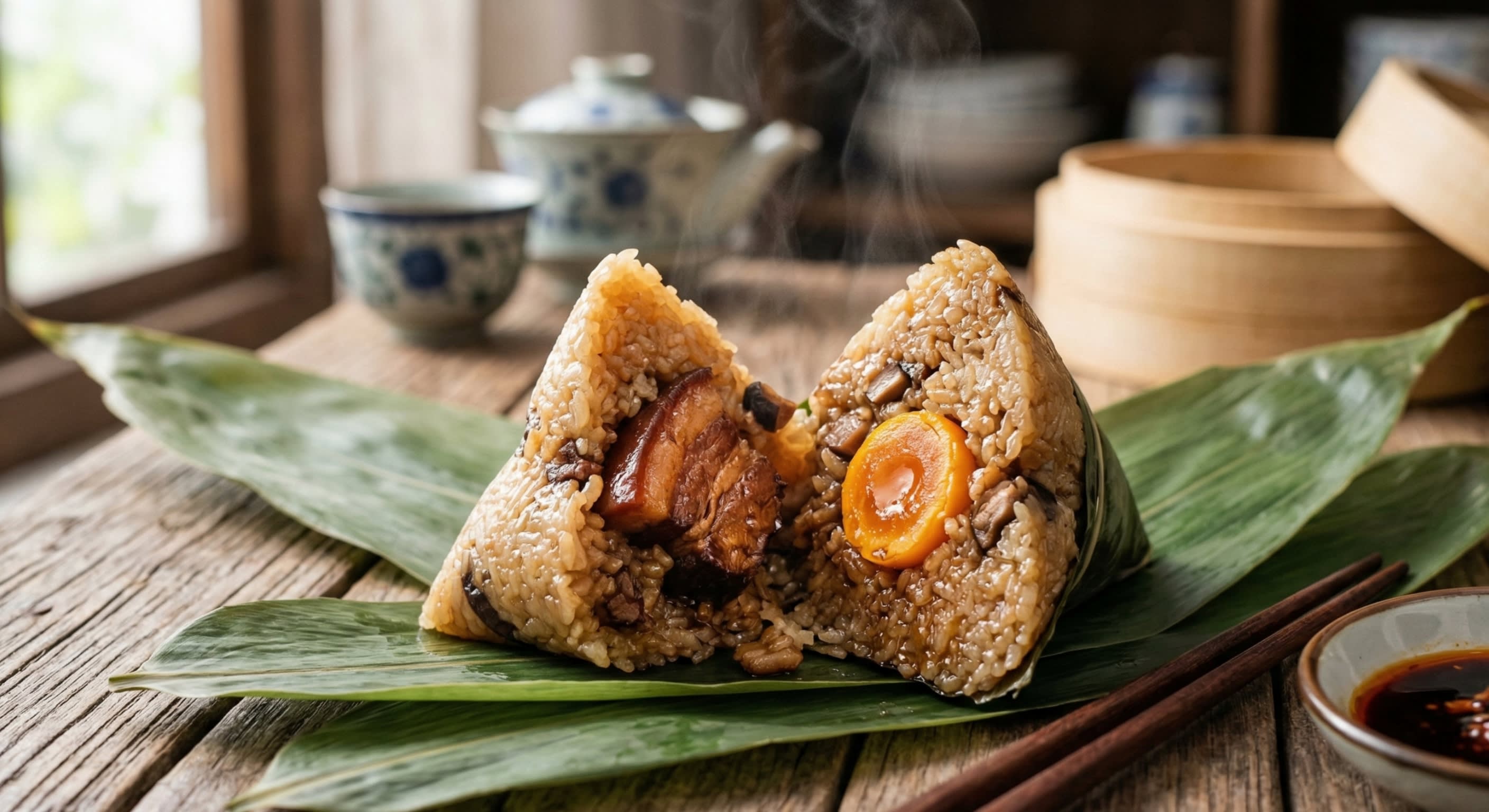
Making Zongzi is a labor-intensive art form. Glutinous (sticky) rice is soaked, tightly packed into large, aromatic bamboo leaves, folded into a precise pyramid or tetrahedral shape, tied tightly with twine, and boiled for hours. The result is a dense, fragrant dumpling where the earthy aroma of the leaf has completely infused the rice.
The Sweet vs. Savory War (甜咸之争)
If you want to start a passionate, never-ending argument between a Northern Chinese and a Southern Chinese person, simply ask them what should be inside a Zongzi. This is known as the famous Tián xián zhī zhēng (甜咸之争)—the Sweet vs. Savory War.
- The Northern Sweetness: In northern China (like Beijing), Zongzi are strictly a dessert. They are filled with sweet red bean paste or whole dried jujubes (red dates). The rice is pure white, and locals often dip the unpeeled dumpling into a small dish of white sugar before taking a bite.
- The Southern Savory: In southern China (especially around Shanghai and Guangdong), Zongzi is a heavy, savory main course. The rice is marinated in dark soy sauce and packed with chunks of rich, fat-marbled pork belly, shiitake mushrooms, and a salted duck egg yolk. During the long boiling process, the pork fat completely melts into the sticky rice, creating a luxurious, mouth-watering explosion of umami.
Both sides believe their version is the only “correct” way to eat it, but a true cultural explorer will gladly devour both.
🌿 4. Surviving the “Poison Month”: Ancient Health and Magic
While the legend of Qu Yuan provides the romantic tragedy, historians know that the roots of the festival go even deeper into ancient Chinese cosmology and medicine.
The Dragon Boat Festival falls on the 5th day of the 5th lunar month (often mid-to-late June). In ancient times, this period was known as the “Double Fifth” and was considered the unluckiest, most dangerous time of the entire year. As the intense summer heat sets in and the humidity skyrockets, diseases spread rapidly, and the Wǔ Dú (五毒)—the Five Poisonous Creatures (centipedes, scorpions, snakes, toads, and geckos)—emerge from hibernation.
To survive the “Poison Month,” ancient Chinese people essentially turned the Dragon Boat Festival into a massive Public Health and Hygiene Day, disguised as magical rituals.
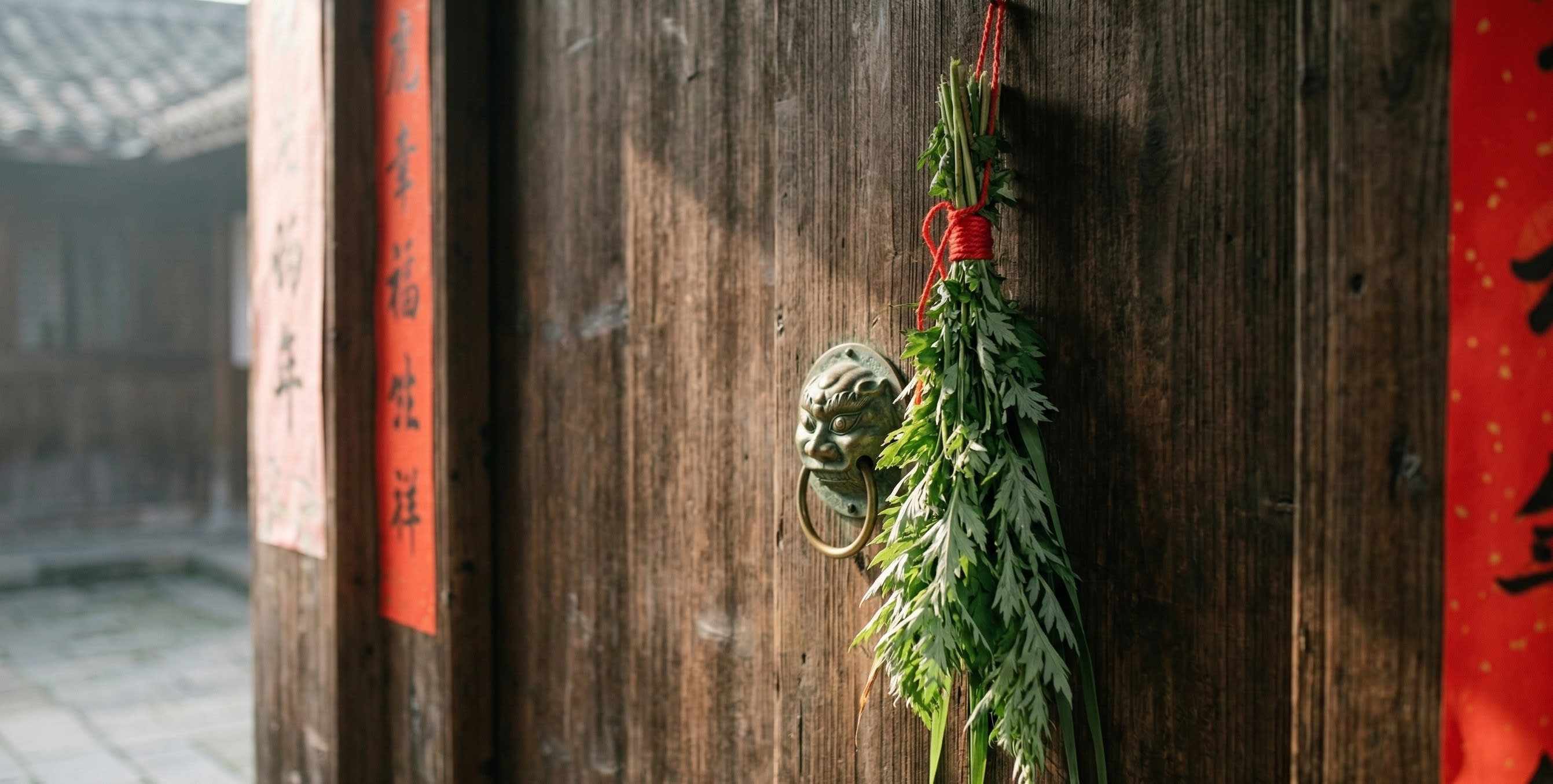
Hanging Mugwort and Calamus (艾草和菖蒲)
Walk through any local Chinese neighborhood during Duanwu, and you will see bundles of leafy green herbs hanging from the front doors. These are Àicǎo (Mugwort) and Chāngpú (Calamus). Their pungent, herbaceous smell acts as a highly effective natural insect repellent, keeping mosquitoes and bugs from entering the house. In folklore, the sword-like shape of the Calamus leaves is said to cut down evil spirits.
Drinking Realgar Wine (雄黄酒)
Historically, adults would drink Xiónghuáng jiǔ (Realgar wine), a yellow-orange liquor mixed with realgar powder. Because realgar contains arsenic sulfide, it is highly toxic to insects and snakes. Parents would even dip their fingers in the wine and write the character for “King” (王) on their children’s foreheads to protect them from venomous bites. (Note: Because of modern medical knowledge regarding arsenic, people today use safe herbal alternatives or simply sprinkle it around the house rather than drinking it!)
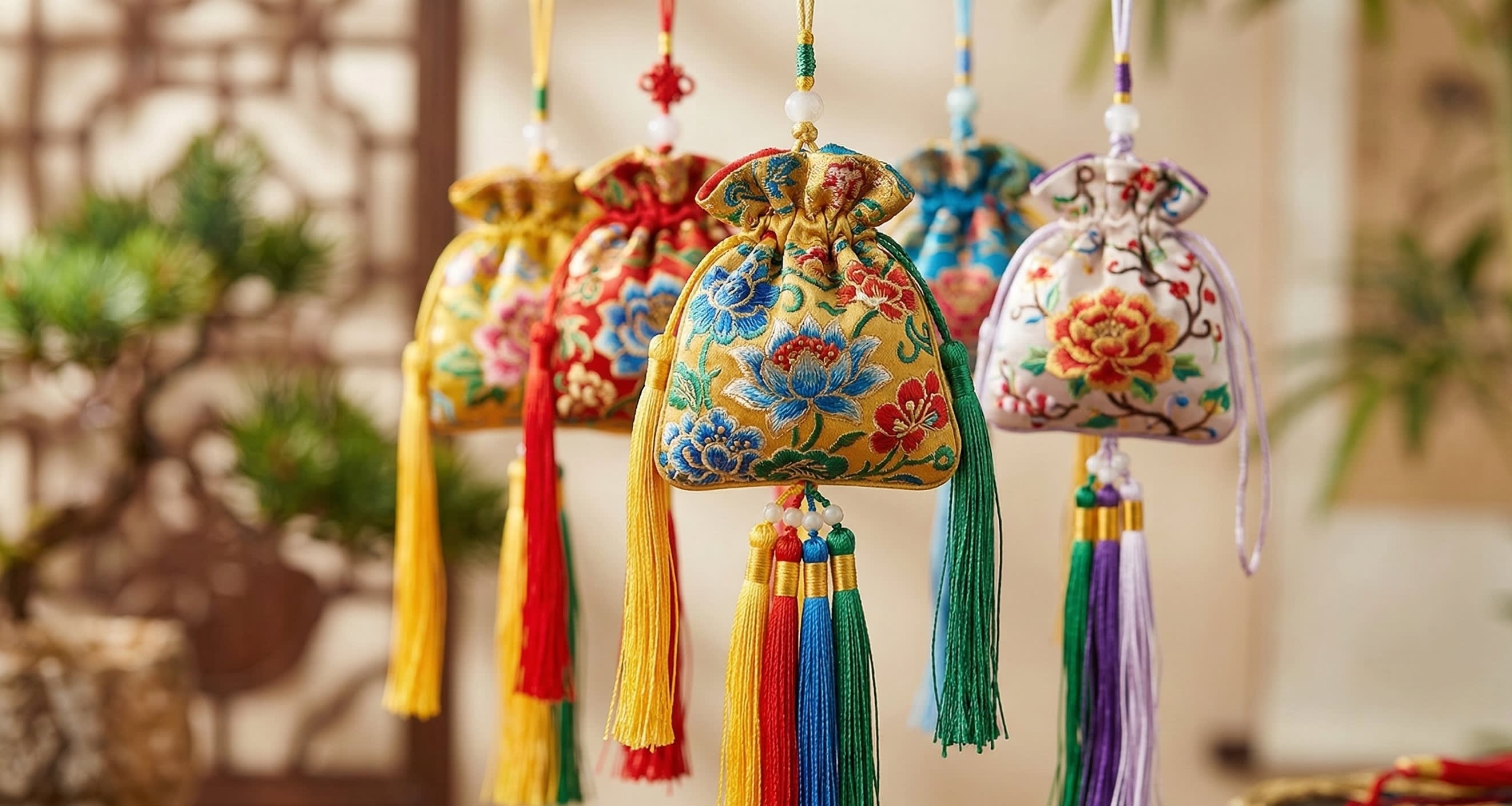
Scented Sachets (香包)
Children are traditionally gifted small, beautifully embroidered silk pouches called Xiāngbāo (香包). These sachets are filled with crushed, aromatic herbs like cloves, mint, and angelica root. Worn around the neck, they act as an ancient form of personal aromatherapy and a wearable bug repellent. They are often tied with five-color silk threads, representing the five elements and meant to trap any bad luck before it can reach the child.
💬 5. Essential Duanwu Vocabulary
If you are traveling in China during June, or simply buying a Zongzi from your local Asian supermarket, these phrases will immediately elevate your cultural credibility:
| The Term | Characters & Pinyin | Meaning & Context |
|---|---|---|
| Dragon Boat Festival | 端午节 Duānwǔ Jié |
The official name of the holiday. "Happy Duanwu" is Duānwǔ ānkāng (端午安康 - Wishing you peace and health during Duanwu). |
| Sticky Rice Dumpling | 粽子 Zòngzi |
The essential festival food. Wrapped in bamboo leaves. |
| Dragon Boat Racing | 赛龙舟 Sài lóngzhōu |
The competitive sport born from the myth of Qu Yuan's rescue. |
| The Sweet vs. Savory War | 甜咸之争 Tián xián zhī zhēng |
The endless, passionate debate over what should be inside a Zongzi. |
Final Thoughts from Lei
The Dragon Boat Festival is a masterpiece of cultural layering. On the surface, it is a thrilling, loud, and physically demanding sporting event. A layer deeper, it is a culinary celebration of complex regional flavors. Deeper still, it is a testament to the brilliant, practical ways ancient people protected themselves from the dangers of the natural world. But at its very core, the festival is a 2,000-year-old promise made by the Chinese people to a poet who loved his country too much: You threw yourself into the river, but we will never let you sink into oblivion.
㊗️ Wishing you a peaceful, healthy, and delicious Dragon Boat Festival!
Curious about where to watch the most intense Dragon Boat races in 2026? Check out our travel guide: Adrenaline and Traditions: Where to Watch Dragon Boat Racing or explore the agricultural background of the festival in our guide to the 24 Solar Terms.

