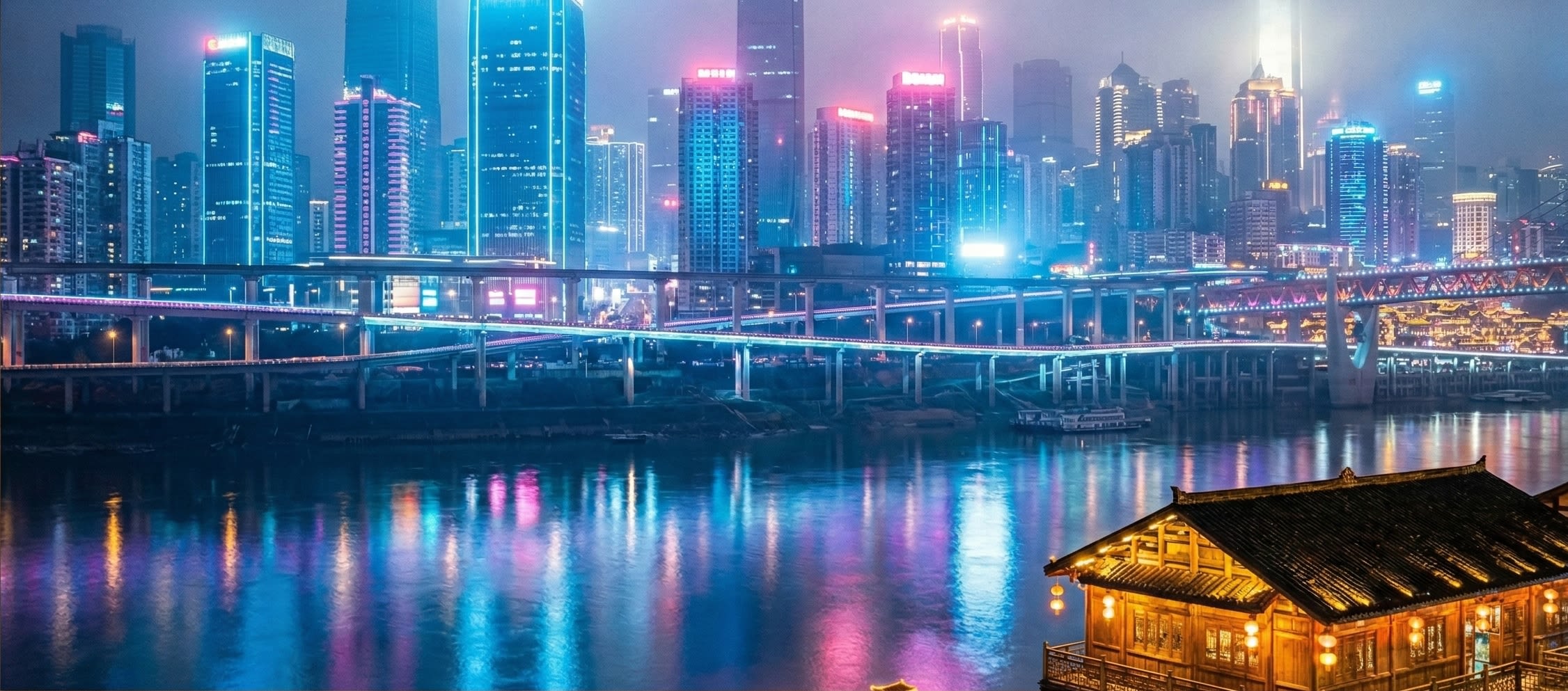
If you have ever stared at the screen during a science fiction epic and wondered, “Is that really a place on Earth?” then Chóngqìng (重庆) is here to shatter your sense of reality. Often dubbed the “8D City” or the “Mountain City” (shāchéng 山城), this sprawling megalopolis is, quite frankly, a visual riot. It is a vertical maze where the “ground floor” of one building might be the roof of another, and where trains vanish into the belly of residential skyscrapers like ghosts in the machine.
In 2026, Chóngqìng has cemented its reputation as the global pilgrimage site for anyone obsessed with the “Cyberpunk” aesthetic. It isn’t just about the neon; it’s about the soul of a city built on top of itself. However, navigating this three-dimensional labyrinth can be a humbling experience. I’ve spent enough time getting hopelessly lost in its infinite stairways to know that a map is practically useless here. Let’s look at how to capture the grit, the glow, and the gravity-defying magic of this urban beast.
The Geometry of the 8D Labyrinth
The most vital lesson I learned in Chóngqìng is to abandon my reliance on GPS. In most cities, “distance” is a two-dimensional concept. In Chóngqìng, we live in a world of floors and elevations. You might walk for twenty minutes along a road, only to realize you are now standing on the roof of a twenty-story shopping mall.
This isn’t chaotic design; it’s pure necessity. Built into the jagged cliffs at the confluence of the Yangtze and Jialing rivers, space is a luxury. The city had no choice but to grow in every direction. If you are planning a photography trip, bring a lightweight tripod. You will be shooting in low light, often in misty, humid conditions, and that extra stability will save your shots when you’re trying to capture the long-exposure blur of the city’s infinite traffic.
Liziba: Where the Train Swallows the Building
Perhaps the most iconic, reality-bending sight is the Lìzǐbà (李子坝) monorail station. When engineers were faced with a cliff too steep for traditional rail, they didn’t blink—they simply built the track through the middle of an apartment block.
- The Experience: Standing below and watching the Line 2 monorail emerge from a concrete wall, gliding silently into the sixth floor of a residential building, is a “Blade Runner” moment if I’ve ever seen one.
- Photography Tip: Don’t make the mistake of just filming from the designated tourist platform. Board the train itself at a nearby station. As it snakes around the cliffside, you get a cinematic, sweeping view of the city’s dense architecture that you can’t get from the ground.
- Pro Tip: The monorail is locally known as qīngguǐ (轻轨). Because it rides on rubber tires, it is eerily quiet, which is exactly how people manage to live inside a transit hub without losing their minds.

Hongyadong: The Real-Life “Spirited Away”
When the sun dips behind the mountains, the city transforms into something out of a Ghibli film. Hóngyádòng (洪崖洞) is a vertical cliffside complex of traditional stilted houses (diàojiǎolóu 吊脚楼). When the golden lights flicker on at dusk, it looks like a tiered, glowing castle hanging over the dark waters of the Jialing River.
| Perspective | Location | Best Shot |
|---|---|---|
| The Floating Castle | Qiansimen Bridge (千厮门大桥) | Perfect for a wide-angle shot of the entire stilt structure. |
| The Neon Canyon | Jiabin Road (嘉滨路) | Looking straight up to see the layers of history and light. |
| The Time-Slip | Inside 4F-9F | Focus on the red lanterns and narrow, crowded food alleys. |
Guanyinqiao: The Neon Soul
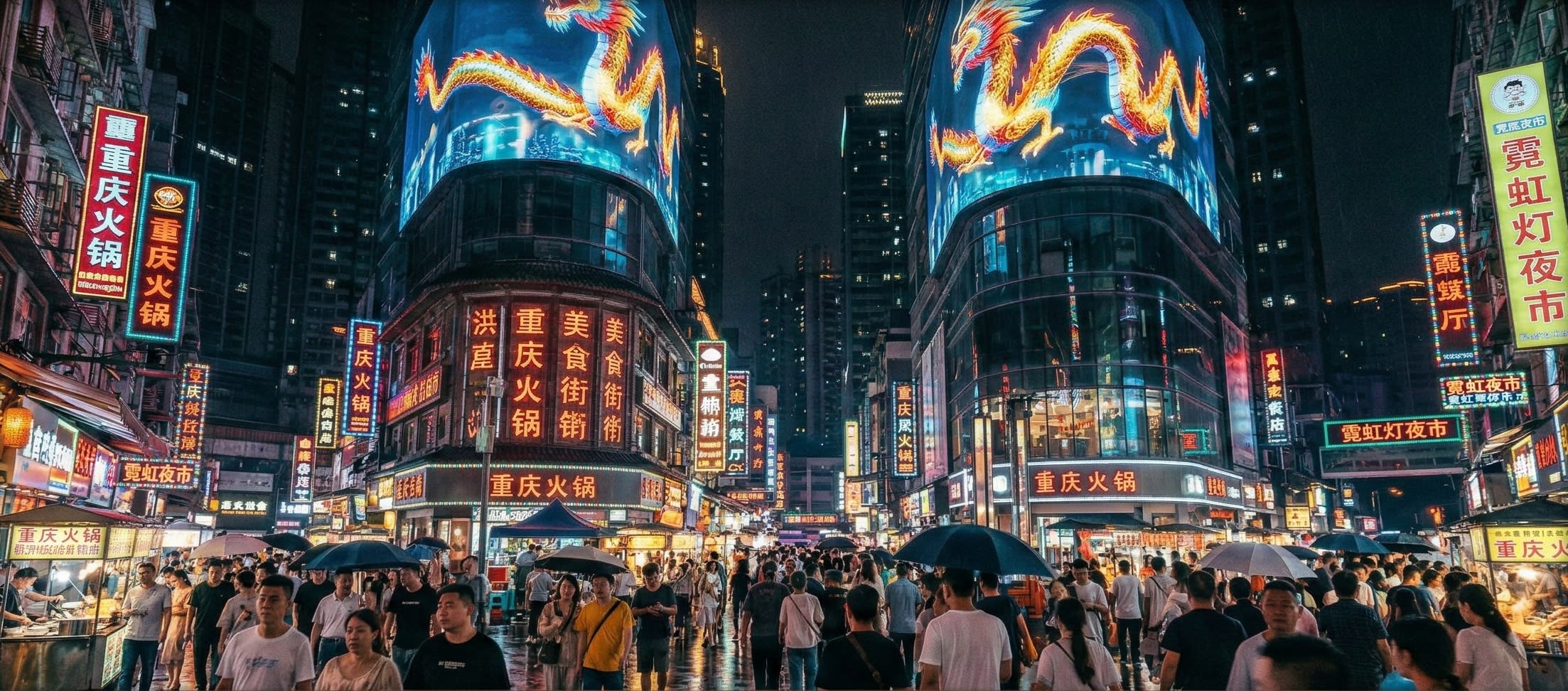
If Hongyadong represents the romantic, ancient side of the cyberpunk coin, Guānyīnqiáo (观音桥) is the hyper-modern reverse. It feels like Tokyo or New York, but with a distinctly Chinese ambition. The giant 3D LED screens here are legendary—you’ll see massive digital dragons that appear to leap out into the street.
It’s in these moments of sensory overload that I find the best stories. Capture the high-tech 3D ads, then pivot your lens to the small, plastic stools in a nearby alley where an elderly shopkeeper is expertly ladling out spicy peppercorns into a boiling pot of broth. That contrast—the future meeting the tradition—is what gives Chongqing its soul. If you’re documenting this, make sure to keep a power bank handy; you’ll be shooting all day and night.
Survival Tactics in the 8D Maze
Chongqing can be physically draining. It is a city that demands your energy and rewards your curiosity. Here is how I survive the incline:
- Embrace the Public Elevators: It sounds funny, but public elevators are often part of the city’s public infrastructure. They connect different “levels” of the city. One minute you’re in a crowded market; the next, you’re in an elevator that dumps you out onto a high-altitude street.
- The Hot Pot Ritual: You haven’t truly lived until you’ve suffered through a proper spicy hot pot (huǒguō 火锅). Do not go to the sanitized mall chains. Find the “old residential building” shops. If you see locals sweating, laughing, and eating by the roadside, that’s where the flavor (wèidào 味道) is.
- The Foggy City: Locals call it wùdū (雾都). If you arrive and it’s raining or foggy, don’t be disappointed. That mist captures the neon light and creates a dreamlike, hazy quality that is the hallmark of the best cyberpunk photography.
The View from the Clouds
Before you leave, you absolutely must take the Yangtze River Cableway (chángjiāng suǒdào 长江索道). It was once the only transit lifeline for commuters crossing the river. Today, it’s the best “slow-mo” view of the city. Floating mid-air between the skyscrapers, watching the river reflect the neon glow below, you begin to see Chongqing for what it really is: a masterpiece of defiance. It’s a city that looked at the mountains and said, “We’re building here anyway.”
Whether you are here to document the architecture or simply to feel the hum of the future, Chongqing will change your perspective on what a city can be. It is messy, loud, and sometimes exhausting, but it is unequivocally alive. Exploring this city effectively requires the same mindset as mastering the best time to visit China in 2026—you need to be patient, observant, and willing to embrace the unexpected. If you want to refine your travel tech before arriving, check out my guide on essential apps for China travel to keep your navigation seamless. For those looking to escape the intensity of a vertical megalopolis afterward, consider the reverse tourism trend to find balance in China’s quieter, more traditional corners.
Captivated by the neon? Dive deeper into our other guides for your 2026 adventure:
- Feeling the urge to explore more vertical history? Read my survival guide to the Real-life Black Myth: Wukong temples in Shanxi.
- Need to stay powered up while shooting? Ensure you have your Digital Survival apps ready before you hit the street.
Disclaimer: As an Amazon Associate, ChinaCurator earns from qualifying purchases.