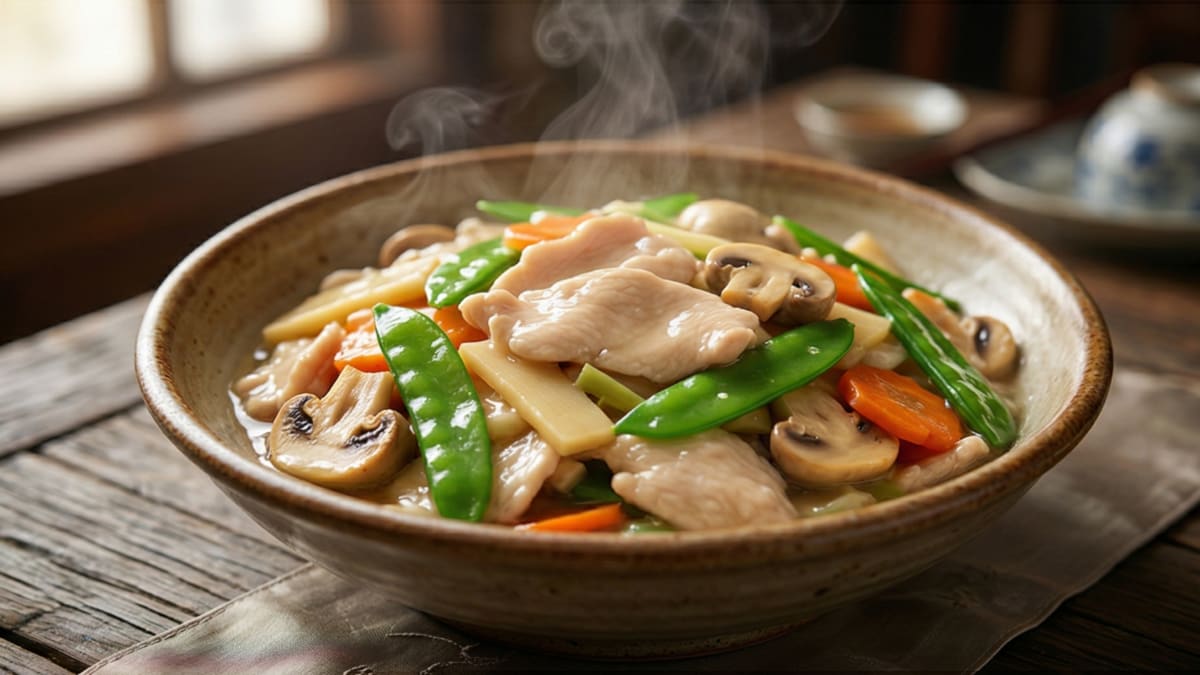
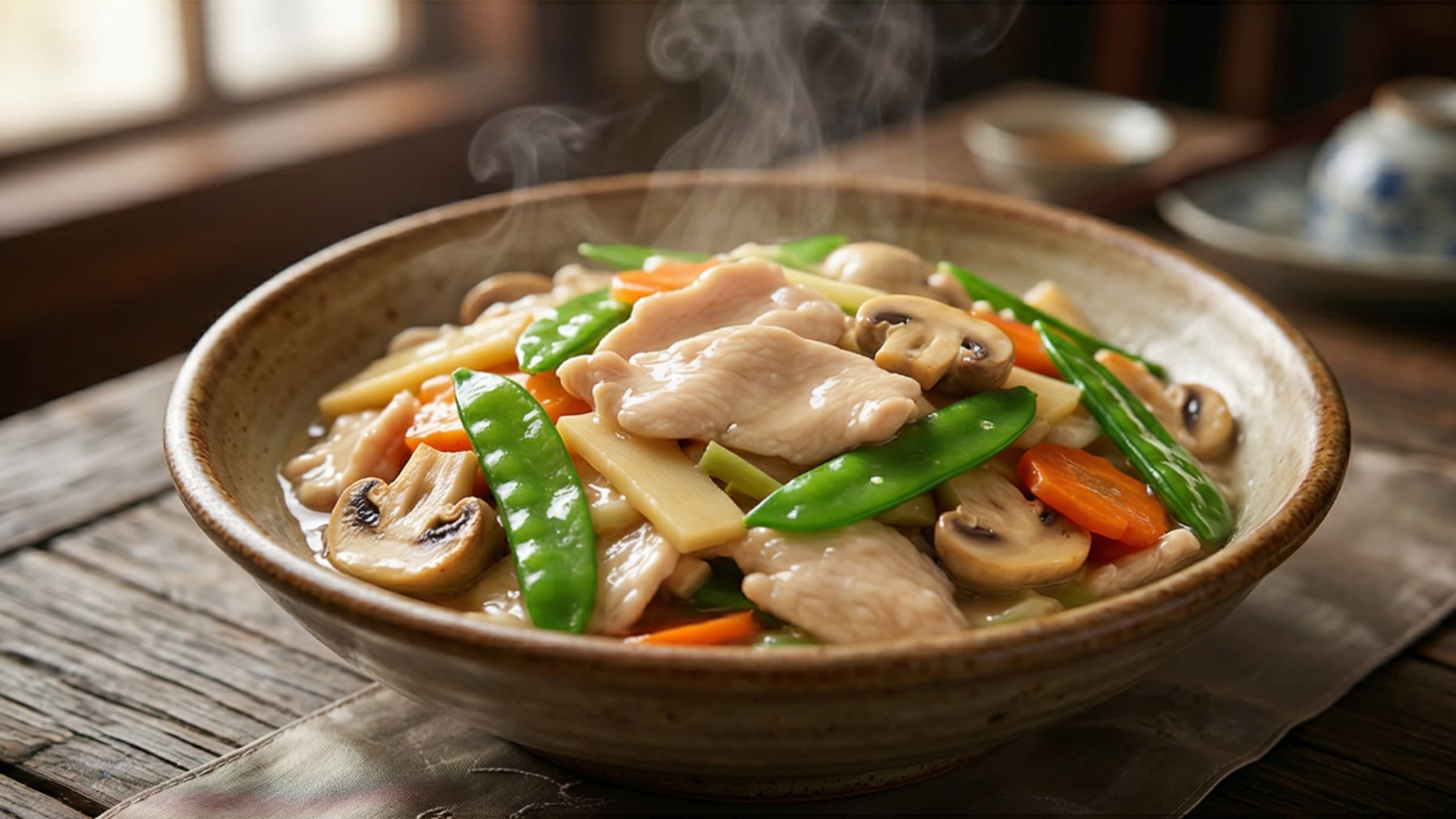
🍄 Introduction: The Ultimate Guilt-Free Chinese Takeout
When you flip open a massive, multi-page menu at your local Chinese-American takeout restaurant, your eyes are immediately drawn to the heavy hitters: the deep-fried General Tso’s, the sticky Orange Chicken, or the heavy, beefy Lo Mein. But tucked away in the “Poultry” or “Diet Menu” section lies a quiet, unassuming, yet absolutely brilliant masterpiece: Moo Goo Gai Pan (蘑菇鸡片 - Mógū Jīpiàn).
For health-conscious eaters, Moo Goo Gai Pan is the holy grail. It is a vibrant, colorful, and incredibly light stir-fry featuring generous slices of lean chicken breast, earthy mushrooms, and a medley of highly crisp vegetables, all brought together by a delicate, savory, and silky “white sauce.” Because there is zero deep-frying and no heavy, sugary caramel glazes, it is the ultimate guilt-free comfort food.
However, its reputation in the West has been severely damaged by lazy takeout joints. Too often, a delivered Moo Goo Gai Pan arrives as a sad, grey, watery soup filled with rubbery chicken cubes and soggy, overcooked vegetables swimming in a bland, tasteless cornstarch glue.
Today, we are going to rescue this magnificent Cantonese classic. We will decode the mystery behind its strange English name, unveil the restaurant-level chemical process that turns lean chicken breast into pure velvet, and teach you how to build a clear, translucent sauce that is exploding with intense umami and garlicky depth.
📜 The Translation: What Exactly Does “Moo Goo Gai Pan” Mean?
If you try to type “Moo Goo Gai Pan” into a standard Mandarin Chinese translation app, you will likely get a confused error message. This is because the name is a phonetic spelling of the traditional Cantonese dialect, brought over by early immigrants from Guangdong province to North America.
Let’s break down the beautiful, literal translation of this iconic dish:
- Moo Goo (蘑菇 - Mógū): This simply means “Mushrooms.” Traditionally, this dish uses fresh white button mushrooms, which provide a delicate earthiness that doesn’t overpower the light sauce.
- Gai (鸡 - Jī): This is the Cantonese pronunciation for “Chicken.”
- Pan (片 - Piàn): This means “Slices.”
Therefore, the authentic name is simply Mushroom Chicken Slices (蘑菇鸡片). This explicitly tells us how the protein must be prepared: you cannot use thick, chunky cubes of meat. The chicken must be sliced incredibly thin so it cooks in seconds and melts in your mouth!
🔬 The Culinary Science: Velveting and the “Bai Zhi” (白汁)
To elevate this dish from a watery home-cooked disaster to professional restaurant quality, you must master two fundamental techniques of Cantonese wok cooking.
1. Slicing and Velveting (上浆 - Shàngjiāng)
Chicken breast is notoriously unforgiving. If you stir-fry raw, unmarinated chicken breast, the high heat of the wok will instantly squeeze all the moisture out of the muscle fibers, turning it into dry, chalky cardboard. To prevent this, Chinese chefs use a technique called Shàngjiāng (上浆 - Velveting). First, you slice the chicken breast thinly against the grain. Then, you massage the meat with a mixture of egg white, water, Shaoxing wine, and Cornstarch (玉米淀粉). This creates a microscopic, invisible gel barrier around the chicken slices. When they hit the hot oil, this barrier locks the natural juices inside, resulting in a texture that is unbelievably soft, slippery, and velvety.
2. The Art of the White Sauce (白汁 - Báizhī)
Most Chinese stir-fries rely heavily on dark soy sauce, which turns the dish a deep, mahogany brown. Moo Goo Gai Pan is different. It utilizes a Báizhī (白汁 - White Sauce) to keep the dish looking bright, fresh, and clean. Because you cannot hide behind dark, salty soy sauce, the foundation of your sauce must be flawless. You must use a high-quality, rich chicken broth. To give it that signature Chinese restaurant kick, we use White Pepper powder (白胡椒粉)—which provides a floral, earthy heat without discoloring the sauce—along with freshly minced garlic, ginger, and a final drizzle of toasted sesame oil.
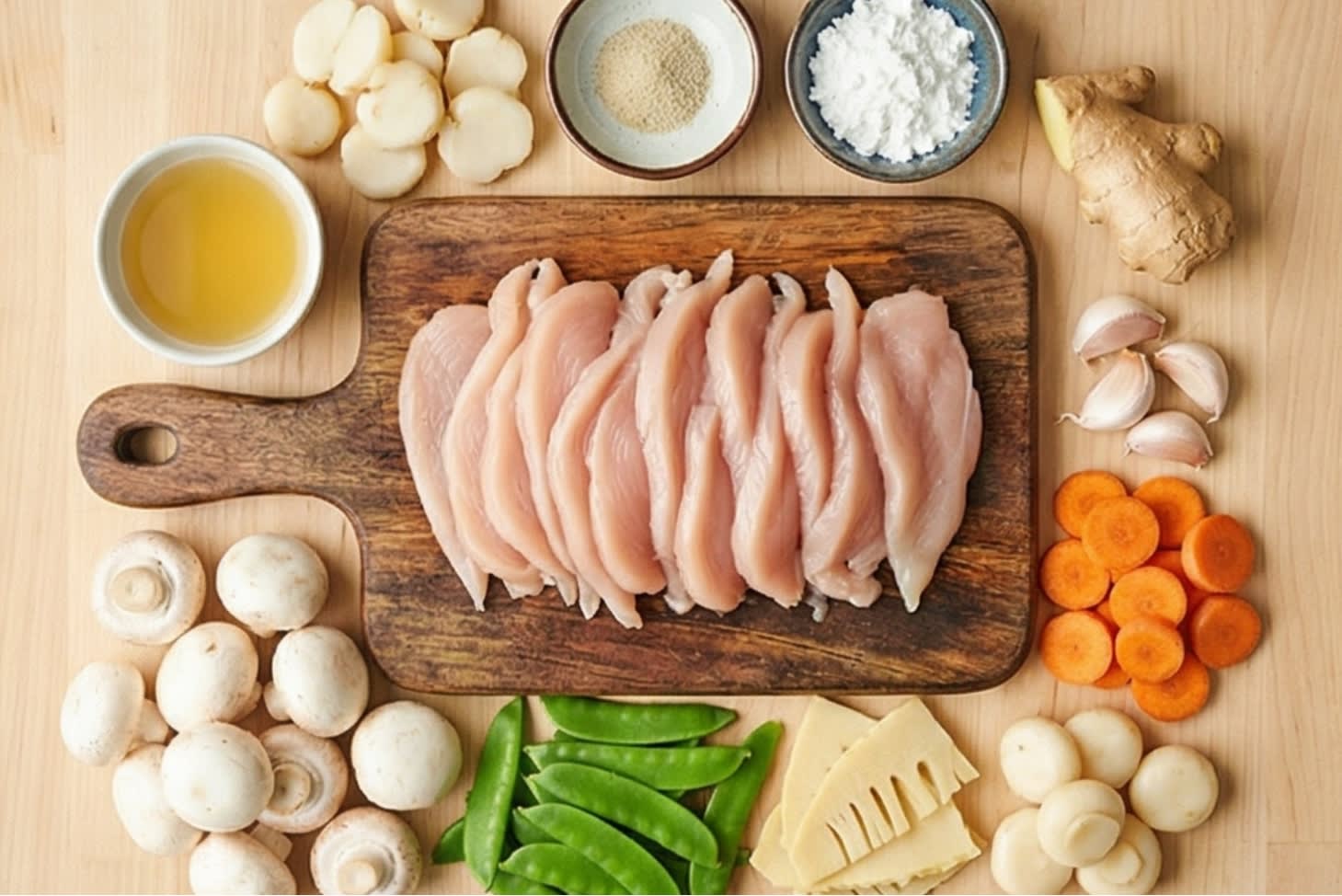
🛒 Ingredients List
The Chicken & Velveting Marinade (上浆):
- 1 lb (about 450g) Boneless, Skinless Chicken Breast (鸡胸肉), sliced 1/4-inch thick against the grain.
- 1 large Egg White (蛋清) - The secret to ultimate silkiness!
- 1 tbsp Shaoxing Cooking Wine (绍兴酒)
- 1/2 tsp Salt
- 1 tbsp Cornstarch (玉米淀粉)
- 1 tbsp Cooking Oil (to seal the moisture)
The Crisp Vegetables (配菜):
- 8 oz (about 225g) Fresh White Button Mushrooms (白蘑菇), thickly sliced. (You can also use fresh Shiitake mushrooms!)
- 1.5 cups Snow Peas (荷兰豆 - Hélándòu), tough strings removed from the edges.
- 1/2 cup canned Sliced Bamboo Shoots (竹笋), drained.
- 1/2 cup canned Sliced Water Chestnuts (马蹄 - Mǎtí), drained. These provide a loud, sweet crunch!
- 1/2 medium Carrot, peeled and sliced diagonally into thin rounds (for a pop of color).
The Savory White Garlic Sauce (白汁):
- 3/4 cup High-Quality Chicken Broth (鸡高汤)
- 1 tbsp Shaoxing Cooking Wine (绍兴酒)
- 1 tsp Light Soy Sauce (生抽) - Just a tiny drop for umami, not enough to turn the sauce brown.
- 1/2 tsp Salt
- 1/2 tsp Sugar (to balance the savory notes)
- 1/4 tsp White Pepper powder (白胡椒粉) - Absolutely mandatory for the authentic flavor!
- 1 tsp Toasted Sesame Oil (芝麻油)
- 1.5 tbsp Cornstarch (for the thickening slurry)
The Aromatics & Frying:
- 3 cloves Garlic, finely minced (蒜末)
- 1 thumb-sized piece of fresh Ginger, finely minced (姜末)
- 3 tbsp high-heat Cooking Oil (peanut, canola, or vegetable oil)
🍳 Step-by-Step Instructions
1. Velvet the Chicken Slices (上浆): Place your thinly sliced chicken breast in a mixing bowl. Add the salt, Shaoxing wine, and egg white. Vigorously massage the liquids into the meat with your hands until the chicken is sticky and has absorbed the egg white. Add the cornstarch and massage again. Finally, pour in the 1 tbsp of cooking oil to coat the slices. Let it rest for 15 to 20 minutes.
2. Whisk the White Sauce (白汁): In a small bowl, whisk together the chicken broth, Shaoxing wine, light soy sauce, salt, sugar, white pepper, sesame oil, and the 1.5 tbsp of cornstarch. Stir thoroughly until the cornstarch is completely dissolved into a milky liquid. Set this bowl right next to your stove.
3. Sear the Velvety Chicken (滑炒 - Huáchǎo): Heat your wok or a large skillet over high heat until smoking. Add 2 tablespoons of cooking oil. Carefully drop in the marinated chicken slices. Spread them out into a single layer and let them sear undisturbed for 30 seconds. Then, stir-fry rapidly for about 2 to 3 minutes until the chicken turns opaque white and is about 90% cooked. Remove the chicken from the wok and set it aside on a plate.
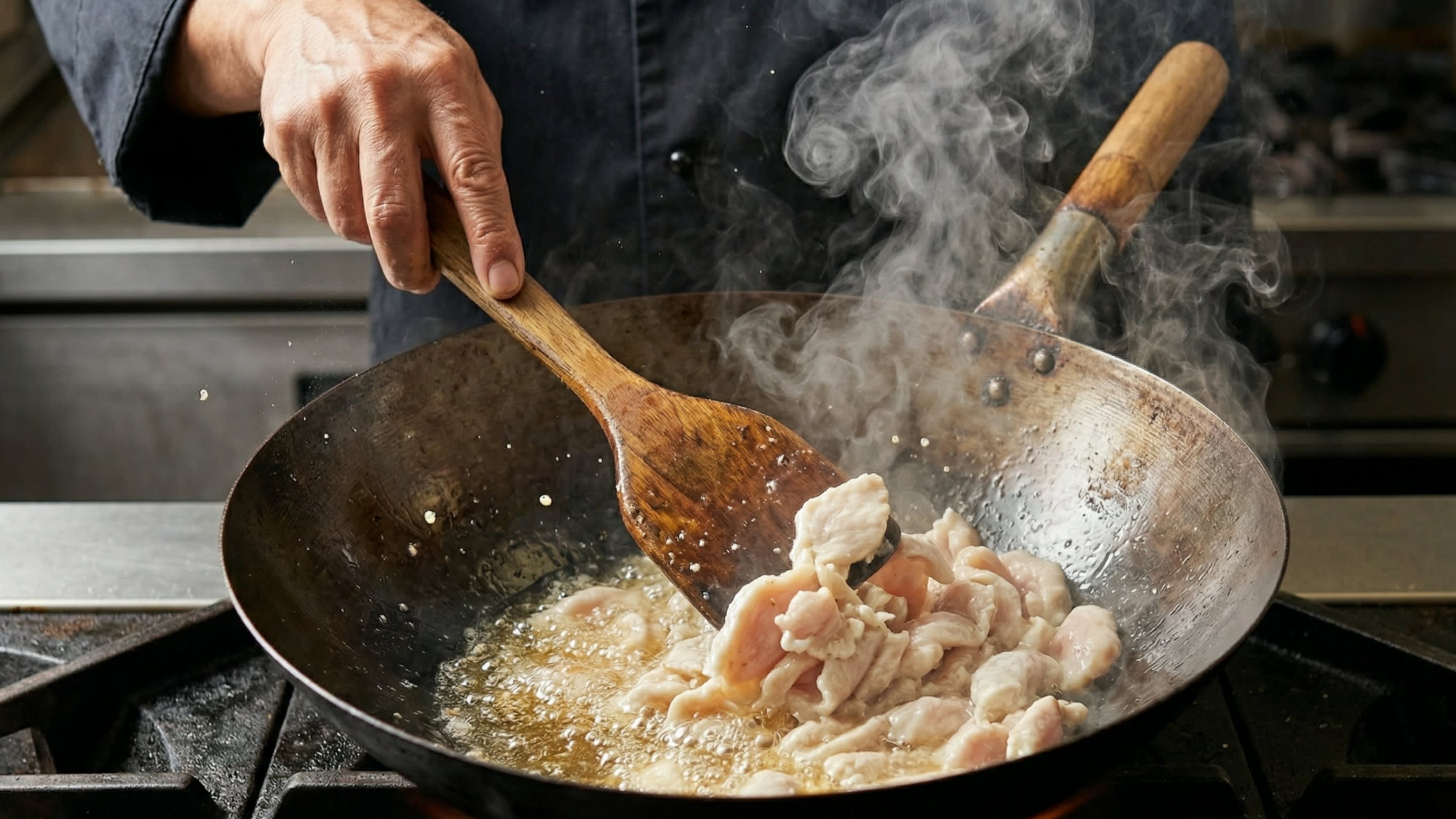
4. Sauté the Earthy Mushrooms: Wipe the wok clean if necessary. Keep the heat on medium-high and add the remaining 1 tablespoon of oil. Toss in the sliced white mushrooms. Stir-fry them aggressively for about 2 minutes. You want them to release their natural moisture and develop a very slight golden-brown sear on the edges.
5. Blister the Veggies (断生 - Duànshēng): Push the mushrooms to the side of the wok. In the center, add the minced garlic and ginger. Let them sizzle for 15 seconds until the kitchen smells incredibly fragrant. Immediately add the snow peas (荷兰豆), carrots, bamboo shoots, and water chestnuts (马蹄). Toss everything together for exactly 60 seconds. You want the snow peas to turn a vibrant, bright emerald green but remain incredibly crisp and snappy. Do not overcook them!
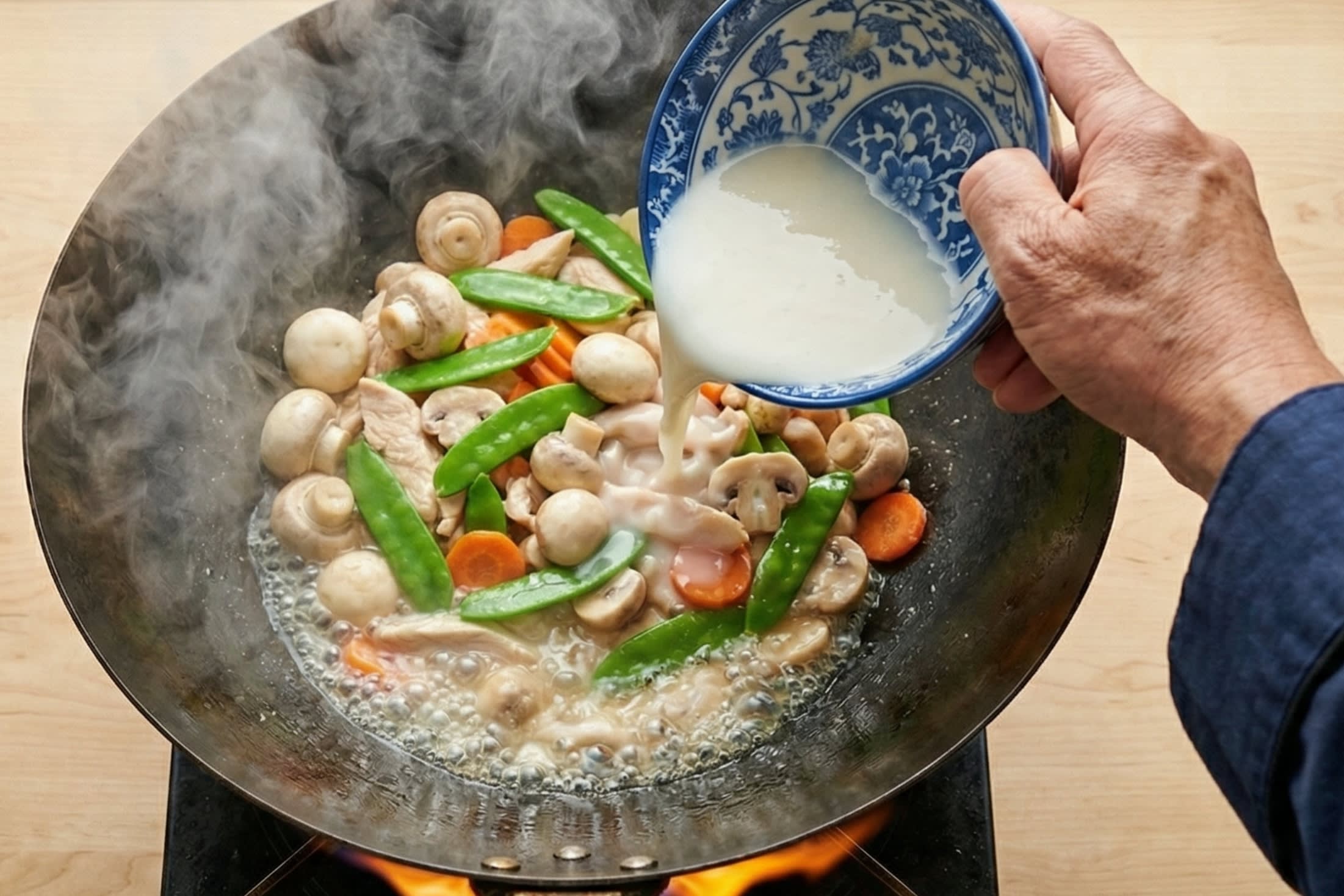
6. Thicken the Glaze (勾芡 - Gōuqiàn): Add the cooked chicken (and any juices from the plate) back into the wok. Give your prepared white sauce bowl a quick stir to lift the settled cornstarch, and pour it directly over all the ingredients in the wok. Stir constantly. Within 30 to 45 seconds, the heat will activate the cornstarch. The cloudy broth will miraculously transform into a thick, highly glossy, translucent, savory gravy that clings beautifully to the chicken and vegetables.
7. Serve: Turn off the heat immediately so the vegetables don’t turn mushy. Plate this breathtaking, colorful, and healthy masterpiece. Serve piping hot with a bowl of steamed Jasmine rice or brown rice, and enjoy the ultimate guilt-free Chinese takeout experience right in your own kitchen!
💡 Troubleshooting & Pro Tips
- My sauce turned into a giant, clumpy jelly! You either used too much cornstarch, or you didn’t stir the sauce constantly after pouring it into the hot wok. When the cornstarch hits the boiling heat, it thickens in seconds. Keep that spatula moving! If it gets too thick, simply splash in a little extra chicken broth or water to thin it out.
- Why does my sauce lack flavor? Because the “White Sauce” relies on a clear base without heavy soy sauce or chili oil, the quality of your Chicken Broth is everything. If you are using cheap, watery, low-sodium boxed broth, the dish will taste bland. Use a high-quality, rich chicken stock, and make sure you do not skip the White Pepper (白胡椒)—it is the soul of the dish!
- My chicken is still tough. You skipped the most important step: the egg white and cornstarch velvet marinade (上浆). Also, ensure you are slicing the chicken breast against the grain. Slicing parallel to the muscle fibers will result in chewy, stringy meat, no matter how much you marinate it.
📦 Shop Authentic Pantry Essentials
To master the delicate, savory, and healthy flavor profile of a high-end Cantonese restaurant, upgrading your pantry with these specific ingredients is highly recommended. (As an Amazon Associate, ChinaCurator earns from qualifying purchases.)
- Premium White Pepper Powder (白胡椒粉) - The absolute mandatory spice for authentic Chinese "White Sauce." It provides a complex, earthy, floral heat without the harshness or black specks of black pepper.
- Kadoya 100% Pure Toasted Sesame Oil (芝麻油) - A tiny dash at the end of the cooking process rounds out the savory sauce with a deep, nutty, roasted aroma.
- Shaoxing Cooking Wine (绍兴酒) - Essential for the chicken marinade. It removes any gamey poultry odors and adds a distinct, authentic restaurant aroma.
- Traditional Carbon Steel Wok - The ultimate vessel for flash-frying the delicate chicken slices and rapidly boiling the glossy cornstarch sauce without overcooking the vegetables.