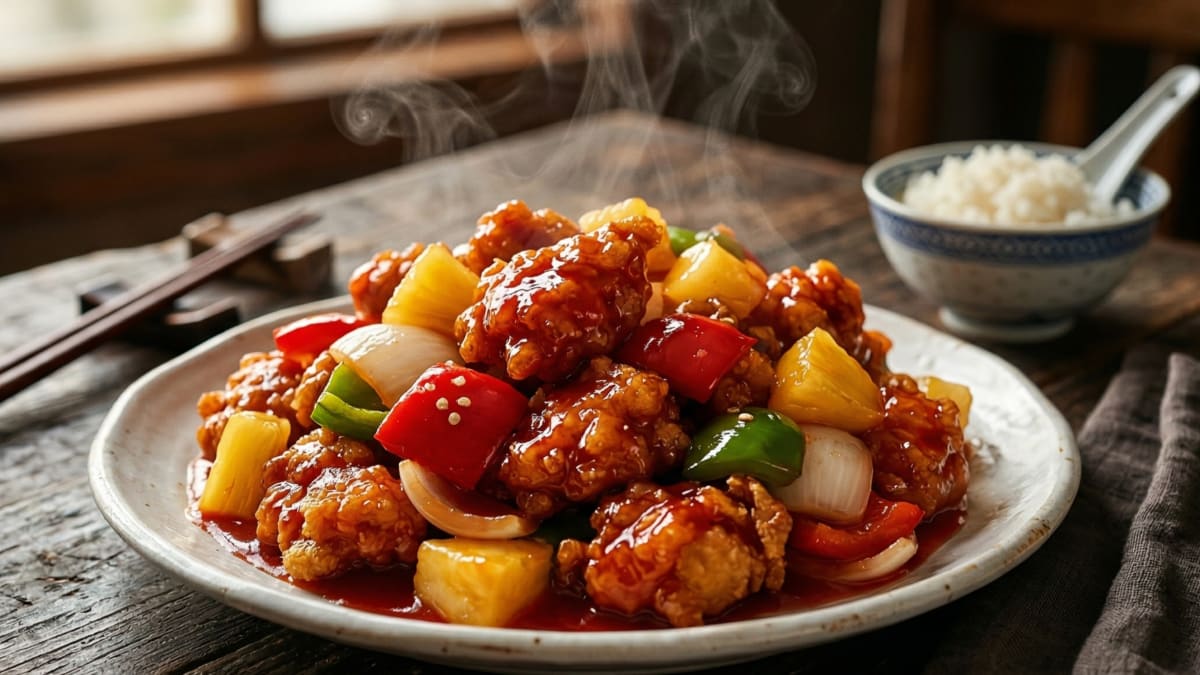

🥡 Introduction: The Neon-Red Takeout Legend
When it comes to Westernized Chinese food, there is one dish that stands out across the globe with its unmistakable, vibrant, neon-red glow: Sweet and Sour Chicken (甜酸鸡 - Tiánsuān Jī).
For many of us, this dish was our first real introduction to Chinese flavors. It’s a nostalgic kaleidoscope of textures—massive chunks of ultra-crispy, golden-fried chicken, sweet and juicy pineapple, and crunchy bell peppers, all bathed in a sticky, ruby-red glaze that catches the light like lacquer.
I still remember the first time I tried to recreate this at home. I grabbed a jar of “sweet and sour sauce” from the supermarket, thinking it would be a simple shortcut. The result? A bowl of sad, soggy chicken swimming in an artificial, cloyingly sweet syrup that left me questioning my life choices.
Today, we are ditching the bottled stuff. We’re going to master the culinary science of a real Tangcu (糖醋) balance, unlock the restaurant secret to an indestructible crispy batter, and build a Sweet and Sour Chicken so good, you’ll never feel the need to call the local takeout joint again.
📜 The Ancestry: From “Gu Lu Rou” to Chicken
Before we heat up the wok, let’s peel back the layers of history. Is Sweet and Sour Chicken actually eaten in China?
In traditional Chinese culinary arts, the “sweet and sour” flavor profile is known as Tángcù (糖醋), literally “sugar and vinegar.” It is one of the most venerable flavor combinations in Chinese history, used for centuries to prepare everything from whole carp to pork ribs.
The direct ancestor of our beloved takeout dish is a legendary Cantonese classic: Sweet and Sour Pork (咕噜肉 - Gūlūròu). Authentic Gu Lu Rou relies on heavily marbled pork and a sophisticated sauce derived from Chinese black vinegar, hawthorn flakes, or preserved plums, rather than the ketchup-heavy profile we often see in the West.
When early Cantonese immigrants opened restaurants abroad, they adapted this masterpiece to local tastes. They substituted pork for chicken—which was readily available and widely popular—and swapped traditional souring agents for tomato ketchup and white vinegar. This created that iconic, bright red color and fruity, approachable tang that helped it conquer the world’s appetite.
🔬 The Science of the Perfect Glaze and Crunch
To reach “takeout perfection” at home, you have to master two separate scientific hurdles: the “Golden Ratio” of the sauce, and the physics of the batter.
1. The “Golden Ratio” of Tangcuzhi (糖醋汁)
The biggest mistake home cooks make is turning this into a dessert. A perfect Tángcùzhī (糖醋汁 - Sweet and Sour Sauce) should make your mouth water from the sharp acidity, immediately followed by a comforting, mellow wave of sweetness. The restaurant secret to this balance is equal parts sugar and vinegar, grounded by the earthy, savory umami of light soy sauce, and finished with a dash of ketchup for that signature glow.

2. The Pineapple Magic (菠萝)
In professional kitchens, Pineapple (菠萝 - Bōluó) serves a higher purpose than just decoration. It contains bromelain, a natural enzyme that tenderizes meat. More importantly, that burst of hot, juicy fruit provides the necessary acidity to cut through the richness of the deep-fried chicken. While canned pineapple works—and provides extra juice for your sauce—fresh pineapple elevates the flavor profile to something truly special.
3. The Indestructible Crunch: “Guahu” and Double Frying
If your chicken turns into mush the moment the sauce hits it, you are likely using wheat flour.
- The Batter (挂糊 - Guàhú): You must use cornstarch. Because it contains no gluten, it creates a microscopic, glass-like shell that repels moisture.
- The Double Fry (复炸 - Fùzhá): This is non-negotiable. The first fry cooks the meat through, while the second fry—performed at a much higher temperature—violently drives out surface moisture. The result is the legendary Wàisū lǐnèn (外酥里嫩 - crispy outside, tender inside) texture that holds its crunch for hours.
🛒 Ingredients List
The Chicken & Marinade:
- 1.5 lbs (about 700g) Boneless Chicken (thighs are juicier, breasts are classic).
- 1 tbsp Light Soy Sauce
- 1 tbsp Shaoxing Cooking Wine
- 1 large Egg
The Crispy Coating:
- 1 cup Cornstarch
- 1/2 tsp Salt & 1/4 tsp White Pepper
The Veggies & Fruit:
- 1 cup Pineapple chunks
- 1/2 Red Bell Pepper & 1/2 Green Bell Pepper, cut into squares
- 1/2 White Onion, cut into squares
The Ultimate Sauce (糖醋汁):
- 1/3 cup Granulated Sugar
- 1/3 cup Rice Vinegar
- 1/4 cup Tomato Ketchup
- 3 tbsp Pineapple Juice
- 1 tbsp Light Soy Sauce
- 1 tbsp Cornstarch
🍳 Step-by-Step Instructions
1. Marinate: Massage the chicken with soy sauce, Shaoxing wine, and the egg. Let it rest for 15 minutes. 2. Coat: Toss the chicken in the cornstarch, pressing the powder firmly into the meat. 3. The First Fry: Heat cooking oil to 350°F. Fry the chicken in batches for 4–5 minutes until pale but firm. Drain on a stainless steel spider strainer.

4. The Second Fry: Crank the heat to 390°F. Flash-fry for 60–90 seconds for that shatteringly crisp exterior. 5. Sauté: Using a traditional carbon steel wok, quickly sear your peppers, onions, and pineapple. They should remain snappy and vibrant. 6. Glaze: Pour in your whisked sauce. Once it bubbles and turns into a thick, glossy syrup, toss in the chicken.

💡 Pro Tips for Success
| Problem | The Fix |
|---|---|
| Batter falling off | Ensure the oil is at 350°F and press the cornstarch firmly into the meat before frying. |
| Sauce consistency | Make sure your cornstarch slurry is fully whisked before hitting the wok; it only takes 30 seconds to thicken! |
If you enjoyed mastering this classic, you might also want to try your hand at authentic Sichuan Mapo Tofu or, if you’re in the mood for more crispy goodness, check out our ultimate Sesame Chicken secret.
🎥 Watch the Restaurant Technique
Disclaimer: As an Amazon Associate, ChinaCurator earns from qualifying purchases.