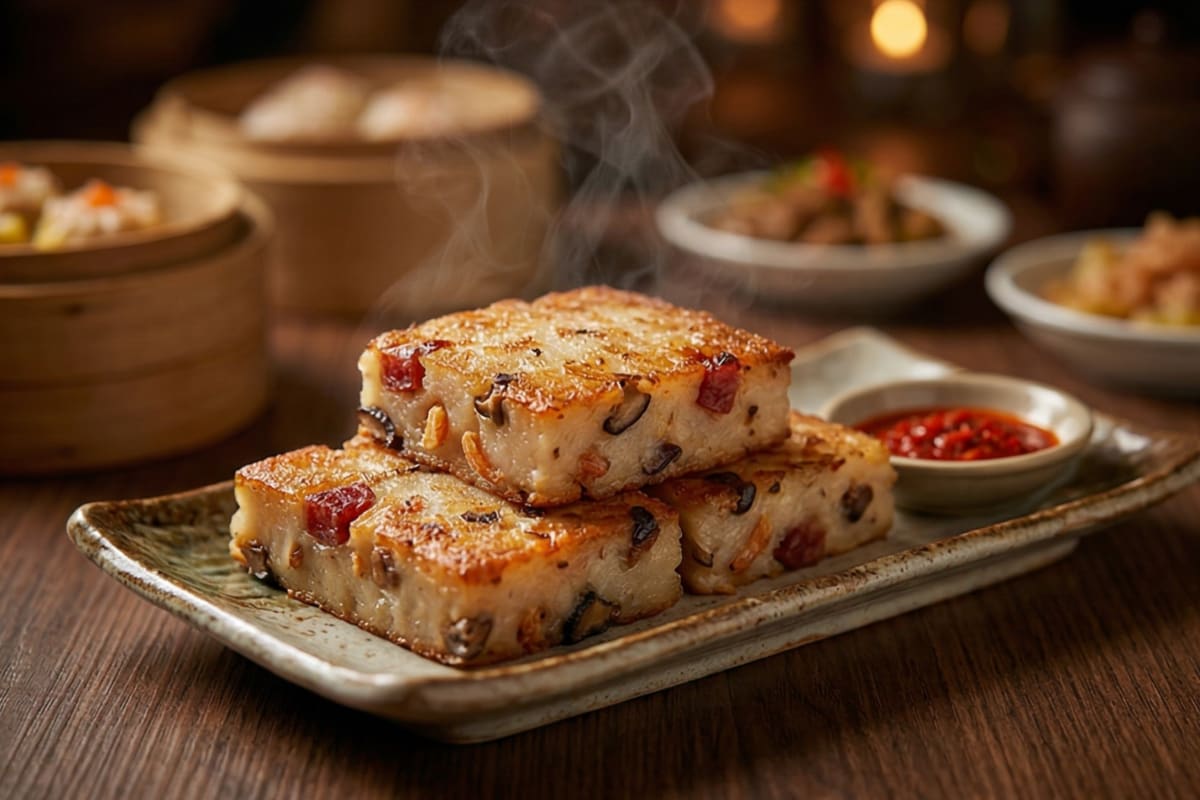
🥢 Introduction: The Undisputed Star of the Dim Sum Cart
If you have ever waded through the boisterous energy of a traditional Cantonese weekend brunch—navigating the rhythmic clanking of metal carts and the chaotic symphony of teacups—you know there is one dish that commands absolute respect: Turnip Cake (萝卜糕 - Luóbo Gāo).
While the name suggests a turnip, this iconic dish is the savory heart of Dim Sum culture. It is especially sacred during the Lunar New Year. In the Hokkien dialect, the word for radish (cai tou) is a homophone for “Good Fortune.” To eat it is, quite literally, to welcome prosperity into your life for the coming year.
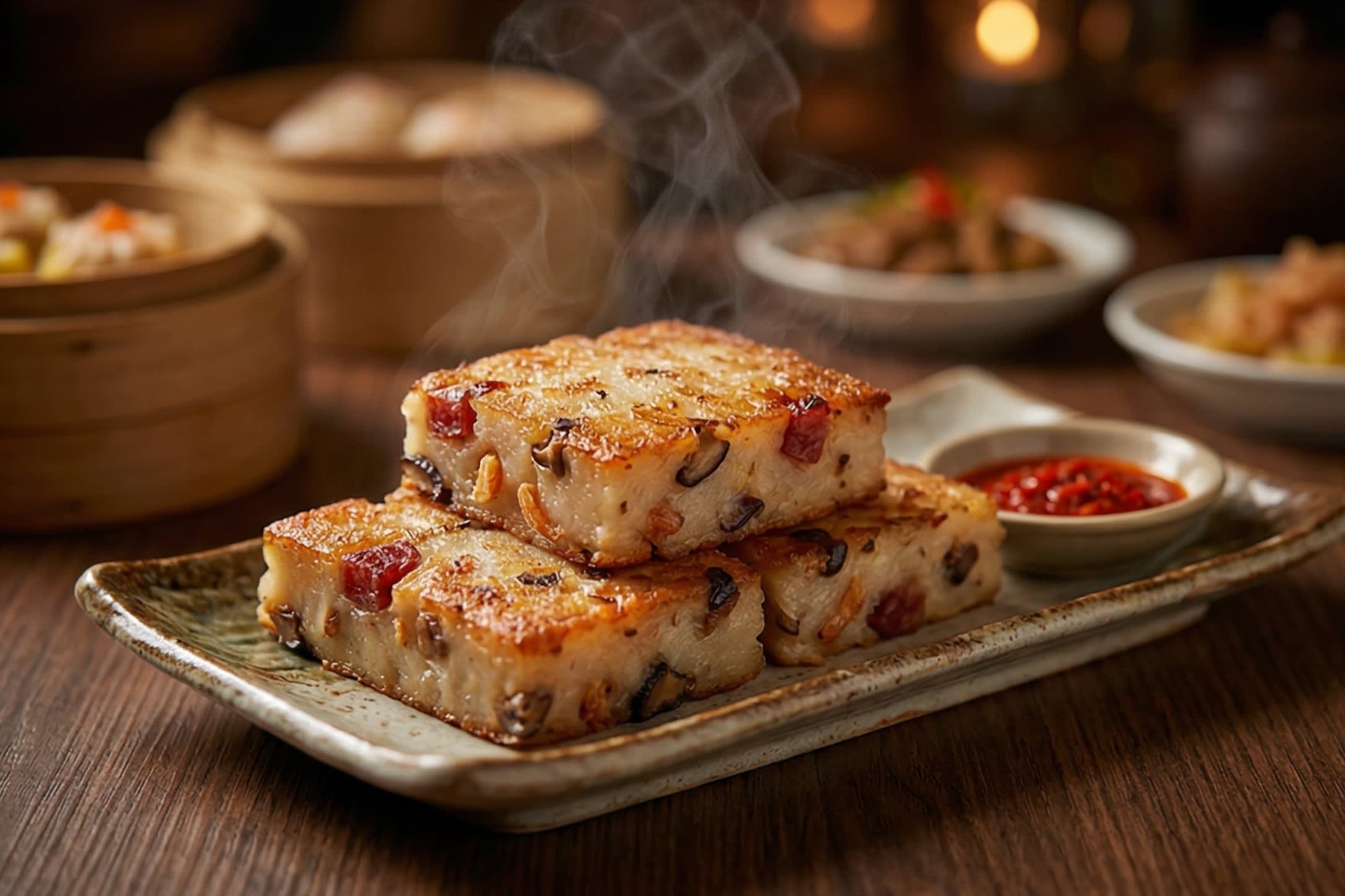
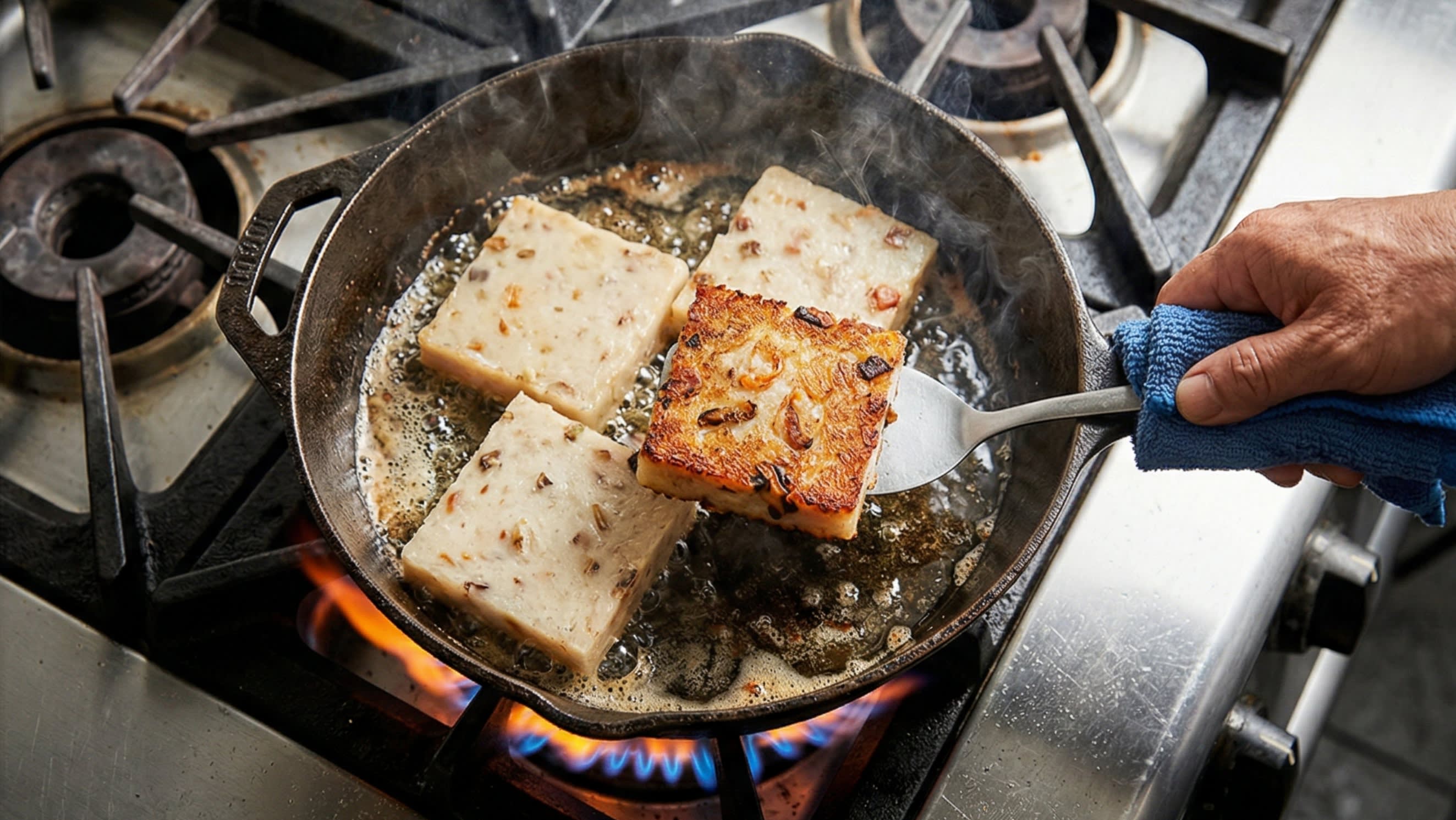
When a master Dim Sum chef prepares this, the result is a textural miracle. The exterior is seared in a hot pan until it achieves a shatteringly crisp, deep mahogany crust. Yet, as your teeth crack through that shell, they sink into an interior that is impossibly soft, savory, and tender. It is an umami explosion, studded with sweet, cured pork, earthy mushrooms, and the briny, ocean-deep punch of dried shrimp.
If you have struggled with this recipe in your own kitchen—if your cakes crumble into a sad, mealy paste or transform into flavorless bricks of starch—take heart. Today, I am breaking down the professional secrets, from the Sheng Shu Jiang technique to the precise radish-to-flour ratio, to ensure your homemade version rivals the best teahouses in Guangzhou.
🚫 The Great Translation Lie: Do Not Use Turnips!
The greatest barrier for home cooks is the English name itself. Please, for the sake of your palate, never use a Western turnip. Those small, purple-topped roots possess a sharp, mustardy bitterness that will dominate the dish in the worst way possible.
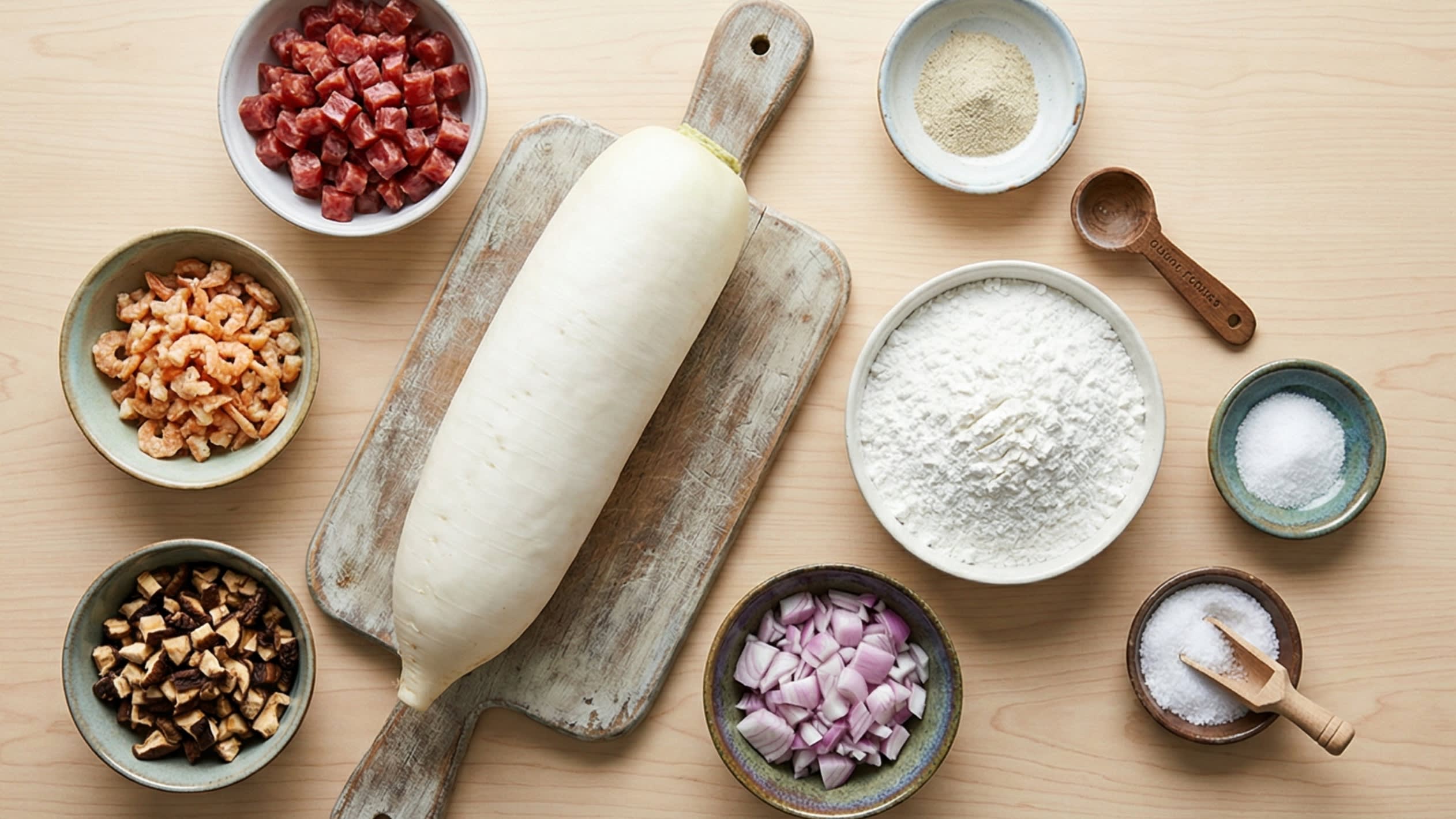
The authentic vegetable is the Daikon Radish (白萝卜 - Bái Luóbo). Daikon is a giant, long, pure white Asian radish. It is a chameleon of the vegetable world: when grated and cooked down, it sheds its initial bite and dissolves into an incredibly sweet, succulent base that provides the moisture needed for a perfect texture.
For those who love mastering Cantonese classics, this level of precision reminds me of my guide to the The ULTIMATE Hong Shao Rou (Red Braised Pork Belly), where fat-rendering is equally essential to flavor success.
🥩 The Umami Engine: Building the Flavor Profile
A cake made of radish and starch alone is merely a canvas. The depth of flavor, known as Làwèi (腊味), comes from the marriage of high-quality cured meats and dehydrated seafood.
- Chinese Sausage (腊肠 - Làcháng): These firm, cured pork links are essential. They bring a distinct, honeyed sweetness and a smoky aroma that anchors the entire dish.
- Dried Shrimp (虾米 - Xiāmǐ): These tiny, dehydrated gems pack a massive, concentrated punch of oceanic umami.
- Dried Shiitake Mushrooms (干香菇 - Gān Xiānggū): These provide a deep, woody resonance that balances the saltiness of the shrimp and the sweetness of the sausage.
The Restaurant Secret: Never add these raw. You must finely dice them and sauté them vigorously in a hot wok. This process renders the pork fat and toasts the shrimp, releasing volatile oils that infuse every particle of the mixture. Before you start, I highly recommend using a high-quality carbon steel wok to ensure the heat retention is sufficient for that quick, aggressive sauté.
🔬 The Culinary Physics: The “Sheng Shu Jiang” Secret
Why do cakes turn into crumbly piles? It usually comes down to the flour chemistry.
1. The Right Flour (粘米粉)
You must use Regular Rice Flour (粘米粉 - Zhānmǐfěn). Avoid Glutinous Rice Flour (糯米粉) at all costs; it will make your cake impossibly gummy and sticky, like a dense marshmallow. We also incorporate a touch of cornstarch to give the finished cake the structural integrity required for those clean, crisp edges when you slice it. You can find quality Regular Rice Flour at most Asian grocers or online.
2. Partial Gelatinization (生熟浆 - Shēng Shú Jiāng)
This is the “aha!” moment of Dim Sum. If you mix cold ingredients and cold starch, the heavier flour will sink to the bottom of your pan before the steam even hits it. We use Sheng Shu Jiang—the “raw-cooked batter” method. By boiling the radish and pouring that piping hot mixture directly into the cold rice flour slurry, you force the starch to partially gelatinize instantly. It creates a thick, sticky paste that suspends the radish and meats uniformly throughout the cake. This is the secret to a professional-grade set.
🛒 Ingredients List
| Ingredient | Quantity/Notes |
|---|---|
| Chinese Sausage (腊肠 - Lap Cheong) | 2 links, finely diced |
| Dried Shrimp (虾米) | 1/3 cup, soaked for 20 mins and chopped |
| Dried Shiitake Mushrooms (干香菇) | 4-5, rehydrated and diced |
| Daikon Radish (白萝卜) | 2 lbs, peeled and coarsely shredded |
| Regular Rice Flour (粘米粉) | 1.5 cups (non-glutinous) |
| Cornstarch (玉米淀粉) | 3 tbsp |
| Seasoning | Salt, sugar, white pepper powder, chicken bouillon |
🍳 Step-by-Step Instructions
1. Sauté the Umami Engine: I always start by heating my wok over medium heat with a tablespoon of oil. I add the shallots, Chinese sausage, shrimp, and mushrooms. I sauté them for about 4 minutes until the sausage fat is glistening and the shrimp is fragrant. Then, I set this mixture aside.
2. Prepare the Slurry: In a large bowl, I whisk the rice flour, cornstarch, and dry seasonings with 1 cup of room-temperature water until the batter is perfectly smooth.
3. Cook the Radish: In the same wok, I add the shredded radish and 1 cup of water or broth. I find it’s best to simmer until the radish is translucent and sweet, as this ensures the base isn’t raw-tasting later.
4. The Gelatinization Magic: I add the sautéed meat mixture to the boiling radish. Then, I stir in my flour slurry. I always work quickly here because the heat turns the mixture into a thick, sticky paste immediately—this is the Sheng Shu Jiang in action.
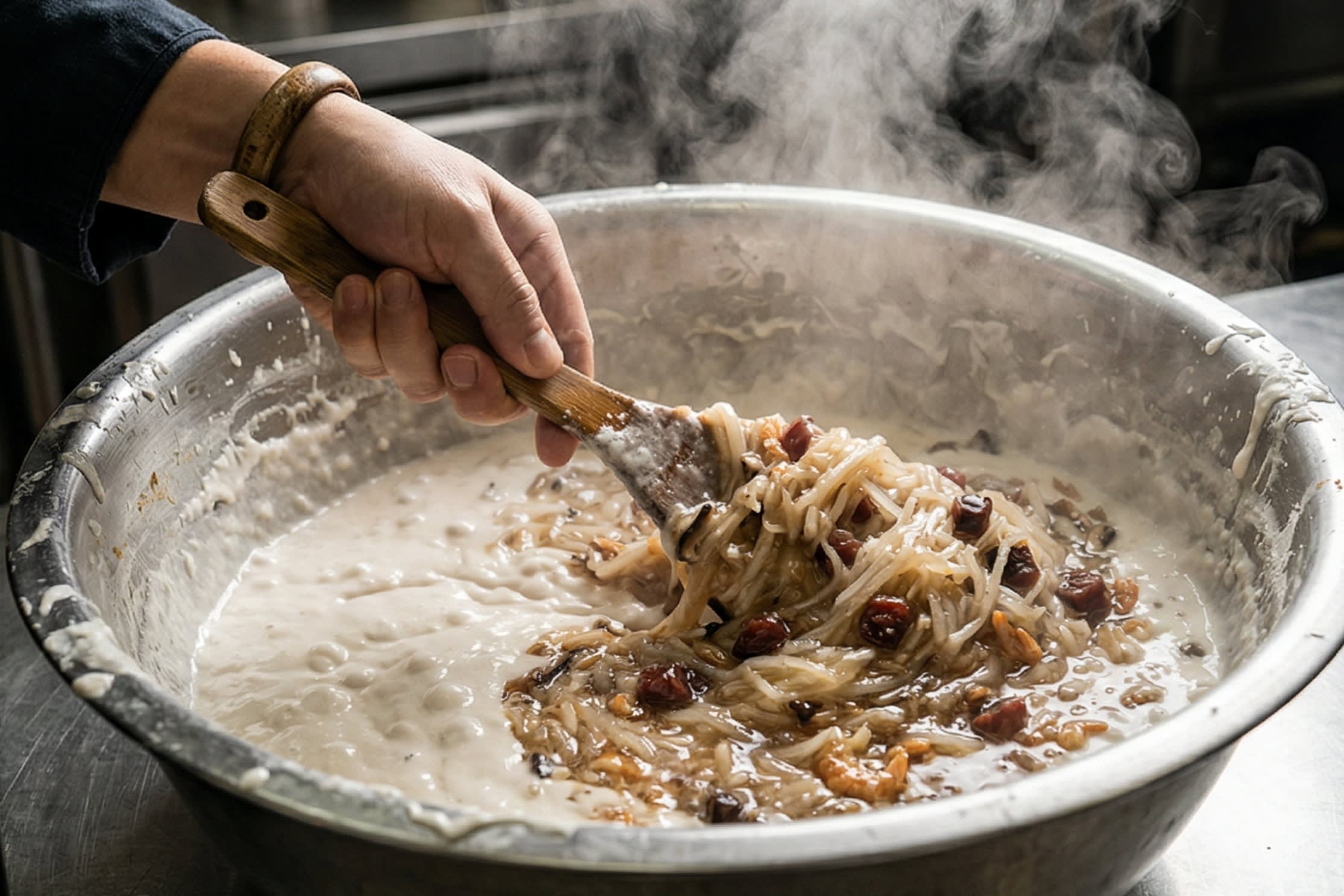
5. Steam: I pour the mixture into a greased pan and smooth the top. I steam it for 50–60 minutes.
6. Chill: This part is non-negotiable for me. I let it cool, then refrigerate for at least 4 hours. In my experience, trying to cut it before this step just results in a sad, warm pudding.
7. Pan-Fry: I slice the cake into 1/2-inch rectangles and fry them in a well-oiled pan. I wait until both sides are dark gold and brittle before serving with some chili garlic sauce.
💡 Troubleshooting Pro Tips
If your cake crumbles, you likely didn’t allow the batter to cool/set in the fridge long enough. If it feels too dense, check your radish ratio; older radishes are less juicy, so you may need a splash more water.
For more techniques on achieving that perfect texture, check out my tips in The ULTIMATE Flaky Scallion Pancakes (The Secret to 100 Crispy Layers).
🎥 Watch the Authentic Pan-Frying Technique
Disclaimer: As an Amazon Associate, ChinaCurator earns from qualifying purchases.