
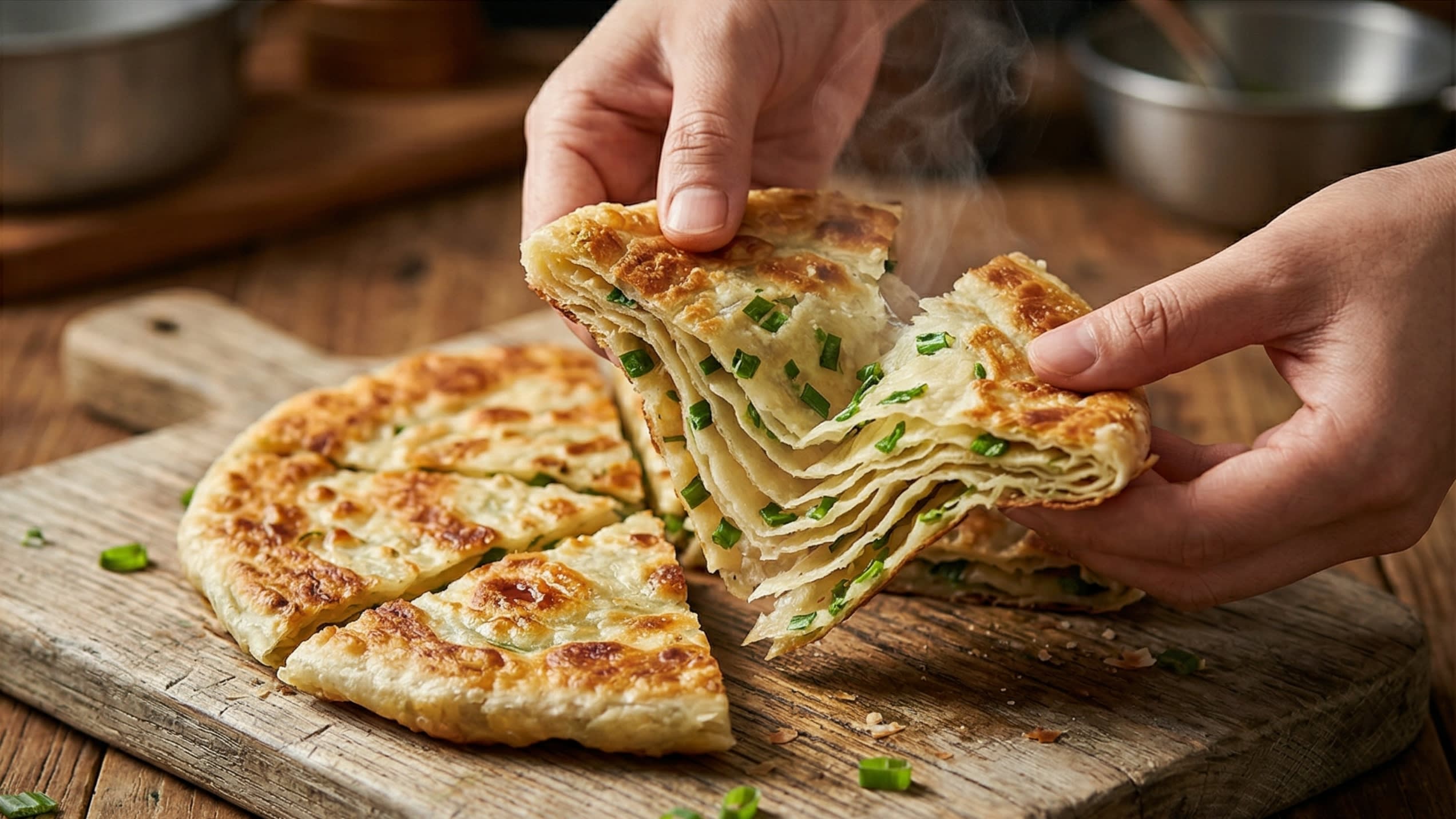
🥞 Introduction: The King of Chinese Street Food
Imagine waking up to the rhythmic clatter of a bustling morning market in Shanghai. The air is heavy with the intoxicating, savory perfume of sizzling oil, toasted wheat, and sharp, caramelized green onions. You step up to a weathered stall, and the vendor hands you a piping hot disc wrapped in a simple grease-stained bag.
This is the Scallion Pancake (葱油饼 - Cōngyóubǐng), the undisputed monarch of the Chinese breakfast world.
A truly masterful Scallion Pancake is an exercise in textural tension. The outer surface should be shatteringly crisp, blistered into a mahogany-gold shell by the hot oil. Underneath, however, it should yield into a soft, elastic, and airy crumb—separated into countless paper-thin sheets. We call this Qiāncéng (千层 - a thousand layers). Every bite should be a symphony of crunch, chew, and aromatic onion punch.
Many home cooks find themselves frustrated, producing dense, rubbery discs that feel more like flattened bread than the delicate, flaky miracle found on the streets of China. Today, I’m pulling back the curtain on the two essential techniques that will change your kitchen game forever. No yeast, no baking powder—just the mastery of dough science.
🔬 The Culinary Science: “Tangmian” (Hot Water Dough)
The most common trap for beginners? Using cold tap water to mix the flour. If you do this, you develop a strong, elastic gluten network, which is fantastic for a crusty sourdough loaf but catastrophic for a delicate pancake. You’ll end up chewing for days.
To achieve that signature tenderness, we use a method known as Tàngmiàn (烫面 - Hot Water Dough).
By pouring boiling water into raw flour, you essentially “shock” the proteins. The extreme heat denatures them instantly, preventing the formation of tight, elastic gluten strands. Simultaneously, the hot water gelatinizes the starches, ensuring the dough remains soft and supple after it hits the skillet.
My Secret: For the best results, I lean on a hybrid method called Bàn Tàngmiàn (半烫面 - Half Hot Water Dough). I combine half the flour with boiling water for melt-in-the-mouth tenderness, then add the rest with cold water to maintain just enough “spring.” When you rest the dough—or Xǐngmiàn (醒面 - waking the dough)—for at least 30 minutes, it becomes remarkably compliant, rolling out like silk without fighting you.
🛢️ The Ultimate Flaky Secret: “Yousu” (油酥)
If you have ever tried to just brush oil onto your dough and roll it up, only to be disappointed by the lack of distinct layers, you are missing the Yousu.
Simple cooking oil just seeps into the flour. To create a true, flaky architecture, you need Yóusū (油酥 - Oil Roux).
This isn’t just oil; it’s a fragrant paste made by pouring sizzling hot fat over a mixture of flour, salt, and Wǔxiāngfěn (五香粉 - five-spice powder). The heat toasts the flour, creating a savory, aromatic foundation. When spread across your dough, the Yousu acts as a barrier, preventing the layers from fusing together during the rolling process. It is the Chinese equivalent of laminating pastry, providing the separation necessary for those legendary 100 layers.
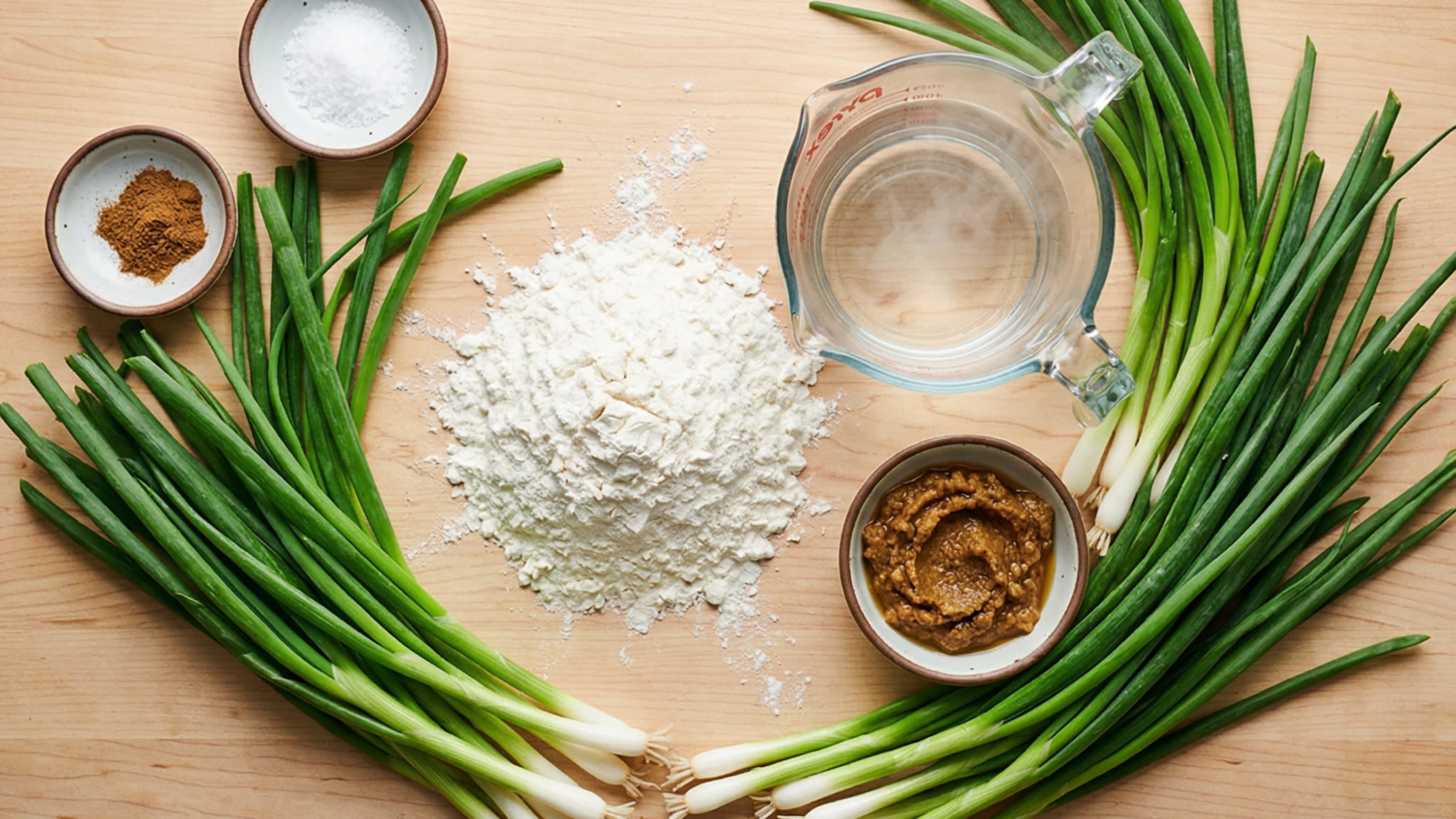
🛒 Ingredients List
The “Half-Hot” Dough (半烫面):
- 3 cups all-purpose flour (中筋面粉)
- 1/2 cup Boiling Water
- 1/2 cup Cold Water
- 1 tbsp cooking oil
The Secret Oil Roux (油酥):
- 1/3 cup All-Purpose Flour
- 1/2 tsp Salt
- 1/2 tsp five-spice powder (五香粉)
- 1/2 cup high-heat vegetable oil
The Aromatic Filling:
- 2 cups fresh scallions (葱花 - Cōnghuā), finely chopped (ensure they are dry!)
The Dipping Sauce:
- 2 tbsp light soy sauce
- 1 tbsp black rice vinegar (镇江香醋)
- 1 tsp chili crisp
🍳 Step-by-Step Instructions
- Mixing the Dough: In a bowl, separate your flour into two halves. Pour boiling water over one half and mix until it forms shaggy, cooked curds. Pour cold water over the other half. Bring everything together, add the tablespoon of oil, and knead until smooth. Rest for 30 minutes.
- Developing the Roux: Place flour, salt, and five-spice in a heat-proof bowl. Heat your oil until it just begins to shimmer, then carefully pour it over the mixture. It will bubble and release a toasted, savory scent. Cool before using.
- The Roll: Divide the dough into four pieces. On an oiled surface, roll one piece into a translucent, paper-thin rectangle.
- Coiling: Spread your cooled Yousu over the sheet. Scatter your dry scallions evenly. Roll the dough into a tight “snake,” then coil it into a snail shell (蜗牛状). Let this rest for 15 minutes to relax the gluten.

- Final Flattening: Using your rolling pin, gently press the snail coil into a 7-inch disc. Be careful not to crush the internal structure!
- Pan-Fry: Heat your cast-iron skillet over medium heat. Fry until both sides are deep golden-brown.
- The Fluff: While the pancake is still in the pan, use two spatulas to gently scrunch the edges toward the center. This releases the internal steam and “fluffs” the layers apart.

💡 Pro-Tips for Success
| Common Issue | The Fix |
|---|---|
| Dough keeps shrinking back? | Increase your resting time. The gluten needs to be "lazy" to roll thinly. |
| Scallions making dough soggy? | Pat them bone-dry with a paper towel before chopping. |
| Need a meal for later? | Freeze them raw between parchment sheets and fry from frozen! |
Mastering this recipe is a cornerstone of Chinese home cooking. For more ways to elevate your skills, check out my guide on making authentic potstickers or mastering the stir-fry with beef and broccoli.
🎥 Watch the Flaky Folding Technique
Disclaimer: As an Amazon Associate, ChinaCurator earns from qualifying purchases.