
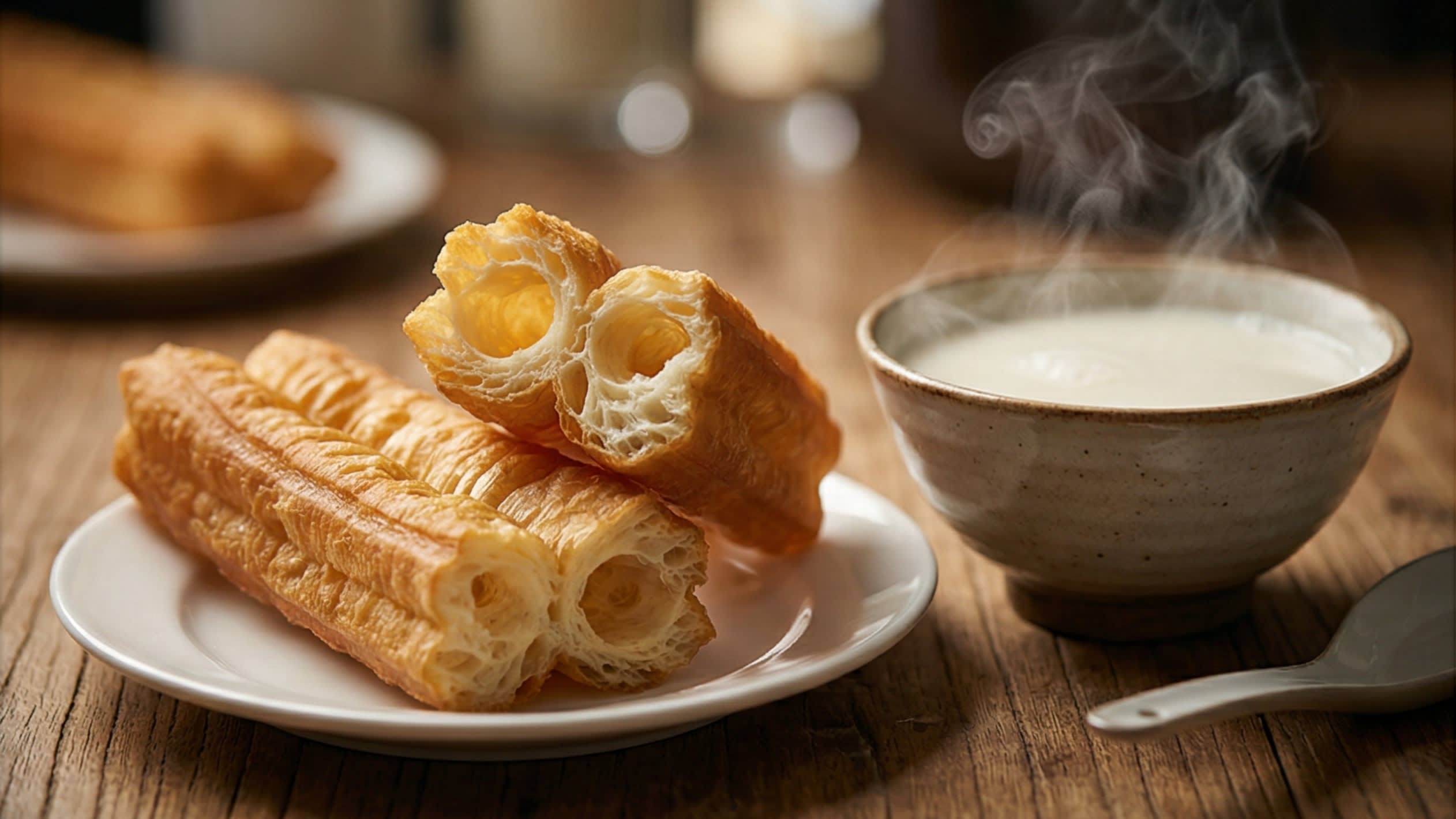
🥖 The King of the Chinese Breakfast Table
If you find yourself wandering the bustling alleys of Beijing, Shanghai, or Taipei as the sun begins to crest, your senses are almost certainly caught by one thing: the intoxicating, rich perfume of toasted wheat and bubbling hot oil. You’ll see queues of locals in heavy coats, breath misting in the cold air, all waiting for a simple, transformative ritual. It’s the pairing of warm, silky soy milk (豆浆 - Dòujiāng) and a freshly fried Youtiao (油条 - Yóutiáo).
Youtiao is the undisputed, golden standard of the Chinese breakfast. When prepared by a master street vendor, it’s not just fried dough; it’s a textural miracle. Imagine a long, slender stick that is shatteringly crisp on the outside (外酥 - Wàisū), yet yields to an impossibly light, chewy, and airy interior (里嫩 - Lǐnèn). It is a hollow vessel, designed specifically to act as an edible sponge for dipping into soy milk or congee—much like how you might enjoy dipping a perfectly toasted piece of bread, though the texture here is far more dramatic.
If you’ve ever tried to replicate these at home in a Western kitchen, you’ve likely been met with disappointment—dense, heavy, and greasy breadsticks that refuse to puff. And then there is the historical reliance on Alum (明矾 - Míngfán), a chemical that many of us prefer to keep out of our pantries today. I’ve spent countless hours refining this method to ensure you can achieve that classic, cavernous hollow without the chemicals. We aren’t just frying dough; we are engineering a morning masterpiece.
🔬 The Chemistry of the Puff: Going Alum-Free
For generations, street vendors relied on a volatile mix of Alum and baking soda to trigger a violent reaction in the oil, forcing the dough to balloon. To move away from aluminum while maintaining that signature “puff,” we rely on a precise double-action leavening system:
- Aluminum-Free Baking Powder: This is the engine of our expansion. It reacts once when mixed into the dough and triggers a second, more powerful surge when it hits the 400°F (200°C) frying oil.
- Baking Soda (小苏打): By introducing a touch of alkalinity, we encourage the dough to release carbon dioxide gas instantly.
When these two meet the screaming hot oil, the internal structure of the dough turns into an airy lattice before the crust has a chance to set. The result? Glorious, empty Hollows (空心 - Kōngxīn).
🥢 The Physics of the Shape: The Chopstick Press
Have you noticed that a Youtiao is never a single piece of dough? It is always two strips, stacked and fused. This is pure physics. If you fry a single cylinder, the exterior hardens too quickly, trapping the dough inside and leaving you with a heavy breadstick.
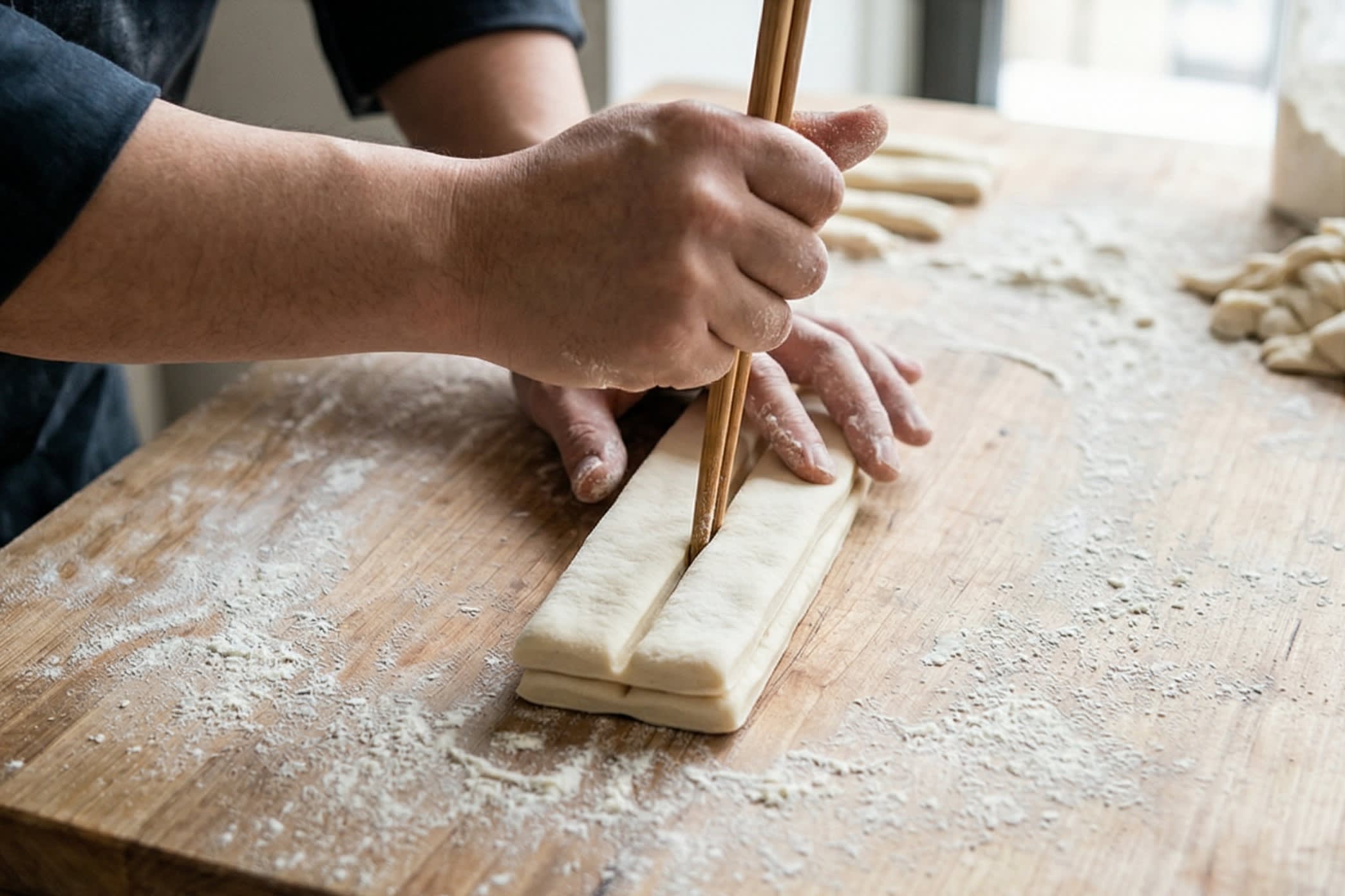
By stacking two strips and using a dry wooden cooking chopstick to press firmly down the center, you create a “hinge.” As the dough enters the oil, the unpressed sides remain pliable for just a second longer, allowing the trapped gases to rip the soft interior apart, pulling the two strips into a hollow arch. If you don’t press them, you don’t get the hollow center. It’s that simple.
🚫 The Iron Rule: Xǐng Miàn (醒面)
If your dough behaves like a stubborn rubber band, snapping back every time you try to shape it, you’ve ignored the most vital step in the process: Xǐng Miàn (醒面 - Resting the Dough).
Gluten is a fascinating protein, but it loves to fight back. We combat this by resting the dough in the refrigerator overnight. This cold-aging process allows the gluten strands to fully relax.
THE GOLDEN RULE: When you pull that dough from the fridge in the morning, DO NOT KNEAD IT! Do not fold it, and do not try to smooth it out. Any manipulation at this stage will snap those strands back to attention, turning your breakfast into dense, chewy rubber. Treat the cold dough with total reverence; it’s already perfect.
🛒 Ingredients List
The Alum-Free Dough:
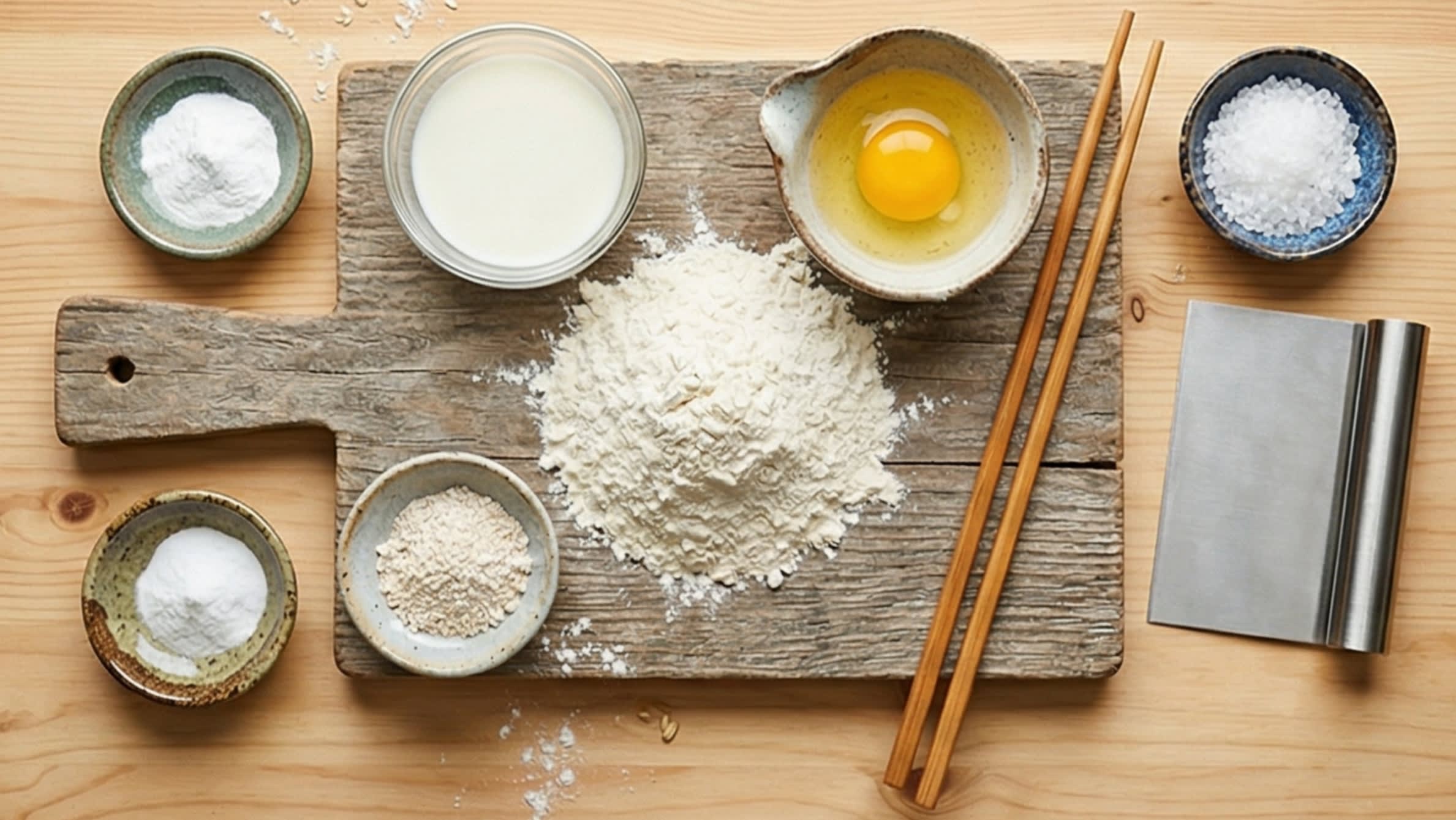
- 2.5 cups (300g) All-Purpose Flour (Avoid bread flour; the higher protein content makes it too tough).
- 1 tbsp (10g) Aluminum-Free Baking Powder.
- 1/2 tsp (3g) Baking Soda.
- 1 tsp (5g) Salt.
- 1 large Egg (room temperature for even incorporation).
- 1/2 cup (120ml) Milk or water (lukewarm).
- 1.5 tbsp (20g) Neutral cooking oil (plus extra for the surface).
For Frying:
- 4-6 cups of high-heat cooking oil (Peanut oil is the traditional choice for its nutty aroma).
- An instant-read kitchen thermometer is non-negotiable here.
🍳 Step-by-Step Instructions
- Combine: Whisk your dry ingredients in a large bowl. Create a well and pour in your egg, milk, and oil. Use a spatula to form a shaggy mass, then use your hands to press it into a cohesive, rough dough.
- The Oil Seal: Shape the dough into a flat rectangle, brush it thoroughly with oil to prevent drying, and wrap it tightly. Let it rest in the fridge for at least 8 hours.
- The Gentle Stretch: Let the cold dough sit at room temperature for 30 minutes. Place it on a lightly floured surface. Using only your fingertips, gently pat it into a rectangle 1/4-inch thick.
- The Press: Cut the rectangle into 1-inch strips. Stack two strips together. Align a bench scraper or chopstick along the center and press down firmly to fuse the layers.
- The Heat Test: Bring your oil to exactly 400°F (200°C). If the oil is cool, the dough will soak up grease instead of puffing.
- The Fry: Pick up your pressed pair, gently pull it to double its length, and lower it into the oil. Watch the magic happen—the dough will almost instantly transform.
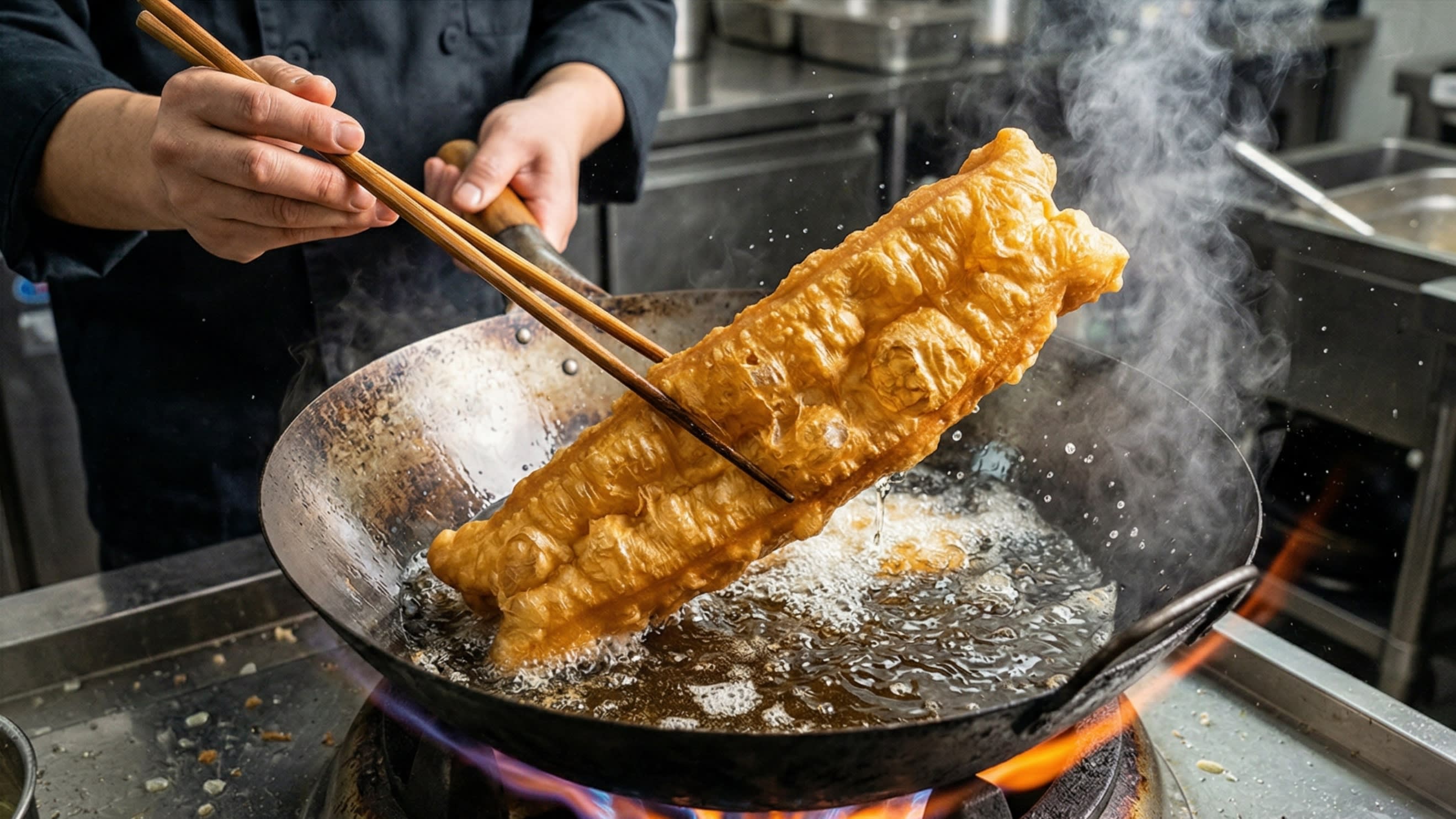
- The Finish: Keep the Youtiao moving in the oil to ensure an even, deep golden color. Drain on a wire rack to keep it crisp.
| Issue | Fix |
|---|---|
| Dense/Not Hollow | Check your oil temp (must be 400°F) and press harder with the chopstick! |
| Dough Shrinks | You kneaded it. Never touch the dough once it's out of the fridge. |
💡 A Curator’s Note
If you’re missing the perfect side for your Authentic Chinese Egg Fried Rice, these Youtiao provide a fantastic contrast. Don’t forget that mastering Chinese comfort food, like my guide to Authentic Sichuan Mapo Tofu, is all about patience and the right tools. Happy frying!
Disclaimer: As an Amazon Associate, ChinaCurator earns from qualifying purchases.