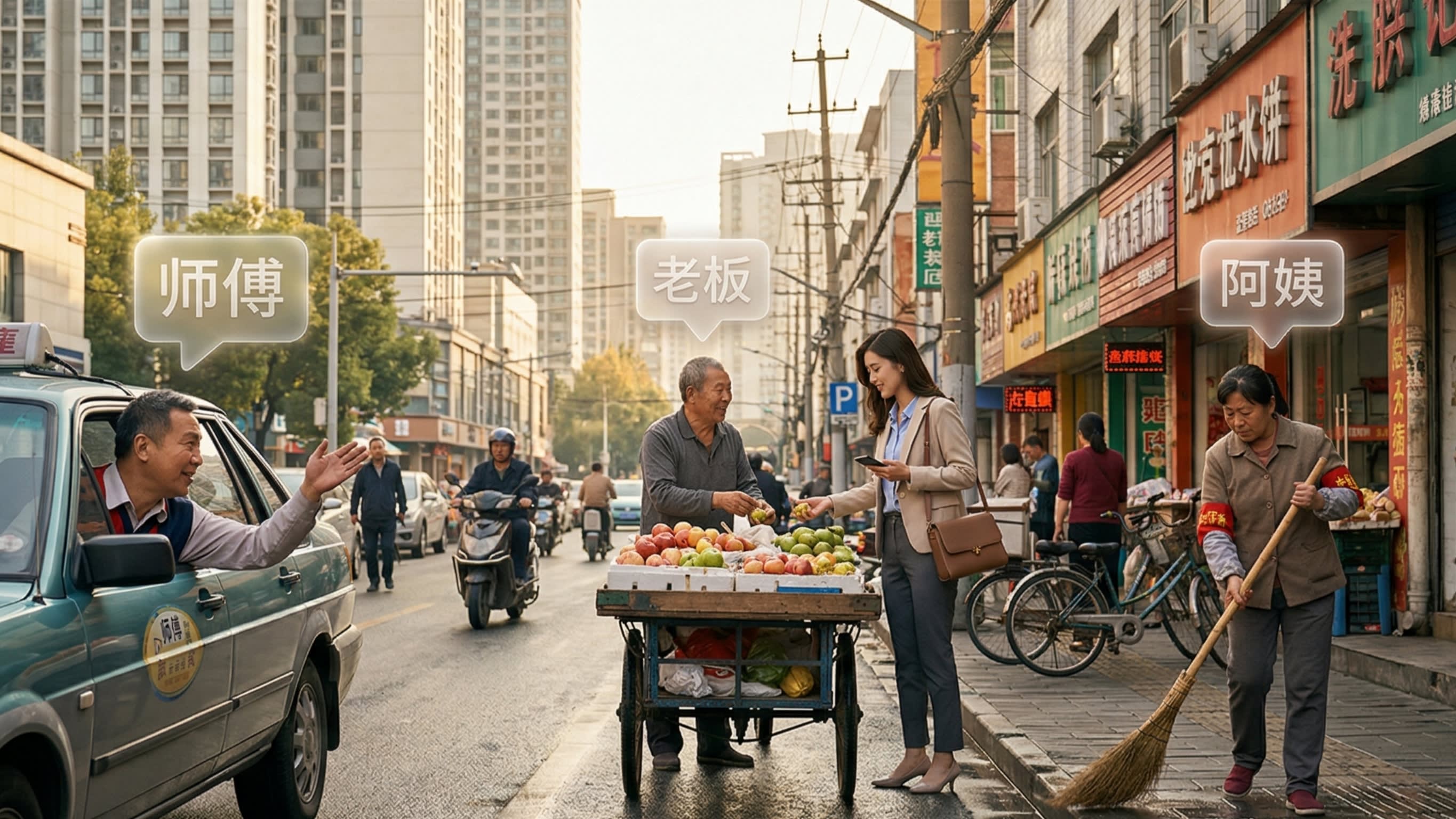
When you first start learning Mandarin, your textbook introduces you to a very comfortable, Western-style way of addressing people: Xiānshēng (先生 - Mr.) and Nǚshì (女士 - Ms./Mrs.).
Equipped with this knowledge, you arrive in China. You step into a taxi and politely say, “Hello, Mr. Driver” (Xiānshēng, nǐ hǎo). The driver gives you a strange look. You go to a local dumpling shop and call out to the middle-aged female owner, “Excuse me, Mrs.!” (Nǚshì!). The entire restaurant goes dead silent.
What went wrong?
In Chinese culture, direct equivalents to “Mr.” and “Mrs.” are incredibly formal. They are reserved for high-end business banquets, academic conferences, or hotel front desks. Using them in everyday life creates an invisible wall of ice between you and the person you are talking to. It sounds robotic, distant, and overly rigid.
Chinese society is built on the concept of Guānxì (关系 - relationships) and social hierarchy. To navigate the streets, shops, and offices of China like a true insider, you need to use relational titles. You categorize people by their profession, their age relative to yours, or a flattering compliment.
If you want to stop sounding like a dictionary and start sounding like a local, here is the ultimate 2026 survival guide to the unwritten rules of Chinese titles.
1. 师傅 (Shīfu): The Master of Trades
In the West, the word Shifu is almost exclusively associated with Kung Fu masters or Master Shifu from the movie Kung Fu Panda. But in modern China, you will use this word almost every single day.
Shifu is a highly respectful title for any skilled blue-collar worker, driver, or tradesperson. It acknowledges that they possess a practical skill that you rely on.
Who to call Shifu:
- Drivers: Whether it is a taxi driver, a Didi (ride-hailing) driver, or a bus driver, they are always Shifu. (e.g., “师傅,前面左转” - Shīfu, qiánmiàn zuǒ zhuǎn / Driver, turn left ahead).
- Mechanics & Handymen: The person fixing your AC, plumbing, or bicycle.
- Street Food Chefs: The person expertly flipping your Jianbing (Chinese crepe) on a hot griddle.
Note: Shifu is traditionally used for men, but it is completely acceptable to use it for female drivers or skilled workers as well.
2. 阿姨 (Āyí) & 叔叔 (Shūshu): The Universal “Auntie” and “Uncle”
In Western cultures, calling a stranger “Auntie” or “Uncle” would be deeply inappropriate. In China, it is the bedrock of societal respect for elders.
Age is highly venerated in Chinese culture. If someone is a generation older than you (roughly the age of your parents), you instantly elevate them by bringing them into your “family” linguistically.
Who to call Ayi (Auntie) / Shushu (Uncle):
- Your friends’ parents.
- Middle-aged or elderly neighbors.
- Older street vendors or market stall owners.
- Cleaners and domestic helpers (in fact, domestic helpers are often simply referred to as “Ayis” as a job title).
⚠️ The “Ayi” Danger Zone!
You must be incredibly careful when deploying the word Ayi. If you call a woman Ayi and she believes she is still young, you have just committed a massive social blunder. You are effectively calling her old.
- The Golden Rule: If the woman looks under 45, do not call her Ayi. If you are ever in doubt about a woman’s age, use Jiějiě (姐姐 - Older Sister) or Měinǚ (美女 - Beautiful girl) instead. Flattery will save you; assuming old age will destroy you.

3. 老板 (Lǎobǎn) & 老板娘 (Lǎobǎnniáng): The Bosses
Chinese culture deeply respects entrepreneurship and business ownership. When you walk into any small, independent business—be it a mom-and-pop noodle shop, a convenience store, or a local tea house—the ultimate form of flattery is to address the owners as “Boss.”
Who to call Laoban (Boss) / Laobanniang (Female Boss):
- The owner of any small restaurant or shop.
- Independent merchants in a wholesale market.
Why it works: Calling someone Laoban makes them feel successful and respected. If you are trying to negotiate a discount or ask for an extra scoop of noodles, starting your sentence with “Laoban…” dramatically increases your chances of success.
- Example: “老板,结账!” (Lǎobǎn, jiézhàng! - Boss, the bill please!)
4. 帅哥 (Shuàigē) & 美女 (Měinǚ): The Casual Compliment
How do you get the attention of a waiter or a retail worker who is roughly your age?
Ten years ago, textbooks taught foreigners to yell Fúwùyuán (服务员 - Waiter/Attendant). However, in 2026, yelling Fuwuyuan in a trendy cafe or a boutique can sound a bit demanding and old-fashioned.
The modern, street-smart approach is to use casual flattery.
- 帅哥 (Shuàigē): Literally “Handsome Brother.” Used for young men.
- 美女 (Měinǚ): Literally “Beautiful Girl.” Used for young women.
Do not worry—this is not catcalling or flirting. In modern Chinese service industries, these terms have been completely stripped of their romantic undertones. They are simply the standard, friendly way to address a young person whose name you do not know.
- Example: “美女,能给我一杯水吗?” (Měinǚ, néng gěi wǒ yì bēi shuǐ ma? - Beautiful girl [Miss], can I have a glass of water?)
5. 老师 (Lǎoshī): The Ultimate Sign of Respect
Lǎoshī means “Teacher.” Naturally, you use this for anyone who teaches in a school or university. But the usage of Laoshi extends far beyond the classroom.
In Chinese society, knowledge is power. Calling someone Laoshi implies that they have a level of expertise or wisdom that you respect, even if they have never taught a class in their life.
Who to call Laoshi:
- Actual teachers and professors.
- Writers, artists, and journalists.
- Senior experts in a corporate workplace (e.g., if you are a junior coder, you might call a senior software architect Laoshi).
- Any respected public figure or mentor.

6. The “Title + Surname” Professional Rule
When you enter a formal corporate environment, the rules change entirely. You do not use Mr. or Mrs., nor do you use Shifu or Shuige.
In the Chinese business world, your job title is your identity. You address people by combining their Surname + Job Title. (Notice that the surname always comes first in Chinese!).
- 经理 (Jīnglǐ - Manager): If a manager’s surname is Wang, you call them 王经理 (Wáng Jīnglǐ).
- 总 (Zǒng - Director/CEO/VP): This is a powerful abbreviation for Zǒngjīnglǐ (General Manager) or Zǒngcái (President). If your company’s VP is named Li, you address them as 李总 (Lǐ Zǒng). This is the ultimate corporate power title.
7. The Ultimate Titles Cheat Sheet
To help you survive your next trip to the market, the office, or the restaurant, save this matrix to your phone:
| The Title | Pinyin | Literal Meaning | When to Actually Use It |
|---|---|---|---|
| 师傅 | Shīfu | Master worker | Taxi drivers, mechanics, street food chefs. |
| 阿姨 / 叔叔 | Āyí / Shūshu | Auntie / Uncle | Anyone a generation older than you (elders, cleaners). |
| 老板 | Lǎobǎn | Boss | Owners of small restaurants, shops, or market stalls. |
| 帅哥 / 美女 | Shuàigē / Měinǚ | Handsome / Beauty | Waiters, retail workers, or strangers your own age. |
| 老师 | Lǎoshī | Teacher | Teachers, writers, mentors, respected professionals. |
Final Thoughts from Bo
Learning vocabulary is easy, but learning social context is what separates a tourist from an insider.
In China, what you call someone is the foundation of your relationship with them. By dropping the robotic “Mr.” and “Mrs.” and embracing titles like Shifu and Laoban, you are immediately showing respect for Chinese social structures. You are signaling that you understand how the local world works.
The next time you jump into a cab, try greeting the driver with a loud and friendly “Shifu, ni hao!” Watch how quickly their face lights up, and enjoy the authentic conversation that follows.

Want to level up your social intelligence even more? Discover How to Say “No” Politely Without Losing Face or learn the Unspoken Rules of WeChat Slang & Emojis.

