
Let’s address the elephant in the room. If you are a foreigner living in China, doing business with Chinese clients, or simply learning Mandarin, you need a Chinese name.
However, the way most expats choose their Chinese names is a cultural disaster.
Some people use a free online translator that phonetically mashes their English name into a string of meaningless, awkward-sounding Chinese syllables. Others open a dictionary and pick the most aggressive, intense nouns they can find, proudly introducing themselves as Lóng (龙 - Dragon) or Lǎohǔ (老虎 - Tiger). And then, there are those who accidentally name themselves after their favorite late-night snack, unironically walking into a Beijing boardroom introducing themselves as Bāozi (包子 - Steamed Bun).
Having a weird Chinese name is the equivalent of a Chinese student coming to the West and naming themselves “Lord Voldemort,” “Thunderstorm,” or “Chicken Nugget.” It is a massive neon sign pointing at you, flashing: “I don’t understand your culture!”
A truly authentic Chinese name is a bridge. It shows deep respect for the culture, demonstrates high emotional intelligence, and instantly makes you more approachable. If you want to avoid the “Menu Item Trap” and choose a name that commands respect, here is your ultimate, step-by-step guide.
1. The Anatomy of a Chinese Name
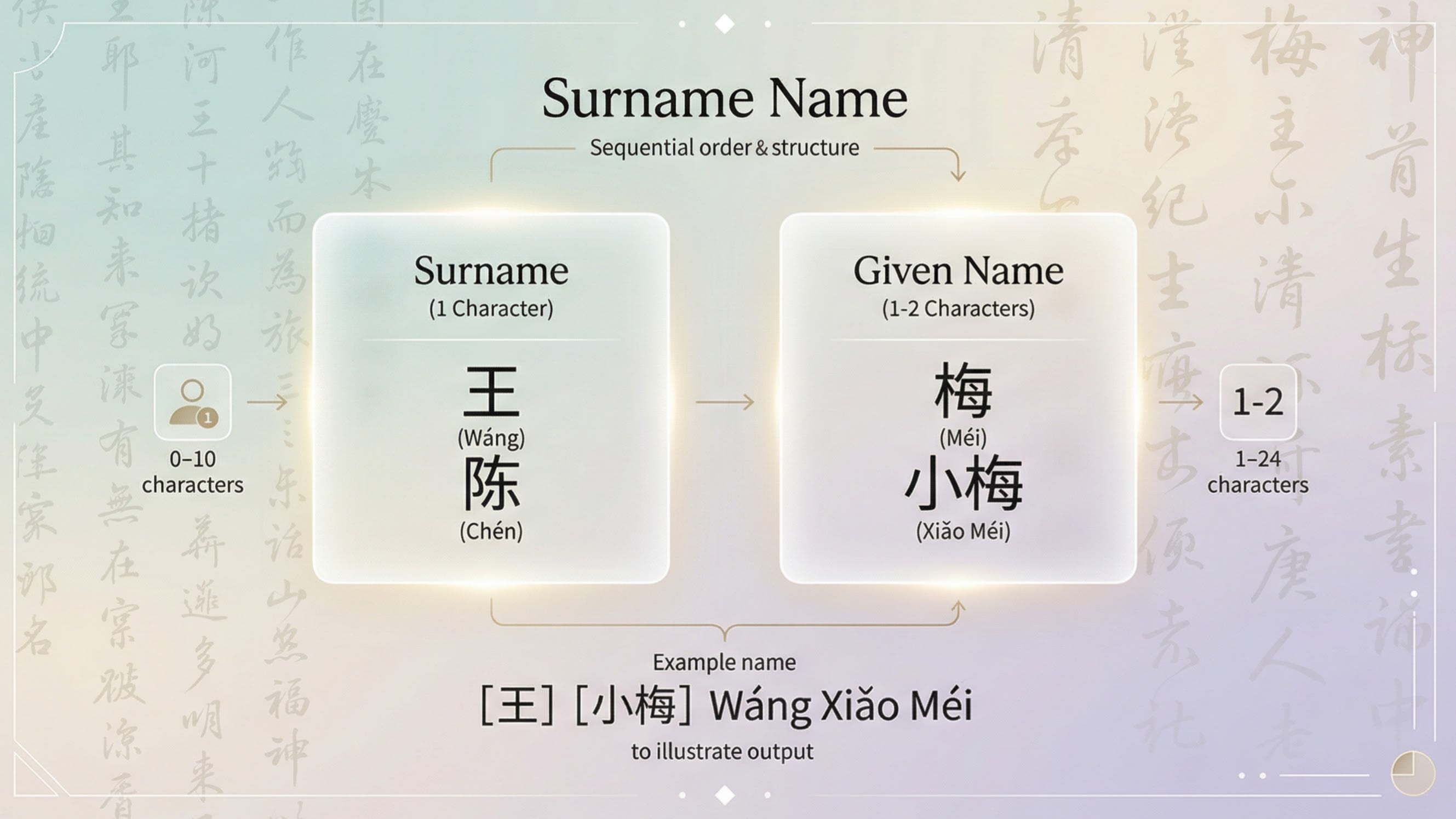
Before you can choose a name, you must understand how they are built. Unlike Western names (First Name + Middle Name + Last Name), Chinese names follow a strict, elegant formula:
Surname (1 character) + Given Name (1 or 2 characters) = Total 2 to 3 characters.
- The Surname comes FIRST. For example, in the name Yáo Míng (姚明), “Yao” is the family name, and “Ming” is the given name.
- Four-character names are a red flag. Unless you are from a specific ethnic minority or have a rare compound surname (like Sīmǎ 司马), having a four-character name sounds incredibly strange and immediately marks you as a foreigner who just phonetically translated “Alexander.”
2. Step One: Steal a Surname from the “Baijiaxing”
Do not try to invent a Chinese surname. The concept of family lineage is sacred in China. You must choose from the established Bǎijiāxìng (百家姓 - Book of Family Names).
The easiest and most authentic way to pick a surname is to find one that sounds vaguely similar to the first syllable of your English last name, or shares a similar meaning.
Phonetic Matching Examples:
- Smith / Simpson: 史 (Shǐ) or 司 (Sī)
- Johnson / Jones: 张 (Zhāng) or 钟 (Zhōng)
- Miller / Martin: 马 (Mǎ - Horse) or 麦 (Mài - Wheat)
- White / Black: 白 (Bái - White) is a very common, highly respected Chinese surname.
By grounding your name with a real, recognizable Chinese surname like Wang (王), Li (李), or Chen (陈), you instantly legitimize everything that comes after it.
3. Step Two: The Given Name (Meaning Over Sound)
This is where most foreigners fail. Do not use Google Translate to find characters that sound like “Michael” or “Jessica.”
In Chinese culture, a given name is a poetic wish for the person’s life. It is about Meaning, Virtue, and Imagery, not sound. When Chinese parents name a child, they consult poetry, literature, and the five elements (Metal, Wood, Water, Fire, Earth) to find a harmonious balance.
The “Menu Item & Object” Trap
Never name yourself after an everyday object, an animal, or food.
- Do not use: 苹果 (Apple), 饺子 (Dumpling), 猫 (Cat), or 快乐 (Happy). These are literal words, not names. Calling yourself “Happy Dumpling” is a guaranteed way to make people burst out laughing behind your back.
The “Overpowered” Trap
Westerners love picking characters that sound badass. They choose 龙 (Dragon), 霸 (Overlord), or 狂 (Crazy/Wild). In Chinese culture, humility is a core virtue. Choosing a wildly arrogant name makes you sound like a comic book villain or a 1980s triad boss.
What to Do Instead: Aim for Poetic Subtlety
Choose characters that represent positive, subtle virtues, nature, or intelligence.
- For Men: Look for characters implying strength, wisdom, or vastness.
- Examples: 伟 (Wěi - Great/Robust), 宇 (Yǔ - Universe/Vast), 哲 (Zhé - Wise), 瑞 (Ruì - Auspicious).
- For Women: Look for characters implying elegance, nature, or grace.
- Examples: 婉 (Wǎn - Graceful), 婷 (Tíng - Elegant), 雅 (Yǎ - Refined), 萱 (Xuān - A type of daylily, implying forgetting sorrows).
- Gender-Neutral: 宁 (Níng - Peaceful), 凡 (Fán - Ordinary/Mortal, often used to show deep humility), 思 (Sī - To think/reflect).
4. Step Three: The “Homophone” Sanity Check (谐音梗)
Chinese is a tonal language with thousands of homophones (words that sound identical but have different meanings). This is the most dangerous minefield in Chinese naming.
You might carefully select two beautiful characters, but when spoken together out loud, they might sound exactly like a terrible curse word or a bizarre phrase.
- Example: You want your name to mean “Bright Road,” so you choose 明道 (Míng Dào). But if you paired it with the surname 阴 (Yīn), your name becomes Yīn Míng Dào… which sounds suspiciously like “Vagina” in local slang.
- Example: You pick the beautiful characters 史 (Shǐ - a real surname) and 珍香 (Zhēn Xiāng - precious fragrance). Put them together: Shǐ Zhēnxiāng. It sounds exactly like 屎真香 (Poop smells really good). Yes, this is a legendary naming joke in China.
The Golden Rule: You CANNOT finalize your Chinese name without asking at least two native speakers to say it out loud rapidly. Ask them directly: “Does this sound like anything weird, stupid, or funny?”

5. Examples of Excellent Expat Names
To give you some inspiration, let’s look at how you can craft a name that sounds beautiful, native, and meaningful.
- English Name: Matthew White
- Chinese Name: 白慕哲 (Bái Mùzhé)
-
Breakdown: 白 (Bái) is a real surname meaning White. 慕 (Mù) means to admire or yearn for. 哲 (Zhé) means wisdom. The name sounds highly educated and elegant.
- English Name: Olivia Martin
- Chinese Name: 马婉清 (Mǎ Wǎnqīng)
-
Breakdown: 马 (Mǎ) is a common surname (Horse). 婉 (Wǎn) means graceful. 清 (Qīng) means clear or pure. Wǎnqīng is a classic, beautiful name often found in traditional wuxia literature.
- English Name: David Cole
- Chinese Name: 柯达伟 (Kē Dáwěi)
- Breakdown: 柯 (Kē) is a real surname that sounds like Cole. 达 (Dá) means to reach or succeed. 伟 (Wěi) means great. It sounds like a strong, dependable business professional.
Final Thoughts from Jian
Choosing a Chinese name is a profound right of passage. It is your opportunity to reinvent yourself and consciously decide how you want to be perceived in one of the world’s oldest civilizations.
Do not rush the process. Read classical poetry, explore character dictionaries, and above all, consult with your local friends. When you finally hand over a business card or introduce yourself on WeChat with a beautifully crafted, culturally resonant name, the reaction you get will be worth all the effort. You will stop being just another “Laowai” (foreigner), and you will start being seen as someone who truly understands the matrix of Chinese culture.
Now, take a deep breath, throw that “Dragon” name tag in the trash, and start crafting your true Chinese identity.

Ready to use your new name in the real world? Learn how to address others correctly in our guide to Chinese Titles (Shifu, Ayi, Laoban) or master the art of Polite Refusals in Business.

