
You are running late for a dinner party in Beijing. You finally manage to hail a taxi. You show the driver the address, but as you approach the final intersection, the GPS drops out. The driver looks at you in the rearview mirror and asks, “Zěnme zǒu?” (How do we go?).
You panic. You know the restaurant is on the left, but how do you say “Turn left”?
Later, you arrive at your friend’s apartment. You ask where the bathroom is. Your friend yells from the kitchen: “Zài shāfā hòumiàn!” (Behind the sofa!). You wander around aimlessly because you don’t know if hòumiàn means front, back, inside, or outside.
Spatial awareness in a foreign language is a foundational survival skill. However, learning Chinese direction words (方位词 - fāngwèicí) is not just a matter of memorizing vocabulary. Chinese grammar maps physical space completely backward compared to English. Furthermore, the Chinese language takes these physical direction words and uses them to describe time.
If you want to stop getting lost, find your missing keys, and tell taxi drivers exactly where to go, here is your ultimate guide to decoding the Chinese compass.
1. The Core Compass: The 8 Essential Directions
Before we tackle the grammar, you need to memorize the absolute core vocabulary. These single characters are the building blocks of Chinese spatial orientation.
- 上 (shàng): Up / Above
- 下 (xià): Down / Below
- 左 (zuǒ): Left
- 右 (yòu): Right
- 前 (qián): Front / Forward
- 后 (hòu): Back / Behind
- 里 (lǐ): Inside
- 外 (wài): Outside
Bonus Tip: Chinese characters are often highly visual. Look at 上 (Up); the smaller strokes are above the horizontal baseline. Look at 下 (Down); the smaller strokes point below the baseline.
2. The Suffix System: 面 (miàn), 边 (biān), and 头 (tóu)
In spoken Chinese, native speakers rarely use those single characters entirely by themselves to describe a location. A single syllable sounds too abrupt. Instead, they attach a suffix to turn the concept into a physical noun.
You will almost always hear native speakers attach one of three suffixes to the core directions:
- 边 (biān): Means “side” or “edge.” (Very common).
- 面 (miàn): Means “surface” or “face.” (Very common, slightly more formal).
- 头 (tóu): Means “head” or “end.” (Often used in Northern Chinese dialects).
So, “Up” (上) becomes:
- 上面 (shàng miàn) - Top surface / Above.
- 上边 (shàng biān) - Upper side.
“Inside” (里) becomes:
- 里面 (lǐ miàn) - Inside surface.
- 里头 (lǐ tou) - In the interior.
For a beginner, 边 (biān) and 面 (miàn) are almost completely interchangeable. Pick one that feels good to say, and stick with it!
3. The Grammar Trap: “Reverse Geography”
This is where English speakers fail the hardest.
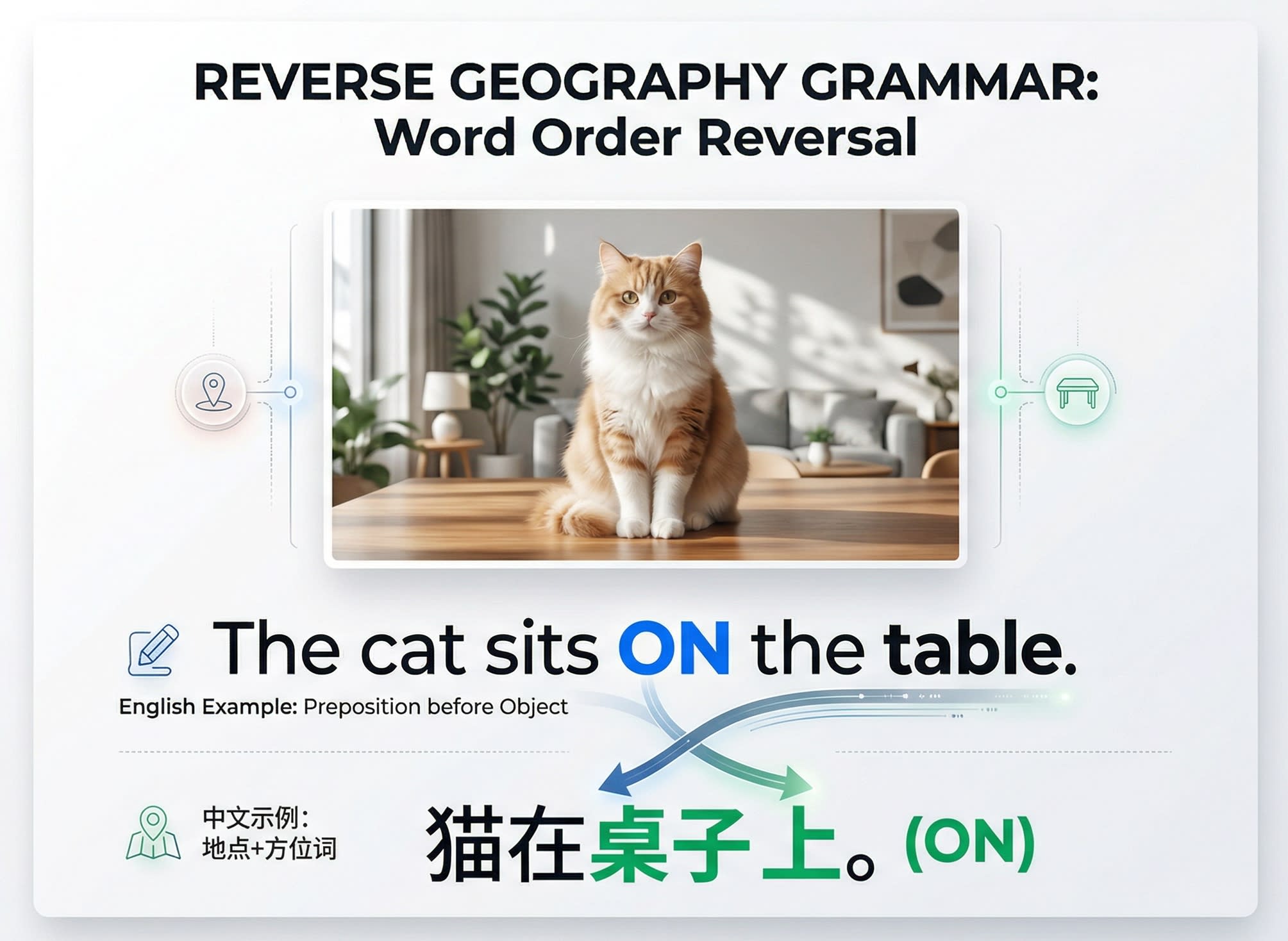
In English, we use prepositions. The location word comes before the noun.
- “The cat is on the table.”
- “My phone is in the bag.”
In Chinese, these are postpositions. The location word comes after the noun. You must state the object first, and then tell the listener which specific surface or side of that object you are referring to. Think of it as zooming in on a map. First, find the table. Then, look at the top of it.
The Chinese Formula:
Noun + 方位词 (Direction Word)
- On the table: 桌子上 (Zhuōzi shàng) - Literal: Table top.
- In the bag: 包里 (Bāo lǐ) - Literal: Bag inside.
- Behind the sofa: 沙发后面 (Shāfā hòumiàn) - Literal: Sofa behind-side.
If you ask your friend, “Where is my phone?” (我的手机在哪儿? - Wǒ de shǒujī zài nǎr?), they will reply using the verb 在 (zài - to be located at):
- “在桌子上。” (Zài zhuōzi shàng. - It is on the table.)
- NEVER say: “在上桌子” (Zài shàng zhuōzi). This translates to “at the up table,” which makes absolutely no sense.
4. Street Survival: Directing the Taxi Driver
Knowing Left and Right is useless if you don’t know the verbs that go with them. When you are in a Didi (the Chinese Uber) or a local taxi, you need to use specific action verbs to command the driver.
- To turn: You can use 转 (zhuǎn) or 拐 (guǎi). In Southern China, people prefer zhuǎn. In Northern China, people prefer guǎi. Both mean “turn.”
- Straight: 一直走 (Yìzhí zǒu - keep walking/going straight).
The Taxi Cheat Sheet:
- Turn Left: 左转 (Zuǒ zhuǎn) / 左拐 (Zuǒ guǎi).
- Turn Right: 右转 (Yòu zhuǎn) / 右拐 (Yòu guǎi).
- Go Straight: 一直走 (Yìzhí zǒu).
- Stop here: 停在这里 (Tíng zài zhèlǐ) or just 到了 (Dào le - We have arrived).
Example Scenario: “师傅,前面路口左拐,然后一直走。” (Shīfu, qiánmiàn lùkǒu zuǒ guǎi, ránhòu yìzhí zǒu.) “Driver, turn left at the intersection ahead, then keep going straight.”
5. The Mind-Bending Rule: Using Space for Time
This is the most fascinating aspect of Chinese linguistics. The Chinese language maps Time using Vertical Space.
To a native English speaker, the past is “behind” us, and the future is “ahead” of us. It is a horizontal timeline. In Chinese, the timeline is vertical. Gravity pulls time downward.
- The past is Up (上 - shàng) because it has already fallen and piled up.
- The future is Down (下 - xià) because it hasn’t fallen yet.
Whenever you talk about weeks, months, or semesters, you must use Up and Down.
The “Up” Past:
- Last week: 上个星期 (Shàng ge xīngqī) - Literal: The up week.
- Last month: 上个月 (Shàng ge yuè) - Literal: The up month.
- Last time: 上次 (Shàng cì) - Literal: The up time.
The “Down” Future:
- Next week: 下个星期 (Xià ge xīngqī) - Literal: The down week.
- Next month: 下个月 (Xià ge yuè) - Literal: The down month.
- Next time: 下次 (Xià cì) - Literal: The down time.
(Note: Years and days use a different system: 去年/明年 for years, 昨天/明天 for days. Save Up and Down specifically for weeks, months, and occurrences!)
6. The Master Direction Matrix
Bookmark this table to rapidly deploy the correct direction word whether you are hunting for your keys or planning a meeting.
| Concept | Chinese Word | Pinyin | Real-World Usage |
|---|---|---|---|
| Up / On | 上面 / 上边 | Shàng miàn / Shàng biān | 在桌子上 (On the table). |
| Down / Under | 下面 / 下边 | Xià miàn / Xià biān | 在椅子下面 (Under the chair). |
| Left | 左边 | Zuǒ biān | 前面左拐 (Turn left ahead). |
| Right | 右边 | Yòu biān | 前面右拐 (Turn right ahead). |
| Inside | 里面 / 里头 | Lǐ miàn / Lǐ tou | 在包里 (Inside the bag). |
| Past (Time) | 上个 | Shàng ge | 上个月 (Last month). |
Final Thoughts from Tao
Learning direction words forces your brain to stretch in completely new ways. You have to remember to put the location after the noun, and you have to start thinking of time as a vertical waterfall pouring from the past down into the future.
But once you rewire these mental pathways, a profound shift happens. You aren’t just translating English to Chinese anymore; you are actually thinking like a Chinese person.
So the next time you get into a taxi, put your GPS away. Take a deep breath, point confidently, and say, “一直走!” (Keep going straight!).

Want to master more essential grammar rules? Learn the ultimate trick to Telling Time in Chinese or decode the visual logic in The Ultimate Guide to Er vs Liang (Two vs Two).

