
🥮 Introduction: The Jewel of the Chinese Bakery
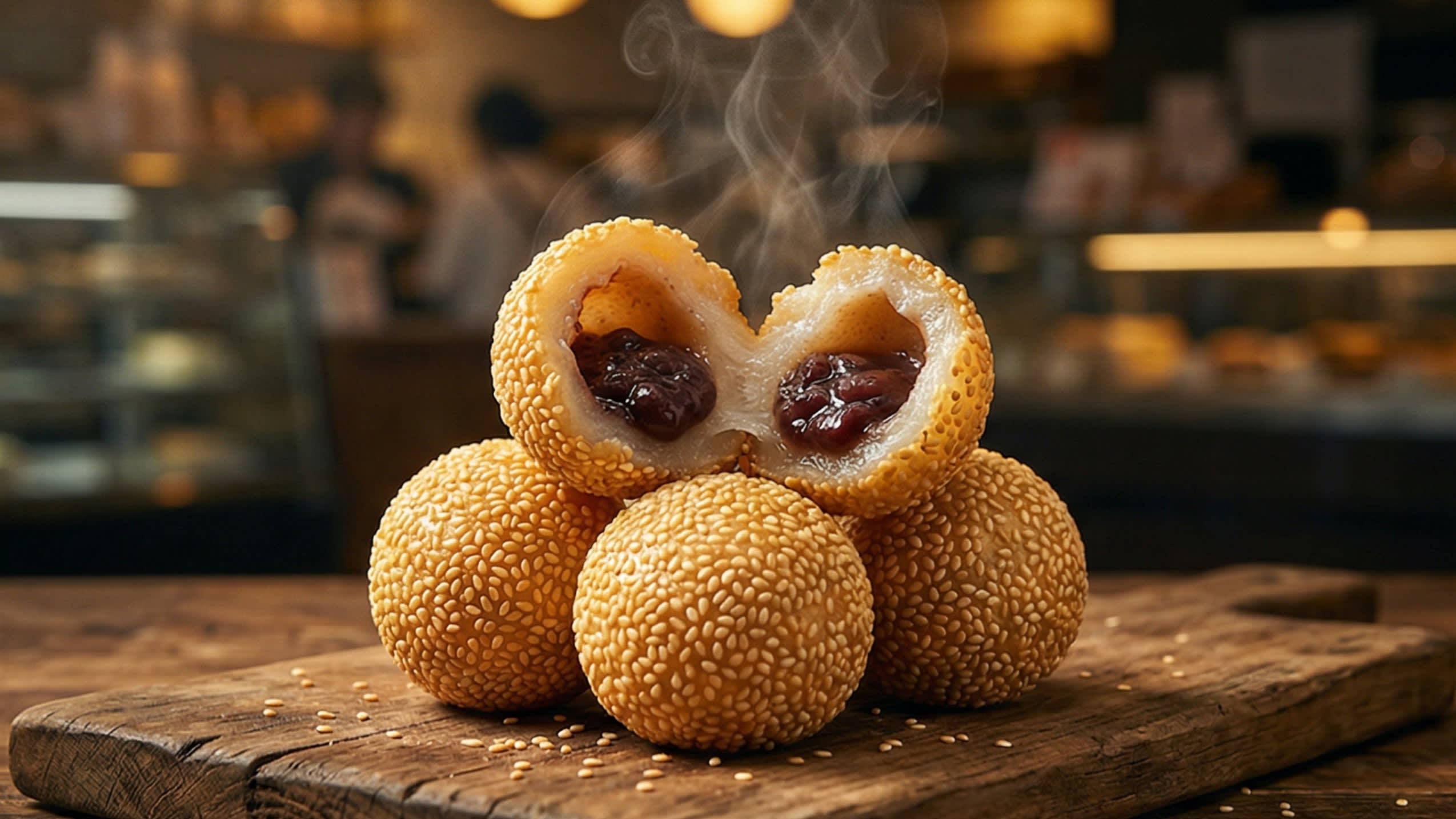
If you walk into any authentic Chinese bakery in the morning, past the sweet egg tarts and the savory roast pork buns, your eyes will inevitably be drawn to a tray of perfectly spherical, golden globes covered entirely in toasted sesame seeds.
These are Sesame Balls (芝麻球 - Zhīma Qiú), also known in Cantonese as Jian Dui (煎堆).
They are the undisputed king of Chinese deep-fried desserts. When executed flawlessly, the sensory experience is mind-blowing. The exterior provides a deeply nutty, shatteringly crisp crunch. Immediately beneath the crust lies a layer of warm, chewy, stretchy dough that tastes exactly like premium mochi. In the very center, suspended in a perfectly hollow cavern of air, is a dollop of sweet, earthy Red Bean Paste. It is the ultimate combination of Wàisū lǐnuò (外酥里糯 - Crispy outside, chewy inside).
During the Lunar New Year, these golden spheres are an absolute necessity. Because they dramatically expand to three times their original size when fried in hot oil, there is a famous Cantonese proverb: “Jian Dui lulu, jin yin man wu” (煎堆辘辘,金银满屋), which translates to: “As the sesame balls roll, gold and silver fill the house.”
However, attempting to make these at home is infamous for causing culinary heartbreak—and sometimes physical danger. Western home cooks often face three disasters: the dough cracks and falls apart, the balls aggressively explode in the hot oil, or they look beautiful in the pan but violently deflate into sad, wrinkled pancakes the moment they cool down.
Today, we are going to master the intense culinary physics of the Sesame Ball. We will teach you the chemical necessity of “scalding” the dough, the mechanical secret to stopping the sesame seeds from falling off, and the legendary “Pressing Technique” that forces the balls to become massive and completely hollow inside!
🔬 The Dough Science: “Tang Mian” (烫面)
The single biggest mistake you can make is treating this dough like Western wheat dough. The base ingredient is Glutinous Rice Flour (糯米粉 - Nuòmǐfěn). Despite its name, it contains absolutely zero gluten.
If you mix glutinous rice flour with cold water, it will behave like wet sand. It will crumble, crack, and be completely impossible to roll into a smooth ball. To conquer this flour, Chinese pastry chefs use a technique called Tàng Miàn (烫面 - Scalding the Dough).
You must pour boiling hot water directly into the flour and sugar mixture. The extreme heat instantly cooks (gelatinizes) a percentage of the rice starches. This gelatinization acts as a natural glue, transforming the crumbly sand into an incredibly smooth, pliable, and stretchy dough that resembles Play-Doh. This structural integrity is what prevents the balls from cracking and leaking their filling into the frying oil.
🧲 The Sesame Seed Glue
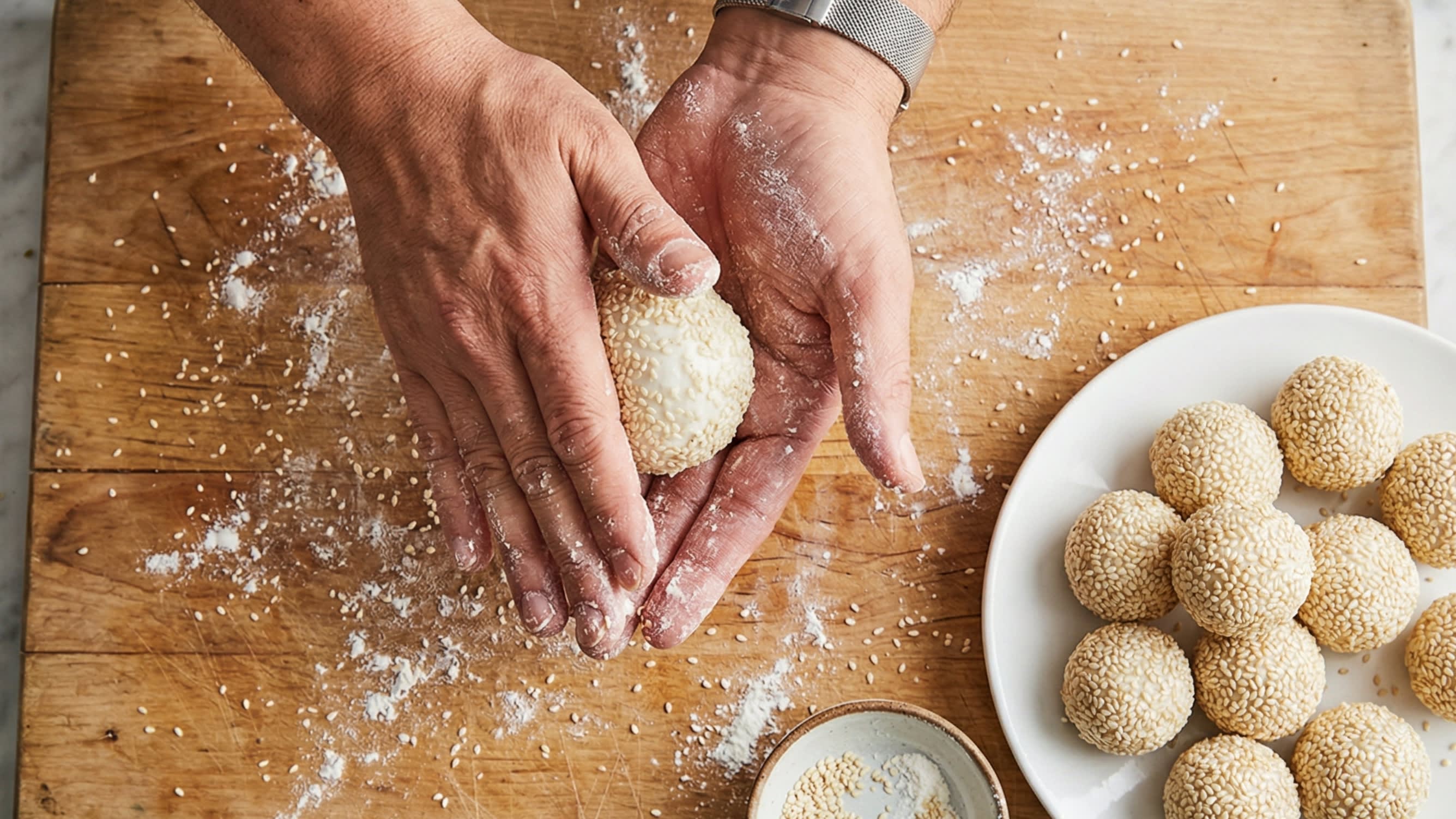
“Why do all my sesame seeds fall off into the oil, leaving me with bald dough balls?” This happens because raw glutinous rice dough is not sticky enough on the outside to hold dry seeds during a violent deep-fry. The Bakery Secret: Once you have rolled your filled dough into a perfect sphere, you must quickly submerge it in a bowl of cold water, then immediately drop it into a plate of dry white sesame seeds. But you are not done! You must pick the coated ball back up and firmly roll it between your palms again. This physical pressure forcefully embeds the wet seeds deep into the surface of the dough, locking them in place permanently.
💥 The Physics of Frying: Low Heat and “The Press”
Frying Sesame Balls violates almost every rule of standard Western deep-frying.
Rule 1: Low Temperature is Mandatory. If you drop Sesame Balls into 350°F (175°C) oil, the outside will instantly harden into a cage. As the moisture inside turns into steam, it will have nowhere to go. The pressure will build until the ball literally explodes, spraying boiling oil everywhere. You must fry them at a low temperature around 300°F (150°C). The slow heat allows the dough to expand gently and evenly.
Rule 2: The “Pressing” Technique (按压膨胀). This is the ultimate Dim Sum chef secret. When the balls fry, they will eventually float to the surface. If you just leave them there, they will be dense and heavy. To make them massive and hollow (空心), you must take a metal strainer or ladle and gently press the floating balls down into the hot oil against the side of the wok. When you release the pressure, they bounce back up. You repeat this pressing motion 4 to 5 times. The Physics: The mechanical pressure, combined with the heat, forces the air and steam trapped inside the dough to expand outward rapidly. The ball literally acts like a hot air balloon, stretching the pliable dough and creating a massive, hollow cavern inside!
🛒 Ingredients List
The “Scalded” Mochi Dough:
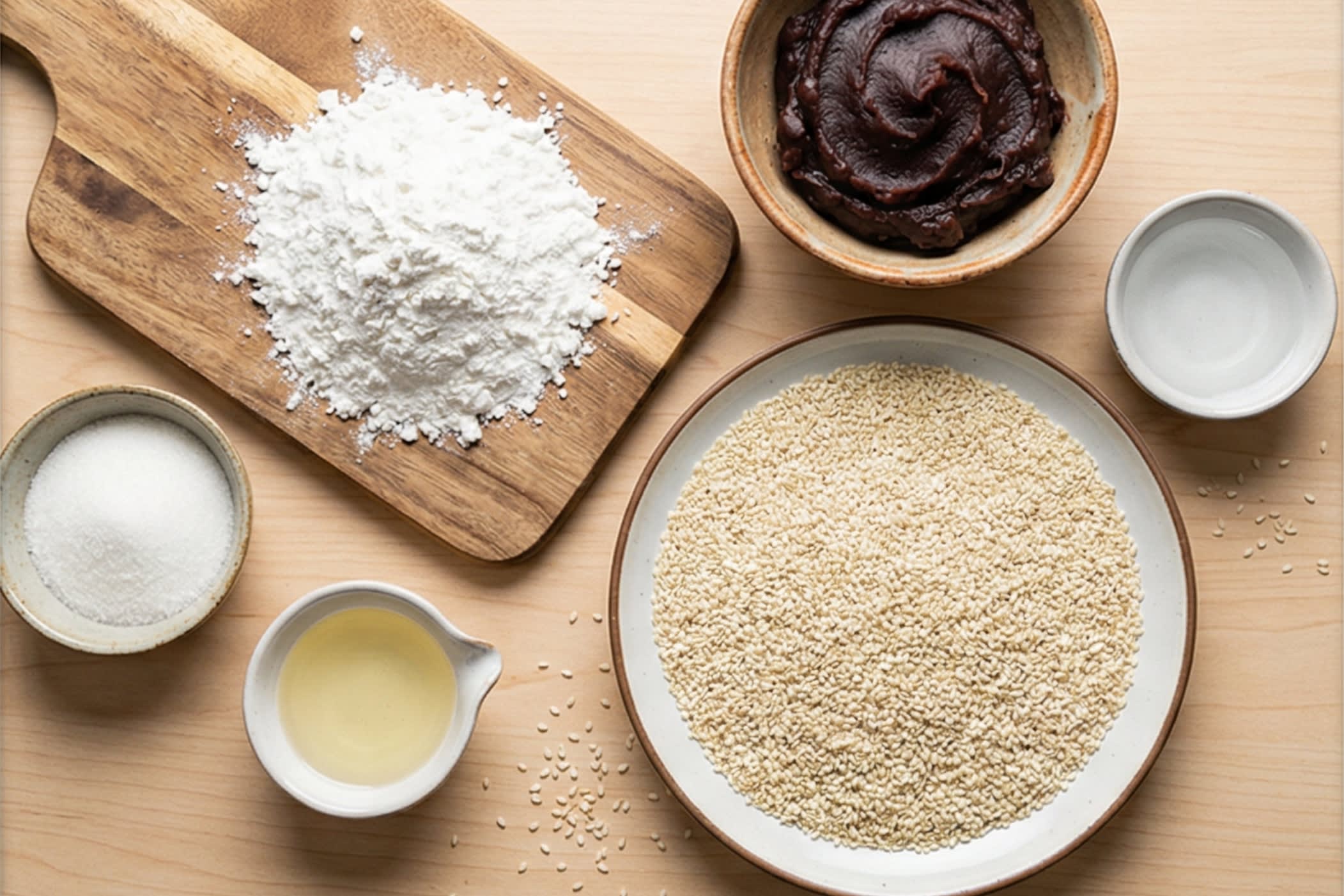
- 2 cups (250g) Glutinous Rice Flour (糯米粉 - Nuòmǐfěn). Make sure it is glutinous/sweet rice flour! Erawan brand (green text) or Mochiko works perfectly. Regular rice flour will fail.
- 1/2 cup (100g) Granulated Sugar (糖)
- 3/4 cup (180ml) Boiling Water (沸水). It must be rapidly boiling!
- 1 tbsp Cooking Oil (to knead into the dough for smoothness)
The Filling & Coating:
- 3/4 cup (200g) Sweet Red Bean Paste (红豆沙 - Hóngdòushā). Available in cans or bags at any Asian market.
- 1 cup White Sesame Seeds (白芝麻). Use raw, un-toasted seeds, as they will toast in the frying oil.
- A small bowl of cold water (for dipping)
- 4-6 cups Cooking Oil (peanut, canola, or vegetable oil)
🍳 Step-by-Step Instructions
1. Portion the Filling: Scoop the sweet red bean paste and roll it into small, uniform balls, about 1/2 ounce (15g) each—roughly the size of a large marble. You should have about 12 to 14 balls. Place them on a plate and chill them in the fridge while you make the dough (cold filling is easier to wrap).
2. Scald the Dough (烫面): In a large mixing bowl, combine the glutinous rice flour and sugar. Pour the rapidly boiling water directly over the mixture. Use a wooden spoon or chopsticks to quickly stir the mixture until it forms shaggy, clumpy flakes.
3. Knead to Smoothness: Once the dough is cool enough to touch, add the 1 tbsp of cooking oil. Use your hands to knead the dough directly in the bowl for about 3 to 5 minutes. The clumps will magically transform into a perfectly smooth, elastic, and slightly shiny ball of dough that feels like soft Play-Doh. Cover it with a damp cloth so it doesn’t dry out.
4. Wrap the Balls: Take a piece of dough (about 1 ounce / 30g). Roll it into a smooth ball, then use your thumb to press an indentation into the center, forming a small bowl shape. Place a ball of red bean paste into the bowl. Carefully push the dough up and around the filling, pinching the top to seal it completely. Crucial: Make sure there are no air bubbles trapped inside, and roll it between your palms until it is a flawless, seamless sphere.
5. The Sesame Seed Glue: Briefly dip the filled dough ball into the bowl of cold water (just for 1 second!). Immediately drop it into the plate of sesame seeds and roll it around until completely covered. Pick the coated ball up and firmly roll it between your palms one more time. This presses the seeds deep into the wet dough so they won’t fall off during frying.
6. Low Heat Frying (低温下锅): Heat your oil in a wok or deep pot to exactly 300°F (150°C). Do not go hotter! Carefully drop the sesame balls into the oil. They will sink to the bottom. Let them fry undisturbed for about 3 to 4 minutes. Do not overcrowd the pan; they will triple in size!
7. The “Pressing” Magic (按压膨胀): As the dough cooks, the balls will slowly float to the surface of the oil. Now, the magic begins. Using a metal spider strainer or the back of a ladle, gently but firmly press the floating balls down into the hot oil. They will squish down, then immediately puff back up. Repeat this gentle pressing and rolling motion continuously for the next 5 to 7 minutes. Watch in amazement as they expand into massive, hollow spheres!
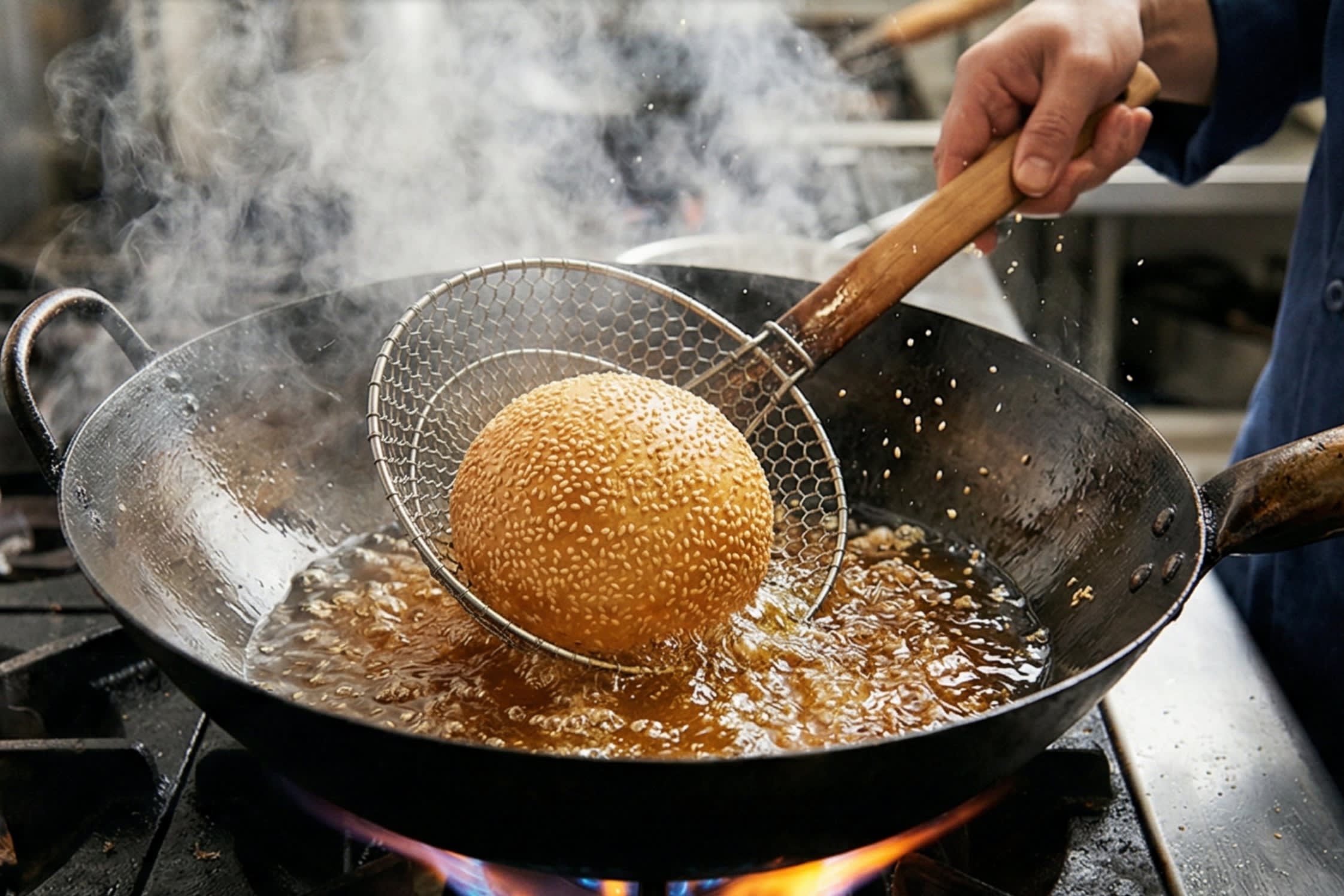
8. Golden Finish: Once the balls are massive and the sesame seeds have turned a gorgeous, deep golden-brown, turn the heat up slightly for the last 30 seconds to force out excess oil. Remove them with your strainer and drain on a wire rack. Serve warm! Experience the ultimate crunch, the chewy mochi, and the sweet red bean center.
💡 Troubleshooting & Pro Tips
- My sesame balls exploded in the oil! This is dangerous. It happens for two reasons: 1) Your oil was too hot (above 320°F/160°C), causing the water inside to turn into steam faster than the dough could expand. 2) You trapped an air pocket inside the dough when wrapping the red bean paste. Wrap them tightly!
- They looked beautiful in the wok, but deflated like balloons when cooling. You didn’t fry them long enough. The outer crust needs enough time to completely dry out and harden to support the massive hollow interior. If you pull them out while the crust is still soft and blonde, they will collapse. Fry until deeply golden!
- The dough cracked while I was wrapping them. Your dough dried out. Glutinous rice dough loses moisture rapidly. Always keep the bulk of the dough covered with a damp towel while you are wrapping individual balls. If it gets too dry, knead in a tiny drop of warm water.
📦 Shop Authentic Asian Baking Essentials
To capture the authentic, massive expansion and shatteringly crisp texture of a Chinese bakery, having the correct flour and tools is absolute mandatory. (As an Amazon Associate, ChinaCurator earns from qualifying purchases.)
- Erawan Brand Glutinous Rice Flour (糯米粉) - The absolute mandatory ingredient. Do not buy regular rice flour! This green-labeled bag is the gold standard for creating that chewy, stretchy, mochi-like texture.
- Sweet Red Bean Paste (红豆沙) - The traditional, earthy, and sweet filling that perfectly balances the deep-fried sesame crust.
- Asian Stainless Steel Spider Strainer - The essential tool for safely reaching into the hot oil to perform the legendary "Pressing Technique" without burning your hands.
- Instant Read Kitchen Thermometer - Frying at exactly 300°F (150°C) is the secret to preventing explosions. Do not guess the oil temperature!