🥢 Introduction: The Undisputed Star of the Dim Sum Cart
If you have ever experienced a traditional Cantonese weekend brunch, the rhythmic clanking of the metal Dim Sum carts, and the chaotic symphony of teacups, you know there is one dish you absolutely must order: Turnip Cake (萝卜糕 - Luóbo Gāo).
Also known interchangeably as Radish Cake, this iconic dish represents the pinnacle of Chinese savory pastries. It is especially revered during the Lunar New Year because the word for radish in the Hokkien dialect (cai tou) sounds identical to the word for “Good Fortune.” Eating it guarantees a prosperous year ahead!
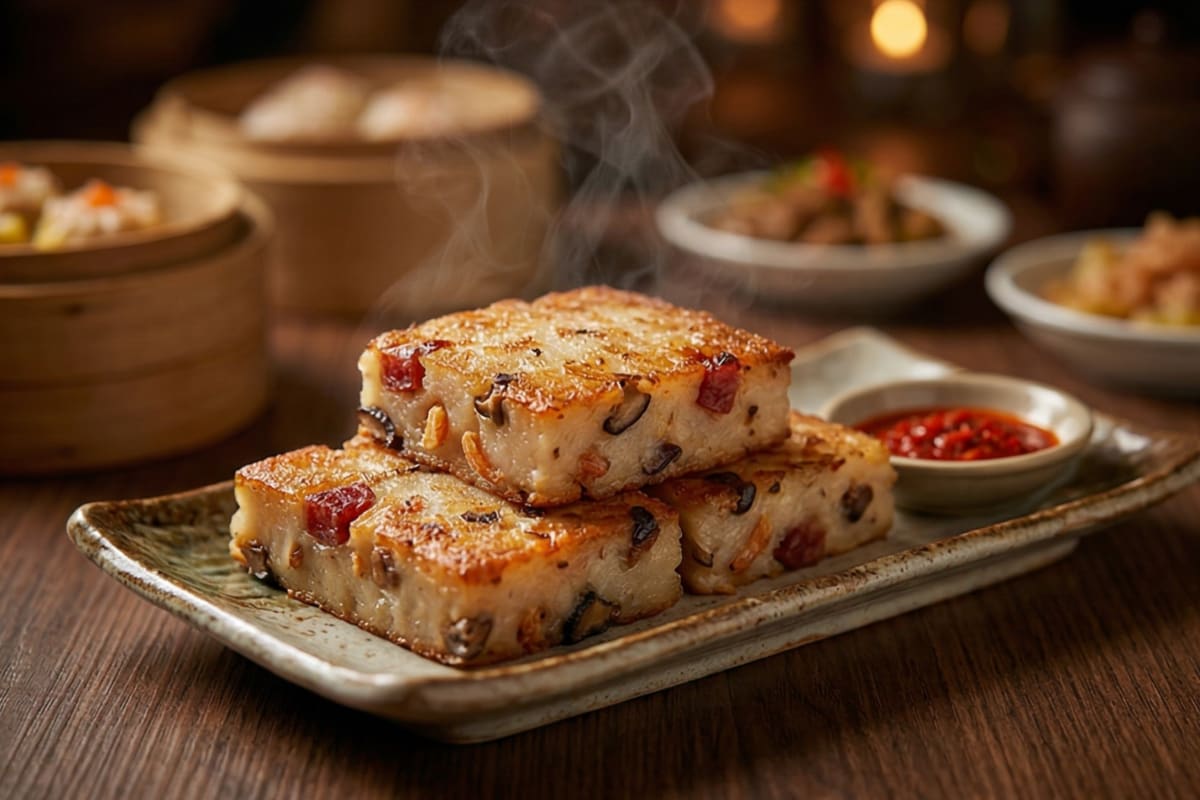
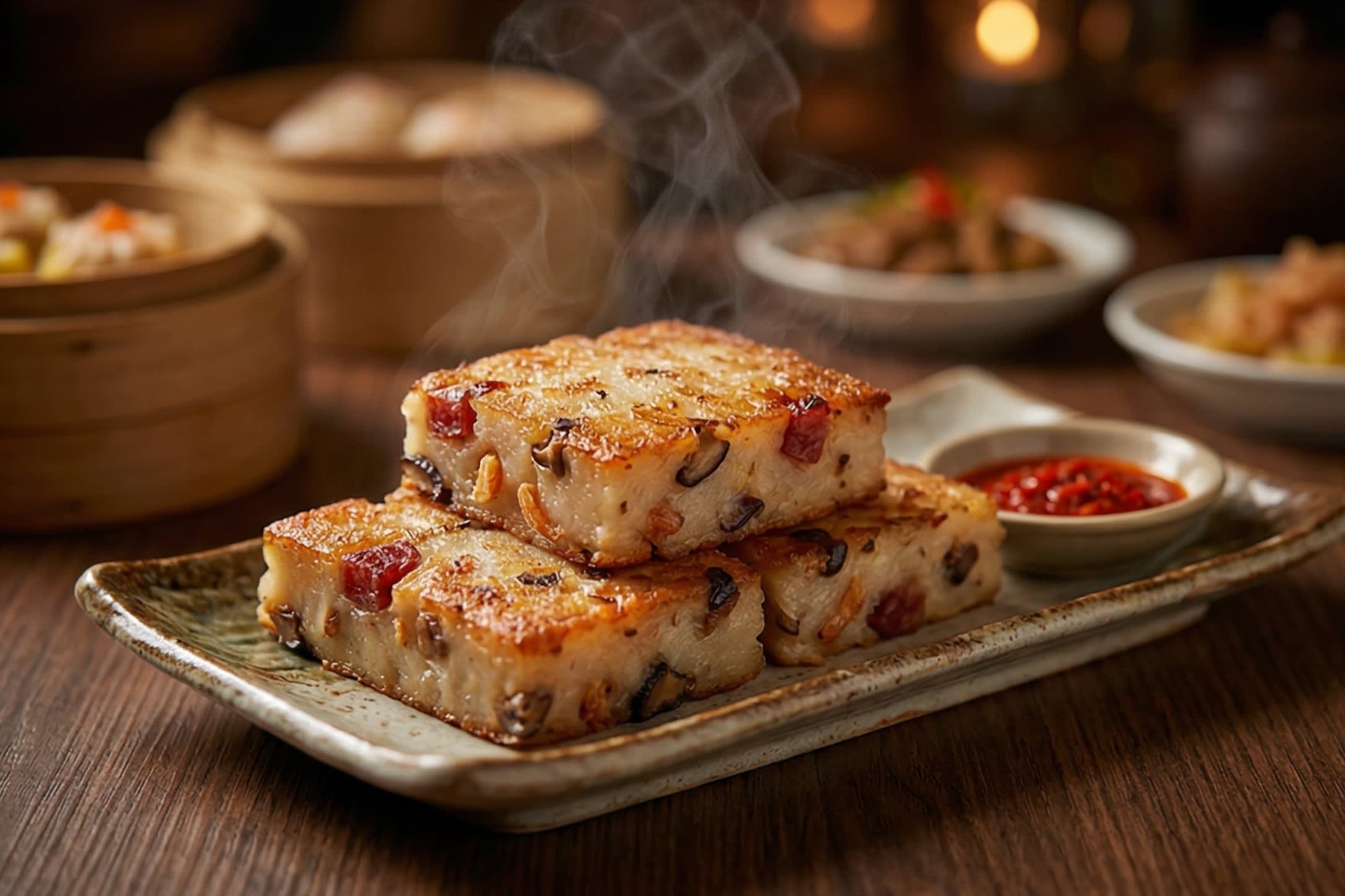
When executed by a master Dim Sum chef, a slice of Pan-Fried Turnip Cake is a structural and textural miracle. The exterior is pan-seared in hot oil until it forms a shatteringly crisp, deep golden-brown crust. The moment your teeth crack through that shell, you are greeted by an interior that is impossibly soft, savory, and almost melt-in-your-mouth tender. Every bite is an umami explosion, heavily studded with cured sweet pork sausage, earthy mushrooms, and deeply savory dried shrimp.
However, when Western home cooks attempt to make this masterpiece, it often ends in a tragic culinary disaster. The cake crumbles into a messy paste the moment the knife touches it. Or worse, it turns into a dense, hard, unchewable brick of flavorless flour.
Today, we are going to demystify the complex chemistry of Cantonese Dim Sum. We will clarify the famous “Turnip vs. Radish” translation error, reveal the professional “partial gelatinization” secret that prevents a crumbly cake, and teach you the unbreakable iron rules of pan-frying.
🚫 The Great Translation Lie: Do Not Use Turnips!
The biggest trap for Western cooks is the English name itself. It is called “Turnip Cake,” but you must never, ever use a Western Turnip. Western turnips are small, purple-topped, and possess a sharp, mustard-like bitterness that will completely ruin the dish.
The authentic vegetable used in this recipe is the Daikon Radish (白萝卜 - Bái Luóbo). Daikon is a massive, long, pure white Asian radish. When cooked down, it loses its mild spicy bite and transforms into an incredibly sweet, juicy, and delicate vegetable. It provides the essential natural sweetness and high water content required to make the cake tender and moist.
🥩 The Umami Engine: Building the Flavor Profile
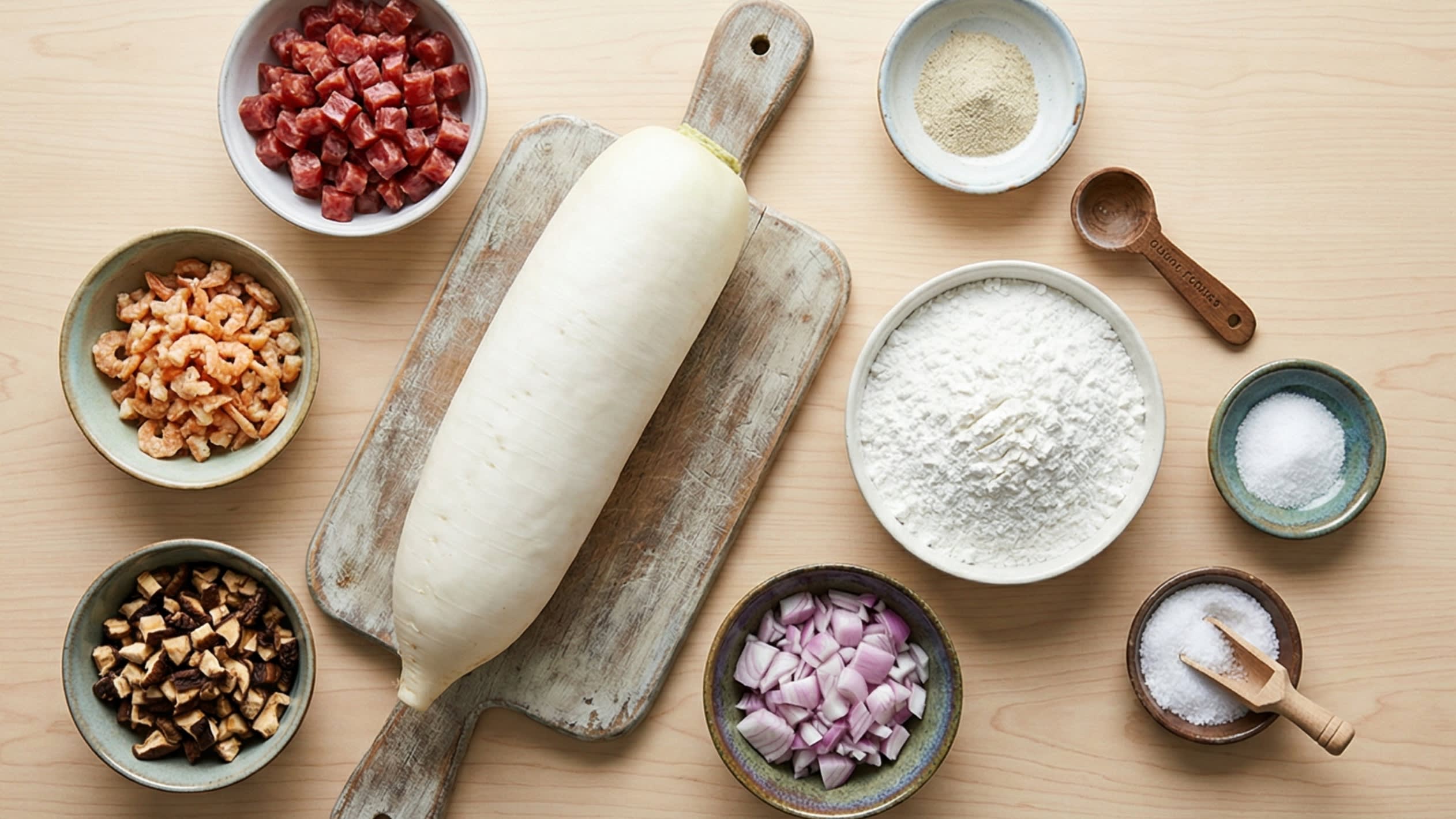
A plain radish and flour cake is boring. The legendary savory depth of this dish comes from a highly specific, traditional mix of cured meats and dried seafood, collectively known as Làwèi (腊味).
- Chinese Sausage (腊肠 - Làcháng): A firm, cured pork sausage that is distinctly sweet, smoky, and fatty. It acts as the rich baseline of the dish.
- Dried Shrimp (虾米 - Xiāmǐ): Tiny, dehydrated shrimp that pack a massive, concentrated punch of oceanic umami.
- Dried Shiitake Mushrooms (干香菇 - Gān Xiānggū): Much more intensely flavored than fresh mushrooms, providing a deep, woody earthiness.
The Restaurant Secret: You cannot just toss these raw ingredients into the batter. You must finely dice them and vigorously sauté them in a hot wok. This crucial step renders the sweet pork fat and toasts the dried shrimp, releasing their volatile essential oils into the pan. This flavor-infused oil will eventually coat the entire cake!
🔬 The Culinary Physics: The “Sheng Shu Jiang” Secret
If your cake is crumbly, or if you steam it and find a layer of hard flour at the bottom and a layer of watery radish at the top, you failed the chemistry test of the batter.
1. The Right Flour (粘米粉)
You absolutely must use Regular Rice Flour (粘米粉 - Zhānmǐfěn). Do not accidentally buy Glutinous Rice Flour (糯米粉) or Sweet Rice Flour, or your cake will turn into a giant, sticky, unchewable marshmallow! To give the cake extra structural integrity so it holds clean edges when sliced, we mix in a tiny bit of Cornstarch or Wheat Starch.
2. Partial Gelatinization (生熟浆 - Shēng Shú Jiāng)
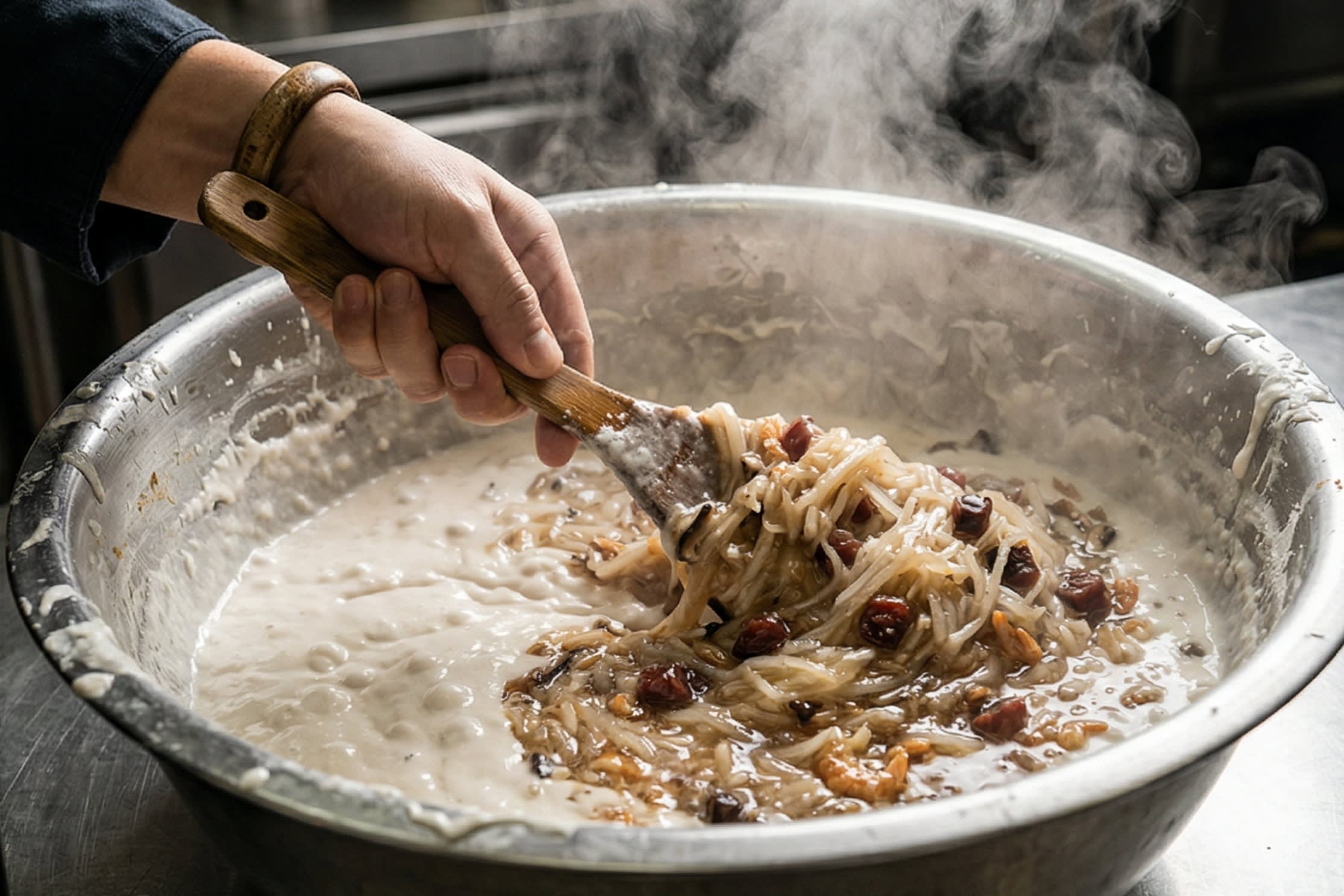
If you just mix cold water, cold flour, and cold radishes, the heavy flour will sink to the bottom during steaming. Dim Sum chefs use a brilliant physics hack called Sheng Shu Jiang (Raw and Cooked Batter). You boil the shredded radish in a wok until it is piping hot. Then, you pour that boiling hot radish and its liquid directly into the cold rice flour mixture. The intense heat instantly, partially cooks (gelatinizes) a percentage of the rice flour. This thickens the batter immediately into a sticky paste, suspending the radish and meats perfectly in the mixture. When you steam it, the cake sets evenly and perfectly, guaranteeing it will never crumble when you slice it!
🛒 Ingredients List
The Umami Engine (腊味):
- 2 links Chinese Sausage (腊肠 - Lap Cheong), very finely diced.
- 1/3 cup Dried Shrimp (虾米), soaked in warm water for 20 mins, drained, and finely chopped.
- 4-5 Dried Shiitake Mushrooms (干香菇), soaked in hot water until soft, squeezed dry, and finely diced.
- 2 Shallots (红葱头), finely minced.
- 1 tbsp Cooking Oil
The Radish Base:
- 2 lbs (about 900g) Daikon Radish (白萝卜). Peeled and coarsely shredded.
- 1 cup Water or Chicken Broth (for boiling the radish)
The Dry Batter:
- 1.5 cups (200g) Regular Rice Flour (粘米粉). NOT glutinous rice flour!
- 3 tbsp (25g) Cornstarch (玉米淀粉)
- 1 cup Water (room temperature)
The Seasoning:
- 1.5 tsp Salt
- 1 tbsp Sugar (糖) - To highlight the sweetness of the radish.
- 1 tsp White Pepper powder (白胡椒粉) - Crucial for authentic flavor!
- 1 tsp Chicken Bouillon powder (鸡粉) - Optional, for extra umami.
🍳 Step-by-Step Instructions
1. Sauté the Umami Engine (炒香配料): Heat a wok or large skillet over medium heat. Add 1 tbsp of oil. Add the minced shallots, diced Chinese sausage, chopped dried shrimp, and diced mushrooms. Sauté aggressively for 3 to 5 minutes until the sausage fat renders out, the shrimp smells incredibly fragrant and toasted, and the mushrooms are browned. Remove the mixture from the pan and set it aside.
2. Mix the Cold Batter: In a very large mixing bowl, combine the Regular Rice Flour, Cornstarch, Salt, Sugar, White Pepper, and Chicken Bouillon. Pour in the 1 cup of room-temperature water. Whisk thoroughly until you have a smooth, completely lump-free, milky liquid.
3. Boil the Radish: In the same wok you used for the meats (keep that flavorful residual oil!), add the shredded Daikon radish and the 1 cup of water/broth. Bring it to a boil over medium-high heat. Cover and let it simmer for 8 to 10 minutes until the radish is translucent, very soft, and has released its natural sweet juices.
4. The Partial Gelatinization Magic (生熟浆): Turn off the heat. Add your sautéed umami meat mixture into the hot radish and stir to combine. Immediately, while the radish mixture is still boiling hot, pour it directly into the large bowl containing your cold rice flour batter. Stir vigorously and continuously! The heat will instantly cook some of the starch, and the liquid will miraculously thicken into a dense, sticky paste.
5. Steam the Cake (蒸制): Grease a round or square cake pan (8 or 9 inches) generously with oil. Pour the thick, sticky radish batter into the pan. Use an oiled spatula to smooth the top perfectly flat. Set up a steamer with plenty of boiling water. Place the pan in the steamer, cover tightly, and steam over medium-high heat for exactly 50 to 60 minutes. Test for doneness: Insert a toothpick into the center; if it comes out relatively clean (a little sticky is fine, but not milky liquid), it is done!
6. The Iron Rule: YOU MUST CHILL IT! Remove the pan from the steamer. DO NOT TRY TO CUT IT NOW! When hot, the cake is a soft, gooey pudding. Let it cool on the counter for 1 hour, then cover it and place it in the refrigerator for at least 4 hours, or preferably overnight. The cold temperature allows the starches to fully set into a firm, sliceable cake.
7. Slice and Pan-Fry (煎至金黄): The next morning, remove the firm cake from the pan. Use a sharp knife to cut it into thick, 1/2-inch rectangular slices. Heat a non-stick skillet or a well-seasoned cast-iron pan over medium-high heat. Add 2 tablespoons of oil. Carefully lay the slices in the hot oil. Do not touch them! Let them sear completely undisturbed for 3 to 4 minutes on the first side until a deep, dark golden-brown, shatteringly crisp crust forms. Flip gently and fry the other side for 3 minutes.
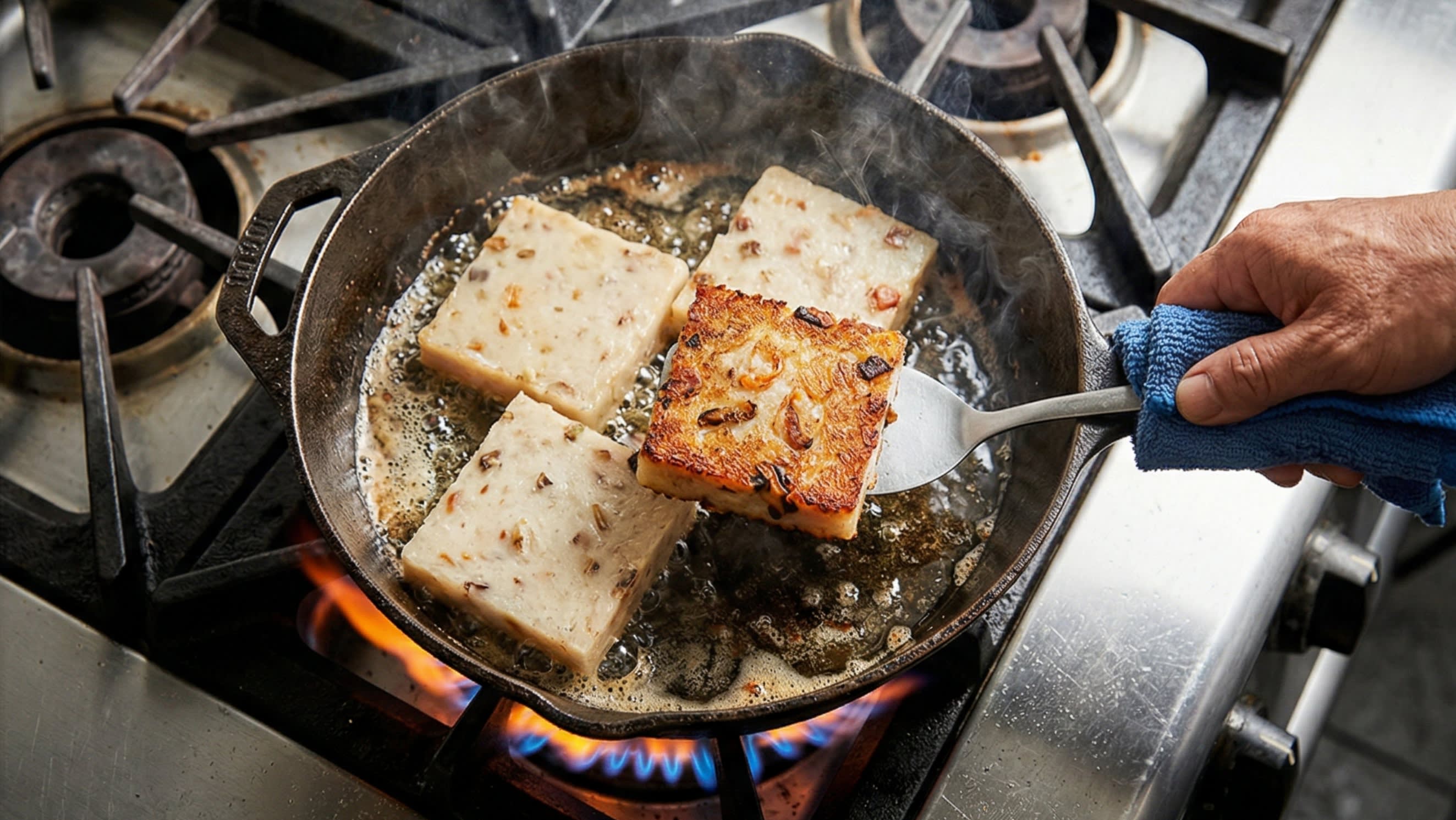
8. Serve: Transfer the pan-fried Turnip Cake to a serving platter. Serve immediately while the crust is piping hot and crispy, accompanied by soy sauce, hoisin sauce, or an authentic Cantonese chili garlic sauce for dipping!
💡 Troubleshooting & Pro Tips
- My cake crumbled and fell apart when I cut it! You broke the Iron Rule. You either didn’t let the hot radish mixture partially gelatinize the batter in Step 4, or you were impatient and tried to cut the cake before it was completely chilled in the refrigerator. Cold starches are firm; hot starches are mush!
- The cake is way too hard and dense. You used too much flour and not enough radish. The golden ratio is crucial. Daikon radishes vary in water content; if your radish was very old and dry, it won’t provide enough liquid. Always use fresh, heavy, juicy radishes!
- Why did it stick to my frying pan and tear? Radish cake is incredibly sticky. You must use a high-quality non-stick pan or a flawlessly seasoned carbon steel/cast iron pan. More importantly, your oil must be hot before the cake goes in, and you must not attempt to flip it until the crust has completely formed and released naturally from the pan!
📦 Shop Authentic Dim Sum Essentials
To capture the authentic, umami-packed flavor profile and structural perfection of a true Cantonese Dim Sum parlor, using the correct ingredients is absolutely non-negotiable. (As an Amazon Associate, ChinaCurator earns from qualifying purchases.)
- Erawan Brand Regular Rice Flour (粘米粉) - The absolute mandatory flour for this dish. Do not accidentally buy glutinous rice flour! This specific flour provides the perfect tender yet sliceable texture.
- Premium Dried Shrimp (虾米) - Essential for providing the deep, concentrated, savory oceanic umami that elevates the cake from boring to spectacular.
- Chinese Sausage (Lap Cheong / 腊肠) - The sweet, smoky, and fatty baseline of the umami flavor engine.
- Premium White Pepper Powder (白胡椒粉) - Provides a complex, earthy heat without the harshness or dark specks of western black pepper.