
If you have been learning Mandarin Chinese for more than a few weeks, you have inevitably crashed headfirst into the most infamous wall in Chinese grammar: the three “De”s.
You are typing a message to a Chinese friend, or perhaps leaving a comment on Xiaohongshu, and you want to say something simple like, “He runs quickly.” You type de on your Pinyin keyboard, and suddenly, the screen presents you with three identical-sounding options: 的, 地, and 得.
They are all pronounced exactly the same—a short, neutral, unstressed de. Yet, structurally, they perform entirely different jobs. Picking the wrong one won’t necessarily stop a native speaker from understanding you, but it acts as a massive neon sign pointing at your sentence, flashing: “A beginner wrote this!”
For native English speakers, this concept is uniquely frustrating because English uses word order and suffixes (like “-ly” or “‘s”) to do the jobs that these three little particles do in Chinese. But do not panic. Chinese grammar is deeply logical. It is built on modular formulas. Once you understand the specific formula for each de, you will never guess again.
Let’s demystify the matrix and break down exactly when to use 的, 地, and 得.
The Root of the Problem: Why Are There Three?
Before we look at the rules, you might be wondering: Why did Chinese do this to us? If they sound the same, why not just use one character?
Historically, these characters actually had distinct pronunciations in ancient Chinese. Over thousands of years of linguistic evolution, their pronunciations merged into the neutral de we use today in standard Mandarin. However, because written Chinese is based on meaning rather than sound, the distinct characters were preserved to maintain grammatical clarity in written texts.
Think of it like the English words “there,” “their,” and “they’re.” They sound identical when spoken, but if you write “I went to they’re house”, native speakers will immediately wince. The three “de”s are the exact same phenomenon.
Now, let’s learn how to use them flawlessly.
1. 的 (de): The “Possessive & Descriptive” De
If you only remember one character from this entire article, make it 的. Statistically, it is the single most frequently used character in the entire Chinese language. It accounts for an astonishing percentage of all written text.
The Golden Rule: 的 is always followed by a Noun.
Its primary job is to link a description, an attribute, or ownership to a noun. It is the bridge between what something is like and the thing itself.
Formula A: Possession (The English “‘s”)
When you want to say something belongs to someone or something, you use 的.
[Owner] + 的 + [Noun]
- wǒ de chá (我的茶) – My tea.
- tā de shǒujī (他的手机) – His phone.
- lǎoshī de péngyou (老师的朋友) – The teacher’s friend.
Formula B: Description (The Adjective Linker)
When you want to describe a noun, you use 的 to attach the adjective to the noun. Think of it as a hook that snags the descriptive word and anchors it to the object.
[Adjective] + 的 + [Noun]
Let’s look at some real-world examples, especially when dealing with the incredible street food culture you’ll find across China:
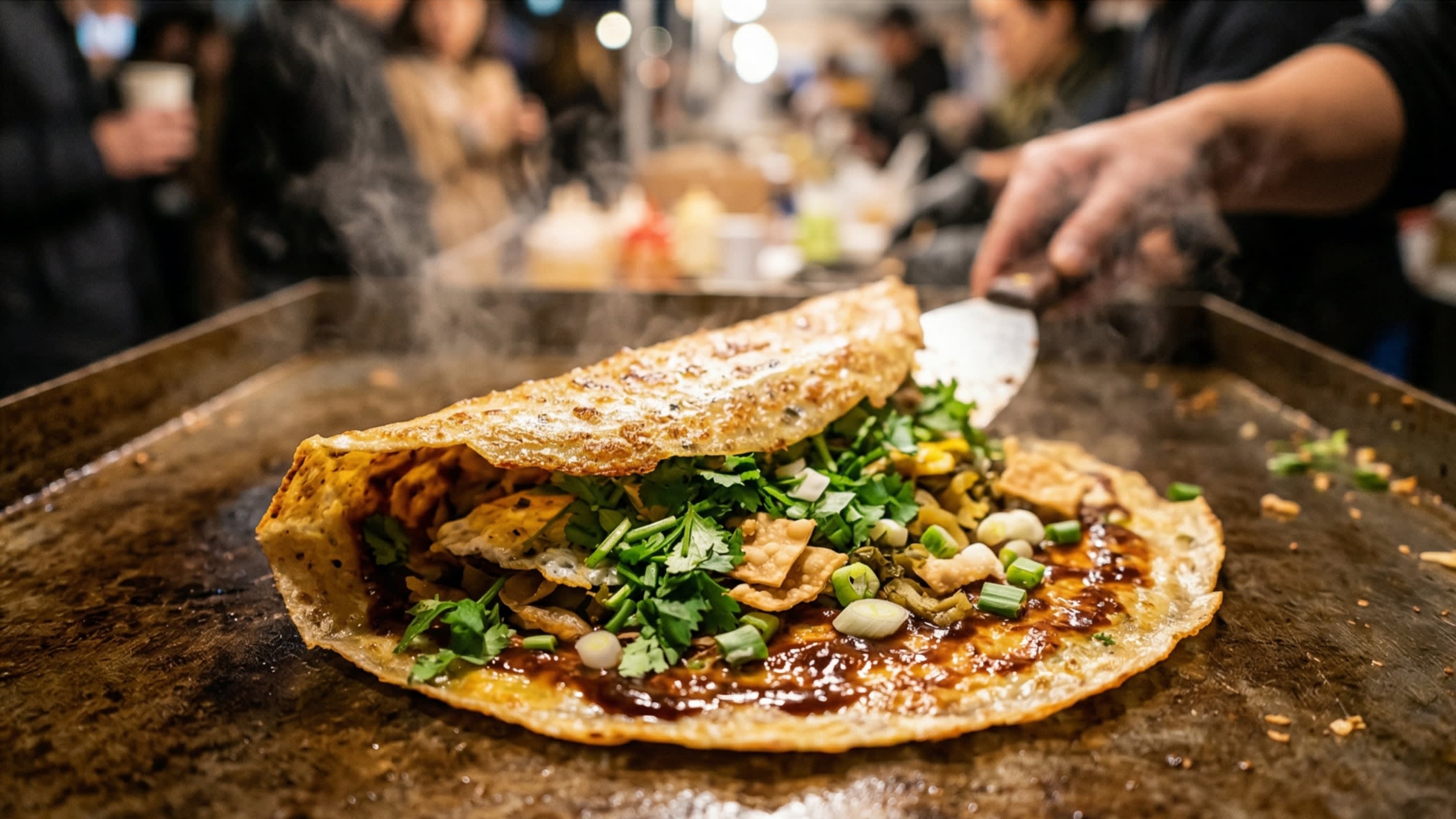
- hǎochī de jiānbing (好吃的煎饼) – Delicious Jianbing (Chinese crepe).
- rè de wūlóngchá (热的乌龙茶) – Hot Oolong tea.
- yǒuqù de wénzhāng (有趣的文章) – An interesting article.
Cultural Slang Bonus: You will see this specific 的 used in the most famous Chinese internet slang: YYDS (永远的神 - yǒngyuǎn de shén). It literally translates to “Forever’s God” or “Eternal God,” used to describe someone or something that is the absolute best (the G.O.A.T). Here, forever (永远) describes the god (神).
2. 地 (de): The “Adverbial” De
If 的 is all about nouns, 地 is all about verbs.
Wait, doesn’t 地 mean “earth” or “ground” (dì)? Yes! This is a classic example of a Chinese character having multiple pronunciations depending on its function. When used as a grammar particle, it is pronounced de.
The Golden Rule: 地 is placed before a Verb.
Its job is to describe how an action is performed. In almost every case, 地 acts exactly like the “-ly” suffix in English (like slowly, happily, quietly).
Formula C: The Action Modifier
[Adjective/Adverb] + 地 + [Verb]
Imagine you are sitting in a traditional teahouse. You shouldn’t just gulp down a premium Pu’er. You should drink it slowly.
- mànmàn de hē (慢慢地喝) – Drink slowly. (Slowly + 地 + drink).
- dàshēng de shuō (大声地说) – Speak loudly. (Loudly + 地 + speak).
- gāoxìng de tiàowǔ (高兴地跳舞) – Dance happily. (Happily + 地 + dance).
If you are ever confused about whether to use 的 or 地, just look at the word immediately following it. Is it an action (verb)? If yes, use 地. Is it a thing (noun)? If yes, use 的.

3. 得 (de): The “Degree & Result” De
Now we arrive at the final boss. 得 is the one that trips up most foreigners because there is no direct, clean equivalent in English grammar.
The Golden Rule: 得 is placed after a Verb.
While 地 tells you how an action is about to be done, 得 tells you the result or degree of an action that is currently happening or has already happened. It evaluates the performance of the verb.
Formula D: The Degree Complement
[Verb] + 得 + [Adjective/Adverb]
Let’s say you are watching a chef skillfully prepare a bowl of hand-pulled noodles. You want to comment on the quality of his cooking. In English, you say, “He cooks very well.” In Chinese, the structure is “He cooks [degree particle] very well.”
- zuò de hěn bàng (做得很棒) – Done very well / Made very well.
- pǎo de kuài (跑得快) – Runs fast. (Run + 得 + fast).
- shuō de hěn qīngchǔ (说得很清楚) – Spoke very clearly. (Speak + 得 + very clear).
Notice the inversion compared to 地:
- 慢慢地吃 (mànmàn de chī) = Slowly eat. (Focuses on the intention/manner before the action).
- 吃得很多 (chī de hěn duō) = Eat a lot. (Focuses on the result/degree after the action).
Formula E: The “Cannot” Complement
得 is also used in a very common phrasing to express physical or circumstantial possibility.
- kàn de jiàn (看得见) – Able to see.
- tīng de dǒng (听得懂) – Able to understand (by listening).
If you want to make it negative, you actually drop the 得 and replace it with 不 (bù). For example, tīng bù dǒng (听不懂 - cannot understand).

The Ultimate Cheat Sheet
To keep things perfectly organized, save this table. When you are writing your next WeChat message, just refer to this matrix:
| Character | The Formula | English Equivalent | Example |
|---|---|---|---|
| 的 | [Adjective] + 的 + [Noun] | 's / descriptive linker | 好喝的茶 (Delicious tea) |
| 地 | [Adverb] + 地 + [Verb] | -ly | 慢慢地走 (Slowly walk) |
| 得 | [Verb] + 得 + [Degree] | Result / Extent | 跑得快 (Run fast) |
Do Native Speakers Make Mistakes? (The “WeChat Exception”)
Here is a little secret that will make you feel much better: Yes, native speakers mix these up all the time.
Because modern communication is dominated by Pinyin keyboards on smartphones, Chinese people type incredibly fast. Since all three characters are typed by pressing d and e, the keyboard’s predictive text algorithm usually defaults to 的 (because it is the most common).
In casual text messaging, many young Chinese people are just too lazy to correct the autocorrect. It is incredibly common to see someone type “跑的快” instead of the grammatically correct “跑得快”. In the context of a quick WeChat banter, no one cares.
However, do not let this be an excuse to ignore the rules!
If you are writing an email to a professor, drafting a business proposal, taking the HSK (Hanyu Shuiping Kaoshi) exam, or publishing an article online, using the wrong “de” is considered a glaring spelling error. It is exactly like a native English speaker writing “Your welcome” instead of “You’re welcome.” Sure, we know what they mean, but it looks unprofessional.
Learning the difference now builds a foundation of true literacy rather than just survival fluency.
A Quick Mini-Quiz to Test Your Skills
Before you go, let’s see if you have absorbed the matrix. Try to guess which “de” belongs in the blank. (Answers are at the very bottom of the post!)
- Wǒ __ péngyou (My friend): 我 __ 朋友
- Tā chàng __ hěn hǎo (She sings very well): 她唱 __ 很好
- Kuàikuài __ chī (Quickly eat): 快快 __ 吃
Final Thoughts from Zixuan
Mastering Chinese grammar is not about brute-force memorization; it is about recognizing patterns. The three “De”s are simply signposts on a road. 的 points to a thing, 地 points to an upcoming action, and 得 points to the result of an action left behind.
Once your brain begins to recognize these signposts automatically, your reading speed will skyrocket, and your writing will command immediate respect from native speakers. Keep practicing, don’t fear the keyboard, and remember: fluency is a marathon, not a sprint.
Answers to the quiz: 1. 的 (Noun follows), 2. 得 (Verb precedes, degree follows), 3. 地 (Verb follows, adverb precedes).
Ready to tackle more real-world Mandarin? Check out our guides on How to Confidently Order Coffee and Milk Tea or dive into the nuances of 2026 Chinese Internet Slang.

