
If you ask any student learning Mandarin Chinese what their worst nightmare is, they won’t say the tones. They won’t say the writing system. They will point to a single, deceptively simple character with only two strokes: 了.
The character “了” is everywhere. It is one of the most frequently used words in the entire Chinese language. Sometimes it sits right after a verb. Sometimes it hides at the very end of a sentence. Sometimes it does both in the exact same sentence.
To make matters worse, your language app tells you it is pronounced “le” (with a light, neutral tone). But then you watch a Chinese drama, and you clearly hear an actor pronounce that exact same character as “liǎo” (with a deep, dipping third tone).
Why does it change? Are there hidden rules? Are there other secret pronunciations?
Do not panic. While “了” seems like a chaotic grammar ghost, it actually follows incredibly strict, logical rules. Once you understand the difference between a “Grammar Particle” and an “Action Verb,” the mystery instantly vanishes. Here is your ultimate, foolproof guide to mastering the pronunciations and meanings of China’s most confusing character.
1. When to Pronounce it “Le” (Neutral Tone)
In 90% of your daily conversations, “了” is pronounced as le (a short, light, neutral tone).
When it is pronounced “le”, the character has absolutely no physical meaning. You cannot translate it into an English noun or verb. It acts entirely as a Grammar Particle—a tiny helper word that tells the listener about the timing or status of an action. It has two main jobs:
Job A: The Action Finisher (Verb + le)
When “le” comes immediately after a verb, it indicates that the action is completed. It is the closest thing Chinese has to a past tense marker, though it technically means “action realized.”
- “我吃了一个苹果。” (Wǒ chī le yí ge píngguǒ.) - I ate an apple.
- “他买了一本书。” (Tā mǎi le yì běn shū.) - He bought a book.
Native Hack: You only use this “le” when an action is truly finished. You would never say “我昨天想了去北京” (I wanted to go to Beijing yesterday) because “wanting” is a state of mind, not a finished physical action.
Job B: The Status Updater (At the end of a sentence)
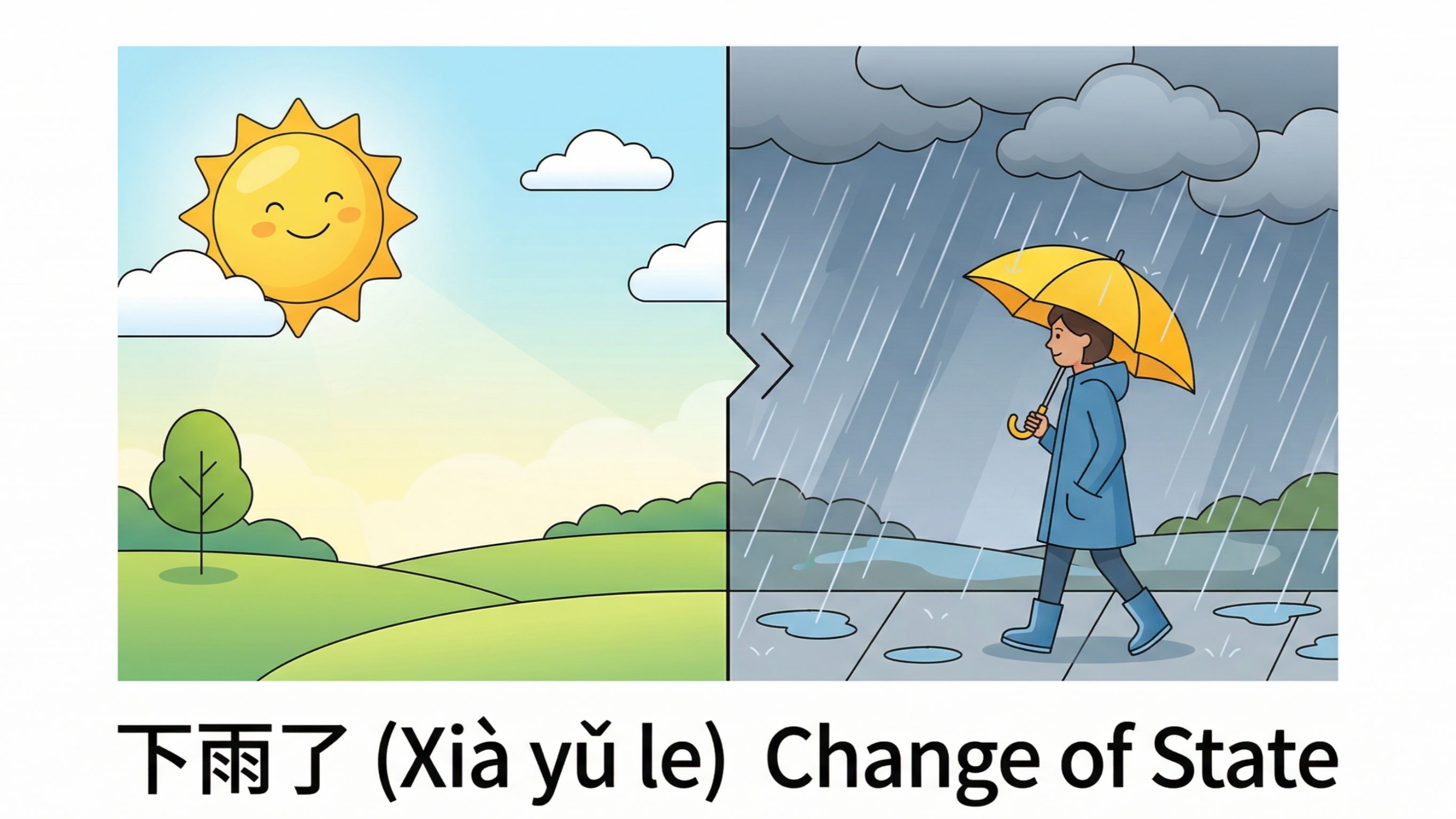
When “le” sits at the very end of a sentence, its job completely changes. It is no longer talking about a finished verb; it is announcing a Change of State or a “New Situation.” It essentially means, “Things are different now than they were before.”
- “下雨了!” (Xià yǔ le!) - It is raining! (It wasn’t raining 5 minutes ago, but the status has changed).
- “我饿了。” (Wǒ è le.) - I am hungry now. (I wasn’t hungry earlier, but my body status has updated).
- “我不买了。” (Wǒ bù mǎi le.) - I am not buying it anymore. (I was going to buy it, but I changed my mind).
2. When to Pronounce it “Liǎo” (Third Tone)
If “le” is the invisible grammar helper, liǎo is the heavy lifter.
When the character is pronounced as liǎo (third tone: falling then rising), it is no longer a grammar particle. It acts as an actual Verb or an indicator of Capability. Historically, “liǎo” means “to finish,” “to conclude,” or “to understand.”
You will use “liǎo” in two highly specific, incredibly common everyday scenarios.
Scenario A: Capability (“Can” or “Cannot” do something)
In conversational Chinese, when you want to express whether you physically or mentally have the ability to tolerate or complete an action, you use “liǎo” combined with 得 (de - can) or 不 (bu - cannot). This is called a potential complement.
If you live in China, you will hear these phrases literally every single day:
- 受不了 (shòu bu liǎo): “I can’t stand it!” / “I can’t take it anymore!” (Used when it is too hot, too noisy, or someone is being annoying).
- 吃不了 (chī bu liǎo): “I can’t eat it all.” (Used when the restaurant portions are way too big).
- 做得了 (zuò de liǎo): “I can do it.” (Showing confidence that you have the ability to finish a task).
If you are at a spicy hotpot restaurant in Chongqing and your mouth is burning, you look at the waiter and say, “太辣了,我吃不了!” (Tài là le, wǒ chī bu liǎo! - It’s too spicy, I can’t eat it!).
Scenario B: Formal Vocabulary Words
Because “liǎo” originally meant “to understand” or “to finish,” it is locked into several high-frequency, multi-character words. In these words, the pronunciation is always “liǎo”.
- 了解 (liǎo jiě): To understand / to know well. (e.g., “我非常了解中国文化” - I understand Chinese culture very well).
- 了结 (liǎo jié): To finish / to wrap up an issue.
- 了不起 (liǎo bu qǐ): Amazing / extraordinary. (e.g., “你太了不起了!” - You are absolutely amazing!).

3. The Ultimate Boss Fight: “Le” and “Liǎo” Together
Now that we know the rules, what happens when Chinese grammar decides to mix them both into the exact same sentence?
This is the ultimate boss fight for language learners: the “Double 了” sentence. Look at this phrase:
“我受不了了!” (Wǒ shòu bu liǎo le!)
Let’s break it down using the rules we just learned:
- 受不 (shòu bu): Cannot tolerate.
- 了 (liǎo): The capability verb (Cannot tolerate it).
- 了 (le): The status updater at the end of the sentence (Change of state).
Together, the literal translation is: “I cannot tolerate it (liǎo), and this is a new situation (le).” In plain English: “I can’t take it anymore!”
Whenever you see two “了” characters sitting right next to each other at the end of a sentence, the first one is always liǎo (capability), and the second one is always le (new status).
- 忘不了了 (wàng bu liǎo le): I can’t forget it anymore!
- 去不了了 (qù bu liǎo le): I can’t go anymore! (I thought I could go, but my plans changed).
4. Myth-Busting: Are there any other pronunciations?
If you search the deepest, darkest corners of internet forums, you might find people claiming that “了” has other mysterious pronunciations like luò or liào.
Let’s clear this up immediately: In modern standard Mandarin, “了” is strictly pronounced as le or liǎo. That is it.
If a native speaker tells you there is a third pronunciation, they are almost certainly confusing it with a completely different character that looks visually similar. For example:
- 子 (zǐ): Child / Son. (Notice the horizontal line cuts all the way through the vertical hook).
- 孑 (jié): Lonely / Solitary. (The horizontal line slopes upward).
You have enough things to memorize in Chinese. Do not waste your brainpower worrying about secret third pronunciations. Stick to le and liǎo, and you will be 100% correct in every modern scenario.
5. The “了” Pronunciation Cheat Sheet
Bookmark this matrix to instantly decode any sentence you encounter in the wild.
| The Role | Pronunciation | The Grammar Rule | Real-World Example |
|---|---|---|---|
| Action Finisher | le (Neutral) | Directly after an action verb. | 买了 (mǎi le - bought). |
| Status Updater | le (Neutral) | At the very end of a sentence. | 下雨了 (xià yǔ le - it's raining now). |
| Capability | liǎo (3rd Tone) | Paired with 得 (can) or 不 (cannot). | 受不了 (shòu bu liǎo - can't stand it). |
| Formal Word | liǎo (3rd Tone) | Inside specific fixed vocabulary. | 了解 (liǎo jiě - to understand). |
| The Double | liǎo + le | Two "了" at the end of a sentence. | 去不了了 (qù bu liǎo le - can't go anymore). |
Final Thoughts from Ming
Learning how to navigate the character “了” is a massive rite of passage for Mandarin learners.
When you stop viewing it as a random, frustrating sound that changes for no reason, and start viewing it as a highly precise tool—either a lightweight grammar particle (le) or a heavy-duty verb of capability (liǎo)—the entire language opens up.
The next time you find yourself sweating over a massive plate of Chinese food that you cannot possibly finish, don’t just say “wǒ chī bǎo le” (I am full). Point at the food, use your new superpower, and confidently declare: “Wǒ chī bu liǎo le!” —

Want to master more essential grammar hacks? Discover the crucial difference between When to use ‘Bu’ and ‘Mei’ or decode the visual logic in The Ultimate Guide to Er vs Liang (Two vs Two).

